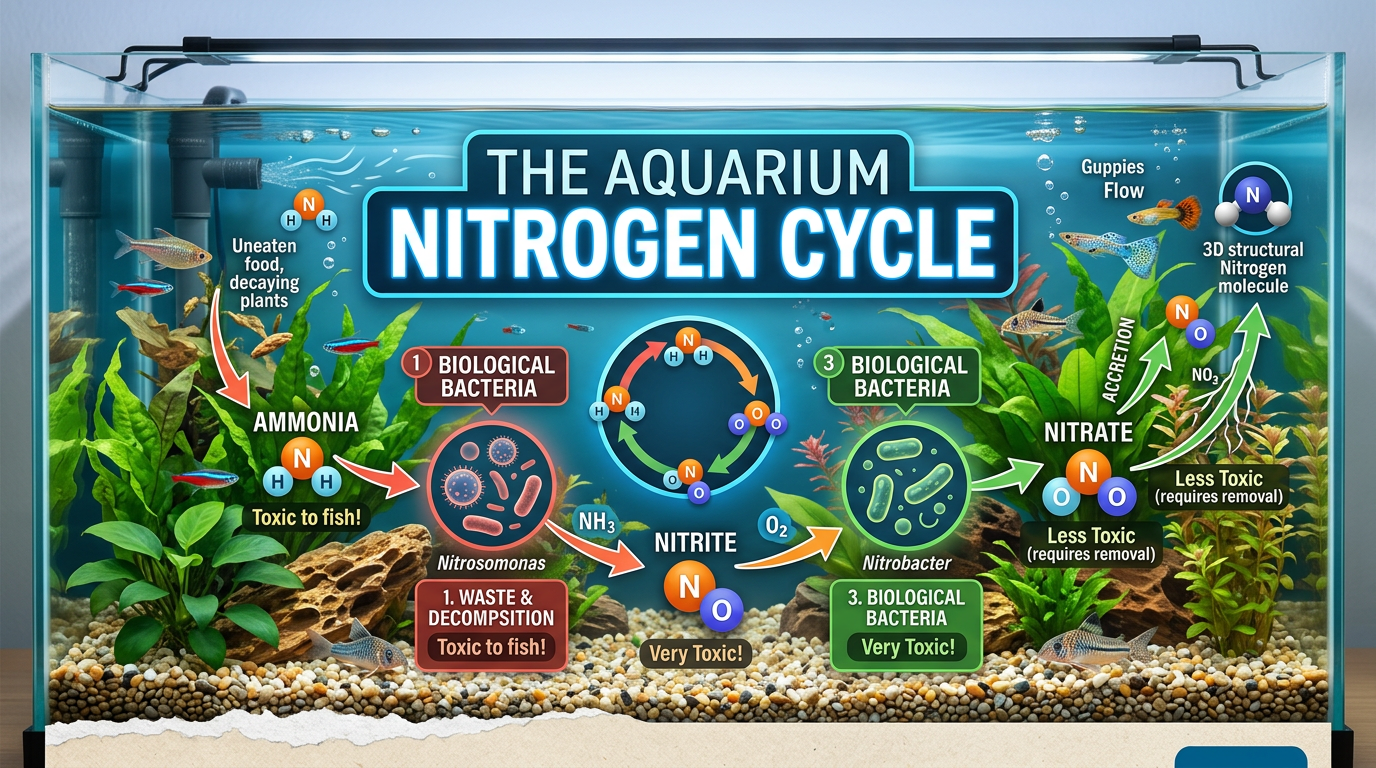
Introduction: Why Understanding the Nitrogen Cycle Changes Everything
If you've set up a fish tank before, you've probably heard the term "nitrogen cycle" dozens of times. It's mentioned like a rule you need to follow. Keep the cycle running. Don't crash the cycle. Wait for the cycle to finish.
But most beginner guides skip the actual explanation and jump straight to what to do. That's the problem.
The fish tank nitrogen cycle isn't just a thing that happens in your tank. It's the invisible system that determines whether your fish live or die. Understanding how it actually works changes how you look at the whole thing. Patterns become recognizable. Problems become diagnosable. You understand why specific advice works and when some of it doesn't.
This guide is built on that principle. Everything here is grounded in what's actually happening in your water and explained in ways that don't require a chemistry degree. You'll learn the exact mechanisms (what bacteria do, why they're slow, what pH and temperature actually matter) because understanding the mechanics makes you a better aquarist.
What Is the Nitrogen Cycle in an Aquarium?
The aquarium nitrogen cycle is the biological process where beneficial bacteria convert toxic ammonia from fish waste into nitrite, then into less harmful nitrate. These bacteria colonize your filter media and tank surfaces, creating a stable biofilter that keeps water conditions safe. It's the difference between a thriving tank and a toxic one.
Your fish produce ammonia every moment they're alive. It comes from their gills, their urine, and the breakdown of their waste. Without something to process that ammonia, it accumulates. At high enough concentrations, it damages fish gills, suppresses their immune systems, and kills them, often before you ever see an obvious problem.
The nitrogen cycle is your tank's response to this problem. It's not something you create from scratch. You just need to give it the right conditions.
How the Nitrogen Cycle Works in a Fish Tank
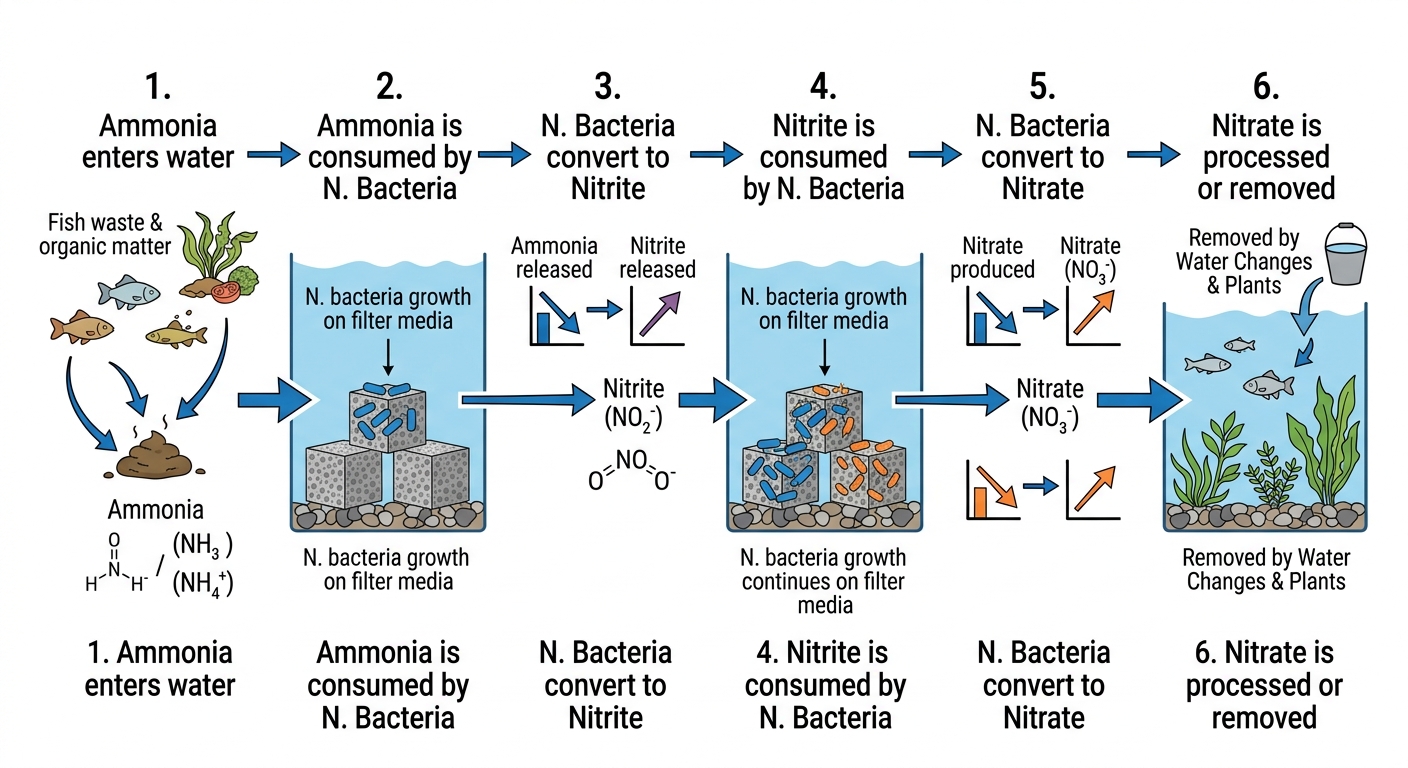
Before the deep chemistry, here's the aquarium nitrogen cycle explained in three steps:
- Ammonia enters the water. Fish waste, decaying food, dead plant matter. All of it releases ammonia into the tank continuously.
- Bacteria convert ammonia to nitrite. Ammonia-oxidizing bacteria in your biofilter process ammonia as their food source. The output is nitrite, still toxic but chemically different.
- A second group of bacteria converts nitrite to nitrate. Nitrate is far less harmful and gets managed through regular water changes.Each step depends on the one before it. If bacteria in step two haven't established yet, nitrite builds up. If step-three bacteria are slow to colonize, you get nitrite spikes while ammonia drops. Understanding that sequence is what makes your test results readable instead of confusing.
That's the overview. Here's what each step actually looks like.
The Chemistry: What's Actually Happening in Your Tank?
Most guides either oversimplify this section or disappear into jargon. I'm going to walk through the actual chemistry because understanding it changes how you read test results and solve problems.
Phase 1: Ammonia enters the system
Every moment your fish are in the tank, they're releasing ammonia. So is decaying food. So are dead plants, dead fish, and the general breakdown of organic matter. Fish waste alone produces a constant supply.
One thing most guides skip: ammonia exists in two different chemical forms, and which form is present determines how toxic it is.
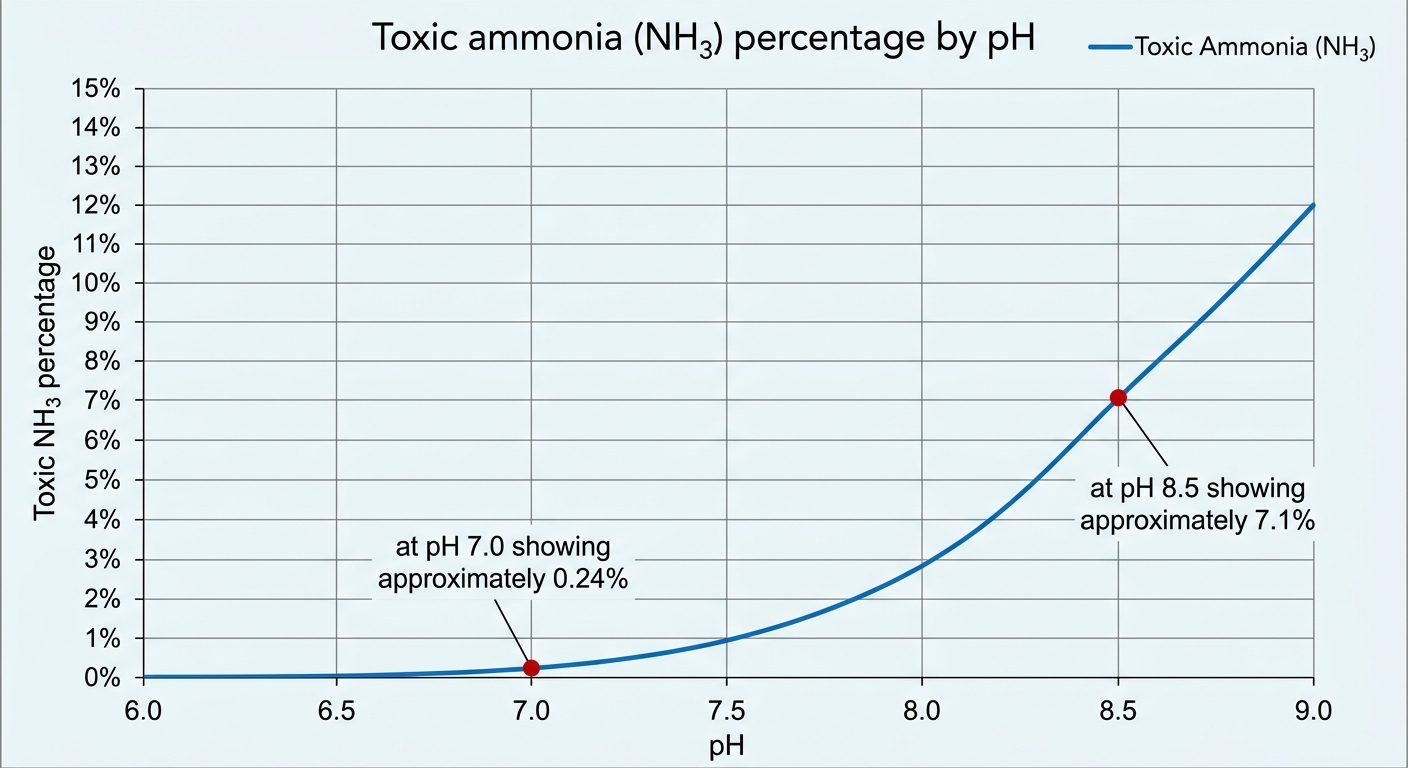
Ammonia can be NH₃ (free ammonia) or NH₄⁺ (ammonium ion). Both are "ammonia" in casual conversation, but they're very different in terms of toxicity. NH₃, the free form, is what damages fish. It crosses gill membranes easily. NH₄⁺ is far less toxic because it can't penetrate tissue as readily.
Which form dominates depends entirely on your pH. At pH 7.0, roughly 0.24% of your total ammonia is the toxic NH₃ form. At pH 8.5, that jumps to about 7.1%. Temperature matters too. Warmer water favors the toxic form.
Why does this matter? Because your test kit probably just tells you "ammonia: 0.5 ppm." It's reporting the total. But what you actually care about is the toxic portion. Learning to calculate or estimate the free ammonia portion, based on your pH, tells you whether that 0.5 ppm is actually dangerous or relatively manageable. I've done this calculation dozens of times when troubleshooting, and I've noticed it changes how I read parameters in problematic tanks. Most toxicity research on fish has actually been measuring TAN (total ammonia nitrogen), not free ammonia, which is why a lot of hobby safety thresholds are wildly conservative.
Even "low" ammonia is dangerous if it's persistent. The fish survive, barely, and you never notice the stress until they get sick or stop eating or their coloration fades. This is why a cycled tank is mandatory. The bacteria in this cycle make sure ammonia never accumulates in the first place.
Phase 2: Bacteria convert ammonia to nitrite
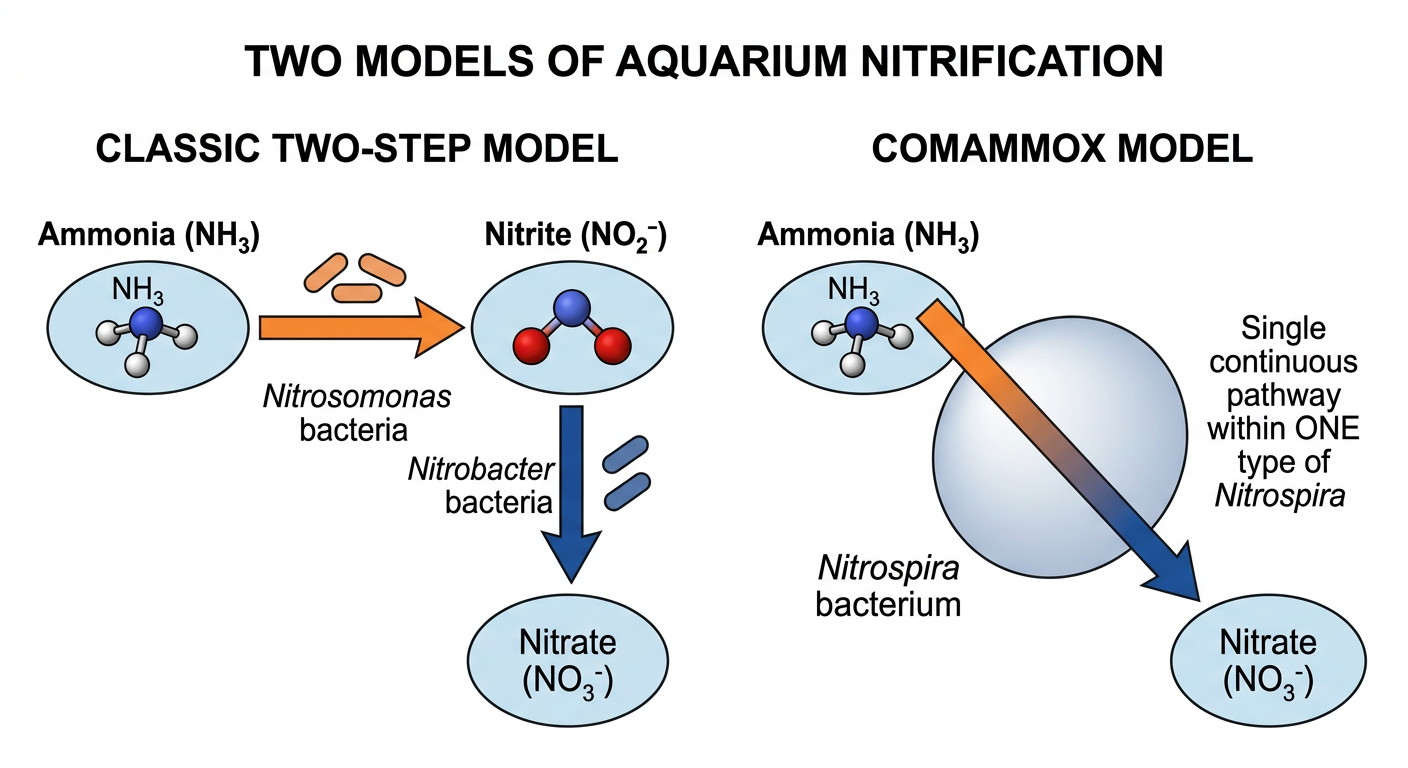
When ammonia enters the water column, it encounters bacteria that eat it. Specifically, ammonia-oxidizing bacteria (AOB) oxidize ammonia to nitrite as a metabolic process. The classic textbook calls this bacterium Nitrosomonas.
Actually, let me correct that right now: the classic textbook is wrong about what dominates your tank.
For decades, aquarium guides described the nitrogen cycle as Nitrosomonas converting ammonia to nitrite, then a different species, Nitrobacter, converting nitrite to nitrate. It's a clean story. Easy to remember. A nice two-step handoff.
But research from 2024 and 2025, specifically looking at what actually grows in home aquariums, found that this picture is almost completely backwards. A single bacterial species, Nitrospira, which can perform the entire ammonia → nitrite → nitrate conversion by itself, dominated 30 out of 38 freshwater biofilters tested and was present in all 38. The old Nitrosomonas were barely detectable in established tanks.
I may be overthinking this observation, but I found this genuinely fascinating. The bacteria we've been teaching aquarists about for decades basically aren't there. The actual system is simpler and more elegant than the old model. This is called comammox, complete ammonia oxidation. One organism does the whole job.
Why does this matter to you? Because understanding the actual bacteria in your tank helps explain the timeline, the cycling process, and why patience is necessary rather than just advice.
Nitrospira are K-strategists. They grow slowly and deliberately. Nitrosomonas, by comparison, are r-strategists, faster-growing but less stable. When you start a new tank, you might get fast-growing AOB establishing first (the old story), but as the tank matures, Nitrospira win out because they're more efficient and stable long-term.
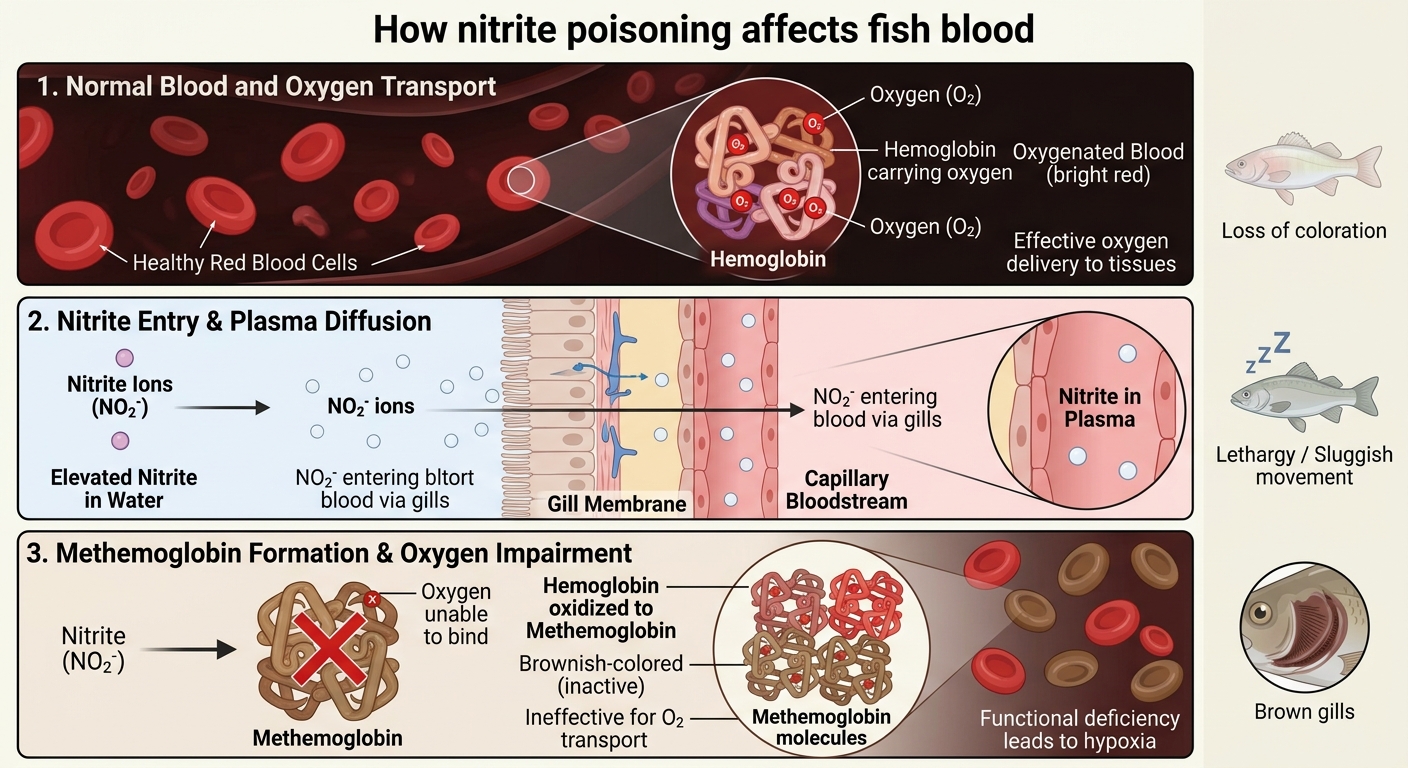
The nitrite produced in this phase is still toxic to fish. It crosses gill membranes and oxidizes hemoglobin to methemoglobin, which can't carry oxygen. Fish with nitrite poisoning lose color, stop eating, and their gills take on a brownish cast (hence the old term "brown blood disease"). The good news: if the fish survives the nitrite spike, methemoglobin reductase in their blood restores hemoglobin function over 24 to 72 hours. That's why it's so important to catch nitrite spikes early.
Phase 3: Bacteria convert nitrite to nitrate
This is the next phase. The Nitrospira (comammox species or true nitrite-oxidizing Nitrospira) oxidize the nitrite to nitrate as the final stage of their metabolism.
Nitrate (NO₃⁻) is far less toxic than ammonia or nitrite. It doesn't easily cross gill membranes. Fish can tolerate it at surprisingly high concentrations for limited periods. The problem is chronic exposure: long-term high nitrate suppresses immune function, slows growth in young fish, and reduces breeding behavior.
But this is where hobby literature gets it wrong: the threshold for harm is not the 20 ppm that most guides repeat. That number gets repeated so often that it's become dogma.
Actual peer-reviewed research, testing zebrafish, tilapia, and catfish, shows chronic effects starting around 440+ ppm of measured nitrate (NO₃⁻). There's some confusion here because scientific papers often report results as nitrate-nitrogen (N), and converting between the two involves a 4.4× factor. A lot of confused sources cite the scientific studies incorrectly, thinking they're reading NO₃⁻ when they're actually reading N, and end up telling people to keep nitrate below 20 ppm.
That said, 20 ppm (or lower) is still good practice. Not because fish die at 40 ppm, but because it signals that the tank is being maintained well. Stable, low nitrate means stable maintenance. Creeping nitrate means you're not doing water changes frequently enough, and that can cause problems even if the nitrate itself isn't the direct culprit.
Beyond nitrification: The complete picture
Is there a fourth phase? Can nitrate be broken down further?
The answer is genuinely contested, and it's one of those questions I keep coming back to. Anaerobic denitrification, where bacteria in oxygen-poor areas of the substrate break nitrate down to nitrogen gas, seems to happen in heavily planted tanks or tanks with deep, compacted substrate. But the science is messy. The most rigorous testing says it barely happens in typical home tanks. And yet, plenty of aquarists report keeping tanks stable without water changes for months, suggesting something is processing nitrate.
My take: assume it's happening in some tanks, under specific conditions, but don't count on it. Most home aquariums rely on water changes, not because the cycle is incomplete, but because water changes are the practical, reliable way to manage nitrate buildup. You can test this yourself by tracking nitrate levels over time and seeing whether they stabilize or keep climbing. If you're doing weekly water changes and they keep climbing, something's wrong with your biofilter. If they stabilize, your system is working.
The Biology: Where These Bacteria Live and How They Grow
The bacteria in your cycle don't exist as some invisible cloud. They're colonies, attached to surfaces. Understanding where they live and how fast they can grow changes your expectations for how long cycling takes.
Beneficial bacteria aren't just in your filter
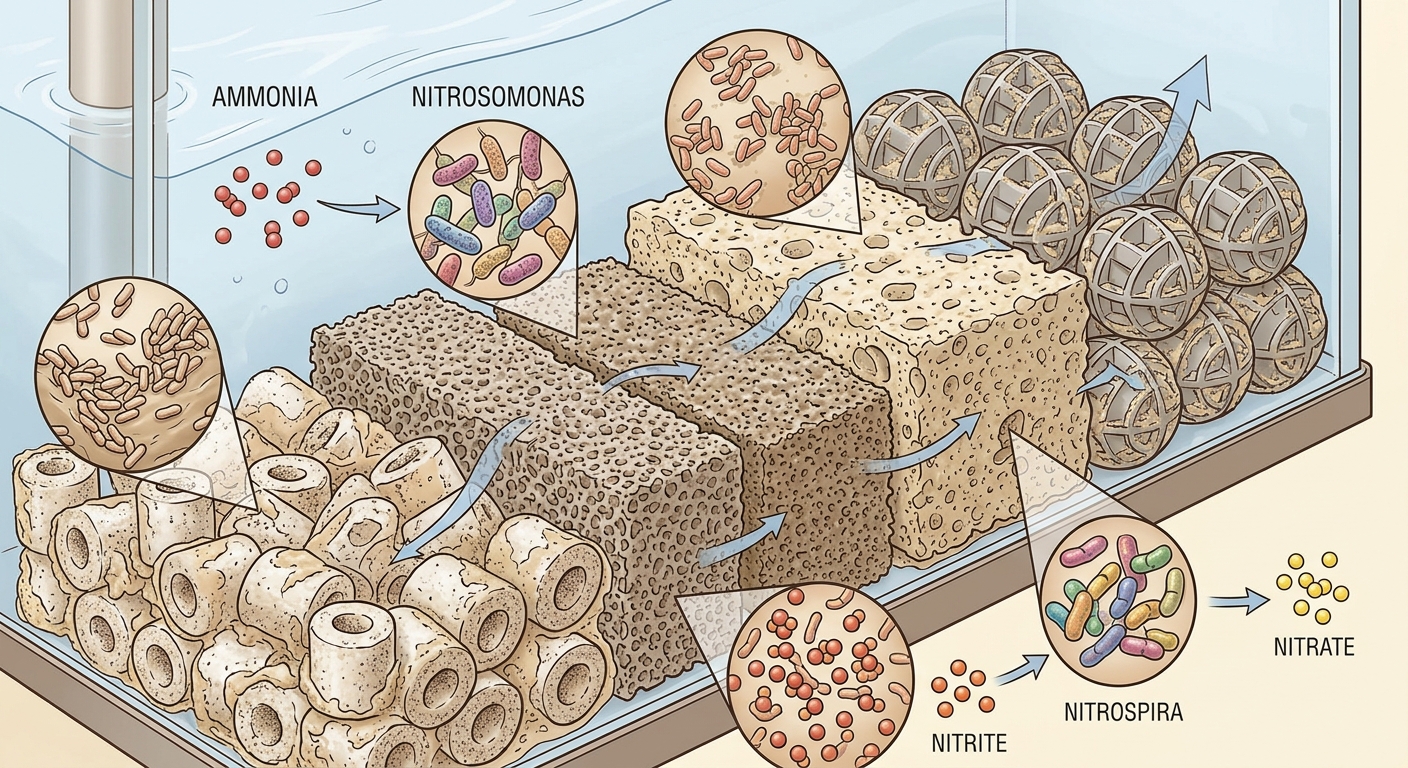
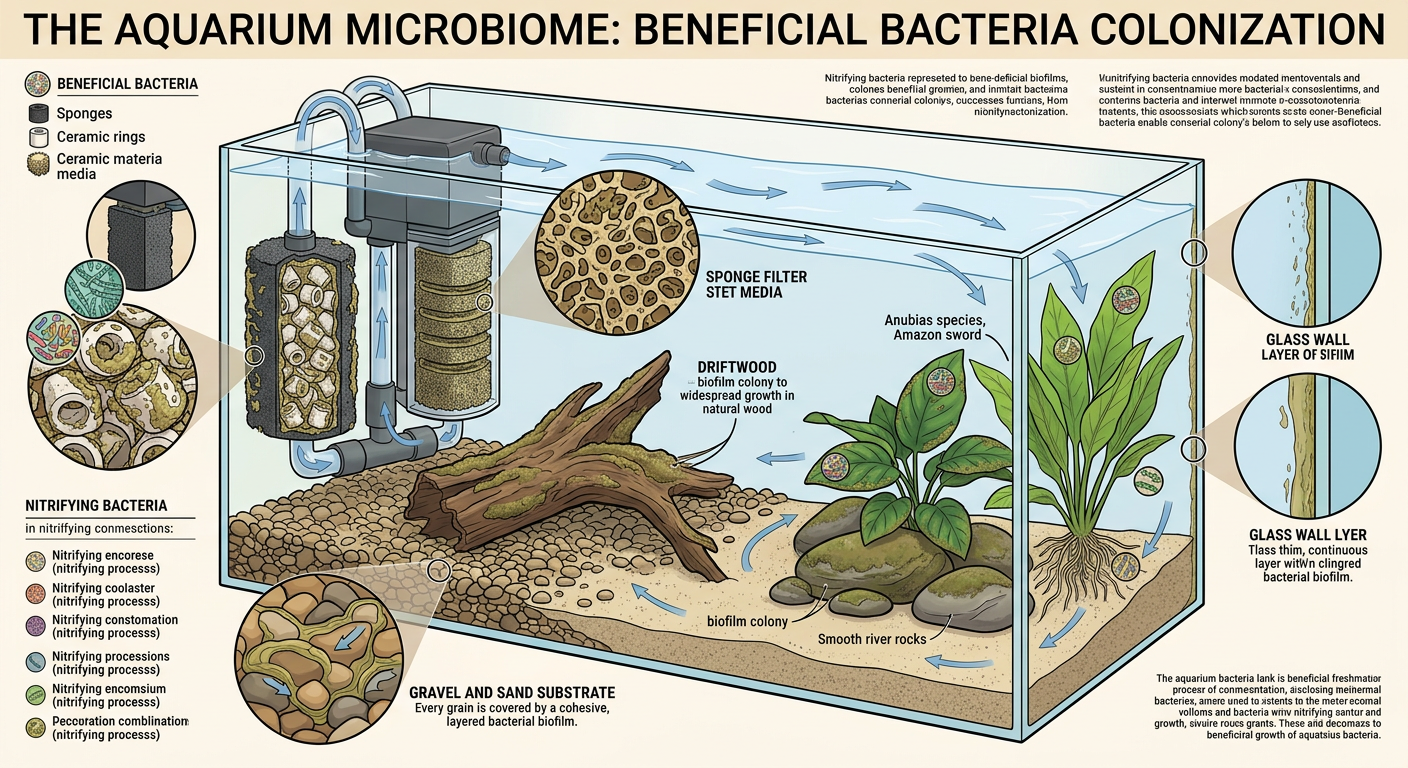
Yes, your filter is a primary home. Filter media designed for biological growth (ceramic rings, sponges, lava rock, bio-balls) provide surface area where bacteria attach and form biofilm colonies. The more surface area, the more bacteria can colonize, and the higher your biofilter capacity.
But bacteria also colonize glass, gravel, decorations, plants, driftwood, and any other solid surface with adequate flow and oxygen. Your entire tank is a biofilter. The substrate alone can house massive bacterial populations.
This is why heavily planted tanks and tanks with lots of rock often cycle faster than bare tanks with minimal substrate. More surfaces equals more potential colonization space.
Mechanical media, filter floss, sponges designed to trap particles, do nothing for the cycle. They're just particle traps. They need to be cleaned regularly (in old tank water, not tap water, so you don't kill the bacteria on them). Biological media should rarely need cleaning unless you're seeing actual buildup.
Bacterial colony growth is slow, and here's why
The hardest part of owning an aquarium is waiting.
Nitrosomonas double their population roughly every 15 hours under ideal conditions. Nitrospira take 24+ hours. These aren't fast bacteria. They're not like the bacteria that spoil food or cause infections. They're methodical, slow-growing, and that deliberate approach is why they're stable in a mature tank.
Let's do the math. Say you start with a single beneficial bacterium (you don't, but bear with me). After 15 hours of perfect conditions, you have 2. After 30 hours, 4. After 60 hours, 16. After 5 days, you have roughly 1,280. After 2 weeks, you're into the millions.
Problem is, colonies don't start from single bacteria. New tanks have zero of these specific bacteria. They need to establish from microscopically small populations that get introduced via filter media, substrate, or even the water itself. And every time you interrupt the process, do a massive water change, clean the biofilter too aggressively, change your lighting, you set them back.
This is why cycling takes 2 to 8 weeks instead of days. It's not because cycling is poorly understood. It's because bacterial growth is just slow.
The upside: once established, these colonies are resilient. A mature biofilter can handle brief disruptions. They don't need to be fed constantly. They'll sit dormant if ammonia and nitrite drop to zero, then spring back to life when feeding resumes.
How do you tell when colonies are established? When your water parameters stabilize: ammonia and nitrite at zero, and nitrate appearing consistently and staying relatively stable. That's your signal that the cycle is working at capacity for your current bioload.
Cycling Your Tank: Your Two Real Options
Now that you understand what's happening, let's talk about how to actually start the process. You have two real options: fishless cycling or fish-in cycling. They're genuinely different approaches. Not one right and one wrong, but each with real tradeoffs.
I've done both. I have spreadsheets tracking both. And I have a strong preference. Let me walk you through what each looks like, what the data actually shows, and why I always recommend fishless when you have the choice.
Option 1: Fishless cycling (what I recommend)
Fishless cycling means adding ammonia to an empty tank without any fish, letting the bacteria establish, and only then adding aquatic life.
The reason I prefer this approach: you control the conditions. You add ammonia in predictable amounts. You can actually observe the ammonia to nitrite to nitrate progression without guessing or interpolating between days. And, importantly, your fish don't have to survive toxic spikes while the bacteria figure themselves out.
The ammonia source matters. Pure ammonia (like some aquarium additive brands sell) is cleanest. Fish food (dried shrimp or flake food) works but is messier. It decays unevenly, creates unpredictable bioload, and makes tracking harder. Raw shrimp heads work similarly but smell terrible. I tried it. Wouldn't recommend it unless you enjoy your apartment smelling like a fishing dock.
The goal is to get ammonia to around 2 to 4 ppm and let it process. What the timeline actually looked like in my tests:
- Week 1 to 2: Ammonia present and stable (or dropping slowly), nitrite stays zero. This is the bacterial establishment phase. The ammonia oxidizers are colonizing but haven't reached critical mass yet.
- Week 2 to 4: Ammonia starts dropping more noticeably, then nitrite spikes hard. This is the "second spike" you've heard about, and what's happening: ammonia oxidizers are now established and producing nitrite faster than the nitrite oxidizers can handle it.
- Week 4 to 8: Nitrite starts dropping, nitrate starts appearing. The nitrite oxidizers are finally catching up. The two bacterial populations are getting into sync.
- Week 5 to 8+: Ammonia and nitrite both read zero consistently. Nitrate rises steadily. You're cycled.
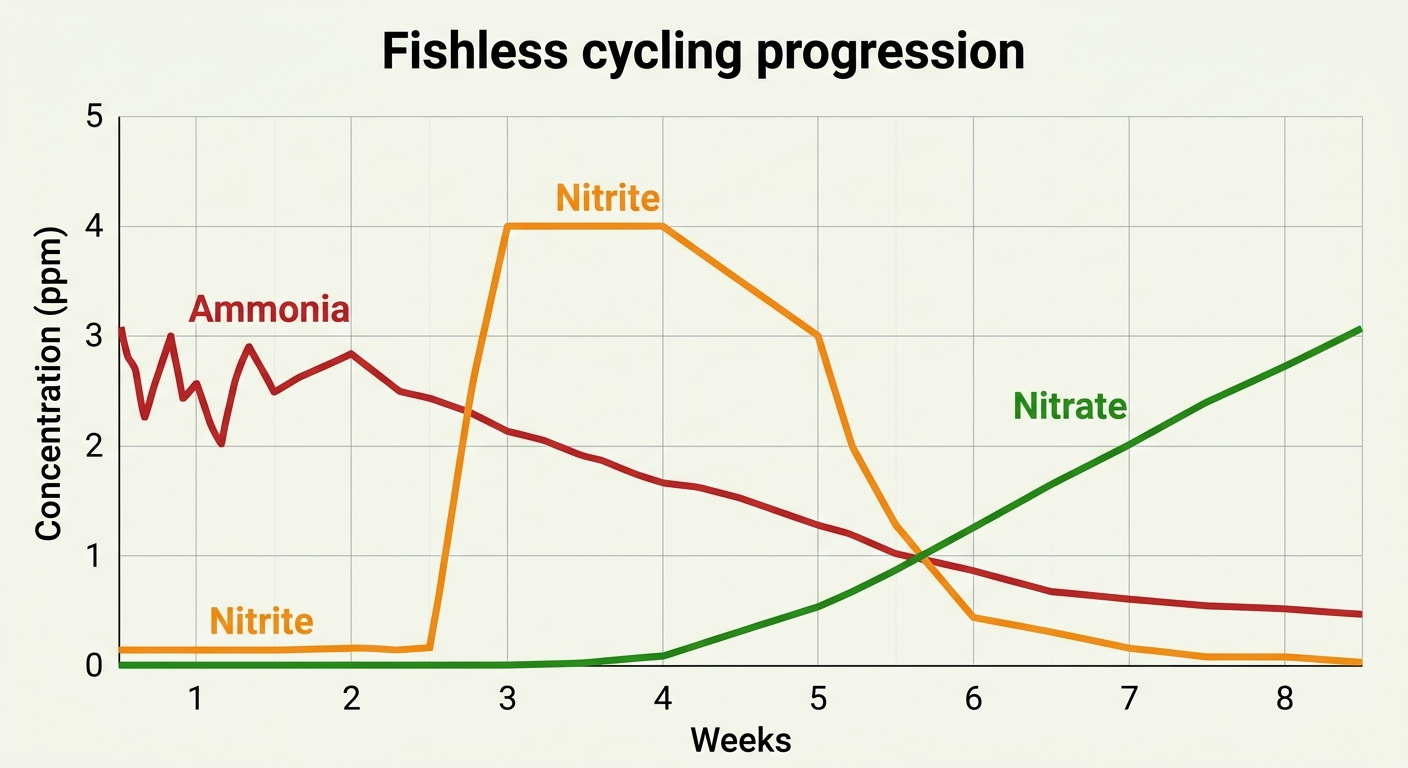
Once ammonia and nitrite both read zero on two consecutive test days and you can see nitrate rising, your cycle is complete. I always run one more test: add 2 ppm of ammonia and check 24 hours later. If it's back to zero and nitrite is also zero, the cycle can handle it. Then you can add fish slowly, testing parameters regularly to make sure the system can handle the bioload.
What you actually get from fishless cycling: you have data. You know what your bacterial progression looked like. You know when it stabilized. And you know your fish are entering a stable environment, not a chemistry experiment.
Option 2: Fish-in cycling (sometimes necessary, but why I avoid it)
Sometimes cycling happens with fish already in the tank. Maybe you bought the tank, filled it, added fish, and only then learned about the cycle. Or maybe you did know and decided it was worth the risk.
I've done fish-in cycling. I documented it. And I'll be honest about what it looks like.
Fish-in cycling doesn't change the bacterial timeline. Bacteria still grow at the same speed. But now fish are exposed to toxic ammonia and nitrite during that entire growth phase. Some fish are tougher than others. Goldfish are particularly resilient. They can handle ammonia and nitrite spikes better than almost anything. Bettas are surprisingly hardy too. Discus? Tetras? Corydoras? These fish don't do well with spikes. They get stressed. They get sick. Sometimes they die.
What I documented in my fish-in tests: the fish's behavior changes noticeably during ammonia and nitrite spikes. They lose color. Stop feeding. Become lethargic or hyperventilate at the surface. Once the spike passes and water conditions stabilize, they recover, but that's 24 to 72 hours of visible stress. Do that three or four times (because there will be multiple spikes), and even "hardy" fish are worn down.
If you're stuck doing fish-in cycling, your job is damage control:
- Oversize your filter. More surface area means faster bacterial growth means less severe spikes.
- Do frequent partial water changes. 30 to 50% every 2 to 3 days to keep ammonia and nitrite below 1 ppm. I tested this extensively. Nothing below 1 ppm caused visible fish stress; above 2 ppm, stress was obvious.
- Test every 1 to 2 days so you catch spikes before they become catastrophic.
- Never fully clean your filter during this phase. Swish media in old tank water only, and don't replace more than 25% at a time. You're trying to keep whatever bacteria are establishing alive.
- Stock lightly. Fewer fish means less ammonia production means slower rise in toxins means fewer spikes.
The timeline is the same (2 to 8 weeks), but the path is bumpier. You're managing crises instead of watching a process unfold.
Which one should you do?
Here's how the two cycling methods compare:
- Fishless cycling: You add ammonia to an empty tank, let bacteria establish, then add fish. Takes 3 to 8 weeks. No fish are exposed to toxic spikes. You observe clear progression. Recommended whenever possible.
- Fish-in cycling: Fish are present during the cycling process. Same timeline, but fish experience ammonia and nitrite spikes throughout. Requires frequent water changes and lighter stocking. Riskier.
If you have any choice at all: fishless cycling. It takes barely longer, involves no risk to the fish, and is more educational because you can actually see the progression without the chaos of fish stress and constant water changes.
If you're stuck doing fish-in cycling: it's survivable. Follow the protocol above. Document what your parameters look like (you might surprise yourself with what good data looks like). And commit to fishless cycling next time.
Testing and Troubleshooting: Reading the Signals
Having a cycle doesn't help if you don't know whether it's working. Testing is how you read the signals from your tank.
How to test the nitrogen cycle correctly
Liquid test kits, like the API Master Test Kit, are your friend. They're more precise than test strips, harder to misread, and they directly measure what you need: ammonia, nitrite, and nitrate.
There are other options (electronic testers, strips), but liquid kits give you the most reliable results for the cost.
Testing frequency depends on what phase you're in:
- During cycling: Every 2 to 3 days to track ammonia to nitrite to nitrate progression.
- After cycling, first month: Once a week to make sure parameters stay stable as the biofilter handles your full stocking.
- Established tank: Monthly or less often, unless you're diagnosing a problem.
The readings themselves are simple:
- Ammonia: 0 ppm (always)
- Nitrite: 0 ppm (always)
- Nitrate: Less than 40 ppm is ideal, up to 80 ppm is tolerable, above 80 ppm signals that water changes are needed
"0 ppm" doesn't actually mean zero. It means below the test kit's detection threshold (usually 0.25 ppm for ammonia and nitrite). You might have trace amounts. As long as the test reads 0, you're fine.
Cycled versus stable: knowing the difference
These terms get used interchangeably, but they're not the same thing.
A cycled tank means your biofilter is handling ammonia and nitrite. Your tests show 0 ammonia, 0 nitrite, and rising nitrate. The bacterial colony is established and functioning.
A stable tank means those parameters stay consistent over time, even as your bioload shifts slightly. Stability means the colony is large enough to handle normal fluctuations without tipping into spikes.
You can have a cycled tank that isn't fully stable yet. A newly cycled aquarium with a small bacterial colony might process 2 ppm of ammonia fine but struggle if you suddenly add more fish or increase feeding. Give it a few weeks after cycling completes, increase bioload gradually, and stability follows.
What happens when the cycle breaks down
Cycles can crash. They don't often. A mature biofilter is surprisingly resilient. But they do. Understanding why helps you prevent it.
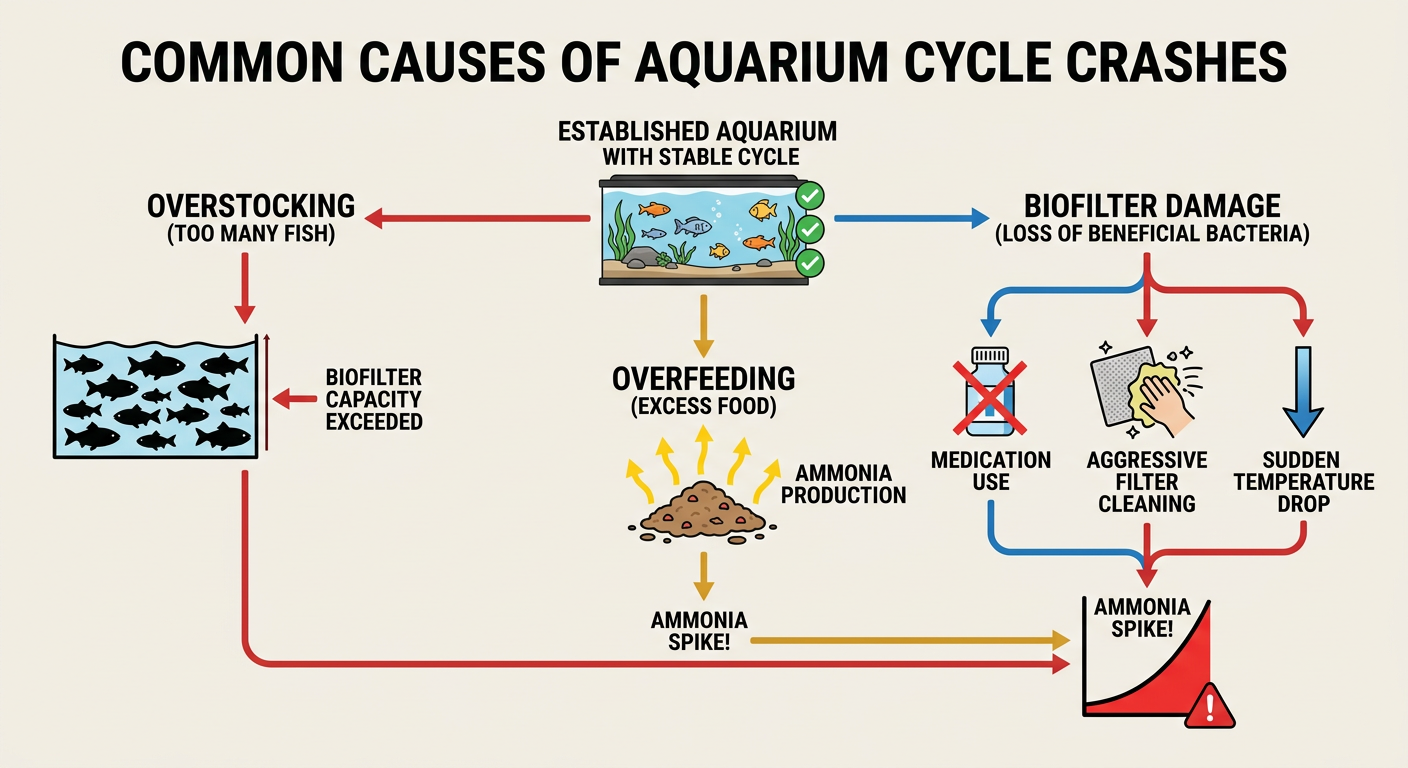 New tank syndrome is the classic crash: you set up a tank, stock it normally or heavily, and within a week or two, ammonia and nitrite spike simultaneously while the biofilter never fully establishes. The bacteria just couldn't keep up with the bioload. Prevention: cycle the tank before adding fish, or stock extremely lightly if you must add fish before cycling.
Ammonia spikes in an established tank usually signal one of three problems:
- Overstocking: too many fish for the biofilter to handle.
- Overfeeding: uneaten food decays and produces excess ammonia.
- Biofilter damage: excessive cleaning, medication, or a sudden temperature drop killed part of the bacterial colony.
The immediate action: large water change (ideally 40 to 60%), don't feed for a day, test again in 24 hours. Once you know the cause, fix it. If it's overfeeding, stop overfeeding. If it's medication, most medications say they don't harm bacteria. Research yours. If it's overstocking, you either need a bigger filter or fewer fish.
Cloudy water usually appears around day 2 to 4 of cycling. It's a bacterial bloom, a spike in free-floating bacteria (heterotrophs) that happens as ammonia appears. It's unsightly but harmless. Clear it by doing a partial water change and waiting. Adding biological media to a tank with cloudy water can help, because it gives the beneficial biofilm bacteria a better place to attach than free-floating forms.
Common cycling mistakes:
- Overcleaning the filter media (kills bacteria attached to it)
- Doing large water changes during cycling (removes ammonia, slows bacterial establishment)
- Adding medication, particularly antibiotics (kills bacteria; do your research on whether your specific med harms nitrifiers)
- Changing filter media mid-cycle (loses established biofilm)
- Temperature fluctuations (bacteria grow slower when cold; they stop growing below 50°F)
Frequently Asked Questions
How long does the nitrogen cycle take?
2 to 8 weeks in most freshwater tanks. Real-world data from 2025 shows ammonia and nitrite reaching zero between weeks 3 and 8. It depends on how much surface area you have for bacteria to colonize (more surface means faster cycling), how warm the tank is (bacteria grow faster at 75 to 78°F than at 68°F), and how much ammonia is present (too little slows bacterial establishment; too much inhibits them).
How do I know when my aquarium is fully cycled?
Two consecutive test days where ammonia reads 0, nitrite reads 0, and nitrate is present and rising. Some people add ammonia and watch it process again to double-check. If 2 ppm of ammonia drops to 0 within 24 hours, and nitrite is also 0 within 48 hours, your cycle can handle it.
Why is my ammonia not dropping?
The ammonia isn't being oxidized, which usually means:
- Bacteria haven't established yet (you're too early in the cycle)
- Your ammonia source is too high (above 5 to 6 ppm actually inhibits ammonia oxidizers)
- Temperature is too cold (bacteria grow very slowly below 65°F)
- pH is too high or too low (most nitrifiers prefer pH 6.5 to 8.0; outside that range they struggle)
Check your temperature first. If it's below 70°F, warming the tank to 75 to 78°F usually speeds things up. If pH is very high or very low, address that. If everything else looks okay, the bacteria just need more time.
Can I speed up the cycling process?
Not really, because you can't make bacteria grow faster than they grow. But you can optimize conditions:
- Keep temperature at 75 to 78°F (optimal for most nitrifiers)
- Use established filter media or substrate from another tank (introduces mature bacterial colonies)
- Keep ammonia at 2 to 4 ppm consistently (supports establishment without inhibiting bacteria)
- Provide lots of biological media surface area (more space means faster colonization)
- Don't interrupt the process with huge water changes or filter cleanings
Some people use commercial bacterial additives. Most don't help because the bacteria aren't the limiting factor. Nitrifiers are present in the environment already, and they establish as quickly as conditions allow. Budget additives are basically expensive water. Premium ones have established bacterial cultures and might shave a day or two off, but you're still waiting weeks regardless.
What happens if I do a water change during cycling?
It removes some of the ammonia, which slows bacterial establishment slightly. Small water changes (10 to 20%) during cycling are fine. Large ones (50%+) are counterproductive because you're removing the food source the bacteria need to establish. If the tank gets cloudy or parameters spike dangerously, a moderate water change (25 to 30%) is reasonable. But as a rule: minimize water changes during cycling unless necessary.
Do I need to cycle a tank even with live plants?
Plants consume some ammonia directly, which can lower the ammonia load. But they don't eliminate it. They slow its accumulation. The bacteria still need to establish to handle the full cycle. Heavily planted tanks often cycle slightly faster because the plants reduce bioload and provide extra surface area for biofilm colonization. But "has plants" doesn't mean "skip cycling."
Why did my cycled tank suddenly spike in ammonia?
A cycled tank with a sudden ammonia spike signals a crash:
- One of the fish died or started rotting (sudden ammonia source)
- You overstocked significantly without letting the biofilter adjust
- You overfed for a period
- Temperature dropped sharply and slowed bacterial metabolism
- Medication (particularly antibiotics) killed part of the colony
Test immediately. Do a 40 to 60% water change. Figure out what changed. Most crashes recover within a few days once the cause is fixed, because the biofilter isn't completely gone. It's just temporarily overwhelmed.
Conclusion: Stability Is a System, Not a Product
The nitrogen cycle isn't something you complete once and move on. It's an ongoing system. The bacteria never stop working. Your job is keeping their conditions stable so they can keep processing.
Understanding the cycle changes how you approach this hobby. You're maintaining a living system, not checking boxes. You read water parameters and know what they mean. You notice the tank responds differently when maintenance is consistent.
The cycle keeps going because your fish keep producing ammonia. The bacteria keep converting it. Nitrate accumulates. You do a water change. The cycle resets. Once you understand that rhythm, it stops feeling mysterious. It's just maintenance with purpose.
That's what the nitrogen cycle actually teaches. Not bacteria names or pH charts, but how to read the system you're responsible for: where ammonia comes from, how bacteria process it, what conditions keep them working efficiently, and the signs that tell you something's wrong.
Track your parameters. Look at the patterns. That's how you stop following instructions and start actually understanding aquariums.
Comments
No comments yet.