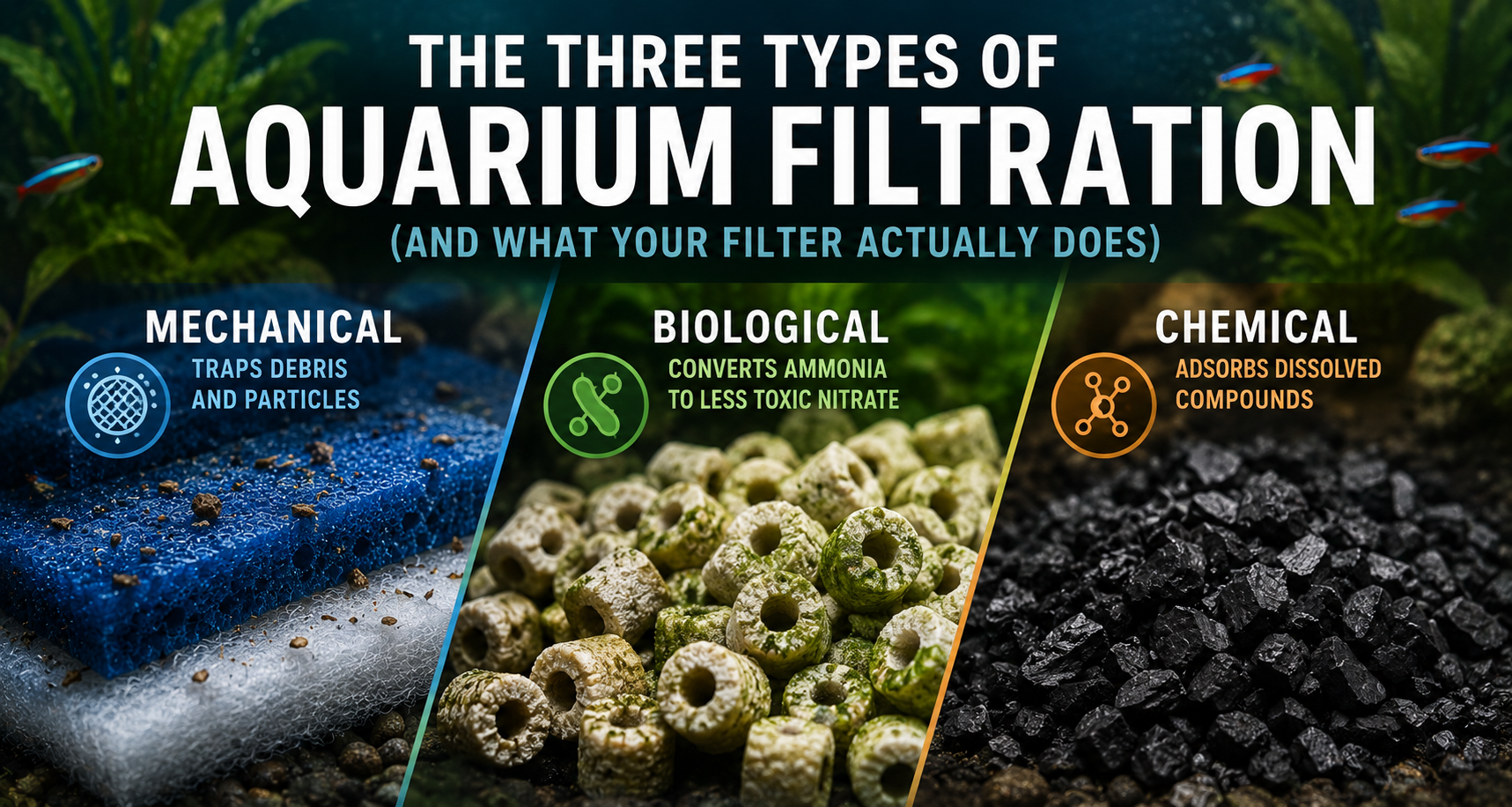
The Three Types of Aquarium Filtration, and What Your Filter Actually Does
If you've spent time in front of the filter aisle at an aquarium store, you know the feeling. Canisters, hang-on-backs, sponge filters, undergravel systems. Marketing copy promising clarity. Price tags that don't match. And underneath it all, you just want to know: what actually keeps the water from poisoning the fish?
Most people don't realize your filter isn't doing one job. It's doing three. The three types of aquarium filtration (mechanical, biological, and chemical) each handle a different category of waste. Once you understand what each one does, the filter aisle stops looking confusing and starts looking like options.
What each type removes:
- Mechanical filtration: traps visible debris and particulates (uneaten food, fish waste, decaying plant matter) using foam, filter floss, or pads.
- Biological filtration: converts toxic ammonia into less harmful nitrate through beneficial bacteria colonizing bio-media surfaces.
- Chemical filtration: adsorbs dissolved compounds like tannins, residual medications, and odors using activated carbon or synthetic resins such as Purigen.
What Filtration Actually Does (And What It Doesn't)
Let's reset expectations. Your filter stops toxic compounds from accumulating to levels that kill fish. That's the job. It's not magic. It doesn't keep water perfect, and it doesn't replace water changes.
What it does: it handles three distinct types of waste. Some filters do all three well. Some specialize in one. You just need to know which is which.
Think about what happens without each one:
- No mechanical: Visible debris (uneaten food, waste, dead plant matter) clouds water. Fish get stressed. Debris decays in the filter itself, releasing ammonia.
- No biological: Ammonia accumulates. Fish get poisoned. This is the one you can't skip.
- No chemical: Tannins color the water brown. Old medications stick around. The tank smells funny. Not a crisis in most cases, just... not great.
The Three Types of Filtration
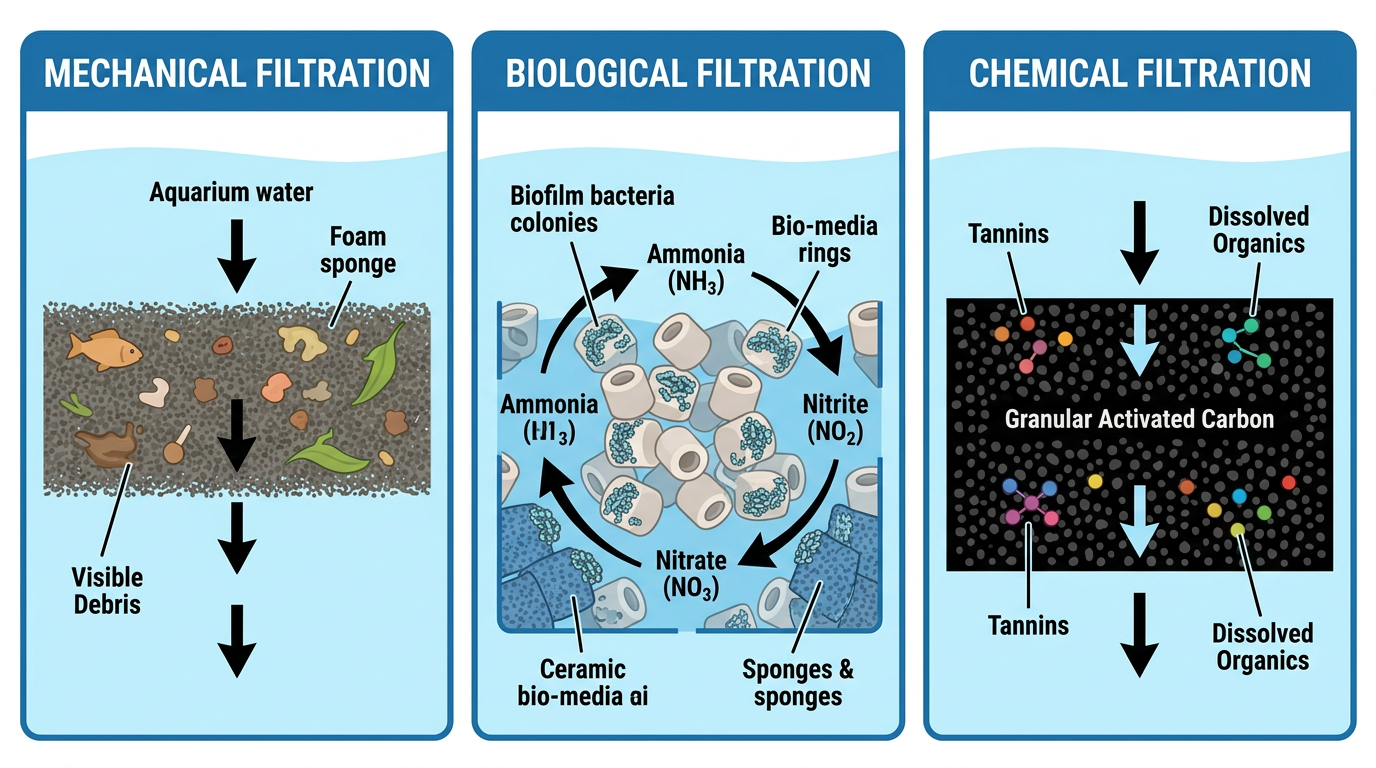
Mechanical filtration: The sieve
What it removes: visible particulates. Uneaten food, fish waste, dead plant matter, anything floating or suspended in the water column.
This one's straightforward. Water passes through foam or floss. Debris gets trapped. Clean water flows through.
Common media: filter floss, foam sponges, polishing pads. All work by particle size. Coarser foam catches big particles, finer foam catches smaller ones.
What people miss: mechanical filtration only works if you clean it regularly. Trapped waste doesn't vanish. It sits there decomposing, becoming a pollution source instead of a solution. Cleaned regularly (every 1–2 weeks), it keeps water clear. Ignored, and you might as well not have it.
The math is simple. Debris in the filter → ammonia back into the tank. Don't leave it dirty.
Biological filtration: The nitrogen cycle
What it removes: ammonia, the most toxic nitrogen compound in an aquarium. Converts it first to nitrite, then to nitrate. Nitrate is far less toxic and manageable through regular water changes.
This is what actually keeps your fish alive. Bacteria colonize surfaces throughout the tank and process fish waste through a two-step conversion. Different bacteria handle different steps: Nitrosomonas species oxidize ammonia into nitrite, and Nitrobacter and Nitrospira species then convert nitrite into nitrate. This is the nitrogen cycle, and it doesn't happen without bacteria.
Common bio-media: ceramic rings, sintered glass, porous clay, and even ordinary foam sponges. All that matters is surface area and steady water flow delivering ammonia and oxygen to the bacteria.
The bacteria live close to ammonia sources, which is mostly why they concentrate in the filter. But here's what matters: they live everywhere. Substrate, glass, decorations, plant leaves. Anywhere wet, there's biofilm, a slimy layer where bacteria live. The filter just gives them premium real estate with steady water flow and oxygen.
Research from 2014 (Bagchi et al., PLOS One) measured where nitrification actually happens in aquariums and found it's distributed roughly: 81–86% in the filter, 14–19% everywhere else combined. The filter matters because it's the highway for ammonia-carrying water. But you're never just "in the filter." If you destroy the bacterial layer by cleaning everything at once, you crash the capacity everywhere.
This is why the conventional advice to never clean all your bio-media at once is backed by actual biology, not superstition. Clean filter sponges when they clog? Yes. Clean them gently in old tank water, never tap water (chlorine kills bacteria). Replace them? No. Rinse and reuse. Clean your substrate? Go ahead, but don't scrub it aggressively the same week you overhauled your filter. Rotate the work. Spread the disturbance.
A new aquarium takes 3–8 weeks to build enough bacterial population to handle ammonia without spikes. This is cycling. You'll see ammonia spike first (week 1–2), then nitrite peaks (week 2–4), then nitrate shows up and ammonia/nitrite drop. That's progress. It's slow because bacteria are slow-growing. Their doubling time is 8–24 hours (source: TFH Magazine). Compare that to heterotrophic bacteria, which double every 15 minutes, and you start to understand why patience matters.
Speed it up by seeding new media with biofilm from an established tank, using a bacterial starter culture, or keeping the water warm (bacteria work faster at 77–82°F).
Chemical filtration: The optional polish
What it removes: dissolved organic compounds that don't settle out and don't involve bacteria. Tannins, residual medications, discoloration, odors.
Mechanical filters particles. Biological handles ammonia. Chemical filtration adsorbs dissolved stuff—the compounds that don't settle and don't involve bacteria.
Common media: activated carbon and synthetic adsorbent resins like Purigen. Carbon works by adsorption (molecules stick to the surface), not absorption (soaking in). A single gram of activated carbon has roughly 1,000 square meters of surface area. That's a lot of sticking power, but it's finite.
What carbon removes: tannins (brown water from driftwood), medications (important when treating disease), odors, dissolved organics. What it doesn't remove: ammonia, nitrite, nitrate, phosphate, hardness minerals. Most advice saying "activated carbon removes everything" is half-true at best.
The catch: after 2–6 weeks, the carbon is saturated. Full. No molecules left to stick. You replace it. Contrary to persistent internet advice, you can't "recharge" it at home. Industrial reactivation requires 800–1,000°C temperatures. A home oven won't cut it. Once it's full, it's spent.
And here's the uncomfortable part: chemical filtration is optional. I know that contradicts a lot of beginner advice. But I've seen many thriving aquariums run only mechanical and biological filtration forever. If your water is clear, parameters are stable, and you're doing regular water changes, you probably don't need chemical media at all. It's most useful in two specific situations: after treating illness (to remove residual medication so it doesn't interfere with bacteria) or if you have heavy driftwood tannins and find brown water annoying. Otherwise, it's a tool, not a requirement.
Filter Types and What They Actually Do
Now that you understand the three jobs, actual filter equipment starts making sense. Each type has different strengths.
Hang-on-back (HOB) / power filters
These clip onto the tank rim and draw water up and over cartridges, then back in. Simple, visible, easy to access. You see the cartridge get dirty; you clean or replace it.
Best for: Tanks up to 75 gallons. Beginners. Situations where you want to see and touch your filter regularly.
Real limitation: Limited media volume. If you're running ceramic bio-media or need heavy mechanical filtration, you'll hit capacity limits faster than a canister would. Aggressive cartridge replacement is also marketing-driven. The carbon wears out; replace that. The sponge? Just rinse it and put it back. Stop throwing money away.
Unexpected upside: High water surface agitation. Great for gas exchange if you're not running plants. Terrible if you're trying to hold CO₂ for a planted tank.
Canister filters
Water is pumped down through a series of stacked media trays in a sealed chamber, then returns to the tank. Inside, the environment is flooded, low-agitation, and optimized for bacteria.
Best for: Planted tanks (gentle return flow preserves CO₂). Tanks 40+ gallons. High bioload situations. When you want to hide equipment. When you need huge media capacity and flexibility, not locked into cartridge replacements.
Real limitation: Complexity. More to maintain. Siphon priming, hose runs, potential leaks. Higher cost. Below 30 gallons, often overkill.
Sponge filters
An air pump drives bubbles through a sponge. The rising bubbles create flow. The sponge is both mechanical and biological media. That's the whole design. Ancient and still works.
Best for: Small tanks (5–40 gallons). Fry tanks. Shrimp tanks. Hospital tanks. Breeding. Anywhere you want gentle, quiet filtration. Anywhere you want something that almost never fails.
Real limitation: Limited capacity. Flow is weak. Not suitable for high-bioload tanks or heavy livestock. Takes up visible tank space. If mechanical bioload is heavy, the sponge clogs.
Unexpected upside: Cheap. Durable. Requires almost no maintenance. Aeration as a side benefit.
Internal / submersible filters
A small box inside the tank with foam cartridges. Saves external space. That's the main pitch.
Best for: Nano tanks. Situations where you have zero space outside the tank.
Real limitation: Tiny media capacity. Takes up visible tank space anyway. Used mostly as a supplement to existing filtration, not as primary.
Undergravel filters (historical note)
An air pump or powerhead pulls water down through the substrate. The substrate becomes the filter.
They've fallen out of favor because substrate clogs with detritus, making them ineffective and hard to clean. They don't work with sand. They're incompatible with planted tanks. Modern options do the job better. You won't need these.
Filter Media and What Actually Goes Inside
Open up a filter and you'll find some combination of these.
Filter floss / polishing pads — Fine fibers that catch tiny particles. Clogs quickly, so use it last in the flow path, not first. Replace when visibly full. Inexpensive. Disposable.
Foam sponges — Available in different densities (PPI ratings). Cheap. Durable. Reusable forever. Rinse gently in old tank water when clogged. Never aggressively scrub: bacteria live in the foam. This is the workhorse media. Most people should use more sponge filters than they do.
Ceramic rings or noodles — Extremely porous internal structure. Massive surface area for bacteria. Don't clog. Rinse if needed. Last for years. Buy once, use forever. Excellent bio-media with zero mechanical function.
Sintered glass (Seachem Matrix, Biohome, and similar products) — Ultra-high porosity. Even better bacterial colonization than ceramic. Premium price. You'll never replace it. Worth it if you're building something engineered for the long term.
Activated carbon — Remove it when medicating (it adsorbs the medication, neutralizing treatment). Use for 2–6 weeks if you want tannin removal or odor control. Then replace. Don't run it continuously unless you have persistent tannin issues.
Purigen and synthetic resins — Adsorb dissolved organics like carbon does, but with higher capacity and longer life between replacements. Rechargeable with bleach solution, then reactivated with a dechlorinator. More expensive upfront but cheaper over time for heavy tannin situations.
Many experienced setups layer media in a specific canister filter order: coarse sponge first (mechanical pre-filter), then medium sponge, then ceramic or sintered glass (biological), then optional fine pad last (polishing before water exits). This ensures larger debris is caught before it reaches sensitive bio-media, and polishing pads don't clog prematurely. The layering handles all three filtration jobs in one chamber.
Sizing Your Filter: Flow Rate Math
Filter size is measured in GPH (gallons per hour). A 100 GPH filter on a 20-gallon tank means the entire volume cycles through 5 times per hour.
Industry consensus on target turnover:
- Planted tanks (low bioload): 4–6× tank volume per hour. Slower flow keeps CO₂ stable for plants. Example: 20-gallon planted = 80–120 GPH.
- Standard community (moderate bioload): 5–8× tank volume per hour. Example: 40-gallon community = 200–320 GPH.
- High-bioload tanks (cichlids, goldfish, heavy stocking): 8–10× tank volume per hour. These fish produce constant waste. Example: 55-gallon cichlid = 440–550 GPH.
But rated GPH is a fantasy number. Manufacturers test filters in ideal conditions (no media, no head height, brand new). Once you add media and run it through tubing, actual flow drops 30–50%. A 200 GPH-rated HOB might deliver 100–140 GPH in real use. Size your filter assuming 60–70% of rated output.
More GPH isn't always better, either. Excessive flow stresses fish, especially long-finned species. In planted tanks, aggressive current uproots plants and drives off CO₂. Find the flow rate that's adequate for your bioload, not maximal.
Where Bacteria Actually Live (And Why It Matters)
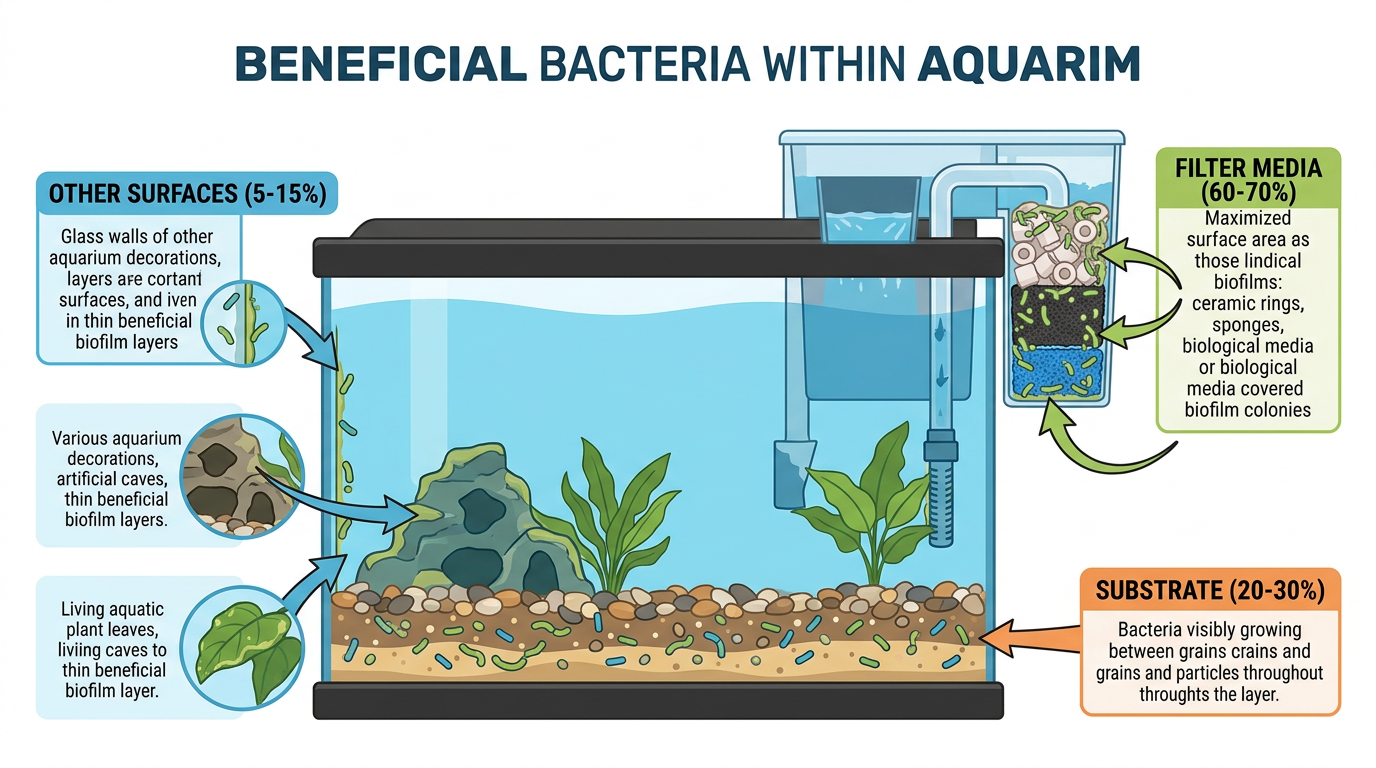
The pattern I keep seeing repeated: "all your beneficial bacteria live in the filter." It's misleading. Bacteria live on every wet surface. Everywhere there's some combination of surface area, water flow, and oxygen.
In a typical aquarium, bacterial distribution looks roughly like this:
- Filter media: 60–70% (high surface area + forced flow + oxygen)
- Substrate: 20–30% (porous gravel and sand; bacteria fill in the spaces)
- Everything else: 5–15% (glass, decorations, plant leaves, tubing)
This is based on actual research. Bagchi et al. (2014) measured nitrification rates across aquarium compartments and found that biofilter nitrification accounted for 81–86% of total nitrogen conversion. The remaining 14–19% happened in substrate and other surfaces.
Why does this matter? I'll tell you exactly why: because now you know why you shouldn't clean everything at once. You're not just cleaning equipment. You're disrupting the majority of the bacterial population that's keeping ammonia in check. Clean your mechanical sponges when they clog. Rinse your bio-media gently. But clean them on rotation. If the filter gets attention this week, leave the substrate alone until next week.
When you vacuum the substrate, you're disrupting bacteria habitat. Not killing them all (the biofilm they produce is incredibly tough), but temporarily reducing capacity. That's why you sometimes see small ammonia spikes after aggressive substrate cleaning. It's temporary, and it passes. Knowledge helps you not panic.
How the Three Types Work Together
These three jobs don't happen independently. They protect each other, and when one fails, the others pay the price.
Mechanical filtration shields biological filtration. If sponges don't trap debris, that debris reaches bio-media, clogs the surface, and starves bacteria of oxygen. Biofilm needs flow and O₂ to function. Gunked-up media means slower nitrification and eventual ammonia problems.
Biological filtration makes chemical filtration less necessary. When bacteria handle ammonia efficiently, you don't need carbon to clean up the consequences. A healthy bacterial population is worth more than a box of replacement cartridges.
Chemical filtration buys time for the other two. It pulls dissolved organics out of the water before they break down into ammonia. It removes residual medications after treatment so they don't kill beneficial bacteria. It's not doing the heavy lifting, but it takes pressure off the systems that do.
The hierarchy is clear: biological first (non-negotiable), mechanical second (protects biological), chemical third (situational support). Most filtration problems trace back to neglecting that order.
Troubleshooting Common Water Problems
Most aquarium issues trace back to one of the three filtration jobs failing. Knowing which one helps you fix the right thing instead of adding more of the wrong thing.
Cloudy white water (new tank): Bacterial bloom. Normal during cycling. Heterotrophic bacteria multiplying faster than the system can balance. Clears on its own within days.
Cloudy white water (established tank): Mechanical filtration failing. Sponges clogged, debris circulating freely. Clean your mechanical media.
Cloudy green water: Algae. Not a filtration problem. Address lighting duration and nutrient levels instead.
Ammonia spike: Biological filtration overwhelmed. Common causes: overfeeding, overstocking, or you cleaned too much bio-media at once. Test water, reduce feeding, add aeration, consider bacterial starter culture.
Brown/tan discoloration: Tannins from driftwood. This is a chemical filtration job. Carbon or Purigen handles it. Alternatively, pre-soak or boil driftwood to reduce tannin leaching.
Foul smell: Decomposing debris trapped in mechanical media that hasn't been cleaned. Rinse sponges, do a water change. The smell usually resolves within hours.
Fish gasping at the surface: Low oxygen or ammonia toxicity. Increase surface agitation immediately. If ammonia or nitrite reads above zero, this is a biological filtration emergency, not just an aeration problem.
The pattern: diagnose which filtration job is failing before adding more equipment or chemicals. Most problems have a simple mechanical or biological cause. Fix that first.
Common Misconceptions
"All beneficial bacteria live in the filter." Nope. They're everywhere: filter, substrate, glass, decorations. The filter houses the majority because conditions are ideal there, but bacteria are distributed throughout an established tank.
"Activated carbon removes ammonia." False. Multiple sources (aquariumscience.org, LiveAquaria, The Tropical Tank) confirm: carbon doesn't remove ammonia, nitrite, or nitrate. If ammonia is present and you want chemical removal, use zeolite. But ammonia shouldn't exist in a cycled tank anyway.
"You must run chemical filtration." False. Most successful aquariums run only mechanical and biological filtration. Period. Chemical media is optional: use it when you need it (post-medication, tannin removal, odor), not as a standing requirement.
"More GPH is always better." False. The right flow matches your bioload and livestock type, not an arbitrary maximum. Too much flow stresses fish and blows plants around.
"Canister filters are always superior to HOBs." False. A good HOB on a 20-gallon does the job faster and cheaper than a canister. Canisters excel at 40+ gallons where media capacity matters.
"Replace filter cartridges monthly." This is marketing. Replace the carbon if you're using it. The sponges? Rinse gently in tank water and reinstall. Throwing them away is expensive and pointless.
"Spent carbon leaches toxins back into the water." False. Desorption requires extreme temperatures (800–1,000°C) or extreme pH. Saturated carbon simply stops working.
"Cloudy water during cycling means something's wrong." False. It's a bacterial bloom (heterotrophic bacteria reproducing rapidly). Completely normal during startup. It clears on its own.
FAQ
Do I need all three types of filtration? — Biological is non-negotiable. Mechanical is strongly recommended. Chemical is situational. Most tanks need biological and mechanical; chemical is optional.
What if I turn off my filter at night? — Don't. Nitrifying bacteria need oxygen and a steady ammonia supply. More than a few hours without flow, and bacteria start suffocating. Some aquarists do 10–15 minute shutdowns at feeding time (minor oxygen dip is survivable), but otherwise: 24/7.
What filter works best for a planted tank? — Canister filters are popular because they return water gently (preserving CO₂ in the water for plants). Sponge filters work well for smaller planted tanks. Avoid HOBs with aggressive surface agitation. Target 4–6× tank volume turnover to minimize CO₂ loss.
How do I clean media without killing bacteria? — Rinse in old tank water (dechlorinated). Never tap water: chlorine kills bacteria. Squeeze sponges gently. Don't scrub ceramic or sintered glass hard. Clean in rotation, never everything at once.
How long does a new tank take to cycle? — Typically 3–8 weeks. Ammonia appears first (week 1–2), nitrite peaks (week 2–4), nitrate follows (week 3–6). Speeds up with seeded media from an established tank, bacterial starter cultures, or warm water (77–82°F).
What's the best filter media? — No single "best." Sponges excel at mechanical + biological. Ceramic and sintered glass excel at biological with extremely long life. Filter floss offers fine polishing but clogs fast. Layer different types to hit all three jobs efficiently.
Can I have too much filtration? — You can't have too much bacterial capacity. More bio-media surface never hurts. You can have too much flow, which stresses fish and plants. Filtration capacity and flow rate are different things.
Will vacuuming my substrate crash the tank? — No. Bacteria produce a tough biofilm. Vacuuming disrupts habitat temporarily but doesn't destroy colonies. You might see a small ammonia spike afterward. Temporary, and it passes. Don't panic.
The Bottom Line
Three jobs, not one. Mechanical gets the visible gunk. Biological keeps ammonia at zero. Chemical handles dissolved stuff when you need it and sits empty the rest of the time.
Bacteria live in your filter, substrate, glass, decorations, whatever gets wet. The filter concentrates them because conditions are ideal there. Don't clean everything at once. Rinse media in old tank water, don't replace it, and spread maintenance across a few sessions instead of one demolition derby.
Do that, and the filter becomes invisible. Water stays clear. Ammonia stays zero. You stop wondering what's hiding behind the filter aisle confusion.
Comments
No comments yet.