Freshwater Aquarium Plants: What They Do, How They Work, What Changes
What Aquarium Plants Actually Do
Most people add live plants to a freshwater aquarium for decoration. They look nice behind glass. They complete the aesthetic. Fair enough — they do look nice.
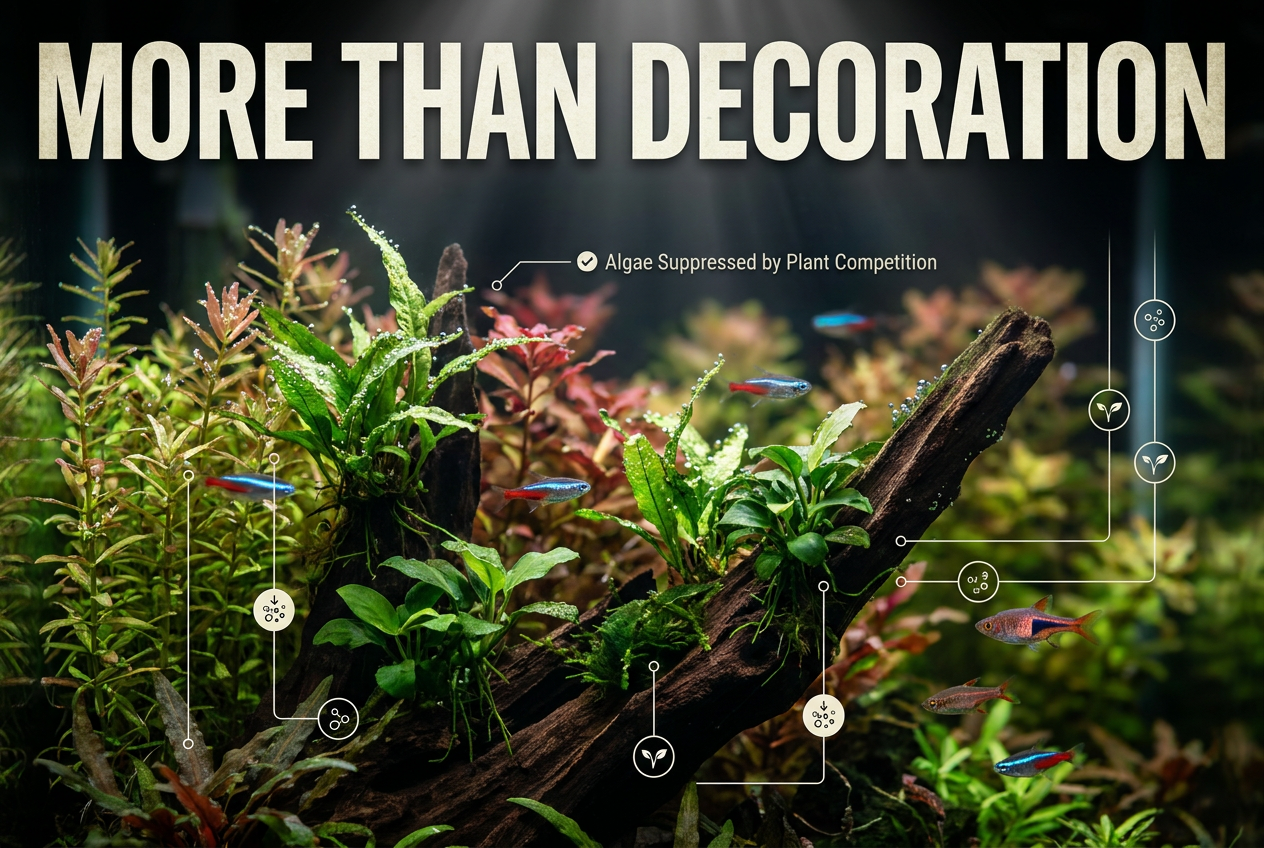
But decoration isn't what live plants *do* in your tank—it's what they *look like*. Plants are ecosystem participants. They're changing the water, managing nutrients, producing and consuming oxygen, influencing everything your fish depend on. None of that is cosmetic.
They consume ammonia before algae does
Here's where the standard aquarium nitrogen-cycle diagram misleads you. The diagram shows: fish produce ammonia → bacteria convert it to nitrite → bacteria convert that to nitrate → plants consume nitrate. Sequential. Tidy.
That's not actually what happens.
Plants vastly prefer ammonium (the dissolved ammonia in your tank) over nitrate. When ammonia enters the water column, plants grab it directly — within hours, both day and night. They pull it from the water faster than bacteria can oxidize it into nitrite. This is direct biological filtration that bypasses nitrification entirely.
A controlled study tracking several plant species found that 75% of incoming ammonia disappeared within 16 hours, before bacterial nitrification had time to make a dent. Another study on water lettuce showed ammonium uptake at roughly one-fifth the time it took the same species to consume equivalent amounts of nitrate. When given both options, the plant chose ammonium, moved faster on ammonium, and stopped consuming nitrate once ammonium was available.
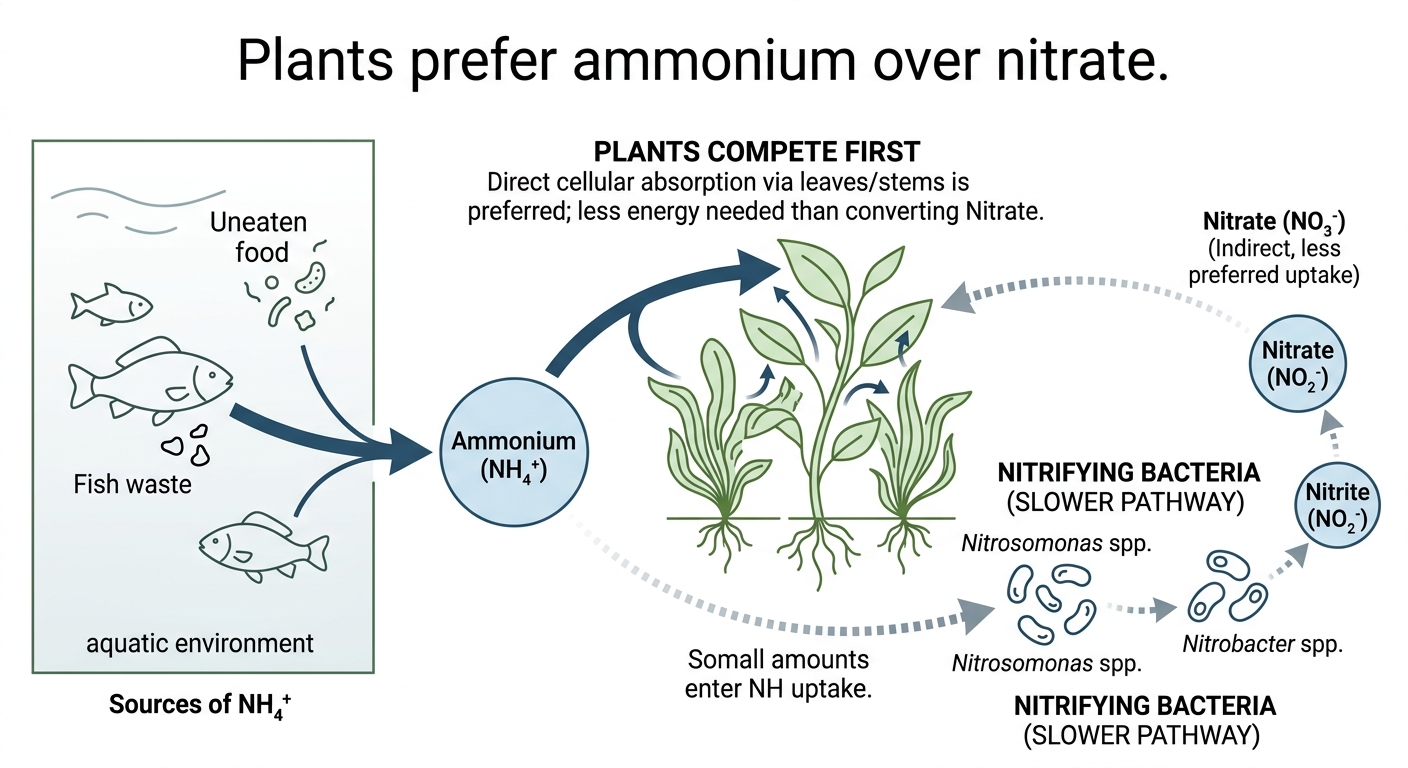 Why does this preference exist? Plants evolved in environments where ammonia was the abundant nitrogen source. They optimized for it over evolutionary time. The bacterial conversion to nitrate is actually a workaround that aquarium hobbyists created—and kept—because it's how the hobby's technical infrastructure was built. We measure nitrate. We worry about nitrate spikes. We built systems around preventing nitrate accumulation. But plants never needed that system. They were handling ammonia before we invented the nitrogen-cycle diagram.
They produce oxygen during the day
Photosynthesis consumes CO2 and releases oxygen as waste. In a well-lit, heavily planted tank, this production is significant. On a clear day with good lighting, oxygen can accumulate to 110–130% of saturation — you'll see bubbles forming on leaf surfaces, a phenomenon aquarists call "pearling." The dissolved oxygen reaches 12–15 mg/L in those tanks, compared to the ~8–9 mg/L saturation point at room temperature.
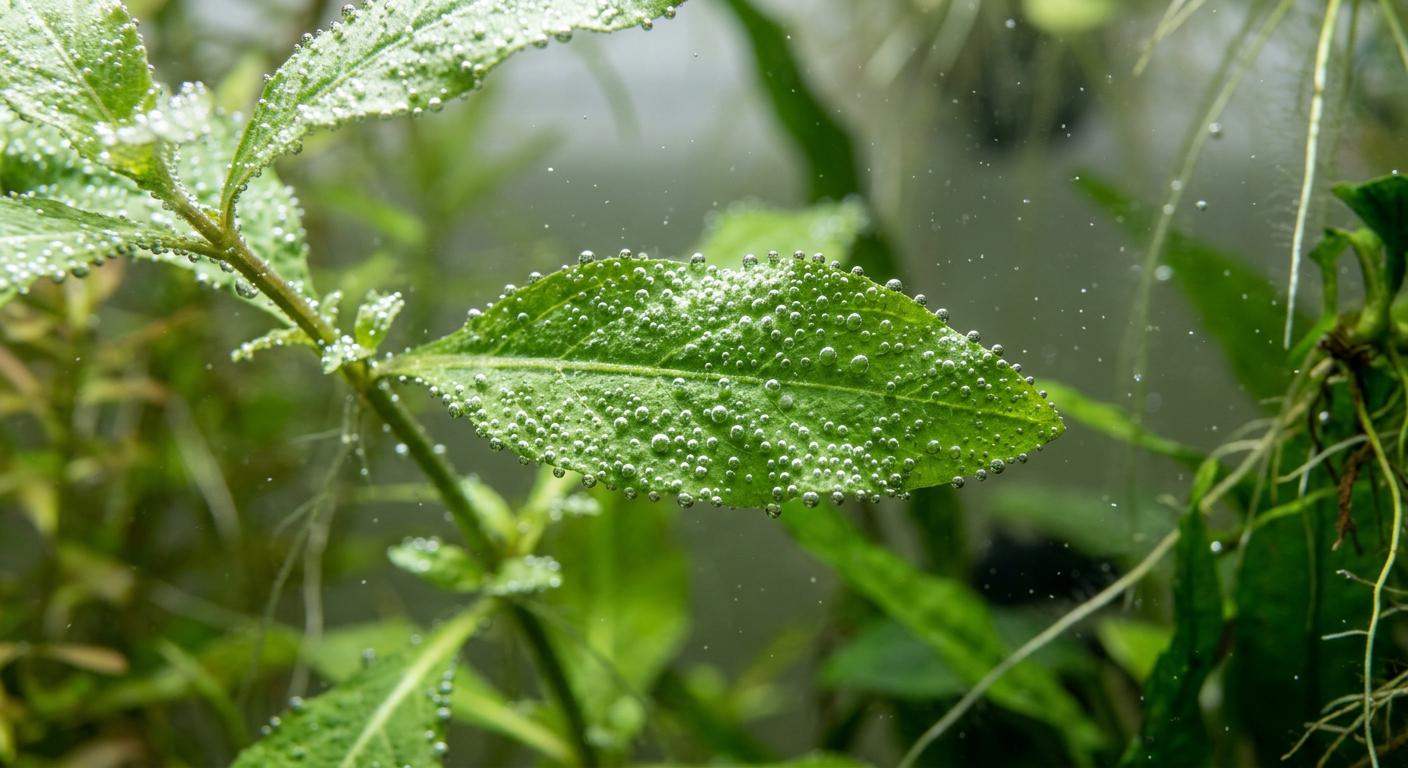 That's real oxygen, dissolved in the water, supporting your fish and aerobic bacteria.
But the day/night swing matters. Once lights turn off, photosynthesis stops immediately. Plants start respiring — consuming oxygen, releasing CO2. Fish, bacteria, and decomposing matter keep consuming oxygen through the night. A tank that pearled vigorously all afternoon can see its dissolved oxygen drop 2–4 mg/L by early morning. Some tanks in controlled studies dropped below 5 mg/L, a level where many fish start showing stress. Here's what surprised me when I reviewed these studies: the single most reliable predictor of overnight oxygen crashes wasn't stocking density or plant mass — it was whether surface agitation continued in the dark. An air stone running 24 hours, or a power head stirring the surface at night, and those oxygen crashes never happened. Turn off all surface movement at night, and the crashes were predictable.
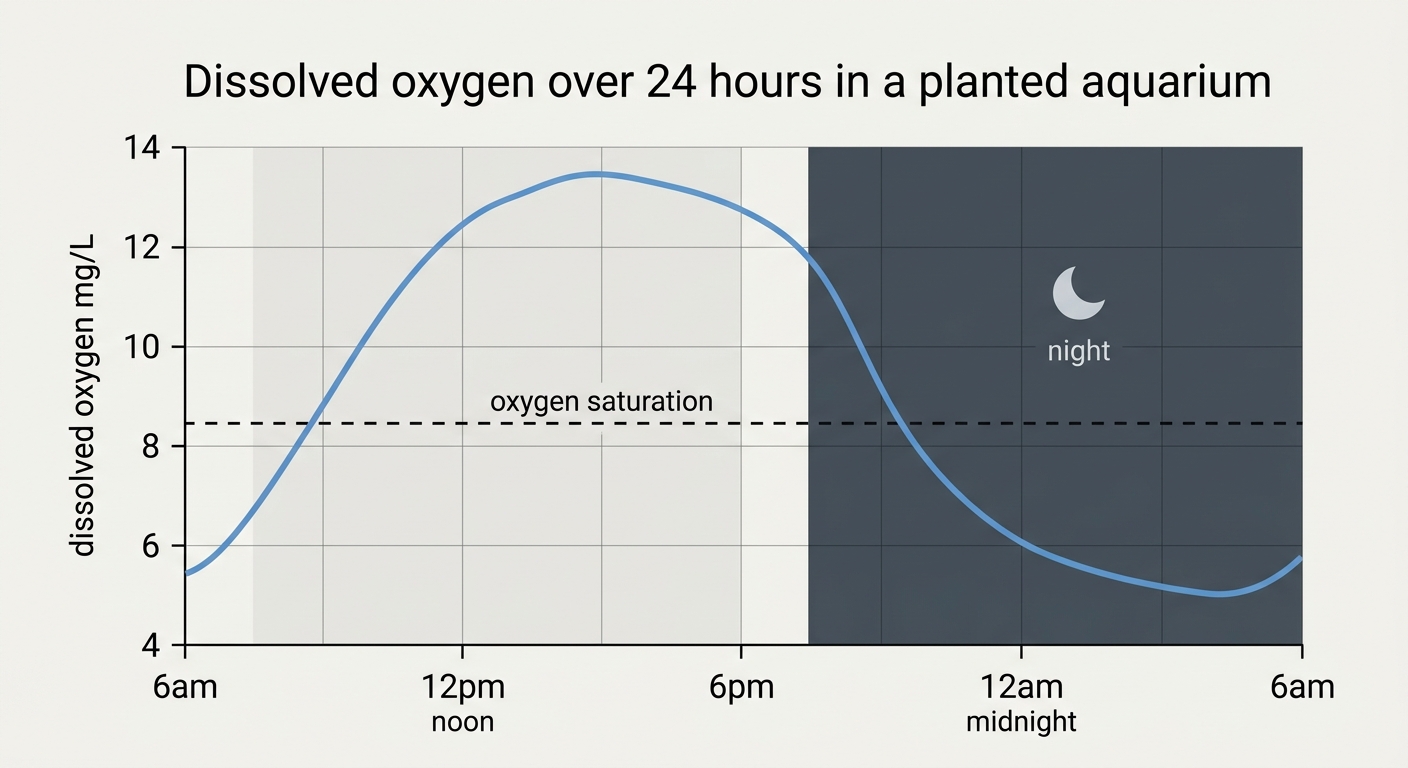 Here's what matters for your tank: plants contribute real oxygen during the day. They don't prevent night-time oxygen loss. Both dynamics happen, and both matter for your fish.
They outcompete algae for light and nutrients
Algae thrives in imbalance. When light exceeds what plants can use given available CO2, the excess becomes algae energy. When nutrients exceed what plants can assimilate given light and CO2, the excess becomes algae fertilizer. When CO2 is intermittent or low, plants struggle and reduce their uptake, leaving light and nutrients for algae.
The mechanism is resource competition, not chemical warfare. Algae is metabolically flexible — it grows at lower light, lower CO2, across a wider nutrient range. Algae thrives when conditions are *just good enough for algae but not yet optimal for plants*.
Once plants are established and growing quickly, they change that equation. Floating plants block light reaching lower water layers. Fast stem plants absorb nutrients aggressively. Heavy planting means plants occupy the space where algae would establish. The competition is structural, not chemical.
Algae doesn't disappear — and it shouldn't. A small amount of algae is normal, even healthy. But the dominant algae types shift. Green water and green spot algae recede first. Diatoms persist longer because they're driven by silicates from new substrate, not nutrient competition. Black beard algae only goes away if you also stabilize your CO2.
They reduce waste accumulation
Fish produce ammonia continuously. Uneaten food decays, releasing organic compounds. Bacterial activity generates metabolic byproducts. Water quality degrades unless something removes those compounds from circulation.
Plants absorb nitrogen, phosphorus, potassium, and trace minerals from the water column and substrate. They incorporate these elements into new leaves, stems, and roots. While fish waste continues accumulating, plant uptake reduces the *accumulation rate*. The water stays clearer. Nutrient spikes that would trigger algae blooms stay shallower. Substrate remains aerobic — plant roots pump oxygen into sediment, preventing the black, anaerobic zones where hydrogen sulfide forms.
None of this is dramatic. It's not eliminating ammonia or nitrate to zero. It's slowing the accumulation enough that your water quality remains stable rather than drifting toward crisis. I've kept notes on this across years of tanks, and the pattern is consistent: plants don't erase the bioload. They make it manageable.
How Plants Work Inside Your Tank
Understanding plant function means understanding two things: what plants consume, and how they get it.
Photosynthesis, respiration, and the day/night cycle
During light hours, plants convert light energy, CO2, and water into glucose and oxygen. That's photosynthesis. It's the only time plants *produce* oxygen. It's also the only time they make the energy they need to do everything else — grow, absorb nutrients, maintain their tissues.
At night, photosynthesis stops. Plants shift to respiration: they break down the glucose they made during the day, release CO2, and consume oxygen. This is how plants get energy at night, when no light is available. It's not optional — all living things respire. This is basic biology, but in aquariums it matters because it's visible.
This cycle creates a daily pH swing in planted tanks. During the day, CO2 consumption raises pH. At night, CO2 production lowers it. Morning pH is consistently lower than evening pH. This is normal. It's not a sign of poor water quality — it's a sign that your tank is photosynthesizing and that your plants are respiring on schedule. If you're tracking pH and you see this swing, your plants are working.
CO2 also matters for growth rate. In low-light environments, CO2 is the limiting factor — even if light is present, plants grow slowly because dissolved CO2 is scarce. In high-light environments, if CO2 is scarce, plants can't photosynthesize fast enough to justify the light investment. CO2 injection accelerates growth but isn't required for survival. Ambient dissolved CO2 from fish respiration, bacterial activity, and atmospheric diffusion is enough for many plant species — in fact, for most beginner plants.
Where plants get their nutrients: roots vs. water column
Plants have two nutrient pathways: roots and leaves.
Rooted plants — swords, crypts, vallisneria — absorb nutrients primarily through their root systems from the substrate. The substrate supplies minerals slowly, which is why heavy root feeders benefit from root tabs every few months. But roots also access free-floating nutrients in the water column, especially nitrogen.
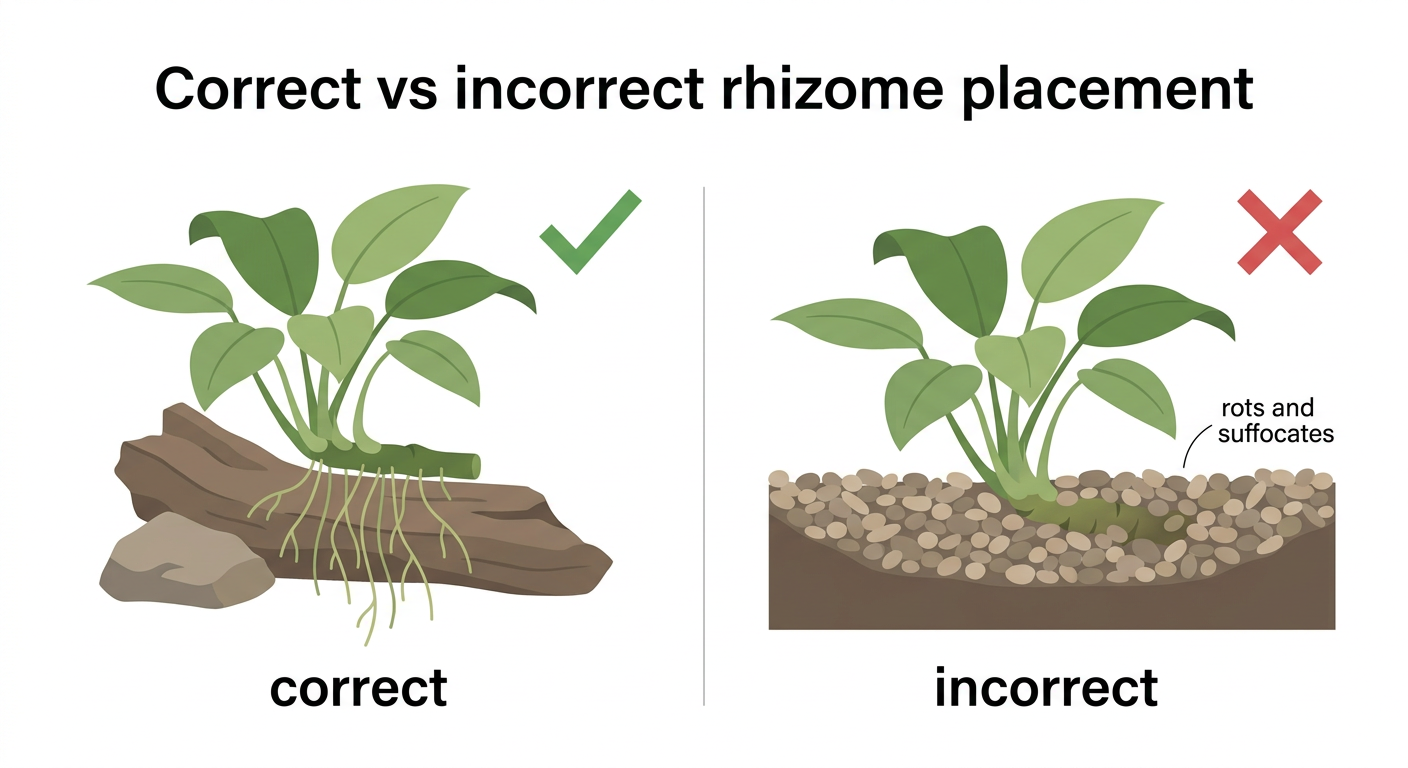
Floating plants and epiphytes — anubias, java fern, duckweed, frogbit — have no meaningful root uptake. They feed entirely from the water column. Their roots (when present) serve as anchors, not nutrient absorbers. This is why epiphytes must never be buried in substrate — the rhizome (the thick horizontal stem) needs water flow, not soil. I mention this because it's the number-one mistake people make with these plants, and it's entirely preventable.
Stem plants span both worlds. They have roots, but they feed through leaves too. This flexibility makes them adaptable to different tank setups and excellent for stabilizing new aquariums.
Here's something worth noting: plants actually prefer leaf uptake for ammonia. In split-chamber experiments where ammonia was added to either leaves or roots of eelgrass, adding ammonia to leaf surfaces reduced root uptake by 77%. The plant essentially said, "I can get this from above; I don't need the roots." This preference means floating plants — leaves at the water surface with dangling roots — have a structural advantage for removing ammonia from your tank. It's not just that they're fast growers. It's that their anatomy puts their main nutrient-absorption surface right where the ammonia enters.
What plants consume: macros, micros, and the patterns behind them
Plants need macronutrients: nitrogen (N), phosphorus (P), potassium (K). They also need micronutrients: iron, manganese, boron, molybdenum, zinc, copper, and others. The "macro" designation just means quantity — plants need more N, P, K than they need trace metals.
Where do these come from in your tank? Fish food and fish waste. In a 10-gallon aquarium with five small fish, the waste they produce supplies significant nitrogen and phosphorus. If your bioload is high enough, plants may never need fertilizer. If your bioload is low — few fish, light feeding — plants will eventually show nutrient deficiencies, usually iron deficiency visible as yellowing new leaves.
The pattern I keep seeing is this: in a tank with fish, nitrogen surplus is usual. Phosphorus is often deficient relative to nitrogen. Once phosphorus becomes the limiting nutrient for plant growth, plants stop consuming as much nitrogen relative to their size. Nitrogen accumulates. Nitrate drifts upward even in planted tanks, though much slower than in unplanted tanks. This is why I haven't found a planted tank that eliminates water changes entirely, even though I keep reading that they can. The exact numbers matter less than the consistency — if you're tracking your parameters, you'll notice the difference.
This is why some aquarists see planted tanks as low-maintenance while others still need water changes. The difference usually comes down to bioload, plant mass, and plant growth rate. Heavy planting + fast growers + moderate bioload = stable water quality for months. Light planting + slow growers + heavy bioload = gradual nitrate drift even with plants present.
Different Aquarium Plant Types, Different Contributions
Not all plants are ecosystem participants in the same way. Each plant type accesses nutrients differently, occupies different water layers, and contributes differently to algae control and waste management. A mix of types gives broader coverage than any single category.
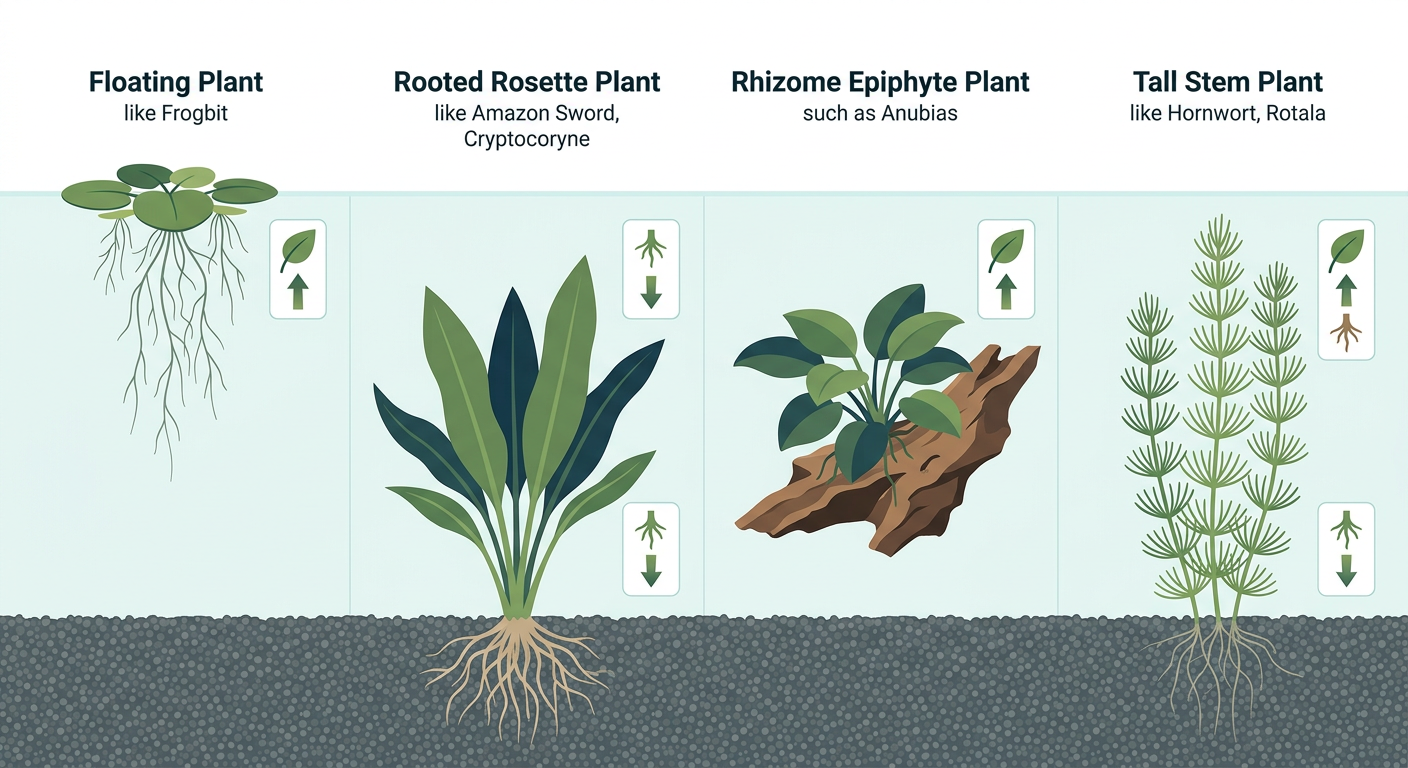 Floating plants
Floating plants sit at the water surface with roots dangling into the water column. They absorb nutrients from the water, including ammonia from above. They access atmospheric CO2 directly — CO2 diffuses roughly 10,000 times faster through air than through water, which gives floating plants a carbon advantage that submerged plants can't match. This carbon advantage means faster growth.
Fast growth means rapid nutrient uptake. Fast nutrient uptake means less available for algae. Floating plants are often the single most effective algae-control tool in a beginner's toolkit.
They also shade the water below, blocking light from reaching lower layers. This benefits slow-growing plants underneath but can block too much light if the surface gets too dense. Thin them regularly to 30–50% coverage.
Common examples: duckweed, frogbit, water lettuce, salvinia, red root floaters.
Rooted and rosette plants
Plants like sword plants, crypts, and vallisneria root into the substrate. They pull nutrients from substrate sediment, particularly iron, which is more bioavailable in soil than dissolved in water. Their roots pump oxygen into the substrate, creating aerobic zones that support beneficial bacteria and prevent anaerobic decay.
Root systems also stabilize sediment. Loose sand or gravel compacts over time, gradually becoming anaerobic deeper down. Plant roots prevent this by creating continuous circulation of oxygenated water through the substrate layers.
Heavy root feeders (sword plants) benefit from root tabs — fertilizer pellets buried in the substrate every 2–3 months. Light root feeders (vallisneria) often survive on fish waste and water-column nutrients alone.
Rhizome and epiphyte plants
Anubias, java fern, bucephalandra, and moss have no true roots. What they have is a rhizome — a thick horizontal stem — and thread-like rhizoids that serve as anchors. These plants attach to driftwood, rocks, or decorations.
They feed entirely from the water column. Because they grow slowly and can't access the nutrient-rich substrate layer, they thrive in low-nutrient, low-light environments. They're extremely tolerant of neglect.
One rule: never bury the rhizome. Bury only the rhizoids (the thin roots). A buried rhizome suffocates and rots. This is the number one reason people lose anubias and java fern. I've watched this happen enough times that I'll mention it again later because it genuinely matters.
 Stem plants and mosses
Stem plants — hornwort, water wisteria, ludwigia, rotala — feed through both roots and water column. They grow quickly, which means they consume nutrients at high rates. This makes them excellent for nutrient sponges in new tanks or high-bioload setups.
You propagate stem plants by cutting and replanting trimmings. Stems root readily, so once you establish a colony, you can keep trimming and replanting indefinitely.
Mosses are thread-like with no true roots. They absorb nutrients directly through leaf surfaces from the water column. They grow in almost no light. They attach to surfaces and provide microhabitat for shrimp, fry, and microorganisms. Java moss and Christmas moss are beginner-proof.
What Actually Changes When You Add Plants
You add plants. You wait. Things shift. Compare a planted tank vs an unplanted tank and the differences aren't dramatic — they're ecological. They accumulate over weeks and months.
Water quality shifts
Ammonia reads lower. Not zero — plants don't eliminate ammonia production — but measurably lower than in an unplanted tank with the same bioload and water change schedule. One controlled study showed ammonia levels of 0.14 mg/L in planted systems vs. 2.09 mg/L in unplanted controls after 25 days of observation.
Nitrite and nitrate follow more slowly. Nitrite depends on ammonia first being converted by bacteria, so if plants are consuming ammonia directly, there's less for bacteria to oxidize. You see less of the nitrite spike that typically comes during the nitrogen-cycle establishment phase.
Nitrate still accumulates — the nitrogen cycle still happens, just with plants intercepting ammonia before bacteria get to it — but accumulation is slower. Water clarity improves. Plants bind suspended particles and reduce bacterial blooms. Substrate stays aerobic.
pH stability improves in the long term. Here's why: nitrification produces acid. Each milligram of nitrate produced costs your tank some buffering capacity. Plant nitrate uptake removes that acid, but at roughly half the rate that nitrification creates it. So over time, the trend is downward pH drift in most aquariums. But aquariums where plants are removing roughly twice as much nitrate as nitrification produces maintain neutral or slightly alkaline pH. This requires plant mass and external nitrate sources (tap water nitrate, fertilizer), not just fish waste, but the principle holds: plants stabilize pH better than unplanted systems.
Algae behavior changes
Green water algae recedes first, usually within 2–4 weeks of heavy planting. Green spot algae follows. Both indicate that plants are now outcompeting algae for the resources it was exploiting.
Diatoms (brown algae) persist longer. New substrate contains silicates, and diatoms love silicates. This is normal. It's not a sign that plants aren't working — diatom growth is driven by silicate availability, not nutrient competition. Diatoms peak around week 2–4, then decline as silicates exhaust.
Black beard algae (the dark red/brown stuff that won't scrape off) is different. It's associated with CO2 instability — where CO2 fluctuates or is consistently low. Adding plants alone won't fix it unless plants also stabilize your CO2, which happens mainly in high-light, CO2-injected setups or in smaller tanks with consistent lighting where marginal changes affect the whole system. Low-tech planted tanks don't usually eliminate existing black beard algae; they just prevent new outbreaks.
Algae elimination is neither possible nor desirable. Healthy tanks support a small amount of algae. The goal is control, not eradication.
Fish behavior and welfare
Fish have more places to hide. More hiding spots mean less stress. This is measurable — guppy studies show lower cortisol levels (a stress hormone) in enriched, planted environments compared to bare tanks. Bettas show fewer negative behaviors — less darting, more natural activity patterns, more actual swimming rather than skulking.
Oxygen support from daytime photosynthesis means fish in well-planted tanks can be more active during light hours. Some species show measurably longer active swimming durations and less surface-breathing behavior.
Some fish nibble plant surfaces for biofilm and aufwuchs (the organic buildup on plant leaves). This is natural foraging behavior that doesn't happen in bare tanks. It's enrichment — the fish is doing something it evolved to do.
The welfare differences aren't subtle to trained observers. Fish in planted tanks demonstrate behaviors and activity patterns that don't exist in bare tanks. You can watch the difference.
Your maintenance routine changes
Water changes become less frequent. Some aquarists with heavily planted, lightly stocked systems go 6+ months between water changes without water quality degradation. This isn't common for beginners — most of us still do monthly changes — but it's possible.
Pruning becomes part of the routine. Floating plants double in mass every 1–2 weeks if conditions are good. Stem plant trimming becomes regular work. What you stop doing is substrate gravel vacuuming — plant waste settling and decomposing in the substrate is fine because plant roots oxygenate it and decomposing organic matter feeds plant growth.
What you start watching for shifts: instead of fixating on ammonia and nitrite, you watch plants for signs of nutrient deficiency (yellowing leaves usually means iron deficiency) or stress (melting, transparent leaves). You notice which plants are thriving and which are struggling. You start understanding your specific tank — its light levels, its CO2 gradient, its nutrient load — because plants make it visible. Your tank stops being a water box and starts being an ecosystem you can read.
Aquarium Plants for Beginners
This is where aquarium plant hobbyist culture makes a mess of things. The internet presents CO2 injection, expensive lights, specialized substrates, and fertilizer regimens as prerequisites. They're not. They're *optimizations* for high-growth plants and aquascaping. They're not requirements for beginners.
Do you need CO2 injection?
No. Not for low-tech setups.
A lot of aquarium plants evolved in low-carbon, low-light environments. They photosynthesize against dissolved CO2 at concentrations that would be considered "deficient" in a high-tech setup. Ambient CO2 from fish respiration, bacterial activity, and atmospheric diffusion is enough.
These plants thrive without injection: java fern, anubias, java moss, crypts, vallisneria, amazon sword, anacharis, water wisteria, hornwort, floating plants, bucephalandra, guppy grass.
CO2 injection accelerates growth. It improves coloration in plants that can access it. It supports demanding plant species that struggle at ambient CO2. But your first planted tank doesn't need it.
What about lighting?
Your current aquarium light probably works.
Your kit hood likely delivers 10–30 PAR (photosynthetically active radiation) at substrate depth in a 20-gallon tank. Low-light plants perform well at 15–50 PAR at substrate level. Most standard LED hoods are sufficient. I keep notes on the tanks I've set up, and the ones that succeeded weren't the ones with expensive lighting — they were the ones running consistent schedules on whatever light was there.
Photoperiod matters more than peak intensity. Run lights for 6–8 hours. Consistency — use a timer — matters more than brightness. In new tanks or after heavy pruning, keep photoperiod at 6 hours while plants recover.
Avoid direct sunlight and avoid sudden jumps in light duration or intensity. A midday break — 4 hours on, 4 hours off, 4 hours on — can reduce algae without harming plants.
Do you need special substrate?
Not for beginner plants.
Floating plants need no substrate at all. Epiphytes need no substrate. Stem plants feed mainly from the water column — plain gravel works. Heavy root feeders (sword plants, crypts) benefit from nutrient-rich substrate but can survive on plain gravel plus occasional root tabs.
If you want to build a substrate layer, the Walstad method is simple: 1 inch of low-nitrogen potting soil capped with 0.5–1 inch of porous gravel or coarse sand. The soil layer provides slow CO2 release from cellulose decomposition and some nutrient availability over months. Cap with gravel to prevent clouding and prevent fish from stirring it.
Liquid fertilizer is optional. In low-tech tanks, fish waste often supplies enough nitrogen and phosphorus. If plants show deficiencies (yellowing, stunted growth), add a comprehensive liquid fertilizer at half the recommended rate once per week.
Easiest plants to start with
Anubias. Tolerates the lowest light of any common plant. Survives neglect and mistake. Thick leaves resist fish nibbling. Grows slowly so you won't need to prune constantly. Just don't bury the rhizome.
Java fern. Nearly indestructible. Reproduces by growing tiny plants on old leaf edges — no trimming required to propagate. Wide parameter tolerance. Same rhizome rule as anubias.
Java moss. Grows in almost no light. Attaches to any surface with fishing line or cyanoacrylate gel. Provides microhabitat for shrimp and fry. Collects debris so trim it occasionally, but otherwise requires zero knowledge.
Hornwort. Extremely fast growth means powerful nutrient uptake. Excellent for stabilizing new tanks. Can float or be anchored. May shed needles in very high light, but this isn't a death sentence — new needles regrow.
Cryptocoryne. Best rooted plant for low light. Multiple varieties with different colors and leaf shapes. Grows lush and bushy. Expect "crypt melt" after planting — the emersed leaves (grown in air at the nursery) die and submerged leaves grow back. This looks like total failure but it's normal. Leave the roots alone.
Vallisneria. Grass-like background plant. Spreads via runners so it fills space without your input. Handles low light well. Don't use liquid carbon products (like Seachem Excel) — they damage vallisneria even at standard doses.
Floating plants. Duckweed, frogbit, salvinia all grow at insane speeds. Access atmospheric CO2 directly. Excellent algae suppressors. Thin them regularly — don't let them cover more than 50% of the surface or they shade everything below too much.
Amazon sword. Classic centerpiece plant. Grows large and impressive. Tolerates low to moderate light. Heavy root feeder — use root tabs or expect slow growth.
Common beginner mistakes
Burying rhizome plants. The most common way people kill anubias and java fern. The thick horizontal rhizome needs water flow and oxygen. Only the thin roots touch substrate. Bury the rhizome and it suffocates and rots. I'm mentioning this multiple times through this article because it genuinely is the primary killer of these otherwise bulletproof plants.
Over-fertilizing out of impatience. In low-light, low-CO2 tanks, plants use nutrients slowly. Excess fertilizer doesn't speed growth — it feeds algae instead. Patience is the critical resource, not fertilizer dosing.
Expecting instant changes. Low-tech plants grow slowly. A tank that looks sparse at week 1 will look lush at month 3. This isn't a sign that something's wrong. It's the expected timeline.
Choosing high-light plants for a low-light setup. Demanding carpet plants and red stems require strong light and CO2 injection. They fail slowly in beginner conditions, and then the aquarist assumes they killed them. You didn't — the setup wasn't matched to the plant's requirements.
Panicking at plant melt. Crypts are grown emersed at nurseries — the leaves evolved in air. When submerged, they die. New leaves grow that are adapted to underwater life. The same happens with many plants. The entire plant can look dead while the roots are fine. In most cases, leave it alone and wait. Melt passes.
Buying too few plants. A single anubias won't compete with algae. Plant heavily from the start, especially with fast-growing species. Density matters for competition to work.
Running lights too long. 6–8 hours maximum for new planted tanks. Longer photoperiods don't make plants grow faster — they feed algae instead. Consistency matters more than duration.
Frequently Asked Questions
Do aquarium plants really help my fish?
Yes. The benefits of live plants in an aquarium are real and measurable — they produce oxygen during light hours, consume ammonia directly, reduce nitrate accumulation, and provide enrichment (hiding spots, foraging surfaces). The welfare improvements are measurable in research — lower stress markers, more natural behaviors. They're not dramatic day-to-day, but they add up.
Do I need special lights for live plants?
No. Your standard aquarium light is almost certainly sufficient for low-light plants. Consistency and photoperiod (6–8 hours) matter more than peak brightness. More light feeds algae, not plants, if you don't also have CO2 and nutrients optimized.
What's the easiest plant to start with?
Anubias. It tolerates the lowest light of any common plant, grows slowly so you don't prune constantly, and survives neglect. Java fern is a close second. Both need only one rule: don't bury the rhizome.
Can aquarium plants survive without CO2 injection?
Most beginner plants can. Anubias, java fern, crypts, vallisneria, amazon sword, hornwort, all floating plants — these evolved to photosynthesize at low CO2 concentrations. Ambient CO2 from fish respiration and bacterial activity is enough. CO2 injection speeds growth but isn't required.
How long before I see a difference after adding plants?
2–4 weeks for algae suppression to become visible (green water clears, green spot algae recedes). 2–3 months for water quality changes to become obvious — ammonia stays lower, nitrate accumulation slows, pH drifts less. Plant mass builds over months.
The Point
Plants aren't decoration. I know I'm repeating myself, but it matters because aquarium culture presents them as optional aesthetics — a nice-to-have that makes your tank look better.
They *do* make your tank look better. But that's not their primary function. They're ecosystem participants. They're actually *doing work* inside your aquarium: consuming waste, producing oxygen, stabilizing chemistry, competing with algae, providing enrichment.
Starting small is fine. Starting hardy is smarter. Buy anubias or java fern, attach them to a rock, drop them in. Add a few floating plants. Watch what happens over the next few months. The biology works with beginner plants. You don't need perfect conditions or special equipment. You need observation and patience.
And if you end up wanting to dig deeper into planted tanks later — higher light, CO2 injection, aquascaping — you'll have months of real-world observation behind you. You'll understand what your tank needs because you'll have watched it work.
That understanding is what I value most about this hobby. Plants make it visible.
Comments
No comments yet.