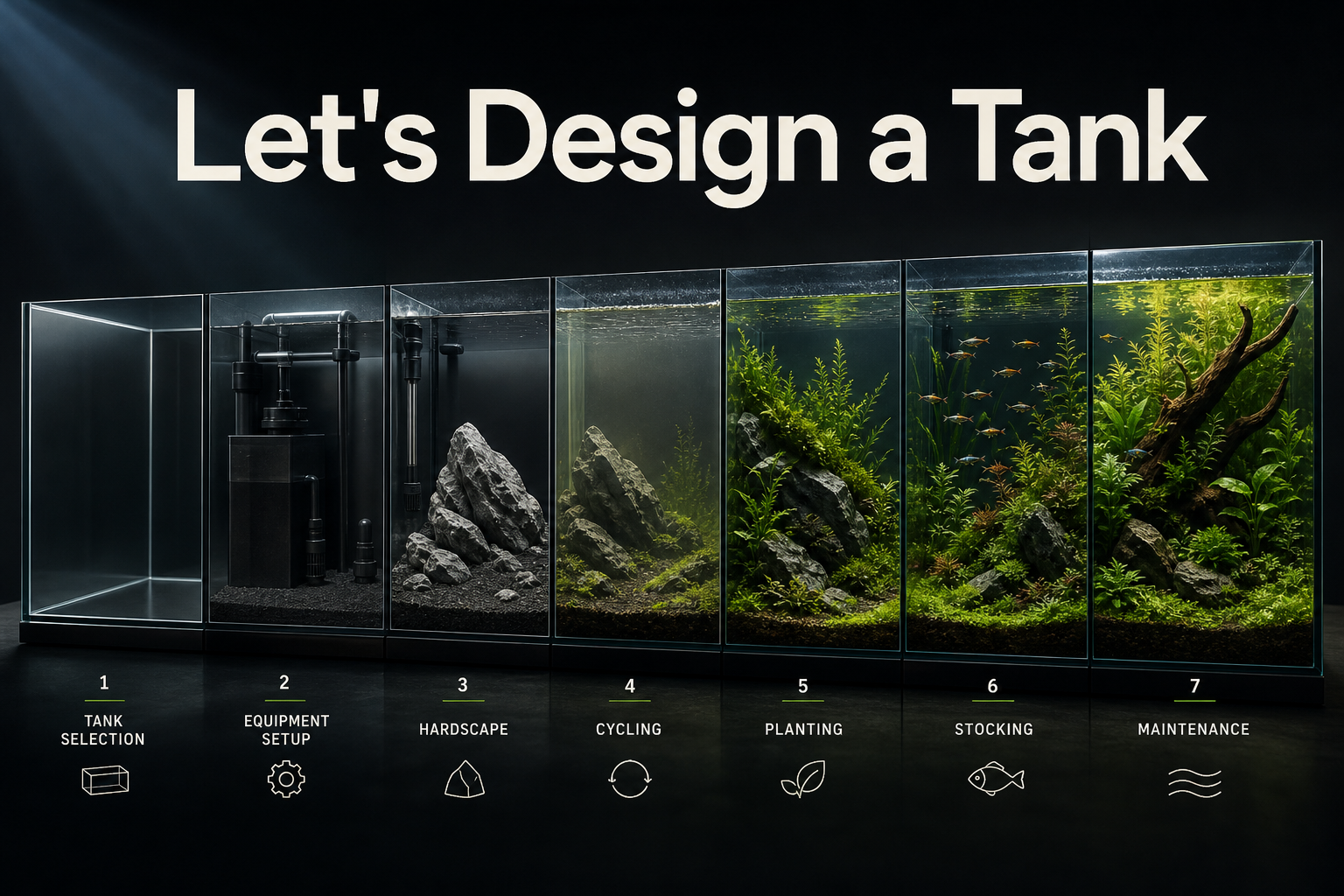
Why water prep matters
The question everyone asks before setting up an aquarium is how to cycle a fish tank safely and correctly. If you've followed the equipment setup from the previous article in the Let's Design a Tank series, your tank, filter, heater, and test kit are ready. Now comes the real work: aquarium water preparation. Testing, treating, and building the biological foundation your fish will depend on.
Most beginner problems don't start with fish. They start here, at the foundation. The water. Water that's been treated, understood, and given time to become a home for the bacteria that keep your fish alive.
Treating your tap water
Tap water comes with invisible passengers. Your water utility adds chlorine or chloramine to kill pathogens on their way to your sink. That's useful for drinking. For fish and the bacteria they depend on, it's poison.
Chlorine and chloramine damage fish gills and kill nitrifying bacteria on contact. If you're serious about cycling and stocking, you need a water conditioner.
Choosing a conditioner
Water conditioners do the same basic job—neutralize chlorine and chloramine—but some do extra work. Look for products that also bind heavy metals like copper and lead leached from old pipes. The best ones convert toxic ammonia into a harmless form and protect fish slime coating with aloe or similar compounds.
Seachem Prime is the one I see most often recommended, and for good reason. It works fast, handles chloramine (which is trickier than plain chlorine), and the dosing is straightforward. API Stress Coat and Tetra AquaSafe are solid too, if you find them cheaper or prefer different additives.
How much to add, and when
Read the label. Most conditioners follow roughly the same pattern: around 1 to 2 ml per 10 gallons for your initial fill. Dosing for a brand-new tank is different from dosing for a water change.
Initial fill: use what the label says. Water change: usually half the per-gallon dose, because you're only replacing part of the water. Don't overthink it.
Understanding aquarium water parameters
If you're going to cycle a fish tank, you need to understand what you're testing for and why each number matters. These parameters are your window into whether the aquarium is working.
pH: the acidity scale
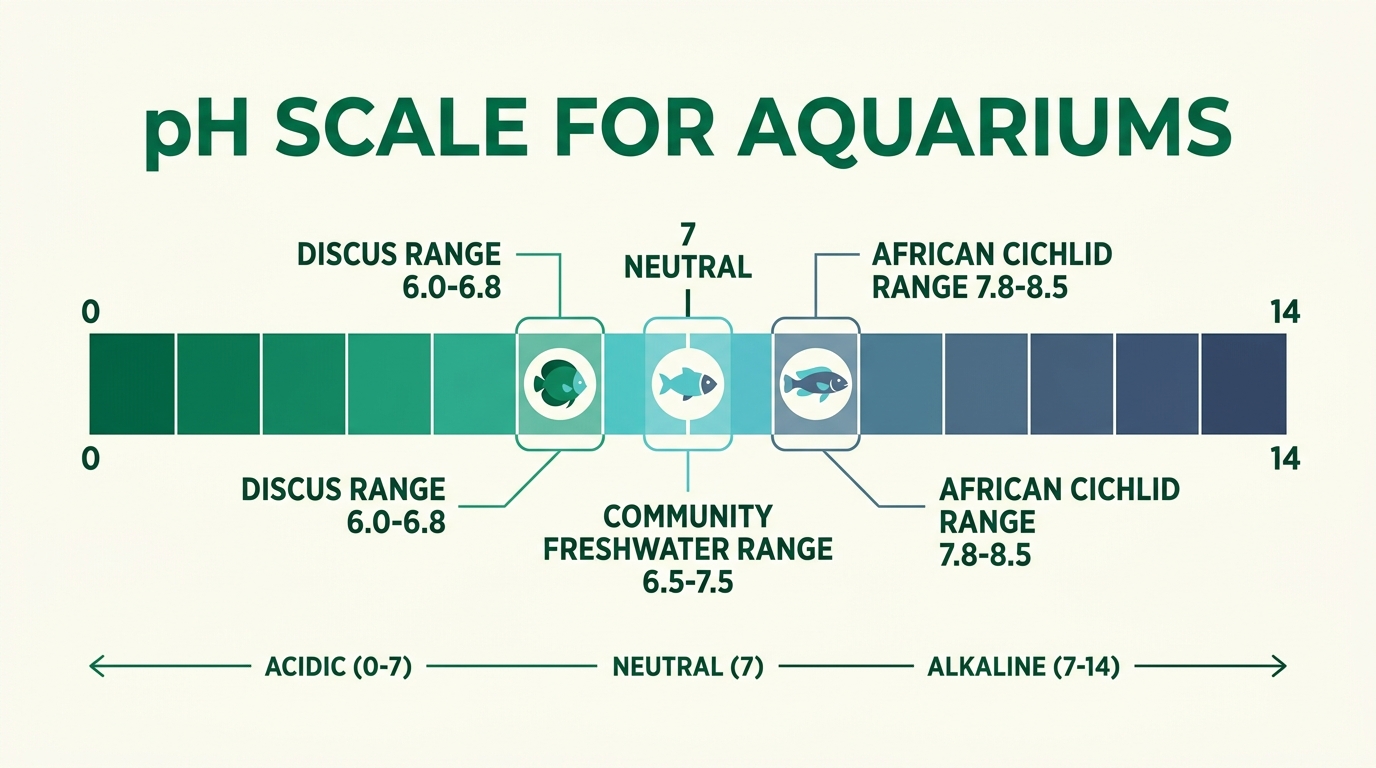
pH measures how acidic or alkaline water is on a scale from 0 to 14. Seven is neutral. Below 7 is acidic. Above 7 is alkaline.
Most community freshwater fish are comfortable between 6.5 and 7.5. Some species need tighter ranges: African cichlids want 7.8 to 8.5, discus want 6.0 to 6.8. I've kept detailed notes across years, and one pattern keeps showing up—stability matters much more than hitting a specific number. Fish can thrive at 7.2 or 6.8 as long as it doesn't swing wildly week to week.
 Test pH weekly during cycling. Once your tank is established, test monthly.
Hardness: GH and KH explained
Water hardness is where I see the most confusion. Aquarium-keeping uses two different measurements, and they sound like they do the same thing.
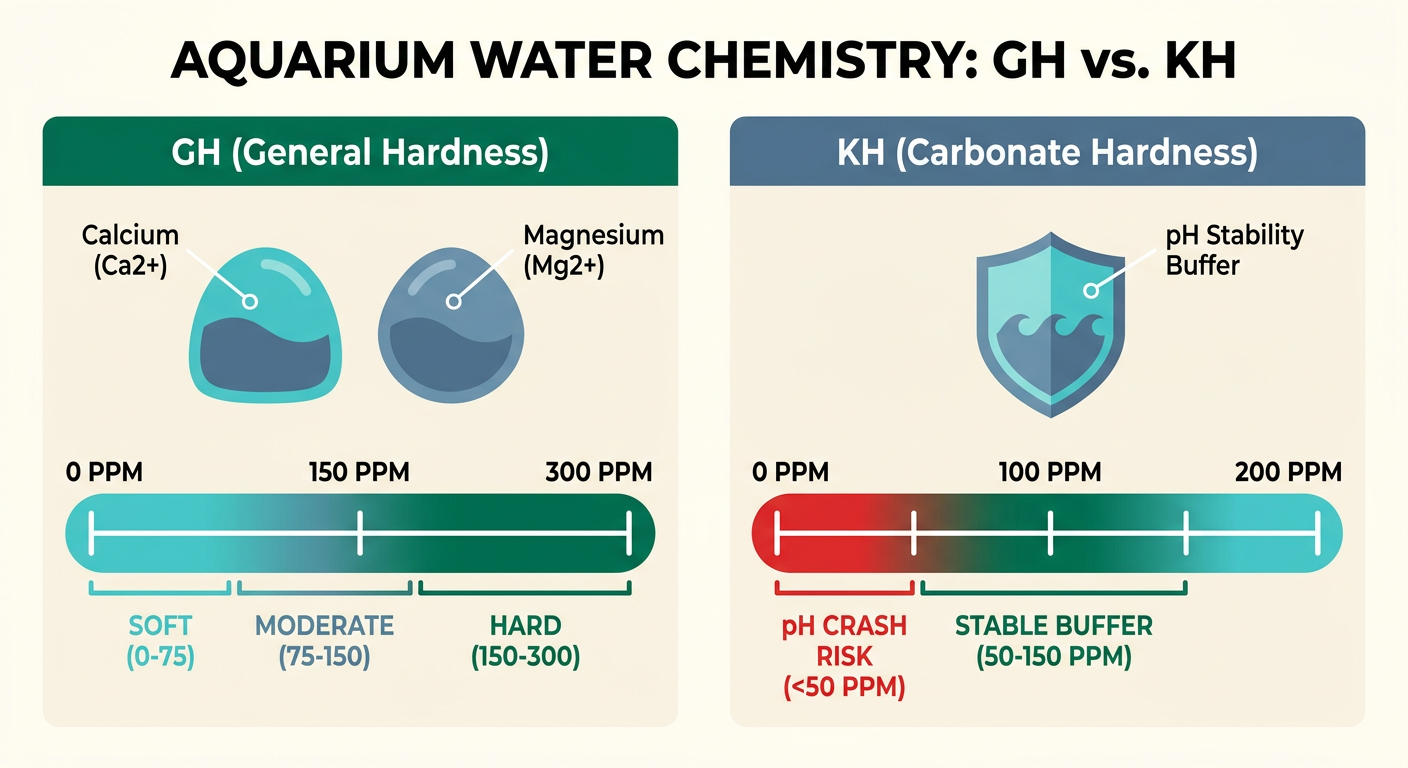
GH (general hardness) measures calcium and magnesium—the minerals that make water hard in the everyday sense. When high GH means soap won't lather well, that's what you're experiencing. Soft water is 0–75 ppm. Moderate is 75–150 ppm. Hard is 150–300 ppm. Most fish can adapt across this range if you match your stock to what you've got.
KH (carbonate hardness or alkalinity) measures carbonates and bicarbonates. Think of it as buffering capacity. KH keeps pH from crashing. During cycling, nitrification produces acid, which pulls pH down. If your KH is low—under 50 ppm—your pH can plummet. If your KH is adequate—50–150 ppm—pH stays stable.
 I've watched tanks crash during cycling because the keeper had good GH but forgot to check KH. The parameters looked fine until suddenly they weren't.
Test both weekly during cycling.
The nitrogen cycle cast: ammonia, nitrite, nitrate
Fish produce waste. That waste is ammonia. Ammonia is toxic: it damages gills, causes stress, kills. But in a cycled tank, ammonia never builds up because bacteria turn it into something less toxic, which other bacteria turn into something harmless.
That's the nitrogen cycle.
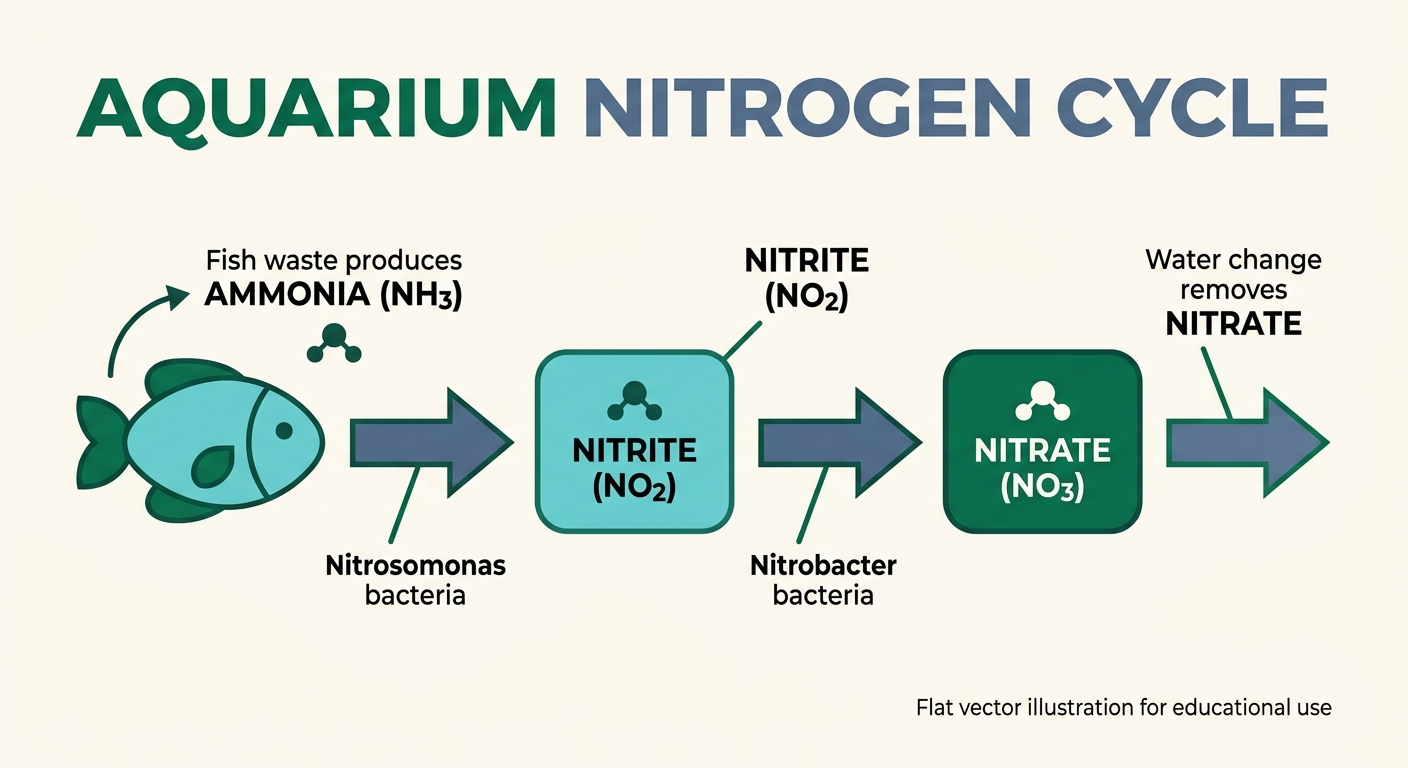
Ammonia (NH₃/NH₄⁺): The waste product from fish respiration, decaying food, and dead organic matter. Highly toxic even at low levels. Safe level is 0 ppm in an established tank. During cycling, you'll see it climb to 3–4 ppm, then drop as bacteria colonize.
Nitrite (NO₂⁻): The intermediate product. One set of bacteria (Nitrosomonas) converts ammonia to nitrite. But nitrite is also toxic. It binds to fish hemoglobin, starving them of oxygen. Safe level is also 0 ppm.
Nitrate (NO₃⁻): The end product. Different bacteria (Nitrobacter) convert nitrite to nitrate. Nitrate is relatively harmless at low levels—it doesn't poison fish the way ammonia or nitrite do. But it builds up over time and can stress fish at high concentrations. Keeping it below 40 ppm (ideally under 20) is why you do water changes.
All three need testing during cycling. You're watching ammonia rise, then fall. You're watching nitrite spike and drop. You're watching nitrate appear and climb. When all three are in the right place, your tank's bacteria have matured.
Temperature and cycling speed
Bacteria are cold-blooded. In warmer water, they colonize faster. A tank at 75°F cycles slower than one at 80–85°F. This isn't intuitive: most people think temperature is just about fish comfort. But it dramatically affects how long cycling takes.
The nitrogen cycle explained (without the chemistry degree)
Here's how the nitrogen cycle works in your aquarium: bacteria are your tank's janitors.
Fish produce mess. The first janitor (Nitrosomonas) sweeps up ammonia and turns it into a different kind of mess (nitrite). The second janitor (Nitrobacter) sweeps up nitrite and turns it into something less messy (nitrate). After nitrate builds up, humans do water changes and remove it.
That's the cycle. Three-step process. Two bacteria doing the work. One parameter becoming less toxic each step.
 Fishless cycling: the recommended path
You have two approaches to fish tank cycling. You can run the cycle with fish in the tank (fish-in cycling), letting them handle the stress of high ammonia and nitrite while bacteria establish. Or you can run it without fish (fishless cycling), dosing the tank with ammonia from other sources and letting bacteria grow on their own timeline.
Fishless cycling is humane and gives cleaner data. Your fish aren't gasping through parameter spikes. Your ammonia and nitrite curves are predictable because you're controlling the dose. Your timeline is stable because you're not dealing with fish stress and acclimation.
I've done both. Fishless is better. I recommend it without reservation.
Ammonia sources for fishless cycling
You need ammonia to feed the bacteria. Three sources work:
Pure ammonium chloride: Pharmaceutical-grade ammonia. Brands like Dr. Tim's Aquatics sell it specifically for aquarium cycling. It dissolves clear, you know exactly how much you're adding, and you can dose precisely. This is what I use.
Fish food: Drop in some flakes or pellets. They decompose, producing ammonia. Less precise, but if you're experimenting or don't want to buy another product, it works.
Raw shrimp: A piece of supermarket shrimp will decay and produce ammonia. The protein breaks down into ammonia as bacteria colonize. Again, less precise, but functional.
For your first cycle, pure ammonia is worth the investment. You'll understand the process better, and your results will be cleaner data to refer back to.
The cycling timeline: what to expect and when
The typical aquarium cycle timeline runs 2–6 weeks. There's no way around it. Bacteria grow at their own pace, and you can't force them faster without shortcuts.
Week-by-week walkthrough
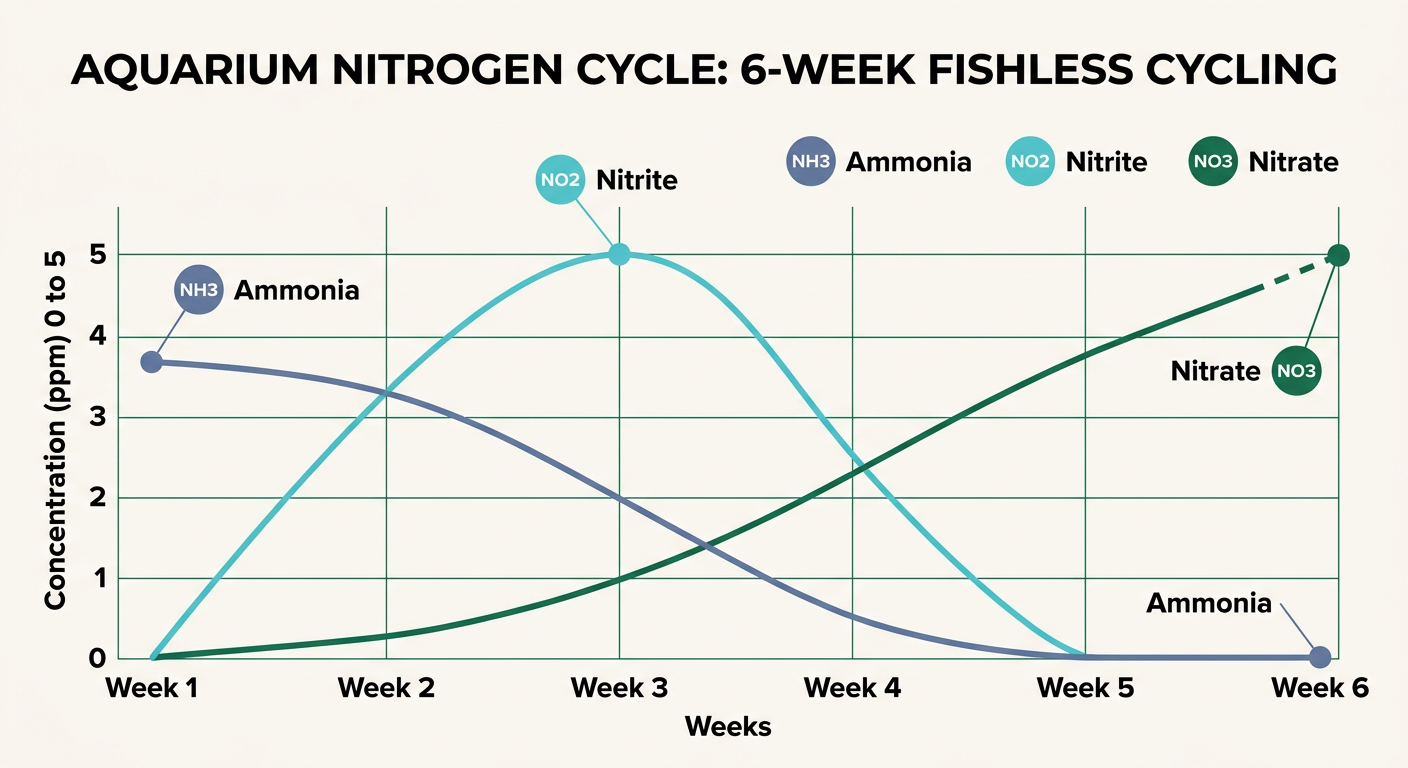
Week 1: You've added ammonia. You test, and ammonia's present—maybe 3–4 ppm. Nitrite and nitrate are zero. Nothing seems to be happening. This is normal. Bacteria are colonizing. You might see cloudy water; that's a bacterial bloom. It looks alarming. It's harmless.
Week 2–3: Ammonia drops. Nitrite appears and starts climbing. This means Nitrosomonas is working. Nitrobacter hasn't caught up yet. Nitrite might spike to 5 ppm or higher. This is the critical window and the most stressful part of the cycle because the tank looks unstable.
Week 4–5: Nitrite drops. Nitrate climbs. Both bacteria colonies are now active, trading work down the chain. You're getting close.
Week 6: Ammonia zero, nitrite zero, nitrate present. The cycle is done.
 Why there's no magic shortcut
I've seen people ask if they can inject bottled bacteria and skip the waiting. The answer is no. Bottled bacteria help, but they don't eliminate the timeline because bacteria still need surface area to colonize, food to eat, and time to establish stable populations. Seeding from an established tank is faster, but even that takes 2–3 weeks.
This isn't a limitation. It's how the process works. Accept it and your cycle goes better.
Testing schedule: how often and what to watch
During cycling, test every 2–3 days. You're looking for the pattern I described above: ammonia rising, then falling; nitrite spiking, then dropping; nitrate appearing. If you notice a stall (ammonia or nitrite stuck at high levels for more than a week), something's wrong.
Test ammonia, nitrite, nitrate, and pH. Ignore everything else for now.
After cycling is done, test weekly for ammonia, nitrite, and nitrate. Test pH, GH, and KH monthly. Once your tank is stable for 3–4 months, you can relax into monthly tests for nitrogen parameters and quarterly tests for hardness.
Which test kit to use
Liquid test kits (like the API Freshwater Master Test Kit) are more accurate than strips. Strips are quicker, but they age and become unreliable. For cycling, where precision matters, buy the liquid kit. It costs $20–30 and will outlast multiple tanks.
Live bacteria and cycle accelerators: do they work?
Bottled bacteria products contain Nitrosomonas and Nitrobacter frozen or in dormant form. When you add them to your tank, they wake up and start colonizing. Do they help? Yes. Do they eliminate the waiting? No.
What they do: reduce cycling time by days to weeks. I've seen cycles drop from 4 weeks to 2 weeks with quality bottled bacteria. But you still need ammonia for them to eat and time for stable populations to establish.
Brands with solid hobbyist track records: Tetra SafeStart, API Quick Start, Seachem Stability, Dr. Tim's One & Only. They're all roughly equivalent. Pick whichever's in your budget.
The seeding shortcut
If you have access to an established aquarium, you can transfer filter media from it to your new tank. That media is already colonized with bacteria. Your cycle drops to 1–2 weeks with significant source material. This is the fastest method.
You can also move gravel or decorations from an established tank. They carry bacteria. Not as effective as media, but useful if that's all you have available.
Common cycling problems and how to fix them
Ammonia stall
Ammonia rises to 3–4 ppm and just stays there. Week two passes. Week three. No drop.
Likely causes:
- pH too low: Nitrosomonas prefer pH above 7.0. Below 7.0, they slow down or stop. Raise pH by adding crushed coral to your filter or a pinch of baking soda to the tank. Test after 24 hours.
- Chlorine or chloramine still in the water: Did you add conditioner? If you didn't, it's killing bacteria. Do a large water change with dechlorinated water and dose conditioner.
- Temperature too low: Bacteria grow faster at 80–85°F. If your tank is 70°F, raising it speeds colonization. Bump the heater up and wait.
- Not enough surface area: Bacteria need somewhere to colonize. If your filter media is minimal or clogged, add more media or clean the existing media in old tank water (not tap water, which has chlorine).
Nitrite stall
Nitrite spikes but won't drop. You're stuck on step two of the cycle.
Likely causes:
- pH too low: Nitrobacter are even more pH-sensitive than Nitrosomonas. They prefer pH above 7.0 and slow dramatically below. Same fix: raise pH.
- Not enough oxygen: Nitrobacter are aerobic bacteria. They need oxygen. Increase aeration by running the filter harder, adding an air stone, or reducing water level so the filter creates more surface turbulence.
- Chlorine still present: Same fix as ammonia stall: water change with dechlorinated water.
If nitrite is above 5 ppm and stalled for more than a week, a partial water change (20–25%) can help by diluting the toxicity and giving bacteria room to work.
Persistent cloudy water
Most cloudy water during cycling is a bacterial bloom: harmless, temporary, resolves on its own in a few days. But there are other causes.
Bacterial bloom: Water looks milky. Clear it by doing nothing. Maybe increase aeration. It clears in 3–7 days.
Algae bloom (green water): Water looks green. This means excess light and nutrients. Reduce light duration to 6–8 hours daily. Don't add fertilizers. Increase water changes slightly if nitrate is high.
Detritus (dirt): Water looks brown or cloudy. You've got mulm in the substrate or uneaten food decaying. Increase filtration, avoid stirring the substrate, and remove visible detritus with a gravel vacuum.
pH crash during cycling
Your pH was 7.0 on day one. By day five, it's dropped to 6.0 or lower. This happens because nitrification is acidic: it produces acidic byproducts that pull pH down. If your KH is low, pH crashes hard.
The fix: increase KH. Add crushed coral to your filter. It dissolves slowly and buffers pH. Or add a pinch of baking soda to the tank. Test after 24 hours and repeat if needed. The goal is to stabilize KH at 50–150 ppm so pH doesn't swing.
This is why I check KH during cycling, not just pH. If KH is adequate to start with, pH crashes are rare.
When to do water changes during cycling
Generally, avoid water changes during cycling. You're feeding bacteria ammonia, and water changes remove it. But there are exceptions.
Do a partial water change (20–25%) if:
- Ammonia exceeds 5 ppm and won't drop (possible ammonia stall)
- Nitrite exceeds 5 ppm and won't drop (possible nitrite stall)
- pH crashes below 6.0 and you need to dilute the acidity
Otherwise, let the cycle run undisturbed.
Is your tank ready? The finish-line checklist
When can you add fish? When three conditions are met:
- Ammonia 0 ppm
- Nitrite 0 ppm
- Nitrate detectable (10–40 ppm is a good range)
That's the basic checklist. But I like to do one more test to confirm the cycle is stable.
The 24-hour ammonia dose test
Add ammonia to raise the level to 2 ppm. Wait 24 hours. Test again. If ammonia is now zero and nitrite is zero, your bacteria are processing ammonia and converting it to nitrate efficiently. The cycle is ready.
This confirms that your bacteria aren't just present: they're actually working at a sustainable rate.
Final water adjustments
Before you add fish, do a partial water change (25–50%) to lower nitrate and remove any accumulated detritus. This gives your new fish the cleanest possible starting conditions.
Test one more time. Ammonia zero, nitrite zero, nitrate under 40 ppm. You're done.
Your tank is cycled and stable. The next step in Let's Design a Tank covers selecting your first fish and introducing them without overloading your new bacteria colony.
FAQ: quick answers
How do I know when my tank is cycled? When ammonia and nitrite are consistently zero and nitrate is present, you're done. Confirm by dosing 2 ppm ammonia and testing after 24 hours: if both are zero, you're ready for fish.
Can I speed up the cycling process? Some. Use bottled bacteria, seed from an established tank, maintain temperature at 80–85°F, and keep pH between 7.0 and 8.0. You'll shave days or weeks off the timeline, but there's no bypass. Cycling takes time.
What causes ammonia spikes during cycling? Excess ammonia from overfeeding, dead organic matter in the substrate, dead fish, or uneaten food. Control it by adding ammonia carefully during fishless cycling and removing dead matter immediately.
Do I need to change water during the cycle? Usually no. Only change water if ammonia or nitrite exceed 5 ppm or pH crashes. Change 20–25% when needed.
Can I add fish right after the cycle finishes? Yes, but slowly. A few fish at a time gives the bacteria room to adjust without spiking. If you dump 20 fish into a newly cycled tank, ammonia will spike again.
What's the difference between fishless and fish-in cycling? Fishless cycling uses pure ammonia and has no fish. Fish-in cycling runs bacteria while fish live in the tank, experiencing high ammonia and nitrite. Fishless is humane and gives more predictable data. Fish-in is stressful and less reliable.
Comments
No comments yet.