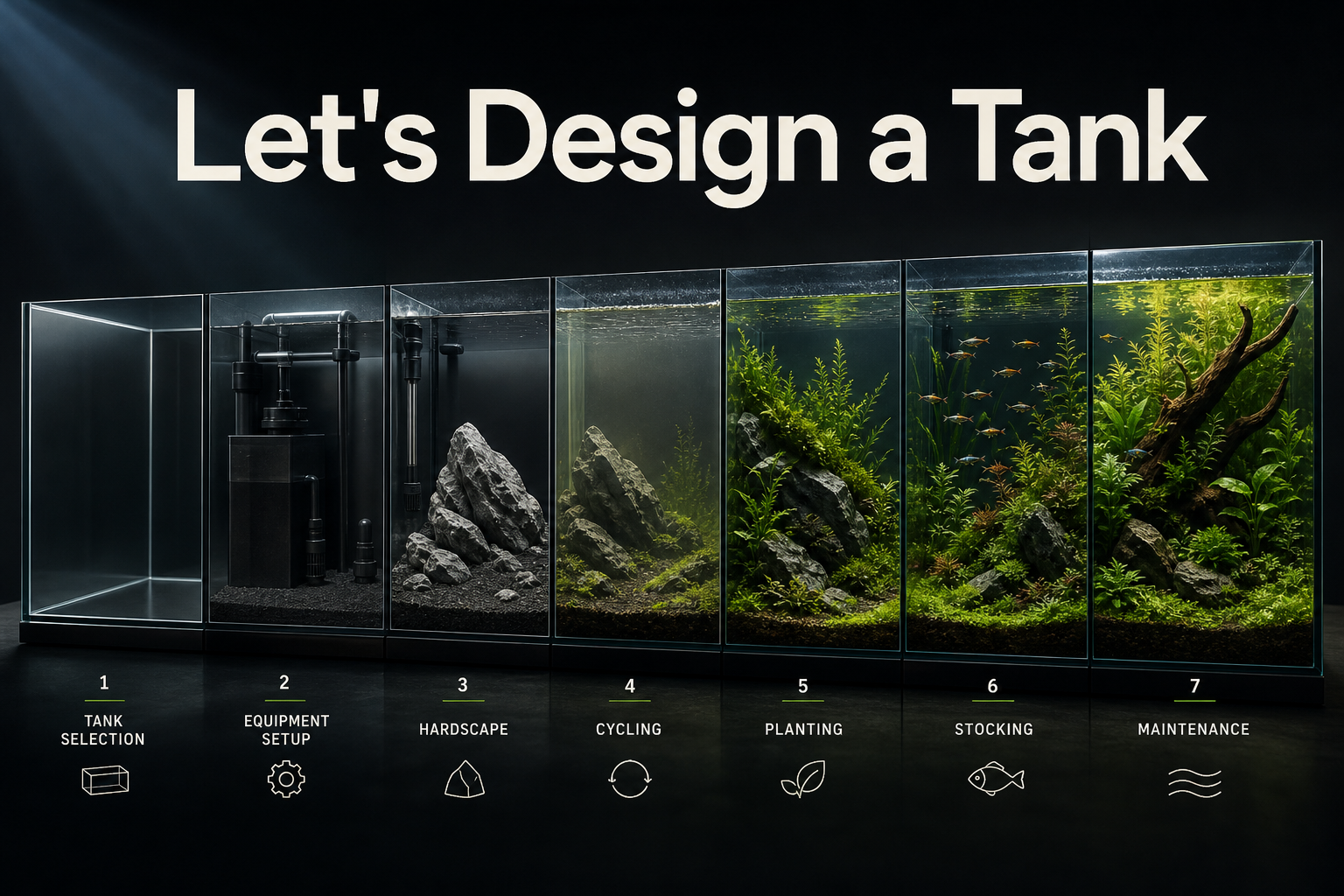
Let's Design a Tank: How to Choose Your First Aquarium Size and Type
Someone buys a 5-gallon tank, fills it with water and plastic plants, adds a few fish, and watches it collapse within weeks. Algae blooms. Fish get sick. Parameters spike. The hobby feels impossible, so they quit, convinced they're just "not good with fish."
I've watched this happen more times than I can count. The problem is rarely the person. It's almost always the tank, or more specifically, the lack of planning before buying it.
why planning matters before you buy
Aquariums feel simple on the surface. You fill a box with water, right? But a tank is a living system, and systems need room to breathe. They need stability, margin for error, and time to settle.
Planning separates a minor setback from a full-blown disaster. Make bad choices upfront, and you'll fight the system every week. Make good ones, and the tank stays stable on its own.
This article is the first in a series on beginner aquarium setup. We'll cover the foundational decisions: size, type (freshwater or saltwater), and whether your space can actually support what you're imagining. Get these right, and everything else gets easier.
The short version, up front: most beginners should start with a 20-gallon long freshwater tank. That's the recommendation that fits most spaces, most budgets, and most first-time keepers. The rest of this guide explains why and walks through the other decisions you'll make before buying anything: freshwater versus saltwater, footprint and weight, access for maintenance, and realistic budget.
freshwater or saltwater: the honest tradeoff
Pick a direction first. These aren't just different systems, they're different hobbies entirely.
freshwater aquariums
Freshwater is forgiving. I've noticed that's the core reason most people stick with it long enough to develop real skill.
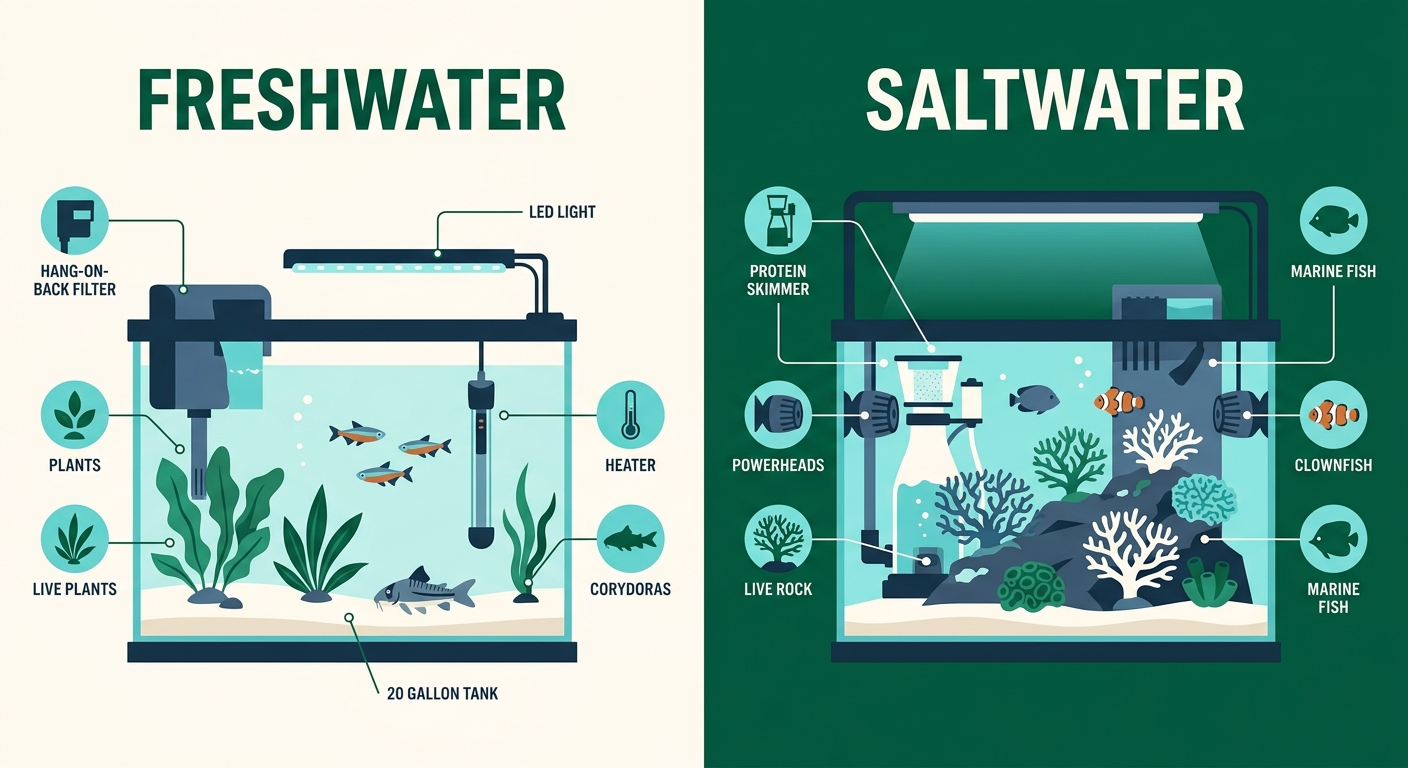
Startup costs run $200–$500 depending on your choices. Ongoing costs are $20–$50 per month. You'll spend 1–2 hours per week on maintenance. That's manageable. The equipment list is straightforward: filter, heater, lighting, dechlorinator, test kit. You can find all of it anywhere.
The fish selection is solid. Tetras, guppies, corydoras, cichlids, livebearers, you have options. Add plants if you want them. Adjust as you learn.
The water itself is forgiving. If your pH drifts a little, if you miss a water change by a day, if you accidentally overfeed, the tank absorbs it. That buffer is what matters when you're learning.
The downside: it might feel less exotic. And you wouldn't be wrong. But simple doesn't mean boring. A well-maintained freshwater tank is genuinely beautiful. Most people just stop looking before they see it.
saltwater (marine) aquariums
Saltwater is demanding. It's also beautiful if you're willing to commit.
Startup costs start at $500 and often run $2000 or higher. Monthly costs are $50–$150. Maintenance takes 2–4 hours per week. You'll need more equipment: protein skimmer, live rock, powerheads, RO/DI water system, salt mix, high-intensity lighting, alkalinity and calcium supplements. The financial commitment is real.
The payoff is biodiversity and visual impact. Clownfish, tangs, corals, invertebrates, you can build something that feels genuinely alive. The systems are complex enough that you'll spend years learning.
The challenge: saltwater tolerance is narrower. Your pH swings matter more. Salinity stays stable or the system collapses. Calcium and alkalinity need actual monitoring, not guesswork. A power outage hits harder. A forgotten water change has faster consequences. The margin for error is smaller, which means you need to understand how your system actually works.
Saltwater isn't harder just because it's more complex. It's harder because mistakes cost more to fix.
freshwater vs saltwater: a quick comparison
| FreshwaterSaltwater (marine) | ||
| Startup cost | $200–$500 | $500–$2,000+ |
| Monthly cost | $20–$50 | $50–$150 |
| Weekly maintenance | 1–2 hours | 2–4 hours |
| Mistake tolerance | High — forgiving | Narrow — costly |
| Equipment | Filter, heater, light, test kit | Skimmer, live rock, powerheads, RO/DI, supplements |
| Livestock variety | Tetras, guppies, corydoras, cichlids | Clownfish, tangs, corals, invertebrates |
| Best for | Learning the hobby | Mastering marine systems |
 how to choose
Ask yourself three questions:
Time: Can you commit 1-2 hours per week right now? Saltwater needs 2-4. If your schedule is already tight, freshwater is the right call.
Money: What can you actually spend without resentment? Add the startup cost to six months of ongoing costs. If that number makes you hesitate, pick freshwater. Resentment kills hobbies.
Learning appetite: Do you want something stable and rewarding, or are you genuinely excited by the idea of mastering chemistry and reef systems? Both are valid. Just be honest about which one actually fits you.
For most people starting out, freshwater wins. Not because it's better, but because it gives you space to make mistakes without catastrophic consequence.
tank size: bigger is more stable, not overkill
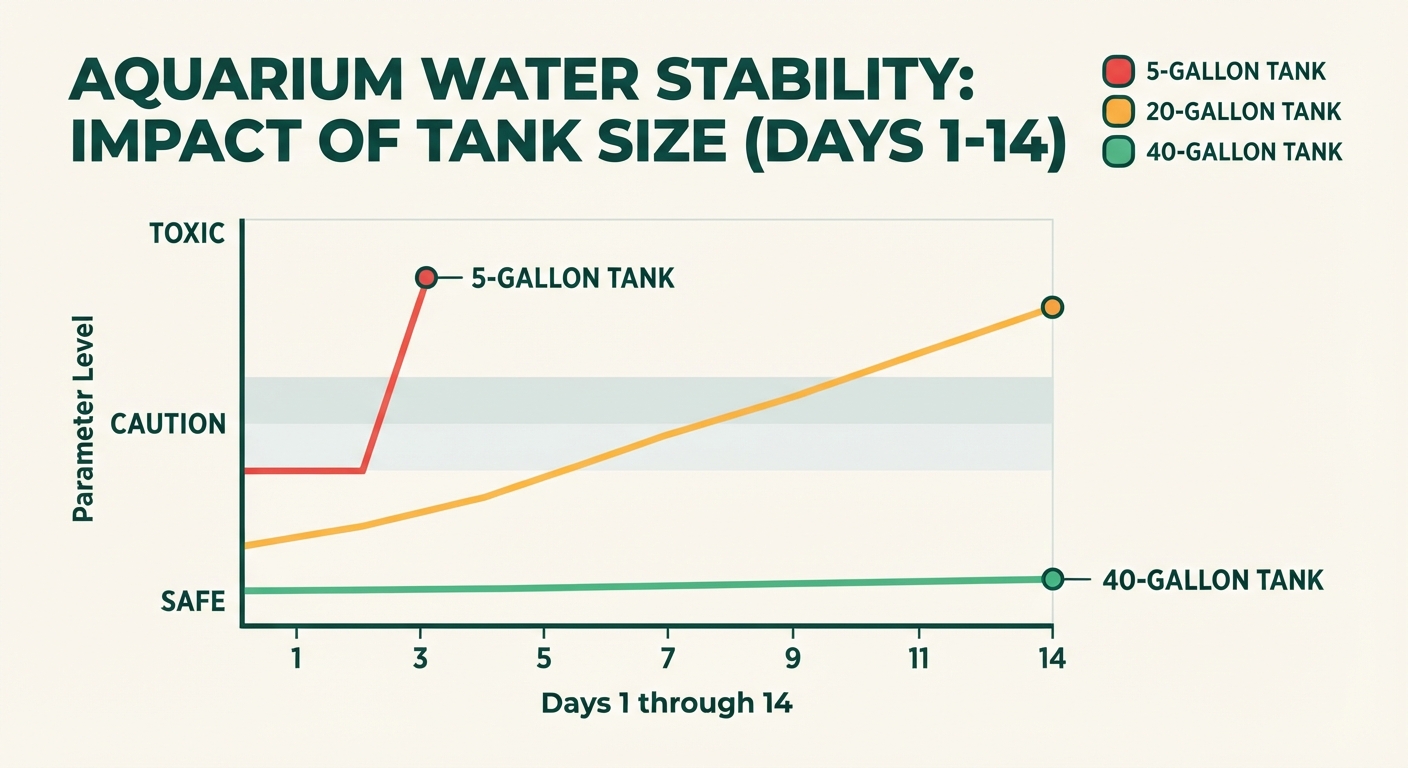
When choosing aquarium size, this is the pattern I keep coming back to: smaller tanks swing wildly. Larger tanks drift slowly.
Water has buffering capacity. When fish waste accumulates in a small tank, parameters spike fast. In a larger tank, the same waste spreads across more volume. Changes happen gradually instead. You catch problems before they become emergencies.
I've kept detailed records of small-tank failures. The pattern is consistent: a 5-gallon tank can swing from safe to toxic in 2-3 days. A 20-gallon might take a week. A 40-gallon takes longer. That time gap is the difference between a quick fix and a full-blown disaster.
 recommended sizes for beginners
Freshwater: Start with a 20-gallon long (30" x 12" x 12", about 75 liters). This is the sweet spot. It's large enough to stabilize on its own, and it fits most spaces. The dimensions give you surface area for gas exchange. You can keep a variety of fish without constantly rehoming them.
If a 20-gallon long doesn't fit your space, a 29-gallon tall or 40-gallon breeder works too. The principle is the same: bigger gives you cushion.
Saltwater: The minimum is 30-40 gallons (115-150 liters). Anything smaller becomes unstable too fast. The advantage of saltwater gets lost in a tiny tank, where you're managing crisis too often to enjoy the payoff. Most people land on 40-gallon breeders or 55-gallon standard tanks as the actual starting point.
Nano tanks (5-10 gallons) do exist, and some people make them work. Those people have experience, patience, and realistic expectations. For a first tank, they're a waste of money. You'll spend more time managing parameters than enjoying the tank.
space, budget, and what actually happens
Bigger tanks cost more. True. But the difference is smaller than you'd think.
A 20-gallon setup (tank, stand, filter, heater, lighting, substrate) runs about $300-400. A 40-gallon setup runs $400-600. You're not doubling the cost to double the volume. But you are roughly doubling your stability and how long the tank actually works.
Ongoing costs scale similarly. Electricity goes up, but not dramatically. Water conditioner, food, and replacements still cost dollars per month. The actual difference is usually $10-20 monthly.
Where budget actually matters is physical space. Measure where the tank will go. Leave 6 inches on the sides so you can reach the back for maintenance. Account for overhead clearance for lights. Measure doorways and stairs if it's moving upstairs. I've seen people buy tanks that won't fit through their bedroom door.
Water source proximity matters too. If your sink is upstairs and your tank is downstairs, water changes become a chore instead of routine maintenance. That affects whether you actually do it consistently.
footprint and weight: the physics everyone forgets
why footprint beats volume
A 20-gallon long (30" x 12" x 12") has more surface area than a 20-gallon tall (24" x 12" x 18"). The math: 360 square inches versus 288 square inches. The long one wins by 25%.
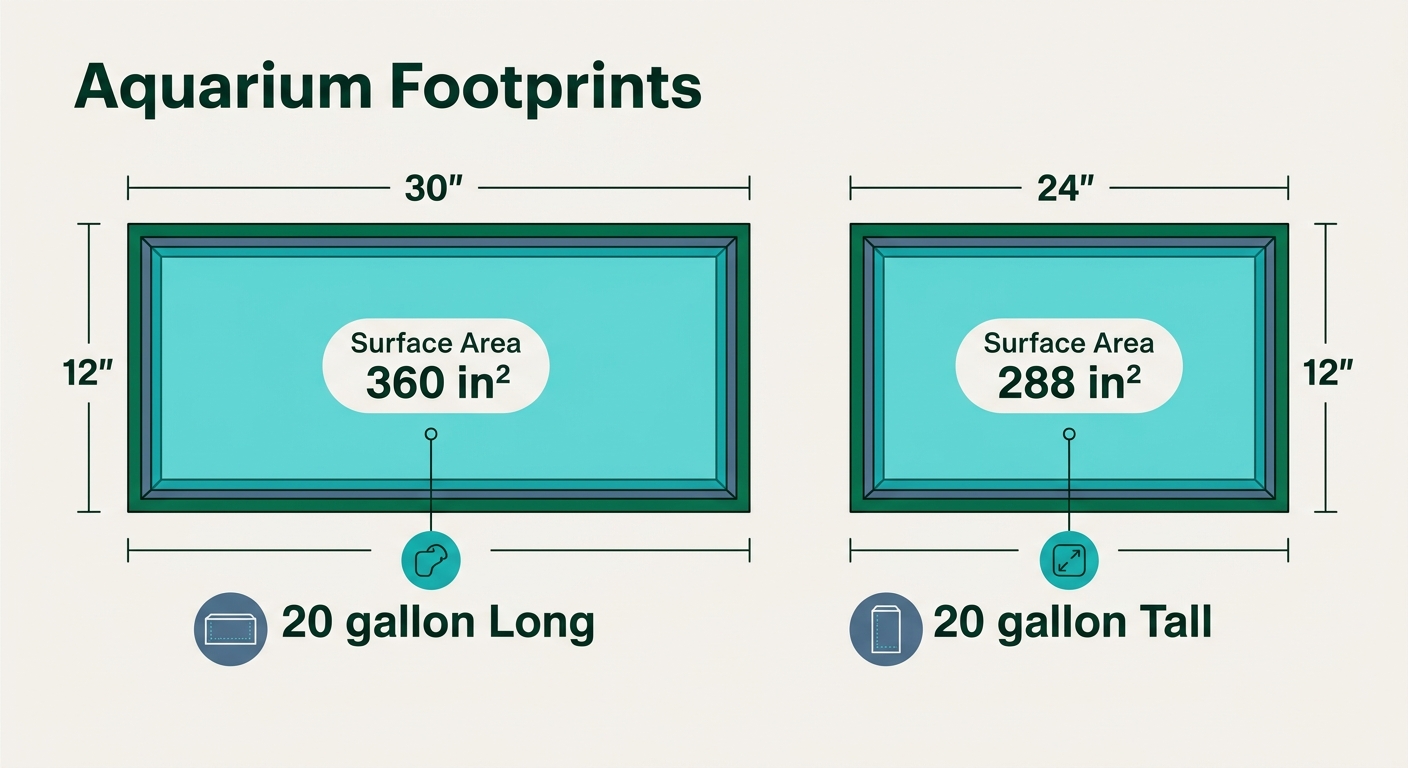 Why does this matter? Surface area is where gas exchange happens. More surface area means more oxygen enters and more CO2 leaves. Fish get better water, healthier gills, longer lifespans.
It sounds small. It compounds.
I've noticed this across tanks I've tracked. Fish in longer, shallower tanks are visibly healthier than fish in tall, narrow tanks with the same volume. The tall tank holds the same number of gallons, but the fish prefer the long one. Swimming space matters. Most fish naturally move horizontally. They work better in a long tank.
weight, floor load, and where your tank can actually live
Water weighs about 8.3 pounds per gallon. Add substrate, rock, and decorations, and you're looking at 10-12 pounds per gallon total.
A 20-gallon tank weighs roughly 200-240 pounds filled. A 40-gallon weighs 400-480 pounds. A 75-gallon weighs 750-900 pounds. These numbers matter.
Residential floors are typically designed to handle 40-50 pounds per square foot. A 40-gallon tank on a 3-foot by 1.5-foot stand is roughly 4.5 square feet. That's about 90 pounds per square foot. On an upper floor in an older house with joists already stressed, this becomes a real concern.
I'm not saying don't put tanks upstairs. I'm saying: if you're putting a large tank on an upper floor, check. Measure the floor. Look at the joists. If you're uncertain, a structural engineer costs less than water damage in your ceiling.
The stand matters. It needs to be level. It needs to support the full weight. I've seen tanks settle unevenly on stands that looked solid, then develop leaks along the bottom. Use a stand rated for your tank's filled weight. Use a level. This is maintenance you do once.
access for the stuff you'll actually do
Placement is more than footprint. You need to actually reach the tank.
Leave space behind it to siphon water during changes. Leave space on the sides to clean glass. Leave overhead clearance for lights and for you to work inside. I've seen tanks crammed into tight corners where the owner can barely touch the back glass. That gets frustrating quickly.
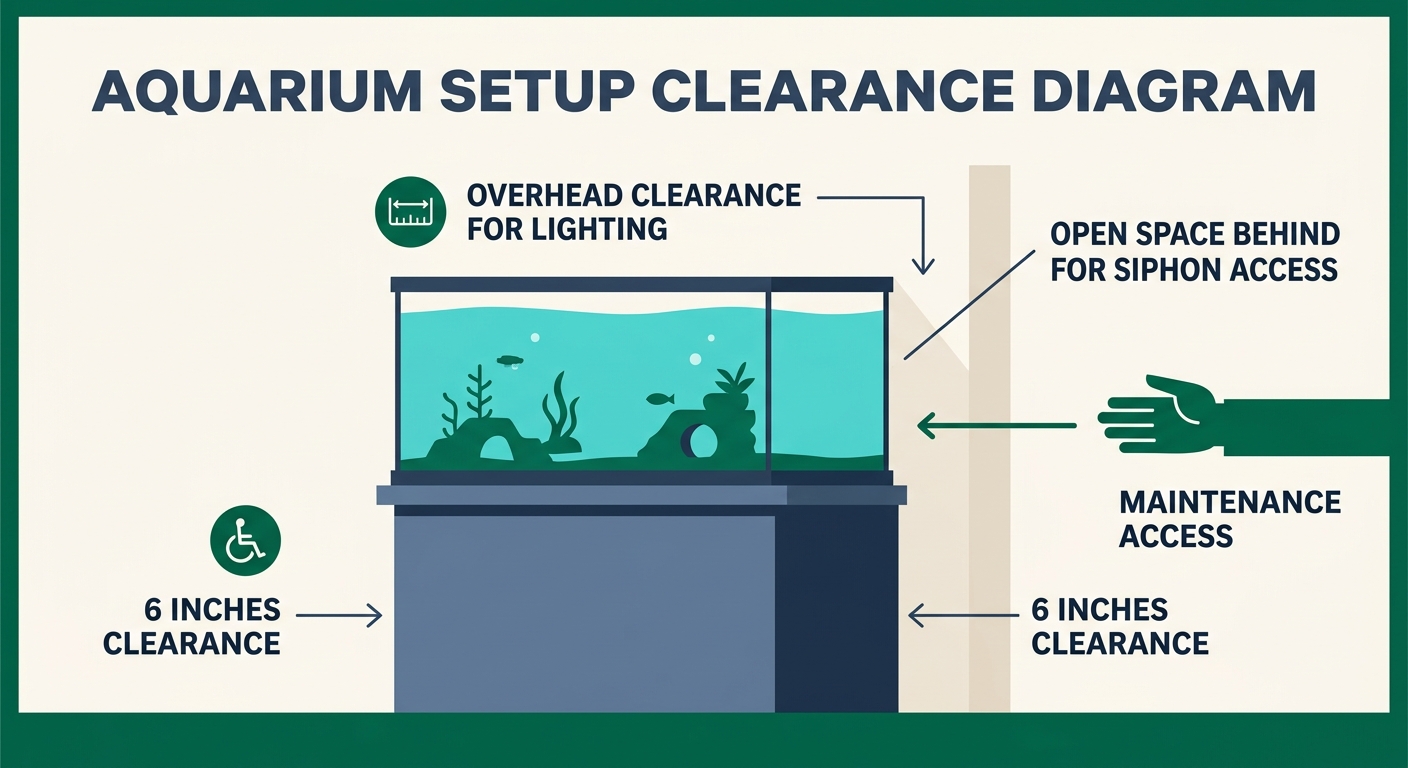 You'll need electrical access with GFCI, too. Water and outlets don't mix safely. Proximity to a water source matters more than expected. If you're hauling water from a sink 20 feet away, water changes become a burden instead of routine maintenance.
common beginner fish tank mistakes
A few mistakes come up over and over in the tanks I've watched fail. Addressing these upfront saves weeks of frustration:
Too small: The "just a betta, he doesn't need much" myth persists. Even hardy fish stabilize better in larger volumes. The pattern I see consistently: small tank, initial success, parameter spike around week 3-4, fish stress, remediation takes weeks. Start with 20 gallons. You won't regret it.
Wrong shape: People pick tall tanks because they "look dramatic" in the room. Then they realize surface area is smaller, fish are stressed, and they're fighting the system daily. The long tank is less dramatic to look at, but it's more stable in actual use.
Ignoring weight: Putting a 500-pound tank on a floor that wasn't checked, then discovering cracks, settling, or water seeping into the apartment below. Check load capacity first. It takes an hour and saves thousands.
No maintenance access: Positioning the tank where you can't reach three sides comfortably, then dreading water changes because they're physically awkward. Space affects whether you actually do maintenance.
Buying the tank before budgeting everything else: A 40-gallon tank is $150. The stand is $80. The filter is $200. Lighting is $100. Heater, substrate, decorations, test kit. Suddenly you're at $700 before adding a single fish. Plan the full budget first. Buy from there.
Adding fish before cycling: The impulse is strong. I get it. The tank looks ready, conditions seem good. Why wait? Because the nitrogen cycle hasn't established yet. Ammonia spikes. Fish suffocate. This pattern kills more aquariums than any other single mistake. Patience here is non-negotiable. We'll cover cycling in detail in the next article.
quick answers to common sizing questions
How big should my first fish tank be? Aim for at least 20 gallons for freshwater, 30-40 gallons for saltwater. Smaller tanks are harder to stabilize, not easier.
Can I start with a 5- or 10-gallon nano tank? Technically yes. Practically, no. Nano tanks swing faster, demand more monitoring, and punish mistakes sharply. Experience matters here, and for a first tank, you want margin, not constraint.
Is a 20-gallon long better than a 20-gallon tall? Yes, for most setups. The long one has more surface area for gas exchange and horizontal swimming space, which is how most fish naturally move.
What's the best tank size for beginners on a tight budget? A 20-gallon long is the sweet spot. It costs slightly more to set up and run than a 10-gallon, but it's materially more stable, and stability saves money on replacements and remediation.
the deciding checklist
Run through this before you commit:
- Freshwater or saltwater? Which one actually fits your budget, time, and interest?
- What's my realistic startup budget, including everything? Tank, stand, filter, lights, substrate, initial livestock.
- What's my monthly budget for ongoing costs?
- Where is the tank going? Measure the space. Measure doorways and stairwells if it's moving upstairs.
- How much overhead clearance is there?
- Can I safely reach behind and beside the tank for maintenance?
- How far is the nearest water source?
- Is the floor appropriate for the filled weight? Check load capacity if uncertain.
- Am I committing to at least 20 gallons for freshwater or 30 gallons for saltwater?
- Can I wait for the nitrogen cycle before adding fish?
- Do I have or can I access a water test kit?
If you answer these honestly, you're ready to move forward.
what comes next
You've decided on size and type. You know where the tank will live. Now you need to build the foundation: filtration and the nitrogen cycle. That's Article 2 in the "Let's Design a Tank" series, where you'll choose filtration and walk through the cycle that makes your tank stable.
The cycle is where most beginner mistakes happen. Understanding it changes everything about how you keep fish. Patience through the cycle, and your tank becomes self-sustaining.
Comments
No comments yet.