Aquarium Lighting: Let's Design a Tank #3
I. More Than Just Seeing Your Fish
Your aquarium light does three things: it lets you see what's inside, it controls how your tank's inhabitants grow, and it determines whether algae takes over. Most people focus on visibility. The other two matter infinitely more.
Bad lighting keeps a tank from working the way you designed it. Good lighting is often the difference between a tank that thrives and one that requires constant cleanup.
This article covers the physics and mechanics of aquarium lighting, then walks through how to choose and set up lighting for your specific tank. Article 1 covered physical setup and design; Article 2 covered filtration. Now we're looking at the system that determines whether the rest of your work pays off.
II. Understanding Light: What the Numbers Actually Mean
Aquarium lighting gets sold in watts. Watts measure electricity. That tells you almost nothing about what your light does to the water.
The measurements that matter are different.
PAR: The light plants and corals actually use
PAR stands for Photosynthetically Active Radiation. It measures the amount of light energy between 400 and 700 nanometers—the wavelengths that photosynthetic organisms can use. It's measured in µmol/m²/s (micromoles per square meter per second).
Plants and corals don't care about watts. They care about PAR.
Go back through old forum threads and you'll see the same pattern: people with expensive high-wattage fixtures getting worse results than people with efficient LEDs half the power. Usually it's because the efficient fixture delivers more PAR at the water surface where it matters.
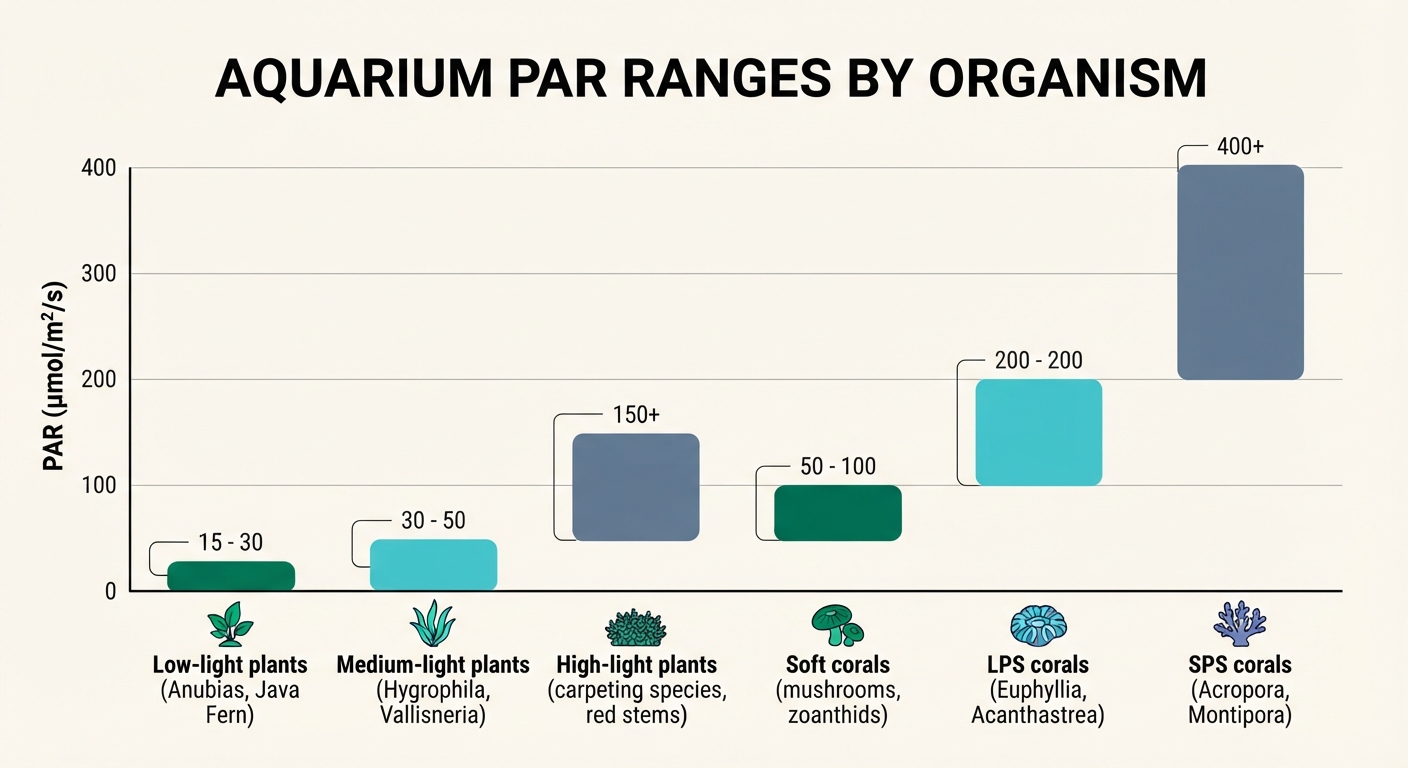
These are real ranges for what you're keeping:
- Low-light plants (Anubias, Java Fern): 15–30 µmol/m²/s
- Medium-light plants (Hygrophila, Vallisneria): 30–50 µmol/m²/s
- High-light plants (carpeting species, red stems): 50–150+ µmol/m²/s
- Soft corals (mushrooms, zoanthids): 50–100 µmol/m²/s
- LPS corals (Euphyllia, Acanthastrea): 100–200 µmol/m²/s
- SPS corals (Acropora, Montipora): 200–400+ µmol/m²/s
 A PAR meter costs $200–400 if you want exact numbers. Most people don't have one, and that's fine. But knowing what those ranges actually mean lets you stop guessing.
PUR: The part of PAR that actually gets used
Not all PAR wavelengths get used equally. Chlorophyll absorbs blue (430 nm) and red (662 nm) most efficiently. Coral zooxanthellae prefer blue and violet (420–490 nm). The pattern's consistent across different organisms, but the specifics matter.
PUR—Photosynthetically Usable Radiation—is the portion of PAR that an organism can actually absorb. Reef lighting tends to run heavy blue because that's what corals use most efficiently. Planted tank lighting needs red and blue, which is why most decent plant fixtures offer both.
This matters when you're buying. A fixture advertising high PAR but weak on the spectrum your tank needs is wasting energy.
Color temperature: Kelvin
Kelvin measures warmth. Lower Kelvin means more orange and red. Higher Kelvin means more blue and white. This is why your aquarium light looks completely different from the bulbs in your living room.
For planted freshwater: 6500–8500 K. This is close to tropical midday sun, which means it supports photosynthesis and looks natural.
In reef tanks, it depends on what you're keeping and how deep the tank is.
- 9000–10,000 K: Good for soft corals and LPS. Warm enough to look good, blue enough to penetrate decent depth.
- 14,000 K: Better penetration in deep tanks (15–30 inches). Still strong PAR, still good growth for most corals.
- 20,000 K: Very blue. Enhances fluorescent pigments so corals glow under actinics, but can slow SPS growth unless you run very high PAR.
Fish-only tanks: 5500–6500 K brings out natural colors without pushing algae. Intensity matters more than the exact spectrum here.
III. Aquarium Lighting Types: LED vs T5 vs Metal Halide
Three main lighting types exist for aquariums. Each has real tradeoffs, and which one's right depends entirely on what you're keeping.
| Feature | LED | T5 Fluorescent | Metal Halide |
| PAR range (typical) | 50–300+ µmol/m²/s | 30–150 µmol/m²/s | 200–500 µmol/m²/s |
| Spectrum control | Excellent (multi-channel dimming) | Good (by bulb selection) | Limited (fixed by bulb) |
| Heat output | Low | Moderate | Very high |
| Lifespan | 50,000+ h | 10,000–20,000 h | 6,000–10,000 h |
| Energy efficiency | 80–150 lm/W | 70–100 lm/W | 60–90 lm/W |
| Upfront cost | Medium–high | Low–medium | Low (fixture) to high (electricity) |
| Best for | Planted tanks, modern reef, any tank where heat or efficiency matter | Planted tanks (even spread), refugiums, supplemental light | Deep reef (>24"), SPS-dominant systems, high-PAR needs |
LED fixtures
LEDs became standard because they're efficient, their spectrum is adjustable, and they don't flood your tank with heat. Most LEDs come with a fan and heatsink to manage what heat they do create.
The downsides exist but they're manageable. LEDs create a point source, so you get bright centers and dim edges unless the fixture uses a lens to spread it. Cheaper LED fixtures sometimes run too blue or too red, which is why you check the spectrum before buying. And yes, the driver can fail before the LEDs themselves do.
For most setups, LEDs are the right choice. For planted tanks especially. A decent LED at 8 inches above the water gives you the control and spread you need.
T5 fluorescent
T5 is older, but it's still useful for specific jobs. Light spreads evenly front to back, so you don't get hot spots or dead zones. Bulbs are cheap and replaceable. A lot of aquarists prefer T5 for planted tanks because that even spread means you can place plants where they belong, not where the light happens to be bright.
T5 runs cooler and mounts closer to the water (2–4 inches). The trade: you're replacing bulbs every 12–18 months, and the spectrum is stuck with whatever bulb you picked.
T5 still makes sense for planted tanks where you want simplicity, for refugiums where you need basic light, or as supplemental actinic in a reef setup.
Metal halide
Metal halide is bright. You get the highest PAR output of any common fixture. That's why deep reef and SPS-heavy systems still lean on it.
But it runs hot. A 250W MH fixture alone can raise your tank temperature 2–5 degrees. You have to hang it at least 12 inches above water, and usually you need a chiller to offset the heat. Bulbs last only 6,000–10,000 hours and cost $40–100 each. Electricity stacks up fast.
Metal halide makes sense if you're running a deep tank over 24 inches or you want SPS corals and can't get the PAR any other way. Most new systems skip it now because LEDs hit comparable PAR without the heat burden.
Choosing the right lighting starts with knowing what type of aquarium you have. Planted, fish-only, and reef tanks have fundamentally different requirements. Each has its own target range.
IV. Lighting for Planted Tanks
Planted tank lighting comes down to two numbers: PAR and spectrum. Get both right, plants thrive. Get one wrong, you're troubleshooting for months.
Low-light plants (Anubias, Java Fern, slow stems) need 15–30 µmol/m²/s. A budget LED fixture at moderate intensity handles this.
Medium-light plants in a mixed setup: aim for 30–50 µmol/m²/s across most of the tank. That's enough for Hygrophila, vallisneria, and most stems without going into high-maintenance territory.
High-light carpeting or red stems: 50–150+ µmol/m²/s. Now CO₂ becomes important. Plants grow fast enough to use it, and without it, algae wins.
Spectrum matters as much as intensity. Look for fixtures with red (660 nm) and blue (450 nm) peaks. Most decent LEDs have both. Cheap ones cut corners on red.
Here's what I've noticed: people often light planted tanks like they're on display. A planted tank doesn't actually need 10–12 hours. 8–10 is the standard. With CO₂, some folks run a siesta schedule: light 4 hours, off 2, light 4 again. It cuts algae risk without slowing growth. Without CO₂, start at 6–8 hours and bump it up slowly as plants get established.
V. Lighting for Fish-Only and FOWLR Tanks
Most people get this backwards: fish don't actually need much light. A healthy, well-fed fish in a stable tank doesn't care whether the light's on 4 hours or 10.
You need light for viewing and for whatever biological balance you've created. More light mostly means more algae.
Fish-only tanks: 6–8 hours is plenty. Lower intensity, lower Kelvin (5500–6500 K), and you get people who enjoy watching without scraping algae every weekend.
Live plants or rock in the system benefit from 8–10 hours and slightly higher PAR (30–50 µmol/m²/s), but stability beats intensity.
VI. Lighting for Reef Tanks
Corals have different light needs depending on what species they are. This is where most people get lost.
Soft corals (mushrooms, zoanthids, leathers) want 50–100 µmol/m²/s. They're forgiving about where you put them and don't demand intensity.
LPS corals (Euphyllia, Acanthastrea, bubble corals) want 100–200 µmol/m²/s. Still manageable. You don't need extreme equipment.
SPS corals (Acropora, Montipora, Seriatopora) are light-hungry. They want 200–400+ µmol/m²/s and heavy blue spectrum because that's what their zooxanthellae actually use. SPS is where metal halide or expensive LEDs become necessary.
Blue spectrum matters for corals. Most reef fixtures run 14,000 K or higher because blue penetrates water well and corals use it efficiently. Starting a reef tank? Aim for 9000–10,000 K minimum. It looks natural and it works.
Here's the thing nobody emphasizes enough: corals bleach when light ramps up too fast. New coral or upgraded fixture? Acclimate it slowly. Shaded spot for a week, then gradually into stronger light. Most people skip this and lose corals.
VII. Photoperiods: Duration Matters as Much as Intensity
Your photoperiod, the on/off schedule, shapes growth, algae, and coral health as much as intensity does.
Timers matter here. Consistent on/off schedules help organisms stabilize, and they make maintenance easier. A mechanical timer costs $15. A programmable controller costs $80–200 and lets you dial in dawn/dusk ramping or adjust duration as seasons change.
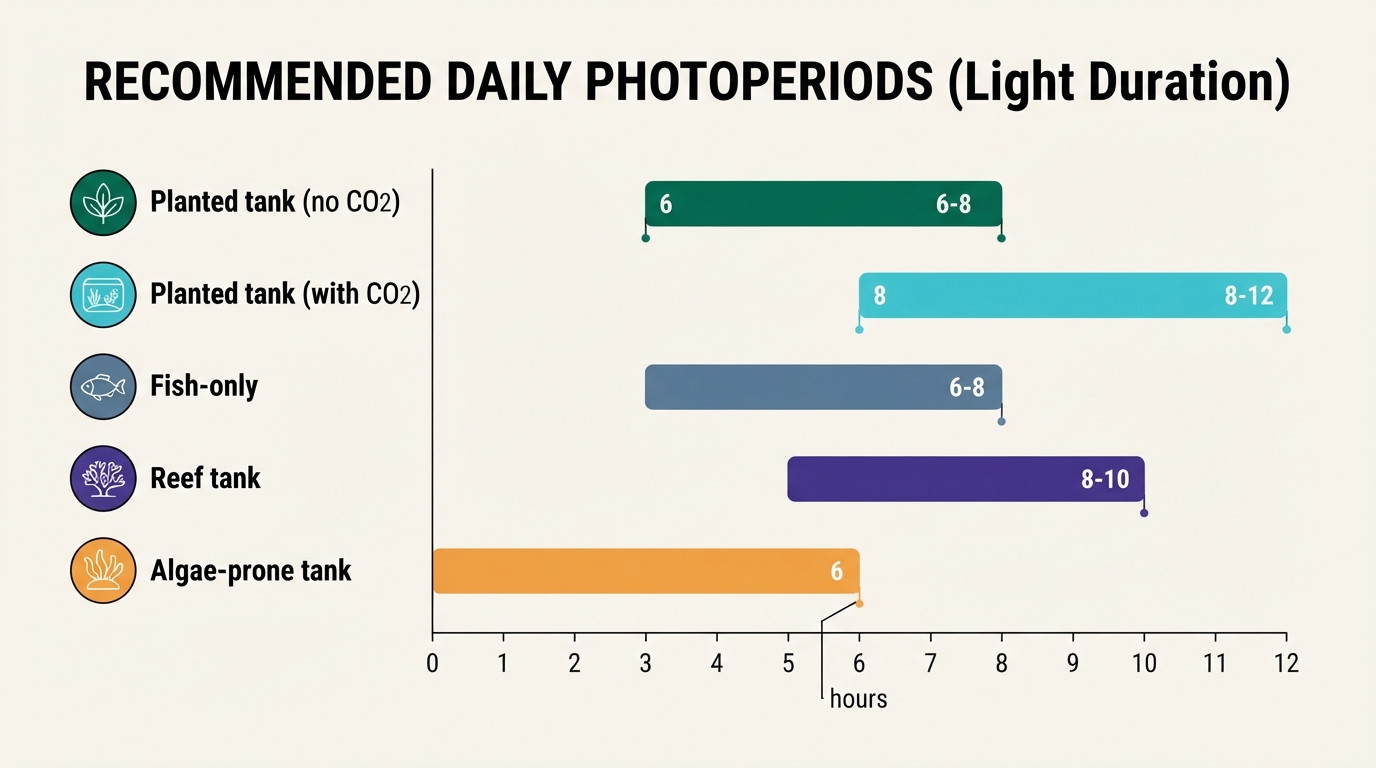
Duration depends on what you're running:
- Planted tanks (no CO₂): Start at 6–8 hours. Increase gradually to 8–10 as plants establish. More than 10 encourages algae.
- Planted tanks (with CO₂): 8–12 hours depending on your comfort with algae management. Some people do a 4h-2h-4h siesta schedule to reduce algae risk.
- Fish-only: 6–8 hours. Viewing is the point; less light keeps algae controllable.
- Reef: 8–10 hours of primary light. Many people add a 1–2 hour dawn/dusk period with blue LEDs only for a natural sunrise/sunset effect and easier coral acclimation.
- Algae-prone tanks: Drop to 6 hours until you get it under control. This is temporary—increase back to normal once the balance shifts.
 When the light turns on doesn't matter to the tank. It matters to you. Morning-to-evening matches your schedule and makes problems easier to spot. Midnight-to-dawn is just annoying because the light fires up when you're sleeping.
VIII. Heat Management and Placement
Placement does two things: it determines how much PAR hits the bottom and how much heat dumps into the water.
Mounting height
LEDs: 4–8 inches above water. This gives good PAR spread without harsh shadows or heat concentration.
T5: 2–4 inches. It runs cooler and spreads light evenly, so you can get closer.
Metal halide: 12+ inches. It creates intense point-source light and intense heat. Distance solves both problems.
These are guidelines. Measure if you can. Without a PAR meter, watch what happens: plants grow evenly, corals show good color, nothing bleached. If the center's bright and edges are dark, raise it.
Heat management
LEDs produce heat at the fixture, not in the water. Good fixtures have a fan and heatsink. Air needs to flow.
T5 runs warm. Good ventilation is enough.
Metal halide is the problem. Heat radiates straight into the water. Clip-on fans blowing across the surface help. Warm climates need a chiller. You can hang it higher to reduce radiance, but you lose PAR.
Any fixture: dust the fans and heatsinks monthly. Dust insulates and kills cooling.
Coverage and shadows
Single LED fixtures create a hot center and dim edges, especially at high intensity. Two smaller fixtures spread PAR more evenly than one large one.
T5 spreads light more evenly because of the tube shape and how fluorescence works. Shadows are less of an issue unless you're undersized.
Know your tank size and the fixture's coverage area. Most manufacturers list it. If they don't, that's a flag.
IX. DIY Aquarium Lighting
Building your own fixture makes sense when commercial options don't fit. Custom tank size. Budget constraints. Spectrum control. Or you just like building.
A budget build for a 24-inch fixture runs $80–200. You need:
- LED modules: Samsung LM301B or LM301H (white), Royal Blue for balance (100–200 LEDs depending on your PAR target)
- Aluminum heatsink or bar: 1–2 W per inch of length capacity
- Constant-current LED driver like Mean Well HLG-150-48: $30–60
- Waterproof diffuser or lens: $10–20
- Mounting brackets and hardware: $15–30
- Wiring, thermal paste, solder-less connectors: $10–20
- Total: $80–200
A commercial LED of equivalent output runs $200–500. DIY saves money if you've got time and basic soldering skills.
Build steps
- Lay out the heatsink bar and mark LED positions. Space them evenly for uniform PAR.
- Apply thermal paste or tape to each LED, press onto the heatsink, hold 30 seconds.
- Wire LEDs in series or series-parallel to match the driver voltage. Solderless connectors keep it modular.
- Mount the driver to the heatsink back. AC in on one side, DC out on the other.
- Attach the waterproof diffuser or lens over the LEDs. This protects the electronics and spreads the light.
- Install mounting brackets. Power on, run 30 minutes before sealing. Check each module temperature.
- Seal connections above water with marine silicone or heat-shrink. Hang it with a suspension kit.
Safety is non-negotiable
Electricity near water is dangerous. What you must do:
- GFCI outlet: Every plug goes in a GFCI. Non-negotiable.
- Drip loops: Cables loop down to the outlet. Water that drips never reaches a connection. Simple. Prevents fire and shock.
- Waterproof connections: Anything near water must be sealed or use waterproof sockets. No bare solder near humidity.
- Proper driver: Use a recognized brand with fusing and grounding (Mean Well or equivalent). Cheap knockoffs fail and sometimes burn.
Not comfortable with this? Buy a commercial fixture. It's worth it.
Common pitfalls
Inadequate heatsinking: LEDs dump heat into the heatsink. Not enough area, they overheat and fail early. Rule of thumb: 1 W per inch. Running 50 W? You need 50 inches of heatsink. That's longer than you think.
Wrong spectrum: Too much red for reef, not enough for plants. Check the spectrum graph. Mixing LED colors requires matched temperatures.
Over-driving without cooling: LEDs have a max current. Run them above it, they're brighter and die faster. Do this, cooling is critical.
Insufficient PAR: You can build something that looks bright but delivers weak PAR. Know your LED density and test if you can.
X. Troubleshooting Common Problems
Algae blooms
Green hair algae, diatoms, cyanobacteria. All of them are limited by light duration and intensity.
What to do: Cut the photoperiod to 6 hours and drop intensity 20–30%. That alone often stops it. Check your nutrient balance (nitrogen and phosphorus). Planted tanks need stable CO₂ around 30 ppm. When CO₂ drops, algae wins.
Most people don't cut hard enough. If it comes back, cut harder.
Light bleaching
White or pale tissue means light stress. Usually intensity ramps too fast.
What to do: Drop intensity 40–50% right now. Move it to dimmer water if you can. Then acclimate slowly. Corals get 2–4 weeks to adjust. Plants usually bounce back once light drops.
Uneven coverage and dead zones
Plants thriving in some spots, struggling in others. Usually a PAR distribution problem.
What to do: Add a second smaller fixture instead of one large one. Use reflectors (T5). Rotate demanding plants so they get bright time. A PAR meter shows exactly where coverage drops if you have the budget.
Fixture running hot
LEDs shouldn't overheat unless something's wrong. T5 should stay warm, not hot. Metal halide gets warm.
What to do: Clean dust from fans and heatsinks first. Dust blocks airflow. Then improve room ventilation with a clip-on fan. If it's still hot after cleaning, upgrade to something more efficient.
When to upgrade vs adjust
Before you spend money: is this a settings problem or a hardware problem?
Adjust if: You see algae (cut duration or intensity), light bleaching (reduce intensity), or uneven coverage (reflectors or a second fixture). These are tuning.
Upgrade if: PAR is consistently below target at max intensity and duration, your organisms consistently underperform compared to others' tanks, or the fixture's failing electrically. That's hardware.
XI. Finding Your Lighting Balance
Lighting is one of the most visible parts of aquarium setup. It's also one of the most over-engineered. What you actually need is the right PAR, spectrum, and photoperiod for what you're keeping.
Planted tank: match PAR to plant type, run 8–10 hours, cut it if algae shows.
Fish-only: 6–8 hours moderate light. You're watching, not growing.
Reef: match coral to light intensity, use blue spectrum, acclimate slowly to changes.
Start conservative. You can always push harder next week. You can't unbreach a bleached coral or un-algae-bloom a tank. Observation beats assumptions. Watch for a few weeks, then adjust.
The next article covers maintenance and monitoring: how to keep the system running and spot when something starts drifting.
FAQ
What is the best lighting for a planted aquarium?
An LED with 30–150 µmol/m²/s PAR depending on plant type. Spectrum peaks at 450 nm (blue) and 660 nm (red). Color temperature 6500–8500 K. Mount 4–8 inches above water, run 8–10 hours daily. Add CO₂ and you can push harder.
How long should I leave my aquarium light on each day?
Planted: 8–10 hours. Fish-only: 6–8 hours. Reef: 8–10 hours. Start at the low end and increase if organisms thrive. Algae? Cut duration before intensity.
LED vs metal halide for reef tanks?
SPS-dominant deep tanks (>24 inches): metal halide still wins on raw PAR (300–500 µmol/m²/s). But it runs hot and costs a fortune to power. Most reefs do better with modern LEDs: cooler, more efficient, adjustable spectrum. Only pick metal halide if you need that PAR and have heat management solved.
Can aquarium lighting cause algae?
Yes. Too much duration (over 10 hours), too much intensity, or poor nutrient balance can trigger it. Light alone doesn't cause algae. It's always light plus excess nutrients. Control photoperiod and check your nutrient levels. Green hair algae responds hard to longer photoperiods and imbalanced fertilizer.
How do I reduce heat from aquarium lights?
LEDs: clean fans and heatsinks, ensure airflow, add a clip-on fan if needed. T5: open ventilation. Metal halide: suspend higher (costs PAR), add a cooling fan, or get a chiller. Metal halide always adds heat. That's just the tradeoff.
Comments
No comments yet.