Fish Tank Stocking Guide: Compatibility, Capacity, and Care
Introduction: The art of stocking your tank
A thriving aquarium isn't about filling the tank with fish. It's about building a stable system where each fish has what it needs to live well: space, compatible neighbors, food it actually eats, and water parameters that won't stress it out.
Getting stocking right means juggling three things at once. Which fish can live together without conflict? How many can your filter actually handle? And can you commit to the maintenance that stocking level demands? Miss one, and the tank suffers.
The good news is that none of this requires advanced math or complicated calculations. It requires observation, a little planning, and willingness to start smaller than you think you can.
Section 1: Compatibility – choosing fish that work together
Understanding temperament and social behavior
Fish have personalities. Some are genuinely peaceful. They ignore other fish and get on with their day. Some are territorial. They claim a space and defend it. Some are predatory. They see smaller creatures as food. And some are social in ways that matter—they get stressed without others of their kind around.
Before stocking, sort fish into rough temperament categories. Peaceful community fish like tetras, rasboras, guppies, and platies do well with other peaceful species. Semi-aggressive fish—certain gouramis, some barbs, smaller cichlids—can work in community tanks but they need enough space and hiding spots to avoid constant conflict. Aggressive or predatory fish like oscars and larger cichlids need their own planning; you can't just drop them in with everything else.
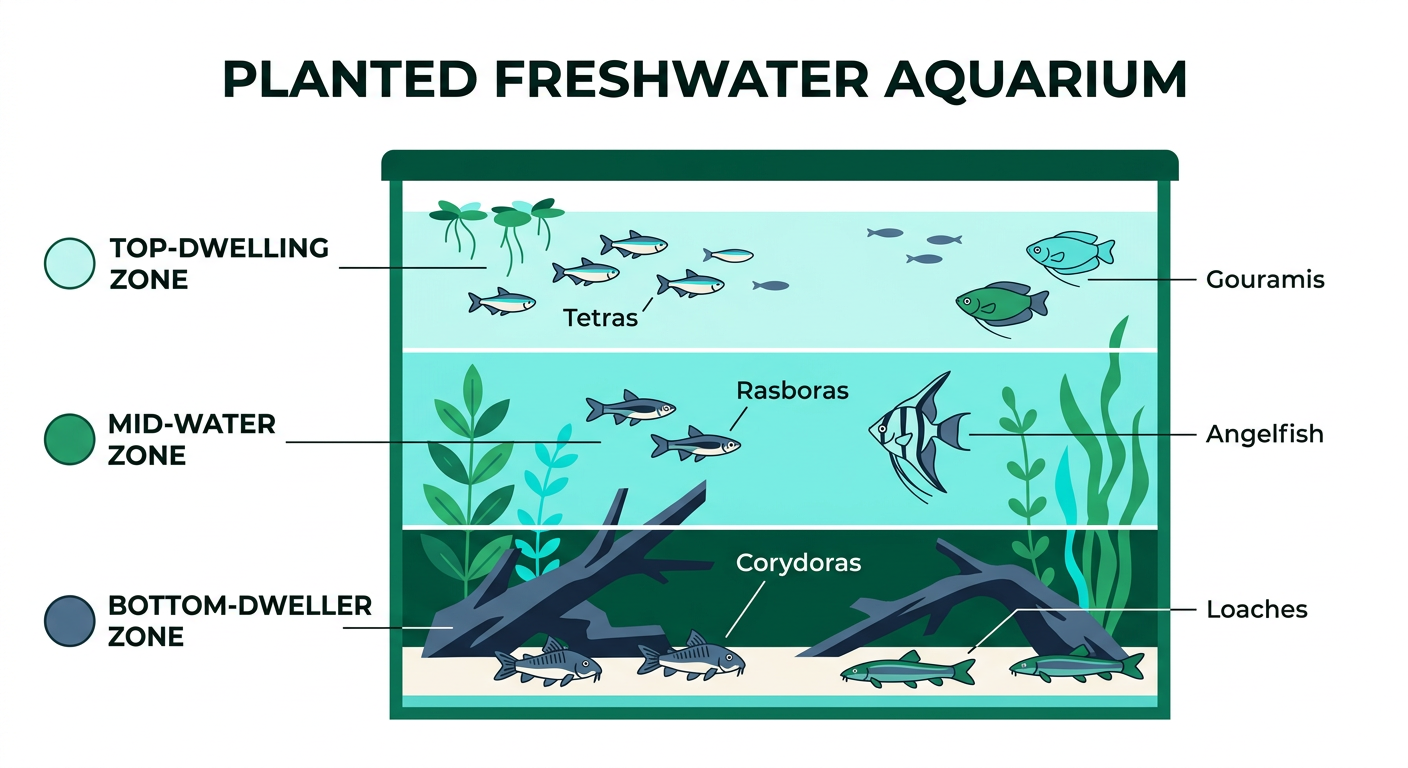
Then there's schooling. Some fish are social and actively need groups. Tetras stay stressed in small numbers; six is the bare minimum, but eight or more is noticeably better. Corydoras catfish act similar—they're bottom-dwellers that school loosely at night. Loaches absolutely need groups; a single loach is a miserable loach. Other fish like angelfish or gouramis form pairs or small groups but can be territorial, so territory matters as much as number.
The pattern I keep seeing: peaceful community tanks work best when you choose species that occupy different zones. Some fish are active in the middle column, some stay at the bottom, some hang near the surface. That natural separation reduces territorial disputes.
 Matching water parameter preferences
Fish have evolved in specific water conditions. A cardinal tetra comes from acidic blackwater streams in South America; it doesn't do well long-term in hard, alkaline water. West African cichlids like harder, more alkaline water. Discus fish need warmer water (30–31°C) than goldfish (18–24°C). If two fish like vastly different conditions, they can't live together well.
Most community fish tolerate a reasonable middle ground: temperature 75–80°F (24–27°C), pH 6.5–7.5. Stay there and you can mix a lot of species. But if you want to keep specialized fish—high pH African cichlids or low-pH South American experts—you're often limited to fish that share those preferences.
Check hardness too. It matters for osmotic balance. A fish from soft-water streams feels stress in very hard tap water over time. If your tap water is hard and your fish prefer soft water, you're fighting uphill.
Size considerations and growth potential
This one catches beginners constantly. That cute little pleco is two inches at the store. It's also going to be twelve inches in two years, and plecos get aggressive as they mature. A "baby" oscar that seems perfect for a 20-gallon tank will outgrow it before you know it.
Always research adult size. Always. Don't assume small means it stays small. Some fish—plecos, silver dollars, goldfish—grow fast and grow large. A common goldfish needs at least 30–40 gallons as an adult, not because of arbitrary rules but because it gets big and produces a lot of waste.
Growth rate matters more in smaller tanks. If you're keeping a 10-gallon tank, even a fish that tops out at three inches will feel crowded faster than you'd think.
Compatibility tools and resources
Before stocking, use a fish compatibility checker to test combinations. AqAdvisor lets you plug in your tank size and intended fish and it tells you whether they're compatible and whether you're overstocking. SeriouslyFish has detailed species profiles—temperature, pH, adult size, temperament, space needs. Both catch problems you might miss.
Local fish store staff can help. Knowledge varies, but they know your local water and what succeeds locally. Online communities like r/Aquariums or Fishlore have people who've kept basically every combination and can tell you what works versus what internet myths claim.
Section 2: Bioload and stocking density – how many is too many?
What is bioload?
Bioload is the biological waste your fish produce. As fish eat, they produce ammonia. Your filter bacteria convert that ammonia to nitrite, then to nitrate. Thinking about bioload and stocking capacity together tells you the ceiling of what your system can handle—when bioload exceeds that capacity, ammonia and nitrite accumulate. Fish stress, the tank crashes.
Bioload varies by species. A hungry goldfish produces way more waste than a small tetra. Active fish tend to produce more waste than inactive ones. Temperature affects it too—warmer water means faster metabolism and more waste production.
The goal isn't zero bioload. That's impossible. The goal is matching your bioload to your filter's capacity to process it.
The inch-per-gallon rule (and why it's not enough)
The traditional guideline is one inch of fish body length per gallon of water. A ten-inch fish needs ten gallons. Two five-inch fish need five gallons each. Simple enough.
Except it's not that simple. The rule ignores fish mass, waste production, activity level, and actual filtration capacity. A plump goldfish at one inch weighs more than a thin tetra at one inch. Body shape matters—a flat fish takes up more swimming space than a streamlined one. A high-metabolism fish produces more waste than a sluggish one.
The rule works as a very rough starting point for standard community tanks with decent filtration. But it's not a law. It's a guideline that oversimplifies.
Body mass and swimming space
A better way to think about aquarium stocking density considers both mass and space. Some resources use one gram of fish per gallon as a rough guideline for bioload. Others use surface area rules—approximately 12 square inches of surface area per inch of fish, because oxygen exchange at the water surface matters for fish respiration.
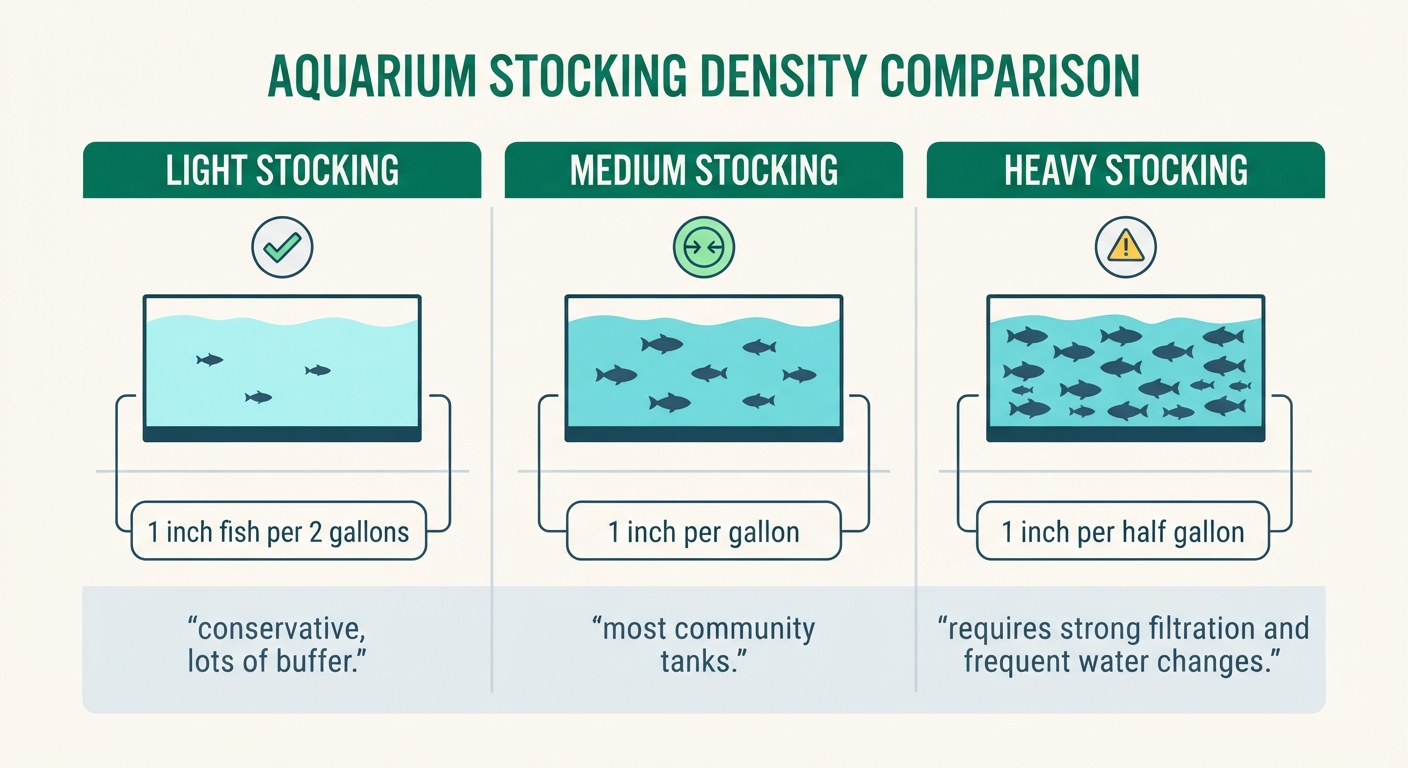
In practice, if your tank has strong filtration and good circulation, you can stock more densely than if it's underfiltered. Light stocking—one inch per two gallons—leaves lots of buffer. Medium stocking, one inch per gallon, is where most community tanks live. Heavy stocking, one inch per half gallon, requires strong filtration, frequent water changes, and watching parameters closely.
 Don't guess your stocking category. Test your parameters weekly for the first month and watch what happens. That data tells you whether you're stocking sustainably or if you need to reduce numbers.
As a concrete example, a 20-gallon community tank typically supports 10–15 inches of small, low-waste fish when filtration is adequate. That breaks down comfortably to ten neon tetras, a group of six corydoras, and a honey gourami as a centerpiece—all compatible, moderate bioload. Push beyond that and you'll need to watch your test results closely.
Filtration capacity and biological media
Your filter's real capacity depends on biological media surface area—the stuff where bacteria live. Ceramic rings, bio-balls, sponge, lava rock. More surface area means more bacteria can colonize, so more ammonia your system can process.
For heavily stocked tanks, aim for at least two to three square feet of biological media per gallon. That's a lot, which is why heavily stocked tanks need large canisters or multiple filters. For lightly stocked tanks, a sponge filter or small canister works fine.
Flow rate matters too. Your filter should turn over the entire tank volume four to six times per hour. A 20-gallon tank running through a filter with 400 gallons-per-hour flow (at max, not in reality) cycles the water frequently enough to process waste before it accumulates.
Signs of an overstocked tank
Watch for these patterns, and they all mean you've added too much:
- Persistent ammonia or nitrite readings above 0.25 ppm. After the cycle completes, these should stay at zero. If they're creeping up, your filter can't keep up.
- Fish gasping at the surface or moving rapidly. That's oxygen stress. Either you're overstocked or you're not circulating water well enough.
- Aggressive behavior and fin nipping. Sometimes it's overcrowding simply stressing fish out.
- Constant algae blooms. Excess nutrients from overfeeding and waste accumulation fuel algae growth.
- Cloudy water that won't clear even with good filtration. Usually means bacterial blooms from high bioload.
If you see these signs, the first step is water testing. Check what's actually happening—ammonia, nitrite, pH. Then decide whether you need to reduce fish, upgrade filtration, or increase maintenance.
Section 3: Acclimation – introducing new fish safely
Why acclimation matters
Fish come from a store tank that's probably different from yours in temperature, pH, hardness, and dissolved gases. Drop a fish straight from the store bag into your tank and you risk osmotic shock and extreme stress, even if the fish survives the initial transfer. The two fish acclimation methods most keepers rely on—the float method and the drip method—both exist to manage that gap gradually.
Acclimation lets the fish adjust. Temperature matters most: a sudden temperature change can kill quickly. But pH and hardness shifts stress fish too, especially sensitive species like discus.
The float method: when it works and when it doesn't
The float method is simple: leave the fish in the bag, float the bag in the tank for 15–20 minutes so the water temperature inside the bag matches the tank temperature, then net the fish out and release it.
That's fine for large temperature differences. But it only equalizes temperature. If your store tank and your tank have very different pH or hardness, the float method won't help. The fish still experiences pH shock when it's released.
For fish that tolerate a range of conditions—typical community fish—float acclimation often works. For sensitive fish or when I know there's a big pH difference, I use drip acclimation.
The drip method: step-by-step
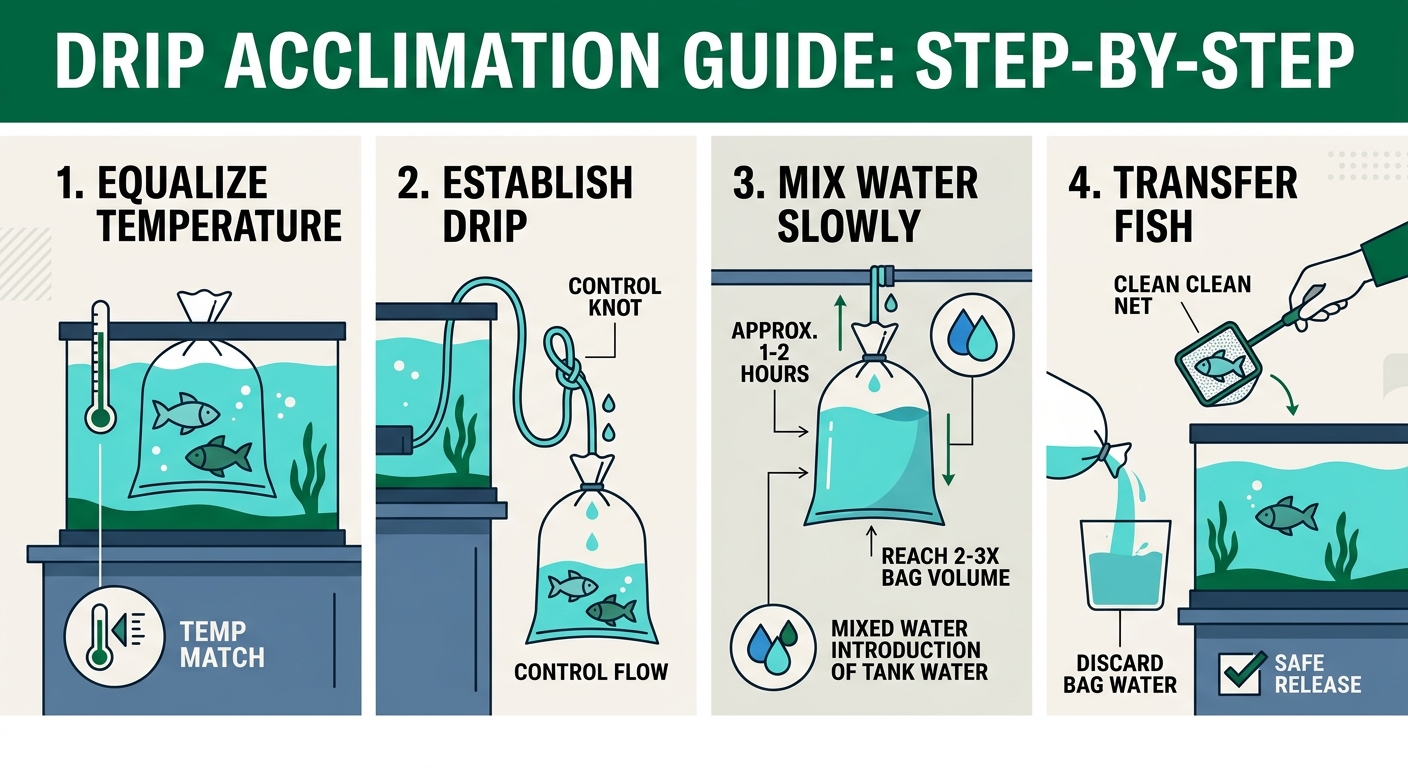
Drip acclimation takes longer but handles both temperature and water chemistry changes:
- Float the bag in your tank for 15 minutes to equalize temperature.
- Set up a drip line using airline tubing and a knot or valve to control flow, or use a siphon break.
- Start a siphon from your tank into the bag at two to four drips per second. Adjust the knot or valve to control the rate.
- Let it drip for 1–2 hours. The bag's volume should roughly double or triple by the end.
- After the time is up, net the fish carefully and release it into the tank. Discard the bag water—don't pour it in.
 For particularly sensitive fish or very different water parameters, I've extended this to 2–3 hours. It's not hurrying anything—the fish is adjusting at its own pace.
Quarantine tank considerations
Quarantine tanks are separate small tanks (10–20 gallons) where new fish sit for 2–4 weeks before joining the main tank. The purpose is to isolate any parasites or diseases the fish might bring in.
A QT needs a heater, basic filtration (a sponge filter works), and hiding spots. You don't need it fancy—it's temporary. Watch the fish closely. If you don't see disease signs after 2–4 weeks, move it to the main tank.
Prophylactic treatments—dosing the QT with medication just in case—are controversial. I only treat if I see actual symptoms: spots, torn fins, lethargy. Healthy-looking fish don't need medication.
First 24–48 hours in the main tank
After acclimation, keep conditions calm. Dim the lights, don't fiddle with the tank constantly. The fish is stressed from transport and adjustment. It needs rest.
Don't feed for the first 24 hours. I know it's tempting, but fasting helps. The fish's digestive system is stressed too. After 24 hours, offer small amounts. Watch whether the fish actually eats.
Monitor for aggression. Sometimes a new fish gets attacked immediately. If that happens, you have choices—remove the aggressive fish, use a divider, or return the new fish to your QT and try again later. Don't ignore it and hope it resolves.
Test your water parameters daily for the first few days. Sometimes introducing new bioload causes an ammonia spike. Catch it early.
Section 4: Feeding – nutrition for long-term health
Understanding dietary categories
Different fish need different foods. Herbivores like plecos and some cichlids need plant-based meals—spirulina flakes, blanched vegetables, algae wafers. They're not carnivores; feeding them only meat-based pellets leads to malnourishment over time.
Carnivores—most tetras, rasboras, and cichlids—need protein. Bloodworms, brine shrimp, quality carnivore pellets. They can't thrive on only plant matter.
Omnivores, which is most community fish, do well with mixed diets. A base of quality flakes or pellets, rotated with frozen food and the occasional vegetable. Variety works.
Know what your fish eats. It changes everything about stocking and feeding strategy.
Food types and their roles
Flakes are convenient. They float temporarily, so you see whether fish are eating them. The downside is they lose nutritional value quickly once opened—nutrients oxidize. Store them airtight and use them within six months.
Pellets come sinking or floating. They're denser than flakes, so less waste ends up uneaten. Quality pellets hold their nutrition longer than flakes. The tradeoff is less visual feedback—sinking pellets disappear into the substrate fast.
Frozen food—bloodworms, mysis shrimp, daphnia—is nutritionally excellent. Thaw it before adding, usually a few minutes in a small cup of tank water. Frozen food spoils faster than dry food once in the tank, so feed what the fish will eat in minutes.
Live food stimulates natural hunting behavior and can be more nutritious, but carries parasite risk. Appropriate when you breed live food yourself or trust the source.
Freeze-dried food is convenient but needs rehydrating. Drop it in a bit of tank water for a minute or two before feeding so it doesn't cause digestion issues.
Feeding frequency and portion control
Adult fish typically eat once or twice daily. Most do fine on once daily—they've evolved for irregular feeding in the wild. If you feed twice, keep portions small so you're not doubling bioload.
Young fish and fry need more frequent feeding—three to four times daily—because they're growing. Herbivores sometimes benefit from more frequent small meals since they're grazers by nature.
The two-minute rule: feed only what the fish will eat in two minutes. After two minutes, remove uneaten food. This keeps nutrient waste from accumulating and prevents ammonia spikes.
One fasting day per week—I use Sunday for mine—helps fish digestive health. They manage fine without food for a day. You might be surprised how much your fish coloration and activity improve with a structured fasting day.
Variety and supplementation
Rotate foods. Mix up flakes, pellets, and frozen across the week. Different foods provide different nutrients. Rotating also prevents fish from getting bored and selective.
Vitamin supplements added to food weekly help, especially if you're not feeding live food regularly. Calcium supplements or a cuttlebone matter if you're keeping invertebrates like snails or shrimp—they need calcium for shell health.
Some keepers soak food in garlic as an immune booster. I haven't seen dramatic effects, but it's harmless enough.
Common feeding mistakes
Overfeeding is the number one beginner mistake. More food doesn't mean healthier fish. Uneaten food decays, spikes ammonia, and fouls the water. Fat fish aren't healthy fish—they're stressed and prone to illness.
Underfeeding is rarer but happens. Fish that consistently hide, show pale coloration, or have pinched bellies are hungry. That's not sustainable long-term.
Feeding stale food—flakes exposed to air for months, frozen food thawed multiple times—degrades nutrition. Replace food supply regularly.
Section 5: Your aquarium maintenance routine
Water changes: how much, how often
A solid weekly water change schedule of 10–25% works for most community tanks. That removes accumulated waste and nutrients without stressing the biological filter too much.
If you're heavily stocked, increase to 25–50% weekly. If you're lightly stocked with hardy fish, even 10% monthly can work, though weekly is more stable long-term.
Match the temperature of new water to tank temperature. Dechlorinate tap water—it'll kill your bacteria otherwise. A dechlorinator removes chlorine and chloramine. Sodium thiosulfate works. Some use bacterial starters or EDTA-based products for added benefit, but basic dechlorination is what matters.
I keep thermometers and a dechlorinator bottle next to every tank. Check the temperature of the new water before it hits the tank.
Substrate vacuuming and detritus removal
Gravel vacuum weekly during water changes. The vacuum removes detritus—fish waste and leftover food that's settled. That waste sits in the substrate and converts to ammonia if it's not removed.
For sand substrates, hold the vacuum intake just above the surface so you don't remove sand. Sand substrates need gentler handling.
Deep cleaning the substrate—stirring and removing all the debris—happens monthly. Weekly vacuuming keeps it from getting too bad.
Filter maintenance done right
Mechanical media—the stuff trapping visible particles—rinses or replaces monthly. Rinse it in old tank water, never tap water. Tap water kills the bacteria living on it. You're trying to clean debris off while preserving colonies.
Chemical media like carbon removes odors and discoloration but gets saturated. Replace it monthly or when it stops working.
Biological media—ceramic rings, bio-balls, sponges where bacteria live—only rinse if it's clogged with debris. Don't replace it all at once. If you replace everything at once, you lose most of your bacteria and cause a cycle crash. Stagger replacements or never replace it if you can avoid it.
Check your filter's flow rate quarterly. If it's noticeably weaker, the impeller might need cleaning or the media might be clogged.
Equipment checks
Heaters fail. Check temperature daily with a reliable thermometer, not just trusting the heater's gauge. If temperature is dropping, the heater's failing. Have a backup heater ready.
Light timers drift. Verify your light is actually on for the duration you set—6–10 hours daily is standard. Inconsistent lighting stresses fish and encourages algae.
Airstones and powerheads clog. Check flow weekly. Clean them if needed.
Testing water parameters
Test weekly—ammonia, nitrite, nitrate, and pH. These are the parameters that change with bioload.
Monthly: general hardness (GH), carbonate hardness (KH), and phosphate. These change slower but matter for long-term stability.
Liquid test kits are more accurate than strip tests. The API Freshwater Master Test Kit is the standard—it's reliable and widely available, though the color cards can be tricky to read in poor light. Get familiar with your kit's results quickly so you're not misreading colors under stress.
Keep a log or spreadsheet. Track trends. If nitrate is creeping up, you might need more frequent water changes. If it's stable, your system is balanced. Data reveals patterns.
Section 6: Troubleshooting common issues
Cloudy water diagnosis
White cloudiness usually means a bacterial bloom—new tank syndrome if your tank is cycling, or your filter is overwhelmed if it's established. Increase filter flow if you can. It clears in a few days usually. Patience helps more than panic.
Green cloudiness is algae bloom. Reduce your photoperiod to 6 hours and control nutrients—do a water change and skip feeding for a day or two. Algae eaters like otocinclus or Amano shrimp help.
Gray or brown cloudiness means detritus in the water column—usually from overfeeding or poor mechanical filtration. Improve vacuuming and reduce feeding. Maybe upgrade filtration.
Algae control strategies
Light is the main factor. Eight to ten hours daily is enough for planted tanks and healthy fish. Reduce to six hours if algae is winning. Most algae problems improve immediately with light reduction.
Nitrate and phosphate fuel algae. Keep nitrate under 40 ppm, preferably under 20. That means more frequent water changes, less overfeeding, possibly fewer fish.
Algae eaters help. Otocinclus and Amano shrimp graze constantly. Nerite snails eat algae but don't reproduce in freshwater, so they don't explode in population. Manual removal—scraping the glass—works too.
Most algae problems aren't crises. They're signals your water is getting too nutrient-rich. Fix the nutrient profile and algae calms down naturally.
Dealing with ammonia and nitrite spikes
If ammonia or nitrite suddenly spikes, the first response is a water change. Pull out 50% immediately. That removes half the toxins and buys time.
Stop feeding for a day or two so you're not adding more bioload while the system resets. The fish can fast without harm.
Test daily until both parameters return to zero. If they spike again, another water change. Some people add beneficial bacteria starters like Seachem Stability, though honestly a big water change often fixes it just as fast.
Once it's back to zero, figure out what caused it. Did you add too many fish? Change your maintenance schedule? Is your filter failing? Solving the cause prevents it happening again.
Fish stress and disease early warning signs
Stressed fish show behavioral changes first. Clamped fins (fins held tight to the body), hiding constantly, losing appetite. Color fades. Movement becomes sluggish or frantic depending on the stressor.
Physical signs come next. Flashing—rubbing against objects—usually means parasites or poor water quality. Spots or raised areas might be fungal infection. Torn fins or lesions can be bacterial or from aggression.
If one fish shows signs, isolate it in a quarantine or observation tank. That prevents disease spreading if there is one, and removes the fish from stress while you figure out what's happening.
Test water parameters immediately. Nine times out of ten, stressed fish mean water quality issues.
Equipment failures
Power outages: fish can survive a few hours without mechanical filtration, but bacteria need oxygen. A battery-powered air pump helps. If you have time, insulate the tank with blankets to hold heat.
Heater malfunction: I keep a backup heater because failures happen and cold stress kills fish fast in tropical setups. Temperature dropping more than a degree or two per hour means the heater is failing.
Filter clogs: keep spare filter media on hand so you can swap it out immediately rather than running without filtration while you hunt for a replacement.
Section 7: Building a sustainable care routine
Creating your maintenance calendar
- Daily: Feed once or twice, observe fish briefly, check temperature. Five minutes if nothing's wrong.
- Weekly: Water change, parameter test, clean glass, substrate vacuum. I do this Sunday evening.
- Monthly: Deep substrate clean, filter media rinse, full equipment check.
- Seasonal: Light bulb replacement if needed, check whether equipment's wearing out.
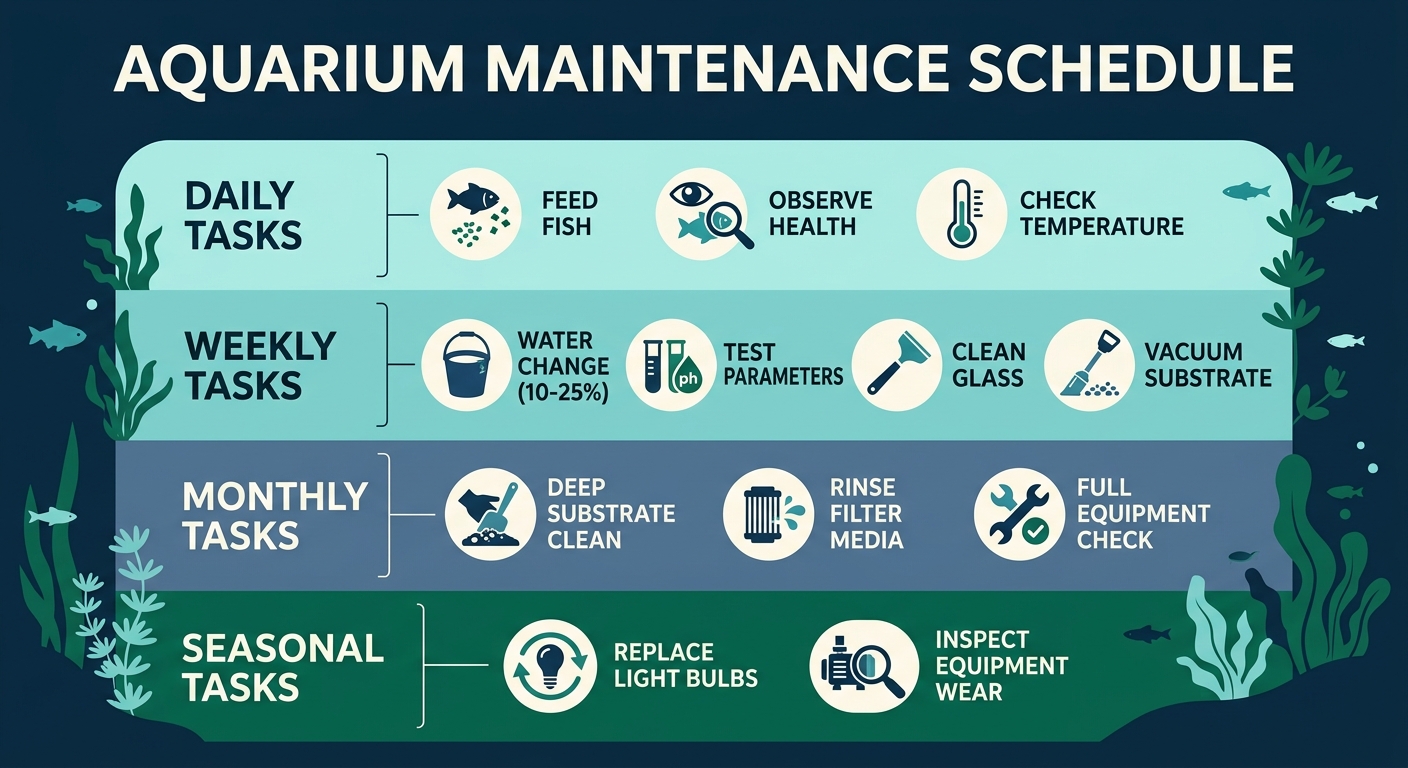 Write it down or set phone reminders. A routine written down actually happens.
Supply management
Keep a 2–3 month supply of food, dechlorinator, and water test reagents. Running out mid-week when the store's closed is frustrating. Store food in a cool, dark place—heat and light degrade it faster. Throw out old food; oxidized food loses nutritional value.
Keep backup equipment: a spare heater, spare air pump, spare filter media. Equipment fails when you need it least.
Recordkeeping and observation
I keep a spreadsheet logging water parameters weekly. It shows trends. If nitrate is creeping from 20 to 30 to 40 ppm, I see it coming and adjust maintenance before it's a problem.
I note when fish are added or die, changes in behavior, any issues. Over months and years, patterns emerge. You learn what works for your setup specifically.
Take photos monthly. Fish growth shows in photos over time. Plant status matters too if you're planted. Visual records catch slow changes you might otherwise miss.
When to call in professional help
Your local fish store can help with compatibility questions and basic disease diagnosis. They know local water parameters and what species do well in your area.
Online communities like r/Aquariums have people who've dealt with basically everything. Post a photo and description of what's happening and you get real answers usually within hours.
Serious fish-only veterinarians exist in larger cities, though they're uncommon. Worth knowing about if you have valuable fish.
The long game: adapting as your tank matures
As your tank cycles completes and matures, something shifts. The system stabilizes. Biological diversity in the substrate and filter increases—snails, micro-organisms, plants. The tank becomes more resilient.
After 6–12 months, you might notice parameters stabilize even with slightly less frequent water changes. That's the tank maturing. Don't interpret that as permission to skip maintenance—stability is fragile and one mistake will crash it. But you might genuinely need fewer water changes because the ecosystem is doing work.
If you keep plants, replant and rescape. Trim plants, propagate fast growers, refresh the hardscape. A scape that works for two years gets stale. A refresh keeps it interesting and addresses any design problems you've noticed.
Equipment ages. Heaters fail. Filters slow down. Lights dim. Replace things before they fail completely so you're not scrambling.
Stocking decisions change as the tank matures. What worked with six fish might feel crowded with eight after a year running, once you know the tank's personality. There's no rush to fill every gap.
Section 8: Frequently asked questions
How many fish can go in a 20-gallon tank?
A 20-gallon community tank typically supports 10–15 inches of small, low-waste fish when filtration is adequate. That's roughly the one-inch-per-gallon guideline. In practice, I'd stock ten neon tetras, a group of six corydoras, and a honey gourami as centerpiece, and call it full. Heavier-waste species, weaker filtration, or live plants all shift the ceiling.
How often should I do water changes?
Most community tanks do well with 10–25% water changes weekly. Heavily stocked tanks benefit from 25–50% weekly. Lightly stocked setups with hardy fish can sometimes stretch to 10% monthly, though weekly remains more stable long-term. Let your test results guide you—if nitrate stays under 20 ppm weekly, your schedule is working.
What's the one-inch-per-gallon rule?
The rule states one inch of fish body length per gallon of water. It's a rough starting point for standard community tanks but ignores fish mass, waste production, activity level, and filtration capacity. Think of it as a ceiling, not a target—most fish do better with space to spare. For fish with heavy bioload (goldfish, cichlids), drop to one inch per two gallons as a safer guideline.
How do I know if my tank is overstocked?
Persistent ammonia or nitrite readings above 0.25 ppm mean your filter can't keep up. Fish gasping at the surface, unusual aggression or fin nipping, constant algae blooms, and cloudy water that won't clear—any combination of those signals your bioload has exceeded your filter's processing capacity. Test before you guess; numbers settle the argument.
What's the difference between drip acclimation and float acclimation?
Float acclimation equalizes temperature over 15–20 minutes by floating the sealed bag in the tank. Drip acclimation equalizes both temperature and water chemistry over 1–2 hours using airline tubing to slowly mix tank water into the transport bag. Use drip acclimation for sensitive species (discus, wild-caught fish) or when source and destination water differ significantly in pH or hardness. Float acclimation is usually enough for standard community fish.
Conclusion: Patience and observation
Successful stocking and care develops over time through learning and adapting. The tank teaches you what it needs if you're watching.
You'll make mistakes. Everyone does. New fish dies unexpectedly. Water parameters do something weird. A piece of equipment fails. That's not failure—that's data. Keep notes and adjust. The best aquarists aren't the ones who never have problems; they're the ones who observe problems carefully and change course.
Start smaller than you think you should. A conservatively stocked tank is harder to crash and more forgiving while you're learning. Add fish gradually. Watch what happens. If everything's stable after two weeks, add more. If anything is off—algae blooming, parameters creeping up, stressed fish—stop adding and figure it out.
Your tank is a living system, and living systems need attention and respect. Give it that, and you get stability and thriving fish. Rush it, and you'll be troubleshooting constantly.
Keep notes. Watch what your fish are doing. That's the work, and it's also the fun part.
Comments
No comments yet.