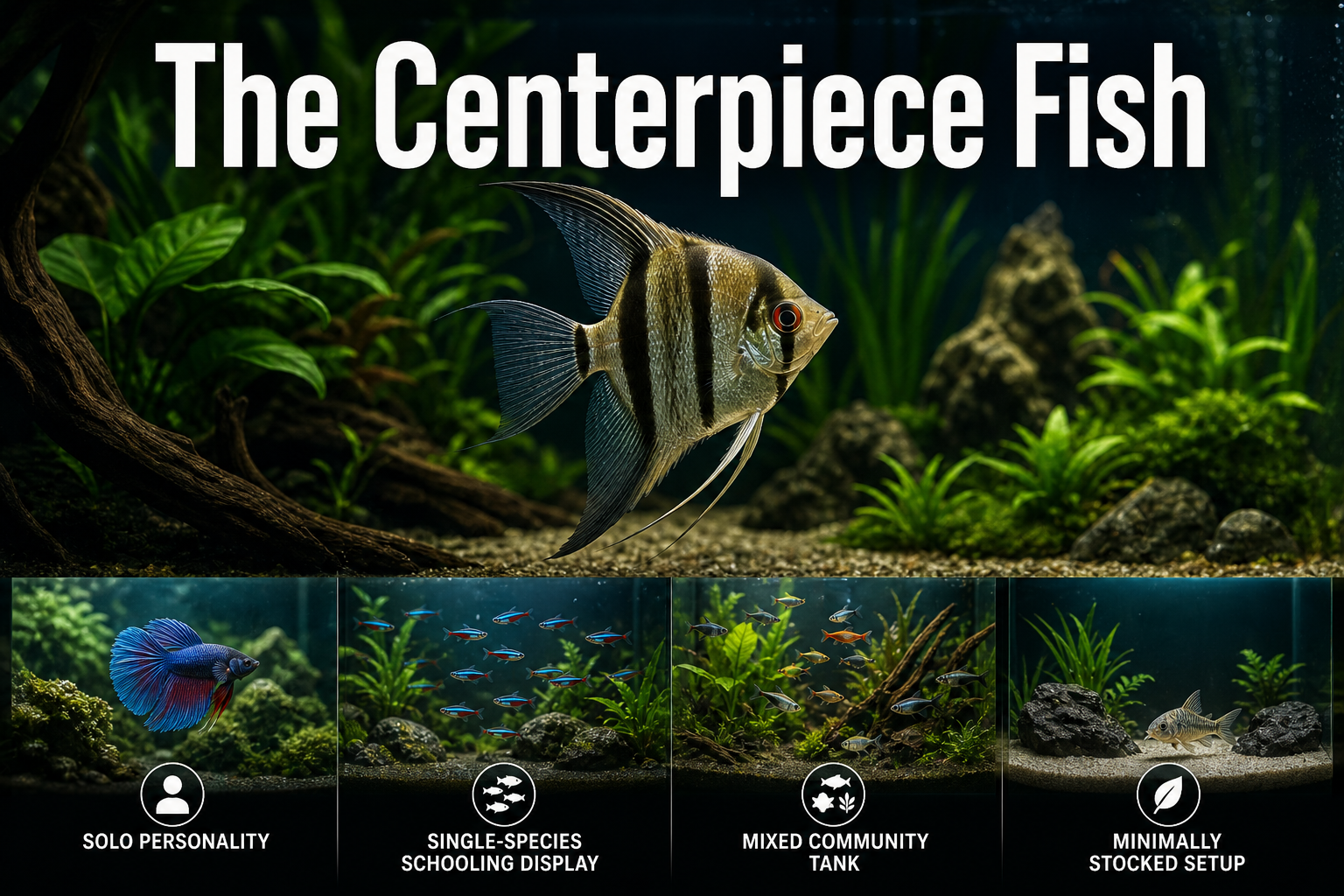
What Is a Centerpiece Fish?
A centerpiece fish is the aquarium's visual anchor — the single fish (or small group of one species) that defines what you'll spend the most time watching and, honestly, what will define your maintenance routine.
This matters because choosing a centerpiece means choosing your aquarium ecology. A betta and a community tank full of tetras create entirely different systems. Different water temperatures, different feeding schedules, different bioloads, different tank sizes. The centerpiece fish isn't decoration. It's the decision everything else follows from.
I'm saying this because I've kept tanks that failed because I picked a centerpiece without thinking through what that actually meant. A five-gallon betta seemed like an easy starter tank until I realized I was watching a bored fish in an undersized box. Same species, different tank, different result.
If you're searching for the best centerpiece fish for your aquarium, the honest answer is that there isn't one right species. There are four fundamentally different approaches, and which one works depends on your tank size, how much time you can commit each week, and what actually interests you when you sit down to look at the tank.
I keep detailed records on my own tanks. I've noticed patterns. The tank that impresses visitors isn't always the one I find most rewarding to maintain. What matters isn't how many fish you have — it's whether they match what you actually want from the hobby.
Archetype 1: The Solo Personality Fish
A solo personality fish dominates your tank. It's one fish, but it's the fish. You know its behavior. You identify its moods. You plan around its needs.
The candidates:
Bettas are the obvious choice. Small, requires modest tank size, has distinct personality, doesn't need any tank mates. Five gallons is technically legal; ten gallons lets you actually observe behavior. The big thing people get wrong: bettas don't get lonely. They're territorial, solitary fish by nature. They're perfectly content alone.
Angelfish work as solos too — one single angelfish in a 29-gallon tank gives you an impressive centerpiece. They're larger, more visible than a betta, and their sheer size commands attention.
Dwarf cichlids (apistogramma species) are special. They get curious. They'll approach your tank glass and watch you like you're in the aquarium. Territorial about bottom space but peaceful with mid- and top swimmers. A single male apistogramma in a 20-gallon with heavy planting is a rewarding setup.
Other options include honey gouramis, certain pleco species (bristlenose, not the monster common pleco), and Bolivian rams if you want something peaceful.
Why choose this path:
One fish means one feeding schedule. One waste producer. One health concern to monitor. You build real familiarity with that fish's behavior in ways you won't with a schooling community.
The bioload is predictable and manageable. Water changes can stretch longer between intervals. Feeding is straightforward — you know exactly how much food disappears each day.
Maintenance is low to moderate. The tank gets set up once and then stays relatively stable.
The tradeoff:
A solo aquarium fish can look lonely in a large tank. A betta in a 40-gallon looks lost. Personality fish are sometimes more demanding than a beginner expects. Cichlids want challenging water chemistry. Bettas need precise temperature control (78–80°F, no room for drift).
You get movement in one location at a time. That's less dynamic than watching a school move across the tank together.
This archetype works if:
You have a small to medium tank (5–29 gallons). You want to build a relationship with one fish. You prefer lower maintenance. You'd rather watch one impressive cichlid than ten forgettable tetras.
Archetype 2: The Schooling Display
This is the approach for schooling fish — one species, large numbers, and visual impact through coordinated movement.
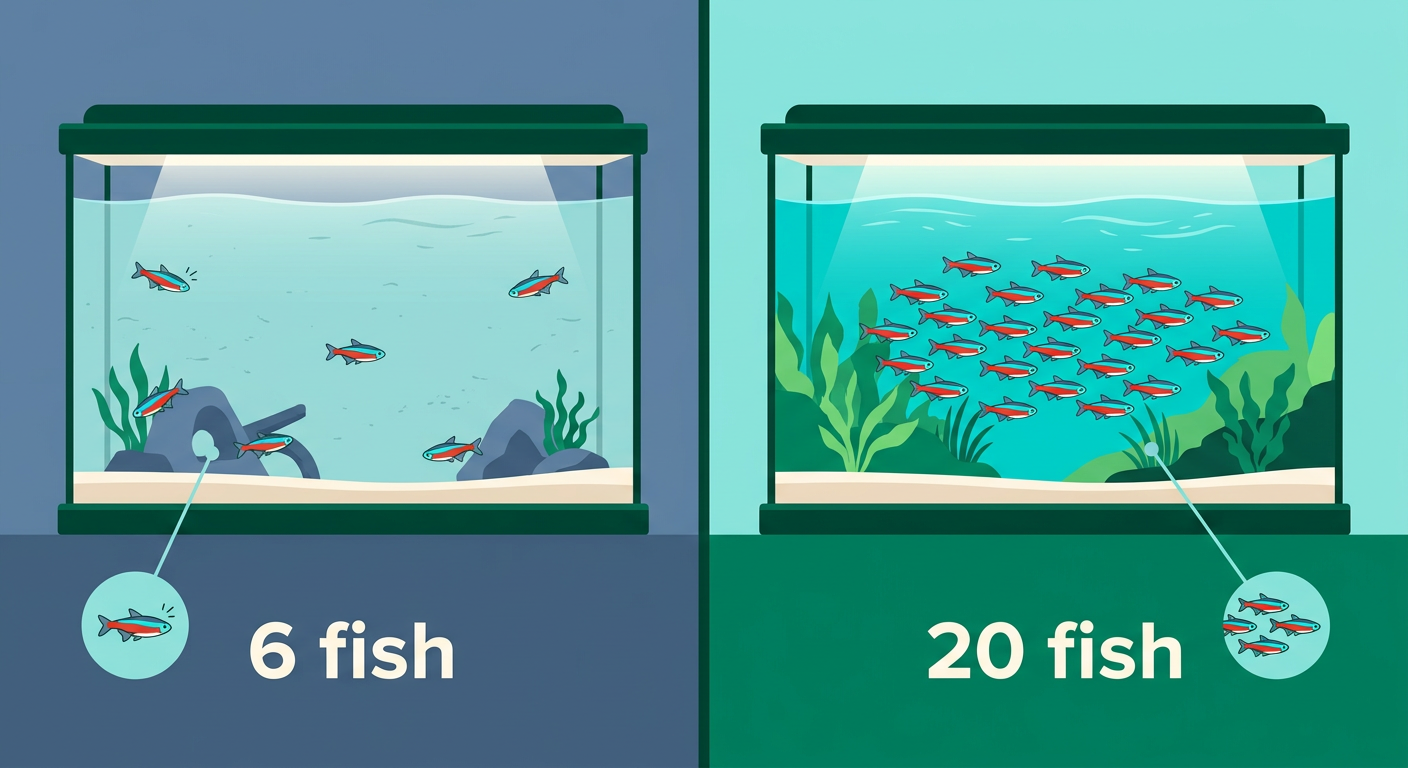
Successful schooling displays need sufficient numbers to actually function. I see a lot of tanks with six neon tetras swimming frantically in a 40-gallon, and those fish are stressed. Six is the minimum for welfare; it's not a target for good behavior.
Here's the pattern I've seen in my records: 6–8 fish in open water show anxiety. 10–12 fish show noticeably more confidence and actual schooling coordination. 15–20+ fish display the behavior the species naturally exhibits. A school of 20 neon tetras moving together through a planted 40-gallon is mesmerizing. The same tank with 6 neon tetras looks empty and the fish hide.
 Reliable schooling species:
Neon and cardinal tetras are classics. Small, colorful, widely available. They want cooler water (74–78°F), which matters if your room is warm. Cardinal tetras are slightly larger and hardier than neons — a reasonable upgrade if you're starting out.
Harlequin rasboras are also classics — orange body with a black triangle patch. Peaceful, hardy, and look better in larger groups. Lambchop rasboras are smaller cousins with the same temperament.
Rummy-nose tetras are excellent. They maintain tight formation and their red nose colors up more vividly when water quality is good — they're a visual indicator of your tank's actual condition.
For larger tanks, congo tetras are impressive. Males develop flowing fins and brilliant colors. It's a whole different scale of presence than small tetras.
Celestial pearl danios are tinier, timid in small groups, but gain confidence at 15+. They're aquascaping favorites in planted tanks.
Why choose this approach:
You're watching natural behavior in real time — schools move together, scatter when startled, form hierarchies. It's a living system with visible activity levels. The tank never feels empty.
Schooling species are generally peaceful. You're not managing aggression. You're not worried one fish will eat the others.
The bioload per fish is low even though total bioload rises with numbers. Small fish just don't produce waste at the rate a large cichlid does.
The tradeoff:
You need to understand that "a school of six" isn't a viable visual option in most tank sizes. If you're committed to getting good behavior from the fish, you're committing to larger numbers. That means more cost upfront and more total bioload to manage.
Small fish are small — they're not a dramatic visual presence the way a six-inch angelfish is. Schooling displays work best in established planted tanks with good aquascaping context. They look like background activity, not a focal point.
This archetype works if:
You have a tank that's 20 gallons or larger (realistic schooling needs at least that volume). You enjoy watching coordinated movement and natural behavior. You're willing to do the math on school sizes — 10–12 minimum for decent display. You understand that a stunning visual result requires patience and stocking discipline.
Archetype 3: The Mixed Community Tank
This is the classic approach to the community fish tank: one centerpiece fish plus compatible tank mates living in layered harmony.
Community tank compatibility requires doing actual work. You can't just throw compatible species names together.
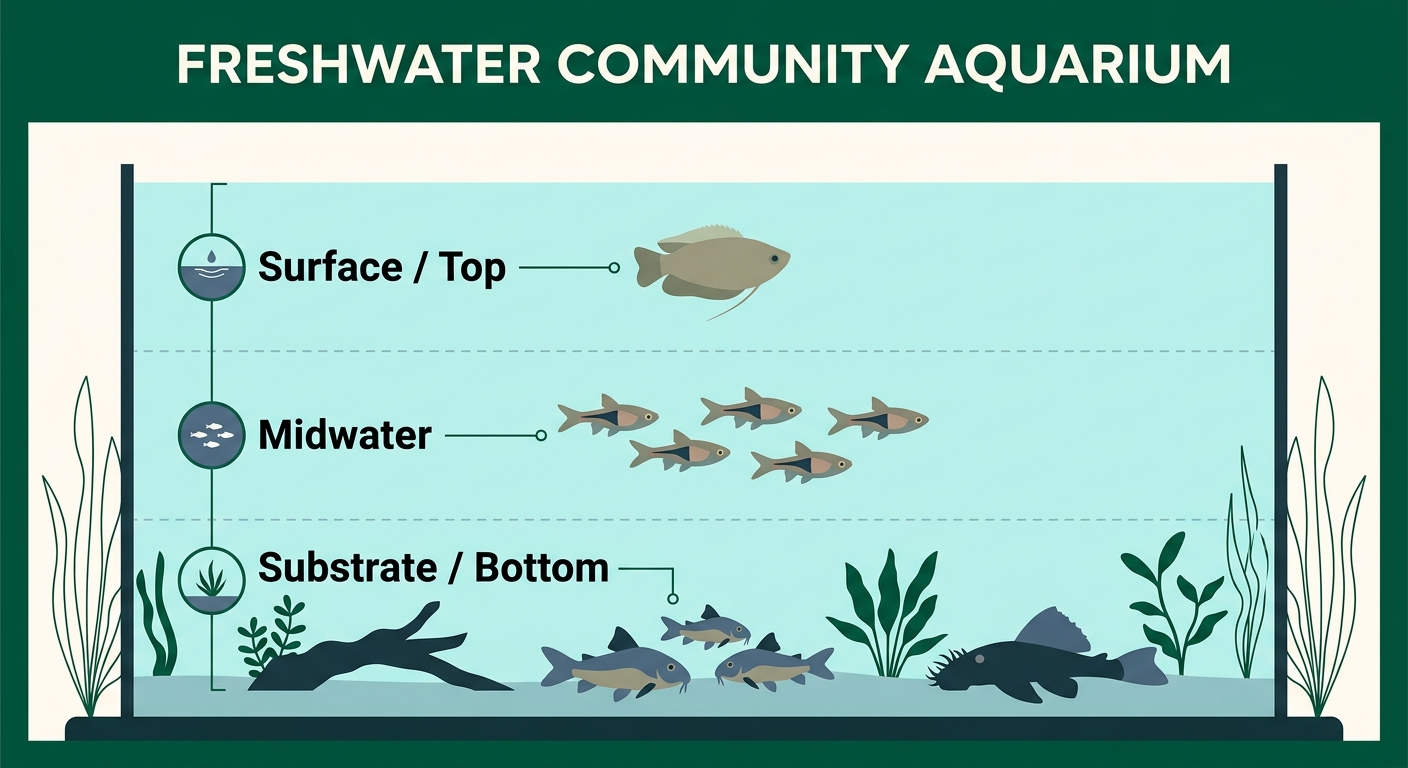
The best fish for a freshwater community tank are species whose temperament, water needs, and swimming levels actually overlap — a centerpiece species at one level, a tight schooling group at another, and bottom dwellers to complete the system.
The real constraints:
Temperament matching is primary. An angelfish will eat neon tetras if they're the same size as its mouth — and wild angelfish are larger than common store fish. Adult cardinal tetras work; neon tetras are risky. You need to think about size and mouth size, not just "community fish."
Water parameters have to overlap. A betta likes warm water (78–80°F). Most tropical tetras like 74–78°F. A discus cichlid wants 82–86°F. If all three are in the same tank, the middle temperature satisfies none fully. Pick species whose ranges actually intersect.
Swimming levels matter more than beginners realize. A surface-dwelling species directly competes with your centerpiece for territorial space. Layer instead: surface swimmers (if any), midwater (your school), bottom dwellers (corydoras, plecos). This spreads aggression potential and uses the whole tank.
 Bioload math actually matters. Sum the waste production of every species. If you're stocking to the edge of your filtration capacity, you have zero margin for error. One seasonal ammonia spike, one filter issue, one oversight with feeding — and you're in a crisis.
Classic combinations that work:
Tetras and rasboras in a community tank form a reliable midwater backbone — small, peaceful, predictable. The combinations below are built around that schooling layer.
A 20-gallon long with a honey gourami, 8–10 harlequin rasboras, and 6 pygmy corydoras. The gourami is visible but not bullying. The school provides movement. The cories clean bottom waste. Different water levels. Manageable bioload.
A 29-gallon with a single angelfish or Bolivian ram as centerpiece, 10–12 black skirt or cardinal tetras, and 6 corydoras. A biotope-feel tank that looks like a real ecosystem.
A 40-gallon breeder with an apistogramma pair (1 male, 2 females), 15+ rummy-nose tetras, 8 corydoras, and a bristlenose pleco. The apistos occupy bottom territory, the rummy-nose school provides visual cohesion, the cories handle waste, the pleco grazes algae. Multiple points of interest.
Why choose this approach:
You get diversity. The tank is never boring. There's always something interesting to watch — the centerpiece's hunting, the school's coordinated movement, the bottom dwellers' substrate work.
It's a balanced ecosystem. Different species handle different roles. Bioload is spread across multiple smaller contributors rather than concentrated in one large fish.
If you're willing to do research and observe carefully, there's a satisfying complexity.
The tradeoff:
This is the highest-maintenance path. Multiple species means multiple feeding types, multiple care needs, ongoing observation for compatibility issues, and a real quarantine protocol (you can't just add fish). One disease outbreak spreads to everything. One stocking mistake creates an aggression problem you can't quickly solve.
Bioload is harder to predict and manage. If you're experimenting, you're experimenting with real animals.
Planning takes time. Most communities fail because people didn't do the work beforehand.
This archetype works if:
You have a tank 20 gallons or larger — realistically 29+ to have comfortable margins. You actually enjoy research. You're intermediate or you're willing to become intermediate. You want a diverse ecosystem and don't mind managing it carefully.
Archetype 4: The Understocked Display
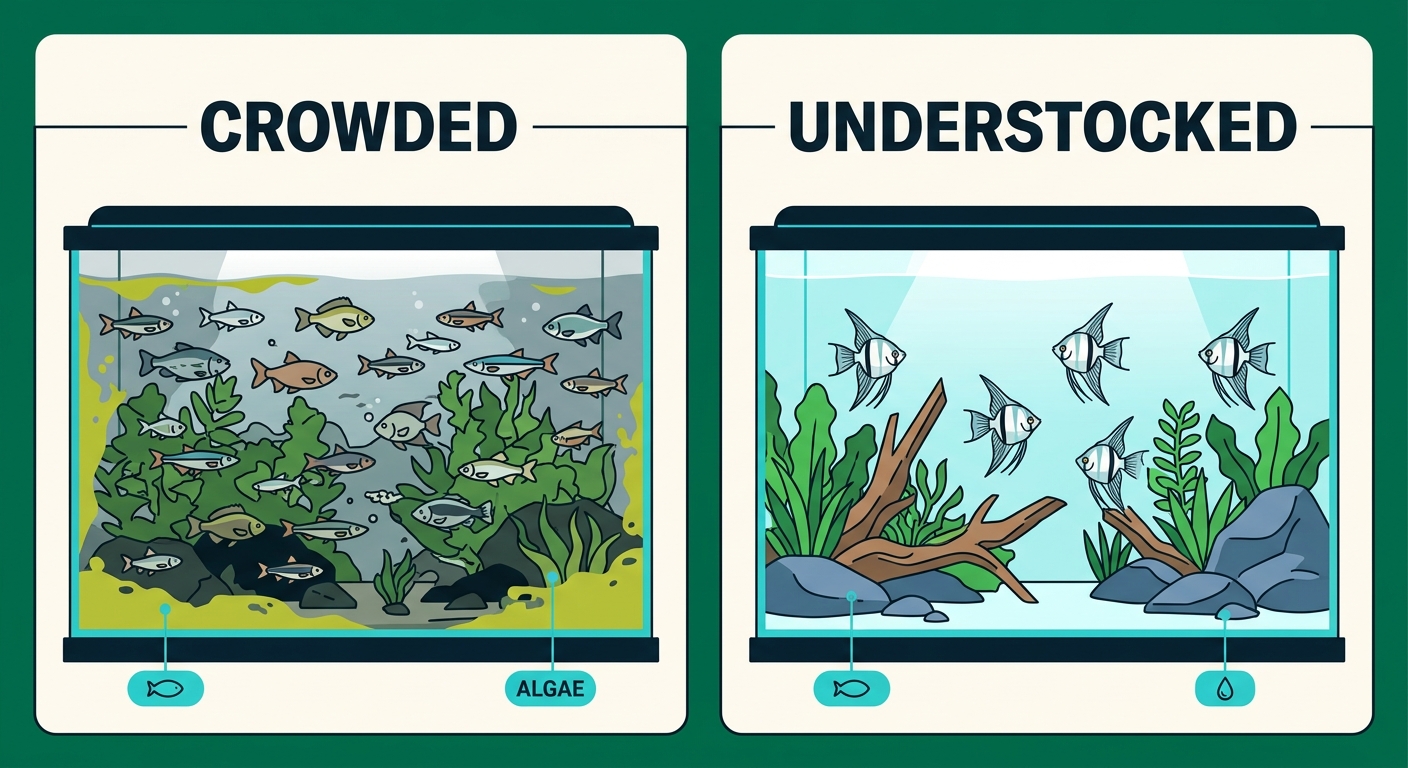
This one catches people off guard because it feels counterintuitive — this is the understocked aquarium approach: deliberately stock far below capacity, and use empty space as a design tool.
I've kept tanks this way. There's something about space that changes how fish behave. A betta in a 20-gallon long with shrimp and heavy planting, nothing else. The betta owns the tank visually. The shrimp provide micro-activity. The space means the betta never feels pressured or without territory.
Or a 55-gallon planted tank with five angelfish and nothing else. Each fish has room for full fin display. Territories are established without constant fighting. The tank looks majestic rather than crowded.
Compare that to a densely stocked 55-gallon community. More activity, sure. But fish are constantly negotiating space. Colors don't shine as bright. Behavior is more defensive.
 Why space changes things:
Fish establish territories in space. Under competition with no territory to claim, they fight. With room available, they patrol territory without invading neighbors. Lower stress hormones means more natural behavior.
Food competition vanishes. Each fish eats. No one starves. No frantic surface-feeding aggression.
The tank doesn't look empty if you aquascape well. Planted tanks, hardscape, careful rock placement — the plants and landscape become the visual anchor. In a well-designed planted tank, large centerpiece fish earn their room — the few fish become accents rather than the whole display.
Example setups:
A 75-gallon planted show tank with 6–8 adult angelfish, no other fish. Aquascaped beautifully. The angelfish are the living element in a designed space.
A 40-gallon breeder with one large pearl gourami, 6 corydoras, and dense planting. The gourami commands attention. The cories add bottom activity without competing. The planting does visual work.
A 20-gallon with a single betta, colony of shrimp, and moss-covered hardscape. Minimalist. Clean lines. The betta is the only fish.
Why choose this approach:
Maintenance is easier. Low bioload means forgiving water chemistry. Every other week water changes work. Feeding is straightforward — understock means overfeeding is harder to accidentally do. No parameter crisis around the corner.
Fish show more natural behavior because space doesn't force constant competition. That betta in 20 gallons moves differently than a betta in 5 gallons.
Each fish is visually prominent. You see individuals, not a crowd.
The tradeoff:
A sparse tank can look empty if you don't aquascape well. Beginners sometimes create understocked setups by accident and end up with a boring tank that's just empty.
It requires aesthetic confidence. You're deliberately not filling available space. That can feel wasteful or incomplete until the plants grow in and the design clicks.
It's not for hobbyists who want constant action or variety. One large fish moves less than fifty small fish.
This archetype works if:
You have a tank 40 gallons or larger — ideally 55+. You value calm, observation, and individual fish presence over activity and variety. You're committed to aquascaping. You're patient enough to let plants establish. You want the easiest possible maintenance path.
How to Choose Your Archetype: A Decision Framework
Here's what I've learned about choosing aquarium fish from keeping detailed records across multiple setups:
Start with tank size. A 5-gallon is solo personality only (betta, shrimp, puffer). A 10-gallon opens schooling and very cramped community. A 20-gallon opens all four archetypes. A 40+ gallon increasingly favors schooling displays, complex communities, or understocked setups.
Then consider maintenance commitment. How much time can you actually allocate weekly? Under 30 minutes — understocked planted tank or solo personality. 30–60 minutes — schooling display or basic solo with observation. 60+ minutes — mixed community with research and ongoing monitoring.
Next, ask what you actually want to watch. Do you want one fish you know intimately? Pick solo personality. Do you want coordinated group behavior? Pick schooling. Do you want complexity and diversity? Pick mixed community. Do you want calm and space? Pick understocked.
Check your experience level honestly. If this is your first tank, solo betta or single-species schooling in a 20-gallon is a real success. Mixed communities work if you're willing to read, observe, and make adjustments. Understocked displays work if you have landscaping vision.
Quick decision questions:
- What size tank do you have or can you accommodate?
- How much weekly time do you have for maintenance?
- Do you want one impressive fish or many smaller fish?
- Are you comfortable researching species compatibility, or do you want something predictable and simple?
- Does your room temperature sit near 72°F (understocked, some colder-water fish possible) or 78°F (tropical species)?
- Do you want to watch behavior change or just have a visually pleasant environment?
Frequently Asked Questions
Can I keep a betta with other fish?
Yes, with specific conditions. Tank needs to be 10–20 gallons minimum. Heavily planted with line-of-sight breaks so the betta feels less threatened. Plakat (short-finned) bettas are better communities than long-finned varieties. Tank mates must be peaceful — no fin-nippers, no surface-dwellers competing for territory. Small tetras (ember, neon), rasboras, and corydoras are usually safe. But bettas are individuals. Some tolerate tank mates. Some don't. Have a backup plan — a separate tank in case your specific betta proves too aggressive.
How many schooling fish do I need?
Six is the bare minimum for welfare. Below that, the fish are stressed. 10–12 is the practical number for decent schooling coordination and visual impact. 15–20+ produces the behavior the species actually displays naturally. The number depends on tank size too — six neon tetras in a 55-gallon will scatter and hide. Twenty in the same tank will school visibly. Don't confuse "minimum for survival" with "minimum for good behavior."
What fish can live alone?
Bettas, single angelfish, dwarf cichlids (apistogramma, rams), honey gouramis, many pleco species, and some larger cichlids. These are solitary by nature — not forced solitude. They don't need conspecifics for welfare. This is different from schooling fish living alone (possible survival, chronic stress).
Is it better to have one fish or many?
Neither is objectively better. One fish gives you deeper individual connection and lower maintenance. Many fish give diverse behavior and more visual activity, but higher complexity and maintenance. The right choice is the one that matches your goals, time commitment, and what you actually enjoy watching.
How do I know if my tank is overstocked?
Watch three things: nitrate climbs faster than your water change schedule can control it. Fish show stress behaviors — hiding, aggression, gasping at surface. You're seeing algae blooms or stunted fish growth. The most reliable measure: test nitrate regularly. If it consistently exceeds 40 ppm despite your maintenance routine, the tank is overstocked for your current setup. This might mean fewer fish, more water changes, more plants, or better filtration — it depends on your setup.
Conclusion: Match Your Fish to Your Life, Not Just Your Tank
You can put fish in almost any tank size. That's not the real question. The real question is what kind of aquarium actually fits your life.
A solo personality fish works if you have patience and attention. A schooling display works if you enjoy watching coordinated behavior. A mixed community works if you're willing to research and observe. An understocked display works if you value calm and space over activity.
I've found that the aquariums I actually enjoy maintaining are the ones where I stopped trying to prove something and started listening to what my specific tank actually needed. The betta I kept in five gallons seemed fine but looked cramped, so I moved it to 10 gallons and watched its personality expand. The community tank I overstocked because I wanted variety became stressful management, so I reduced fish and suddenly had time to actually enjoy it.
Pick before you shop. Think through the archetype that matches your situation. Then stick with it long enough to see the patterns. That's where the actual reward is — not in having the most impressive tank, but in understanding why it works.
Comments
No comments yet.