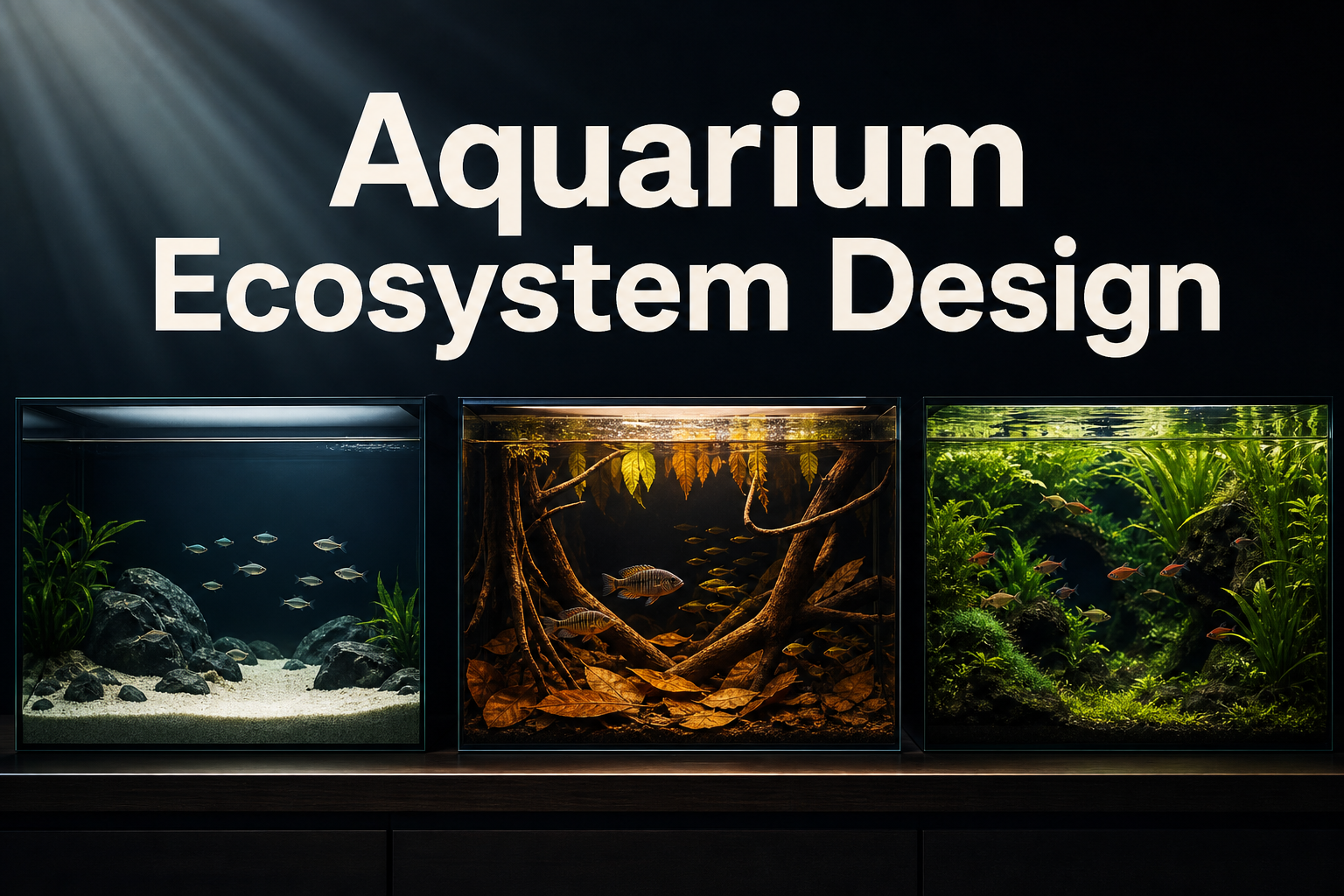
I. Design Is Habitat, Not Decoration
The aquarium you build is a lived-in space. Every rock you place, every plant you leave out, every inch of open water shapes what happens inside that tank every single day. Most people think about aquarium design as an aesthetic choice—and it is. But aquascaping for fish is also a functional choice. The layout you choose determines how fish move, where they hide, how stressed they feel, and whether they can actually behave like themselves.
But here's what changed how I think about this: fish welfare isn't separate from design. They're the same choice. A minimalist tank looks clean and is easy to maintain. But a fish pacing frantically behind your heater because there's nowhere to hide isn't enjoying that minimalism. A heavily planted tank looks natural and lush. Stock it with open-water swimmers that evolved to cruise in rivers, and they'll spend their time hiding between plants instead of swimming. Design matters because it's literally the container that allows or blocks natural behavior.
What follows is about building an aquarium that works for the fish you keep. Not a generic setup. Not a decoration. An environment.
II. The Spectrum of Aquarium Design
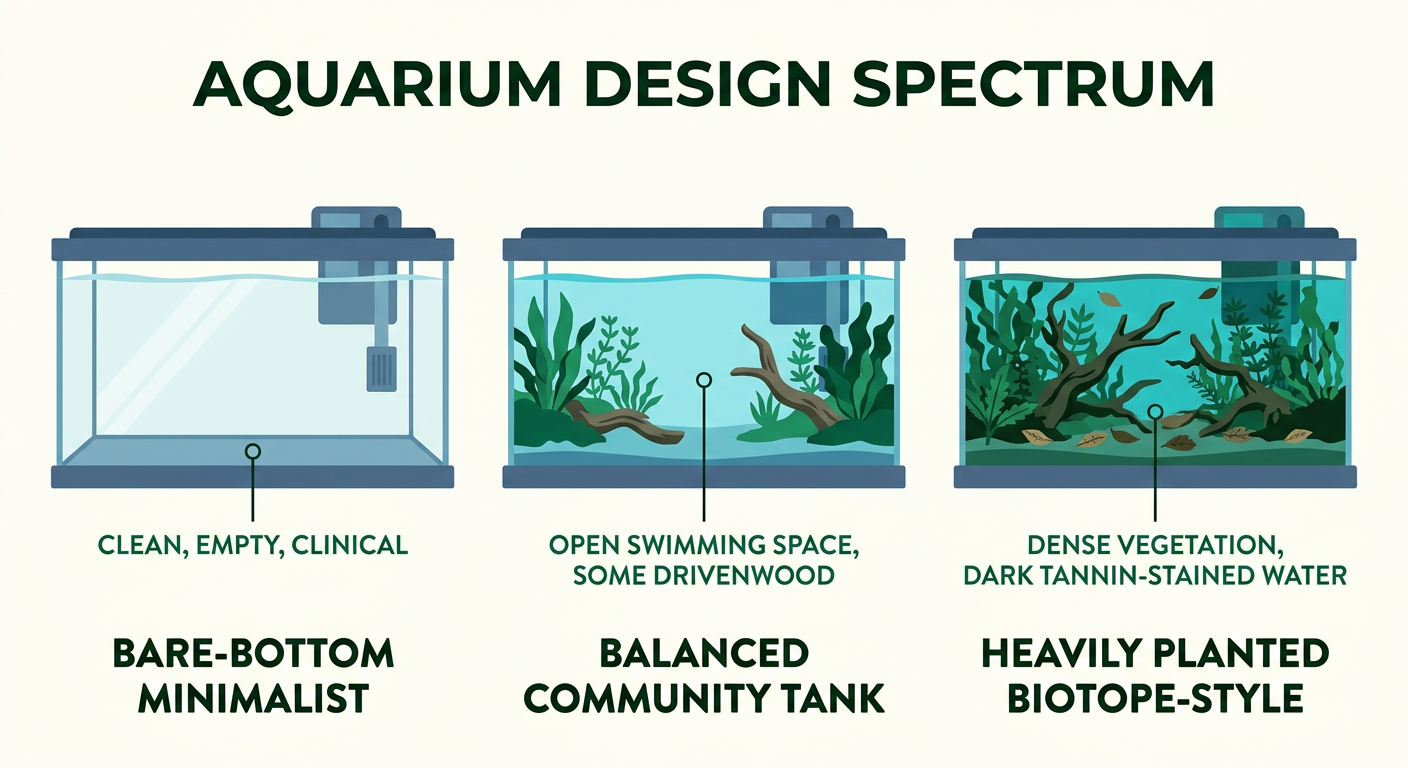
Aquaria range from completely bare to densely planted jungles. Most fall somewhere in between. Where you land depends on what you're trying to accomplish.
 Minimalist setups
A bare-bottom tank is empty. Glass, water, filter. Nothing else. You see them in breeder facilities, hospital tanks, and high-end discus collections. The reason is practical: waste doesn't get trapped in substrate, water parameters stay stable, and you can siphon the floor clean in seconds. That matters a lot when you're doing daily maintenance or dealing with a fish going through treatment.
A bit less stark is the Iwagumi style of aquascaping—Japanese rock gardening applied to aquariums. Usually a single, carefully placed rock formation serves as the focal point. The rest is open water and low carpet plants like HC Cuba. It takes up less visual space than a bare bottom but follows the same principle: simplicity, clarity, open swimming lanes.
Minimalist tanks excel at what they do. You can monitor water parameters without squinting through plants. You won't find dead plant matter rotting in the substrate. Fish recovering from illness or stress recover better in a clean space.
The trade-off is sharp, though. A bare-bottom tank offers almost zero biological filtration surface area beyond your filter media, and substrate bacteria do substantial work in established tanks. More importantly, fish that evolved surrounded by crevices, root systems, and hiding spots feel exposed and stressed in open water. Territorial species become aggressive because they have no way to claim their own space. Shy fish don't emerge at all.
Heavily decorated tanks and biotope realism
The opposite end of the spectrum is a biotope aquarium—a deliberate recreation of one specific natural place. Every element matches: an Amazon blackwater stream might have soft sand, leaf litter, dark tannin-stained water, and driftwood. A Lake Malawi biotope has limestone rock stacks, harder water, and no plants except the ones that actually live there. The Dutch style, popular since the 1930s, is lush with terraced plant rows running across the tank. Nature aquariums, developed by Takashi Amano, use fewer plant species but arrange them with an artistic eye—usually asymmetrical, often referencing a terrestrial landscape in miniature.
Dense decor costs more time and money upfront. Dead plant material contributes to ammonia if you're not careful. It's harder to spot disease or keep up with water parameter testing when plants take up space. Your vacuum hose can't reach the back corners.
But something actually changes in heavily decorated tanks. The bacteria in and around the substrate and plants become a functional biological system. Shy fish emerge. Breeding pairs spawn. Small fish that would pace constantly in open water find security. The tank stops being a container and starts being an ecosystem.
Finding your balance
Most community aquarium environments live somewhere in the middle. Enough open water for active swimmers. Enough structure for shelter and territory. It's not fancy, but it works because the fish can actually live there peacefully.
Your place on that spectrum should come from the species you actually keep, not from a design style you found online. How much structure do they need? How much open space? If you choose the theme first and the fish second, the fish lose. That's a consistent pattern I've watched happen repeatedly.
III. Designing Around Fish Ecology
Different fish occupy different ecological niches. The water column isn't one uniform space—it's layers.
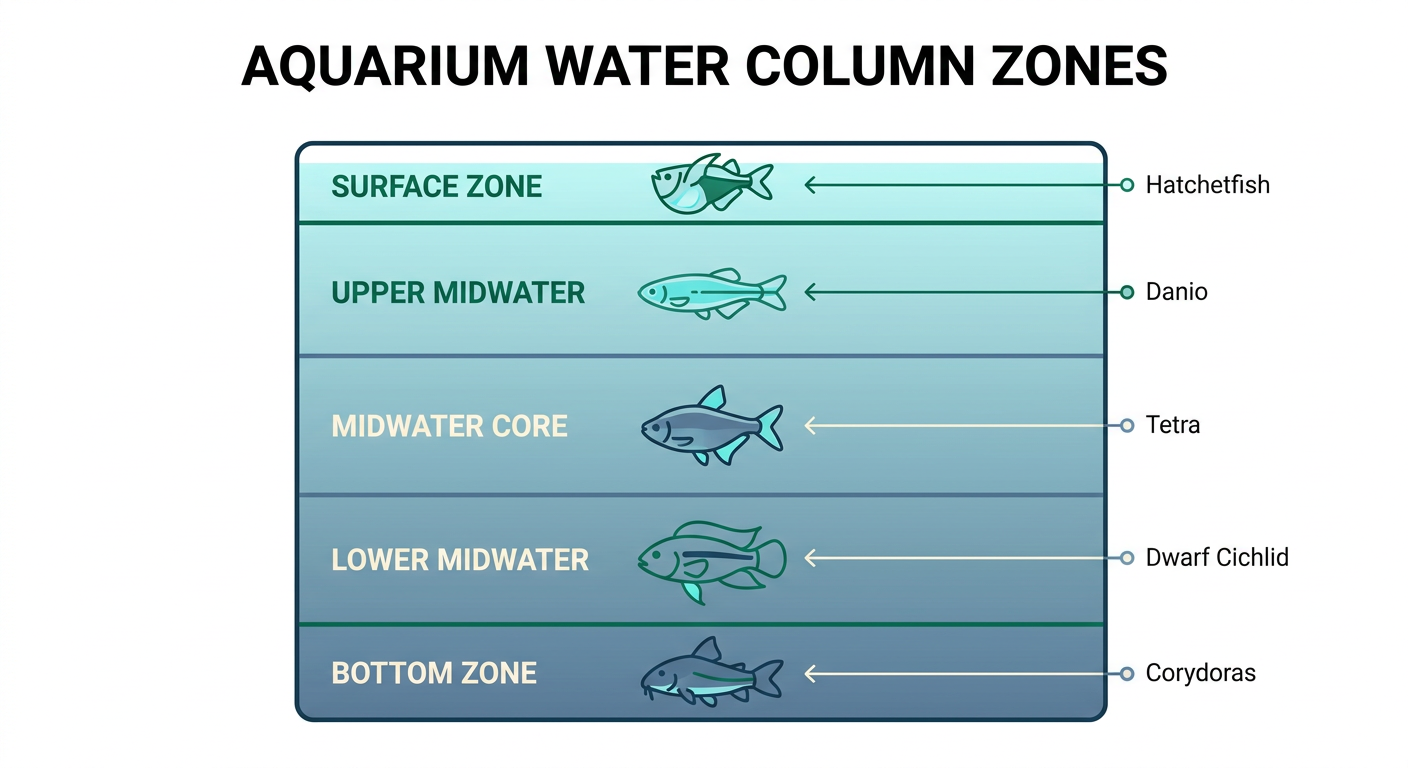 Design your tank with layers in mind, and you can keep species together that would normally stress each other out.
A. Open water swimmers
Neon tetras. Cardinal tetras. Harlequin rasboras. Zebra danios. Rainbowfish. Congo tetras. These all share one thing in nature: they evolved to cruise through open water, schooling for speed and safety.
In a tank, that instinct doesn't go away. Put these fish in a heavily decorated space and they'll hide. Fins clamp down. They stop schooling. They pace the same route over and over. In severe cases, you won't see them swim naturally the entire time you own them. I've watched this happen and documented it across multiple tanks.
Open water swimmers need actual open water. Create a central clear zone, minimum two-thirds of your tank length with no obstacles. Use taller plants and driftwood on the sides and back. Set your filter return to create a gentle horizontal current. You don't need full river flow, but a current that lets them school naturally helps measurably.
Tank shape matters too. A 20-gallon long (24 inches) gives these fish far more usable space than a 20-gallon high (24 inches tall). They need length. Tall just means they navigate up and down.
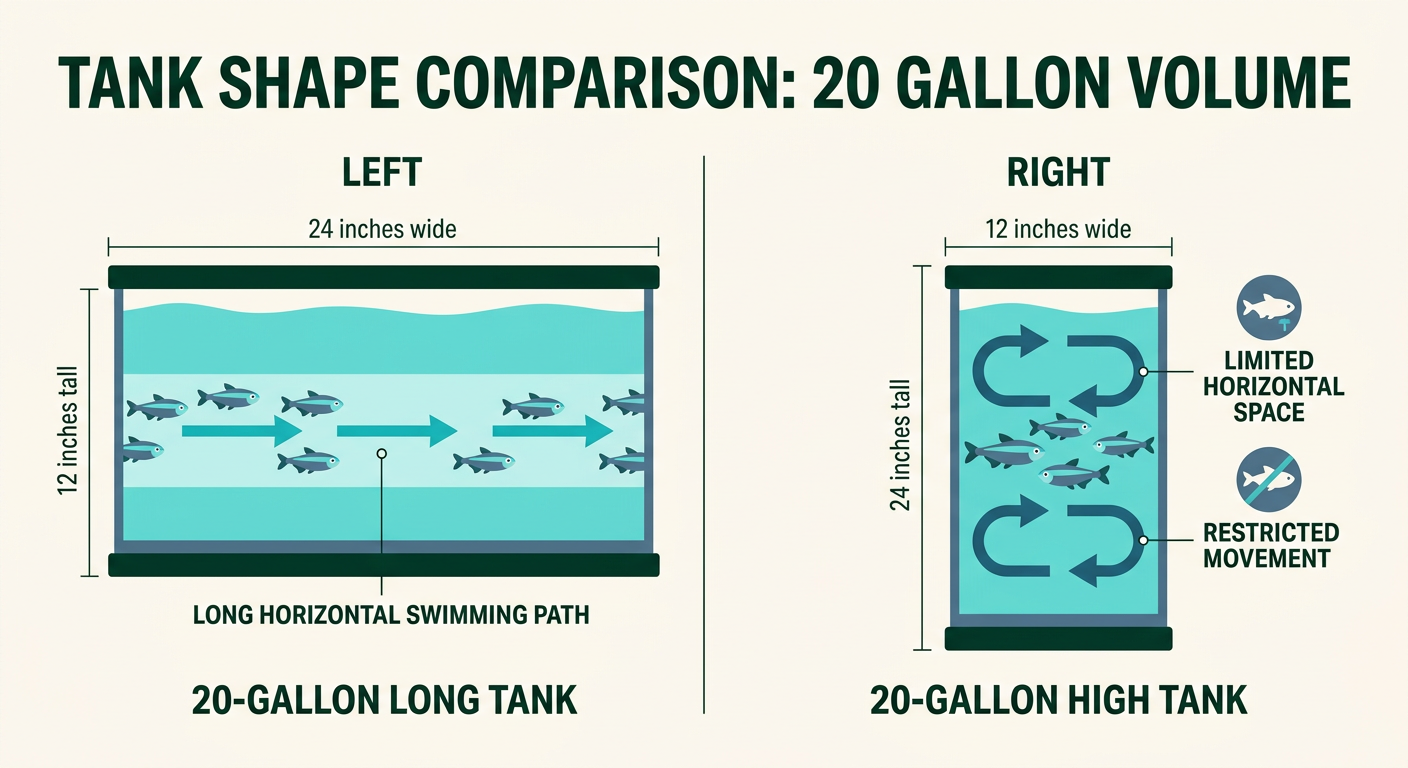 A rough guideline: active swimmers need tank length at least 8 to 10 times their body length to move without constantly hitting decor or glass.
I've watched this consistently: the more horizontal swimming space, the better the schooling behavior and the fewer stress signs. It's worth thinking about before you fall in love with that tall tank.
B. Cave dwellers and bottom species
Plecos. Loaches. Cichlids. Corydoras catfish. These live near the bottom in nature, often in rocky areas or dense vegetation. Many are somewhat reclusive. Several are territorial.
Corydoras are a clear example. These barbeled catfish evolved to push their faces into sand searching for food. Put them in large gravel and they're constantly abrading those delicate barbels. Over time, the barbels get infected and the fish stop feeding. It's a slow decline. Use proper sand, pool filter sand or aquarium sand in the 0.4–0.8mm range, for any Corydoras species. This isn't a preference. It's a welfare requirement.
Territorial cichlids tell this more clearly. Mbuna cichlids from Lake Malawi naturally divide rocky habitat into small, defendable territories. Each male claims a crevice or cave. In an open tank with no rocks, there are no territories to claim. The fish still feel territorial, they just have nowhere to establish themselves, so they fight constantly over undefined space. It looks like aggression. It's frustration.
Stack rocks with varying cave sizes. Create multiple smaller territories instead of one large structure. Add visual breaks, hardscape features that prevent one fish from seeing another from their resting spot. These are line-of-sight breaks. Studies document that they reduce stress hormones measurably. Cortisol drops when a fish can step away from social pressure.
Slope your substrate deeper toward the back. Use rocks at different heights. Many bottom-dwellers use elevation for different activities, lower zones for feeding, higher zones for resting. They're not swimming in one plane. They're using vertical space intentionally.
C. Dense plants and shy fish
Dwarf gouramis. Honey gouramis. Apistogramma. German blue rams. Celestial pearl danios. Dwarf shrimp. Otocinclus catfish. These are smaller species, often somewhat reserved. In dense vegetation, they thrive. In open water, they vanish.
Plant density reduces cortisol. Studies document this effect across species. Dense vegetation provides predator refuge, the fear instinct is hardwired even without actual predators, surfaces for biofilm that small fish graze between feedings, and microfauna habitat they forage through. A shy fish in a planted tank eats more, lives longer, and shows natural behavior. A shy fish in open water barely eats and hides.
Live plants do more than create structure. They absorb ammonia and nitrate from the water and produce oxygen. Java moss, Anubias, Java fern, Cryptocoryne, these aren't fancy. They're workhorses. Artificial plants look good but they don't filter water or create biofilm surfaces. Mix live plants with artificial accents in low-light zones and you get both biological benefit and design flexibility.
Floating plants, water lettuce, Amazon frogbit, duckweed, create overhead cover that transforms shy surface fish. Gouramis become visibly more confident under floating vegetation. Many build bubble nests once they have that overhead security. Small change. Noticeable effect.
IV. Substrate Selection: The Foundation People Overlook
Substrate is invisible until you understand what it does. Then it becomes one of your most important decisions in the tank.
Substrate grain hosts nitrifying bacteria, Nitrosomonas and Nitrobacter that drive the nitrogen cycle. The surface area of substrate grains rivals filter media in established tanks. This isn't aesthetic. It's functional. Coarse sand to fine gravel, 1–5mm, offers the best balance of surface area and water flow.
Some substrates actively change water chemistry. Aragonite and crushed coral raise pH and hardness, useful for African cichlids and livebearers. Active substrates like ADA Aqua Soil lower pH and soften water, good for South American species and crystal shrimp. Choose substrate to match your species, not just because it looks right.
Foraging behavior depends on substrate too. Sand-sifting fish need sand to sift through. It's not enrichment. It's how they eat. Gravel prevents it completely.
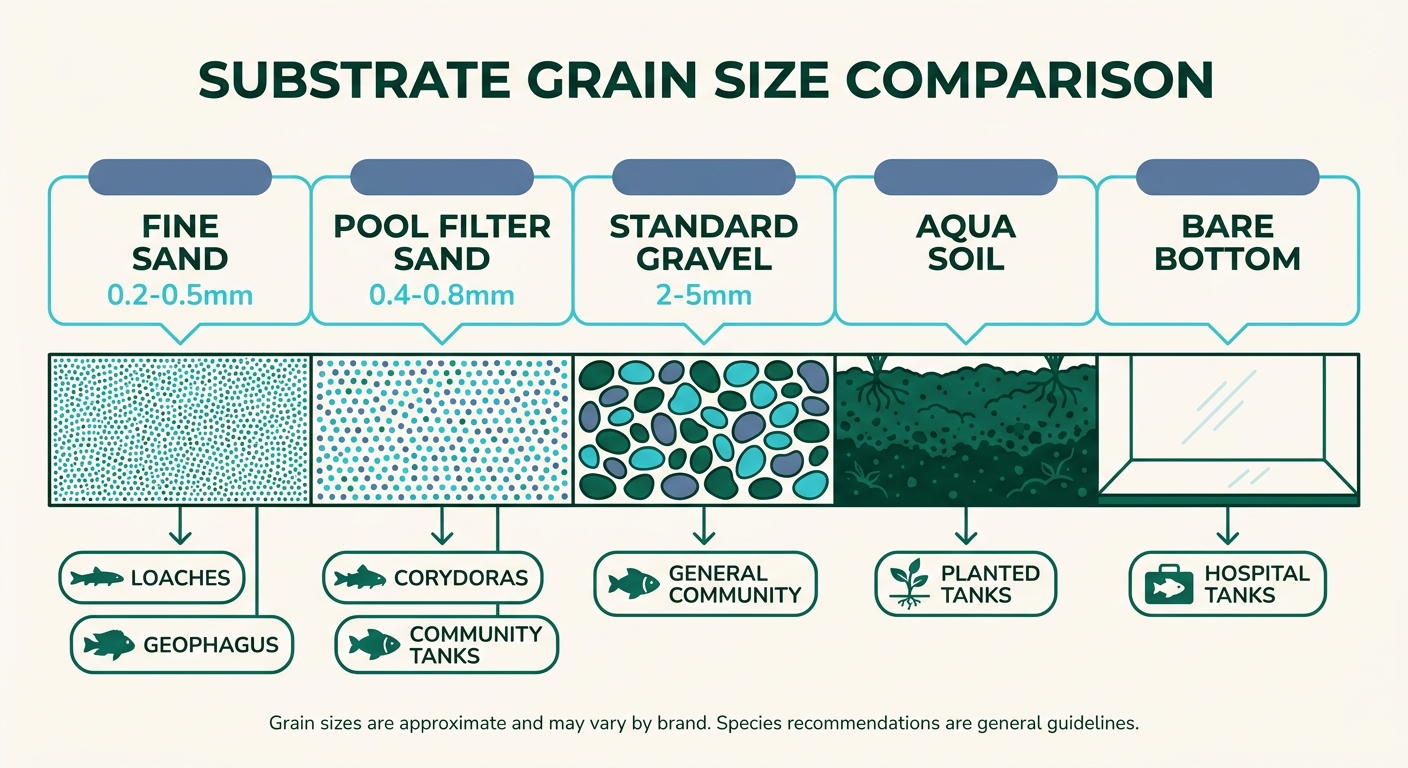 Quick substrate reference:
- Fine sand (0.2–0.5mm): Loaches, geophagus cichlids. Compacts easily and can trap gas. Needs periodic stirring or Malaysian trumpet snails to aerate it. Best choice for fish that need to burrow and forage.
- Pool filter sand (0.4–0.8mm): Community tanks, most planted setups, corydoras-safe. Inert, uniform, cheap, won't cloud. The best all-purpose choice for most aquaria.
- Standard gravel (2–5mm): General community tanks, goldfish. Plant roots penetrate well. Bad for barbel-feeding fish. Easy to vacuum.
- Aqua soil / planted tank soil: High-tech planted tanks, shrimp tanks only. Lowers pH and KH, nutrient-rich, but breaks down in 1–2 years and needs replacement. Expensive.
- Bare bottom: Hospital tanks, quarantine, breeders. No debris trap, easy to clean, but zero biological surface and stressed bottom-dwellers. Use when you have a reason, not as a design choice.
Depth matters. Standard is 1.5–2 inches for gravel, 1–1.5 inches for sand. Planted tanks need 2–3 inches minimum so roots establish. If you're sloping substrate for depth, go 1 inch front to 3–4 inches back. Front depth prevents anaerobic pockets from forming where fish dig.
V. Hiding Spaces and Shelters
Fish in the wild spend significant time near structure. That instinct doesn't disappear in captivity. Every tank layout needs refuges, for confident species too, not just shy ones. Adult angelfish rest under overhangs. Larger gouramis use caves for sleeping. Lack of retreat space increases stress and disease susceptibility through immunosuppression even in species that seem confident.
Different shelters serve different purposes:
Caves and crevices. Plecos need them. Apistogramma need them. Breeding pairs of many cichlids need them. A cave should have one entrance and just enough room for the fish to turn around. Terracotta pots, coconut shells, stacked slate, ceramic caves, materials matter less than shape and size.
Overhangs. Driftwood leaning against glass. Large flat rocks with substrate piled beneath. These create roof zones fish rest under without full enclosure. Most species use overhangs as sleeping spots.
Dense plant thickets. Vallisneria jungle. Java moss walls. Cryptocoryne groupings. Provide visual shelter and physical barrier. Work best for shy midwater species and surface fish.
Floating plant cover. The root mass of water lettuce or frogbit. Surface driftwood branches. Cuts perceived threat from above and builds surface-dweller confidence.
Driftwood roots. Spider wood, manzanita, Malaysian driftwood with branching. Create 3D refuge that fish weave through. Breaks sightlines at multiple depths.
Distribution matters more than single large structures. One massive rock pile creates one territory zone and one refuge. Multiple smaller structures spread across the floor distribute territory claims, provide escape routes from aggression, and make the fish feel less trapped.
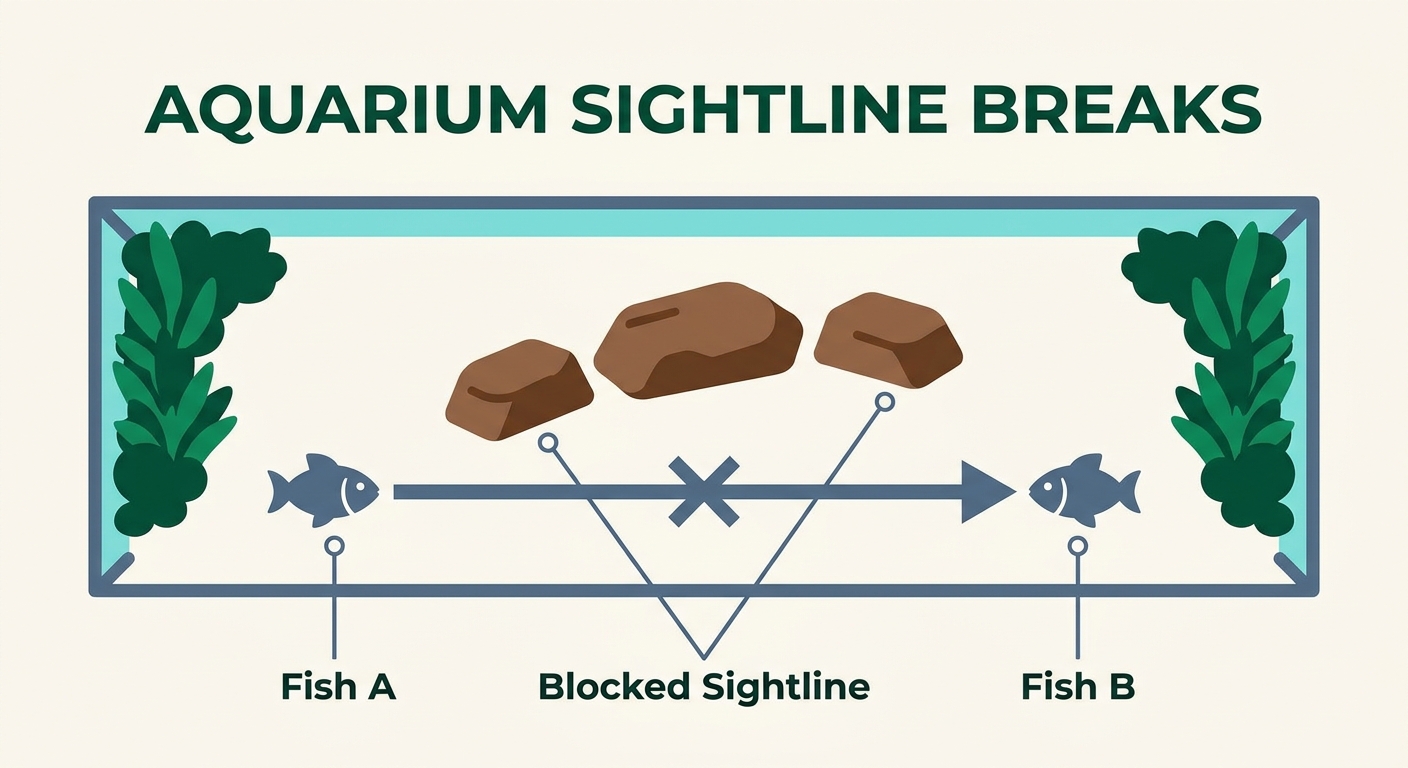 Break the long sightline, the view where a fish at the left can see a fish at the right without obstruction. Mid-tank hardscape should interrupt this in two or three places.
Watch for signs your tank lacks hiding space: fish hiding behind heaters and filters, one fish chasing others with no escape, fish flashing or rubbing (distinct from parasite scratching), faded coloration, feeding issues. Compare those to a tank with enough cover: fish explore openly but retreat periodically, shy species visible during feeding but hiding otherwise (normal), multiple fish using different shelter zones, breeding behavior, normal coloration and active foraging.
VI. Designing a Compatible Community
The most successful community tanks think in layers. Every water column zone, surface, upper midwater, midwater, lower midwater, bottom, has specific species preferences. Stock different layers intelligently, add hardscape and plants that serve each zone, and you reduce direct competition and aggression dramatically. That's the foundation of community tank compatibility.
Surface zone: Hatchetfish, African butterflyfish, atmospheric-breathing gouramis.
Upper midwater: Danios, white cloud mountain minnows, rainbowfish.
Midwater core: Tetras, rasboras, barbs. Most competitive zone.
Lower midwater: Dwarf cichlids, pearl gouramis, some rainbowfish.
Bottom: Corydoras, loaches, otocinclus, plecos.
Pick one or two species from each zone and compatibility improves dramatically.
Common mistakes: stocking only midwater species (all tetras and barbs competing), bare-bottom with corydoras (barbels erode, fish stress), no sightline breaks with territorial species (constant fighting), tall tanks with short decor (midwater fish feel exposed), designing entirely for one display species and adding community fish without adjusting the layout. I've watched all of these happen.
Biotope thinking sidesteps many of these problems automatically. An Amazon biotope eliminates hard-water African cichlids by design. A Lake Malawi biotope eliminates soft-water tetras. The theme itself acts as a filter for what's compatible. If you're not sure where to start, picking a geographic theme and stocking it properly is simpler than mixing random species and hoping design compensates.
VII. Pulling It Together: From Theme to Thriving Ecosystem
Start with your fish—or your theme if you have one. Identify the habitat in nature. Work backward from there, building an aquarium habitat setup around ecology rather than aesthetics.
Working backward framework:
- Pick your primary display species (or your theme).
- Identify its habitat in nature.
- Match substrate grain size, type, and depth to that habitat.
- Add hardscape density that matches the species' ecology.
- Identify which water column zones you'll occupy.
- Select complementary species from different zones.
- Add plants and decor to serve each zone.
- Set flow rate and pattern to match natural habitat.
Final design checklist:
- Primary swimming lane is clear of major obstacles (minimum two-thirds tank length)
- Multiple sightline breaks in the midwater zone
- At least 2–3 distinct shelter types (cave, plant thicket, overhang)
- Substrate appropriate for all bottom-dwelling species
- Cover at surface, midwater, and bottom levels
- Territorial boundaries defined by hardscape, not fish aggression
- Flow pattern creates both calm and current zones (unless all species prefer one)
- All species have a clear water column zone with minimal overlap conflict
A well-designed tank is one where the fish stop thinking about survival and start living. You watch them, but they forget you're there. When that happens, you know it's working.
Comments
No comments yet.