aquarium aeration: how to know if your tank needs more oxygen
If you're trying to figure out whether your fish tank needs an air pump, whether your filter is doing enough, or how to eliminate dead zones in the corners—this is the walkthrough. It covers what aeration actually does, when it matters, and which device (air stone, powerhead, or sponge filter) makes the most sense for your setup.
what aeration actually does
Aeration isn't primarily about bubbles 'adding oxygen' to the water. That's the mental model most people carry, and it's mostly wrong.
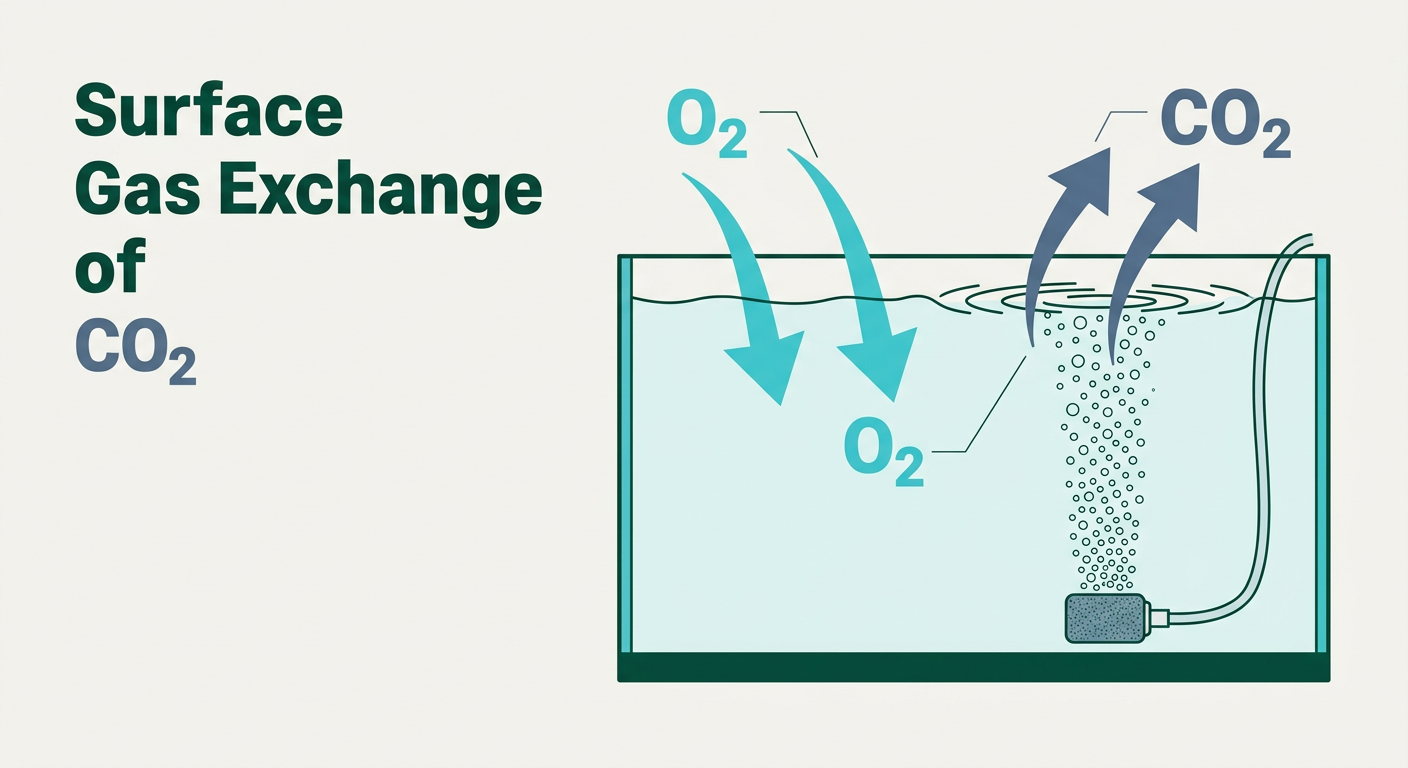
Aeration does three things. The first is surface gas exchange. Oxygen enters and carbon dioxide leaves your water almost entirely at the surface, where air meets water. Bubbles from an air stone don't directly inject oxygen the way you might imagine. Instead, they agitate the surface, breaking the boundary layer between air and water. More surface agitation means more contact area, which means better gas exchange. Aquarium Co-op tested this with a dissolved oxygen meter. A powerhead aimed at the surface increased DO noticeably; the same powerhead running fully submerged and parallel to the substrate did nothing.
 The second job is water circulation. Without movement, temperature and chemistry separate into layers. Warm water from a heater rises and stays warm in one region while cool water sinks to the bottom. Oxygen diffuses from the surface down, but it only goes so far, especially in deeper tanks. Waste and carbon dioxide concentrate near the substrate where bacteria work hardest. A circulation device breaks these layers and distributes oxygen and nutrients across the whole tank.
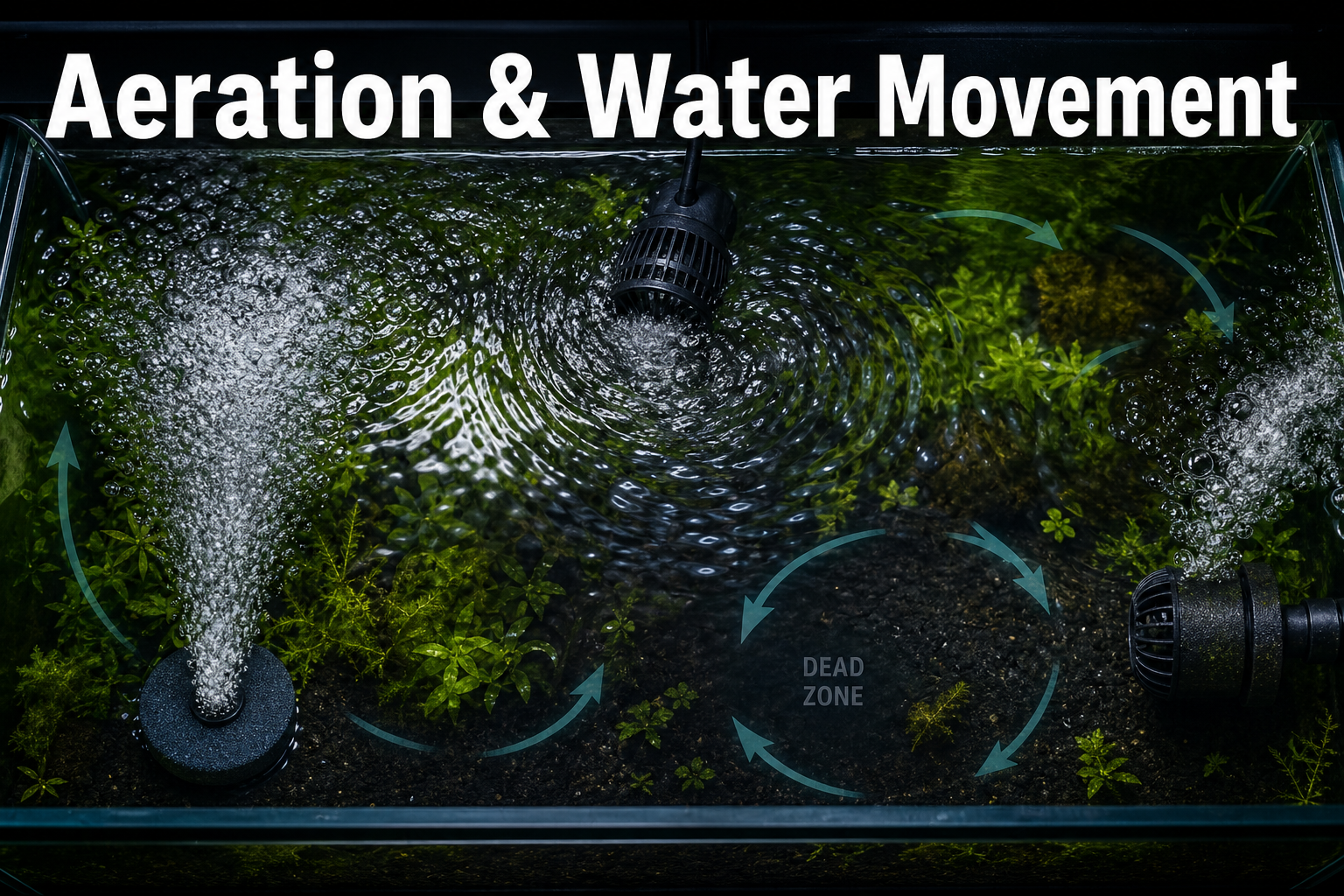
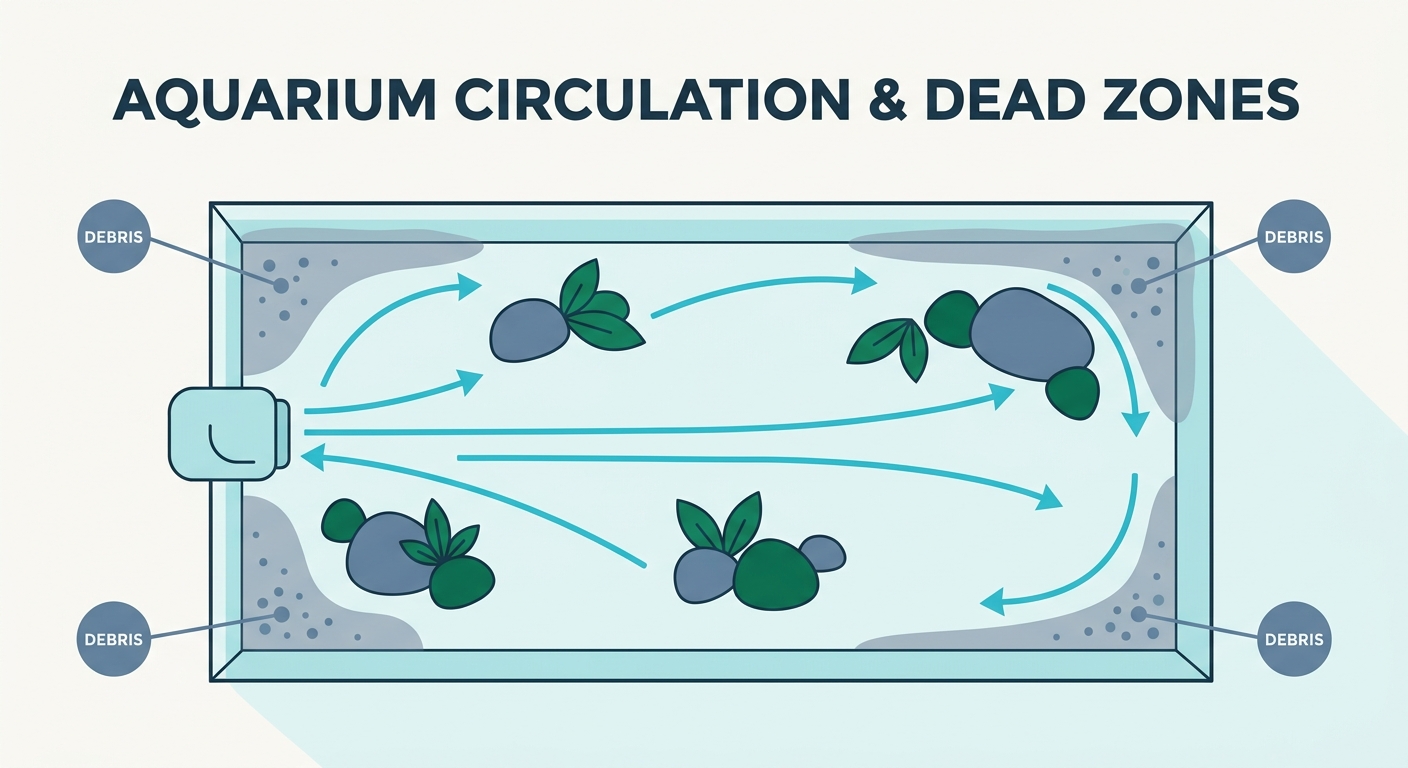
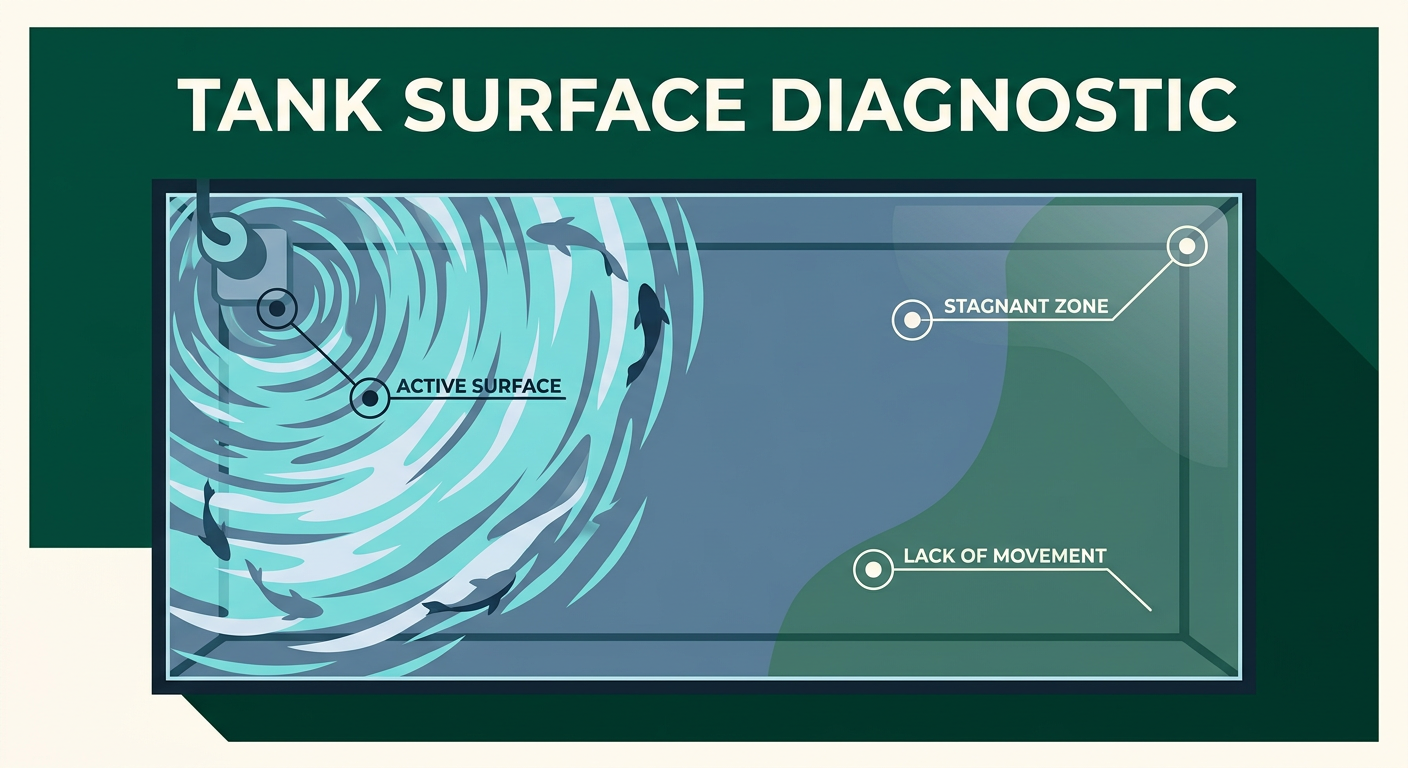
The third is preventing dead zones. Dead zones are low-flow corners where detritus settles, bacteria work hard breaking down waste (consuming oxygen as they go), and carbon dioxide accumulates. Fish often avoid these areas entirely. If you've ever noticed your fish never swimming into one particular corner, that's probably a dead zone.
 when aeration matters most
Overcrowding is the number one cause of oxygen problems. More fish means more oxygen demand. More fish also means more waste, which bacteria break down, and that breakdown process consumes oxygen too. This is called biological oxygen demand, or BOD. If your tank is stocked above its capacity, aeration can help, but it's fighting the real problem: too many fish.
Tropical tanks run hotter than room-temperature setups. Water at 82 degrees holds roughly 15% less dissolved oxygen than water at 72 degrees. That's not a minor difference. A tank that runs fine at 74 degrees might become marginal at 82 degrees with the same stocking and filtration. If you keep tropical fish—discus, rams, neon tetras, cardinal tetras—aeration becomes less optional and more necessary.
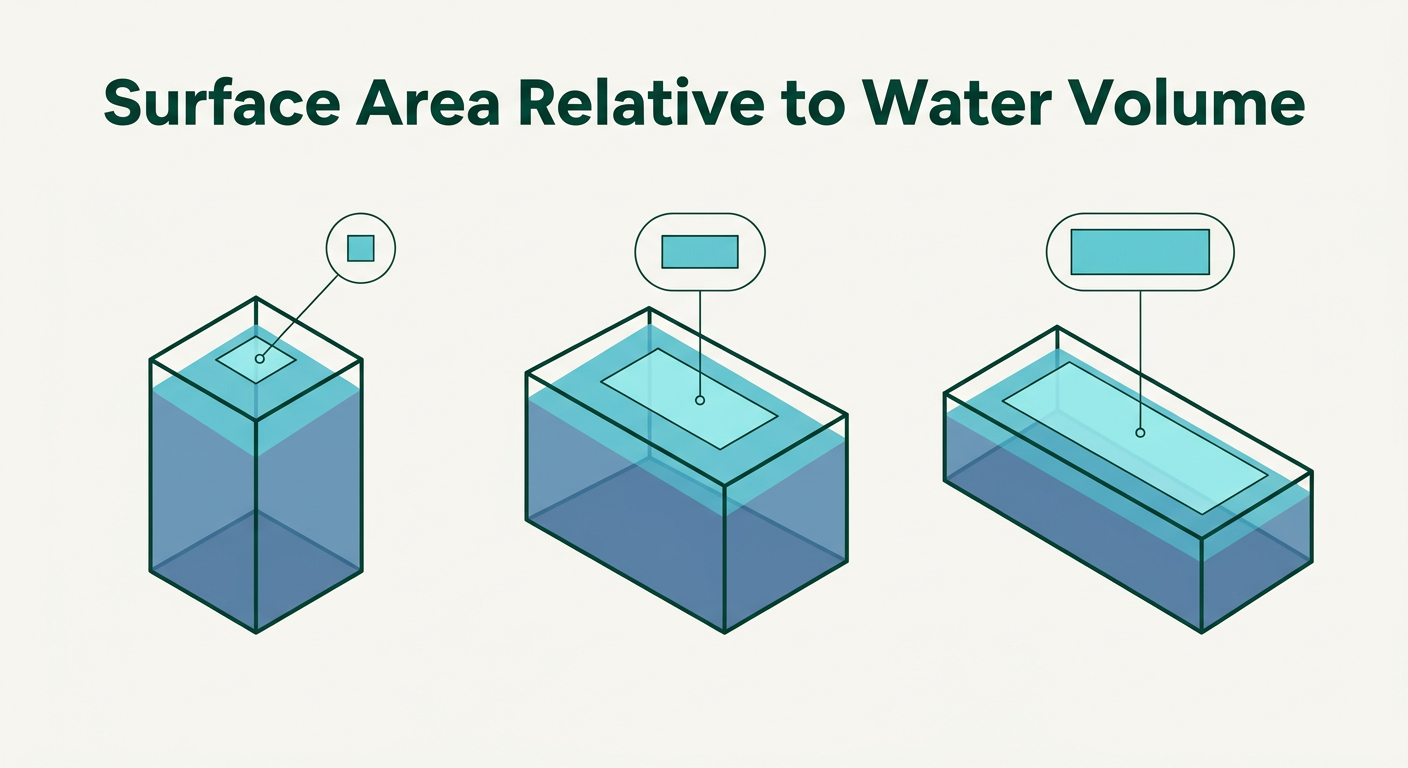
Small tanks and bowls are geometry problems. They have less surface area relative to their volume. A 10-by-10-by-10 cube holds 1,000 mL of water but only has 100 square centimeters of surface. A shallow 20-gallon long is 30 inches wide and 12 inches deep, giving it 360 square inches of surface. A standard 20-gallon is 24 inches wide and 12 inches deep, same volume, only 288 square inches of surface. That long tank naturally exchanges gas better. Bowls and corner tanks are the worst offenders; the shape itself works against you.
 Medications complicate things. Many treatments reduce surface tension or change how water molecules hold oxygen. Adding an air stone during any medication is solid practice, even if your tank normally runs without one.
Planted tanks introduce a deliberate tension. CO2 injection gives your plants the carbon they need to grow. But surface agitation off-gasses CO2. They're in conflict. Many planted tank keepers run aeration only at night, when plants aren't photosynthesizing and aren't competing with fish for oxygen, then turn it off during the photoperiod. This preserves injected CO2 during the day. It's a trade-off: some aeration for better plant growth. If you're not injecting CO2, this tension doesn't exist, and moderate aeration is usually fine.
aeration vs. filtration, what's the difference?
Filtration handles three jobs: mechanical (trapping solids), biological (bacteria converting ammonia to nitrite to nitrate), and chemical (absorbing dissolved toxins). A filter moves water, and that moving water contributes to aeration when the return flow ripples the surface. A hang-on-back filter cascading water is aerating. A sponge filter's bubbles rising create surface agitation, so it aerates. A submerged canister return pointed horizontally or downward does no surface agitation at all.
Here's what confuses people: a filter can exist in your tank without creating surface movement across the whole tank. A HOB filter in the back corner doesn't touch the front surface. A canister return on one side doesn't reach the opposite corner. A large tank can have a filter running while dead zones persist on different sections of the surface.
So no. Your filter does not automatically mean you have enough aeration. It contributes to aeration if the return is designed to disturb the surface. But it's not a guarantee.
types of aeration devices
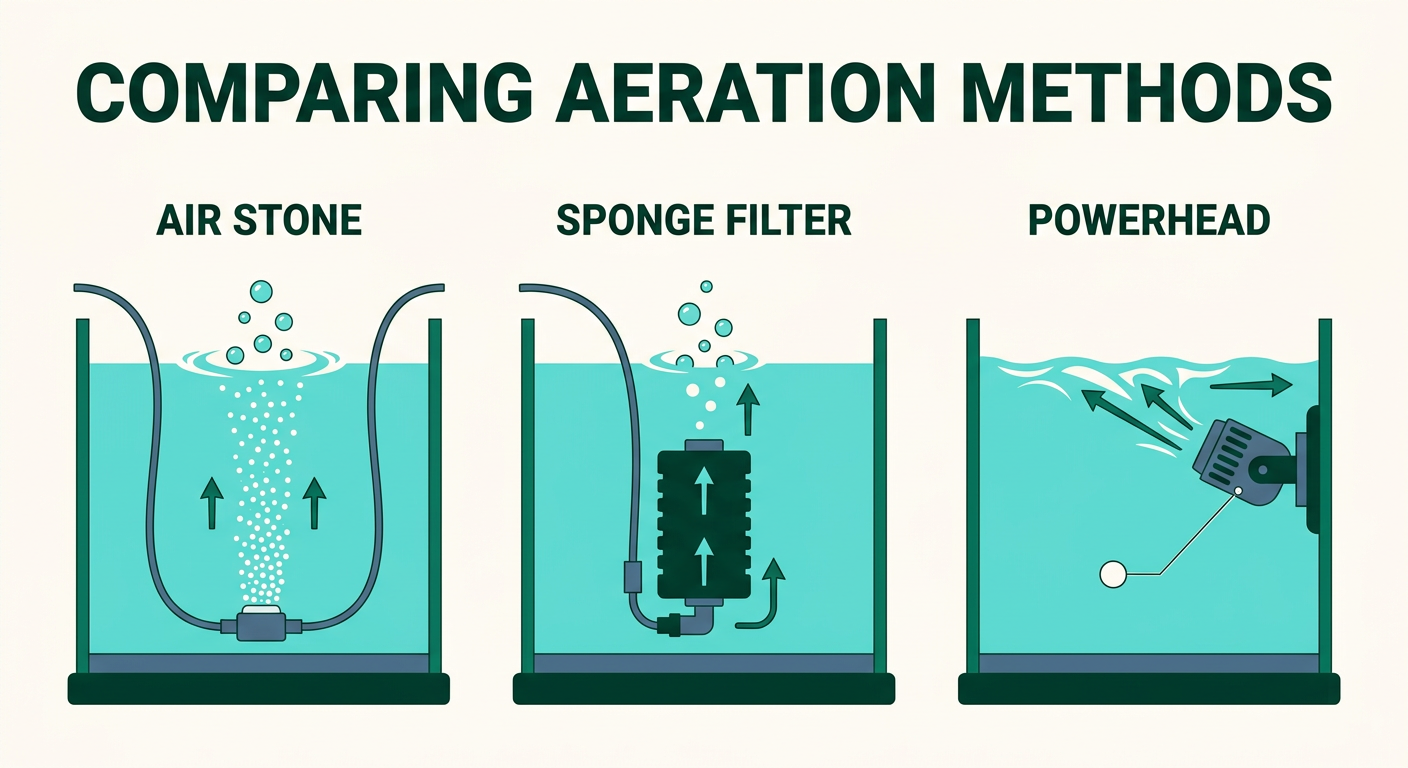
Air stones and bubble wands are cheap and gentle. An air pump pushes air through a porous stone, making bubbles. Finer bubbles create more surface agitation per bubble and make less noise. They clog over time from mineral deposits and algae, but replacement stones cost a few dollars. The circulation they create is limited. The bubble column rises vertically and disturbs the water nearby, but it doesn't push horizontal flow far. A column of bubbles 6 to 8 inches away doesn't accomplish much for the rest of the tank. Air stones work best as supplemental aeration or in small tanks where that vertical column can reach the whole surface.
Powerheads and circulation pumps are submersible impellers that push water directly. You can aim them anywhere: at the surface for gas exchange, across the tank for horizontal flow, up to the top at an angle. Aquarium Co-op's tests showed a powerhead aimed at the surface produced measurably better dissolved oxygen than the same pump running fully submerged. They come in a wide range of flow rates, from gentle 200 GPH models to heavy-duty 1,500+ GPH wavemakers. They don't need an air pump, which means no air-pump hum, just motor noise (usually minimal). In a 10-gallon tank, a powerhead is overkill. In a 60-gallon or larger, especially one with odd shape or deadzone issues, a powerhead is often the better choice.
Sponge filters bridge both worlds. An air pump lifts water up through a foam sponge; as the water passes, bacteria colonize the sponge and start breaking down ammonia. The bubbles exit the top and break the surface. You get biological filtration and aeration in one device. They're gentle, safe for fry, shrimp, and weak swimmers. They cost very little: a sponge body is $5 to $15 and an air pump is $10 to $25. The downside is they don't trap mechanical waste as well as hang-on-backs or canisters. In a heavily stocked or debris-heavy tank, a sponge filter alone might not keep up. But for quarantine tanks, breeding tanks, or small display tanks on a budget, sponge filters are the workhorse.
 factor air stone sponge filter powerhead factor air stone sponge filter powerhead | |||
| noise | low (pump hum + bubbles) | low to moderate (same pump hum) | very low (motor only) |
| cost | $10–25 total | $15–40 total | $25–80+ (unit only) |
| circulation reach | narrow (vertical column) | narrow (vertical column) | wide (directional flow) |
| aeration strength | good surface agitation | good surface agitation | excellent if aimed up |
| filtration | none | biological (some mechanical) | none |
| best for | supplemental, small tanks | QT, breeding, budget | large tanks, dead zones |
| downsides | clogs often; needs pump | limited mechanical filter | overkill in small tanks |
how to tell if your tank needs more aeration
Look at your surface first. Does the water ripple and move across the entire top of the tank, or is there a glassy calm section on the far side from your filter? The calm part is the problem area.
Look at your bottom. Do you see piles of detritus accumulating in specific corners? Dead zones trap waste. Is algae growing heavily on one side of the tank but not the other? Dead zones concentrate nutrients. Do your fish hang out in the same spot all the time instead of exploring? They might be avoiding a dead zone.
Watch your fish in the morning, first thing after lights-on. Are they gasping or breathing rapidly? Are they slow and lethargic? The overnight period is when dissolved oxygen dips lowest. At night, plants stop producing oxygen and start consuming it instead. Fish respire, bacteria work, and nobody's replenishing the oxygen supply. Morning gasping is classic low-oxygen behavior.
Here's a simple observation test: turn your filter off for a minute and watch the surface. Where does it go still? That's aeration-blind. That's where you might place an air stone or reposition your return nozzle.
 practical considerations, the stuff nobody tells you
Air pump noise is real. The pump's diaphragm vibrates, and if the pump sits on a hard surface (a wooden stand, a glass shelf, concrete floor), that vibration conducts through the furniture and amplifies. If noise bothers you, place the pump on something soft, a mousepad, foam, or folded towel, or suspend it from a hook so it doesn't touch anything. A check valve (that one-way rubber flapper in the tubing) also reduces the gurgle when the pump cycles. Some brands are legitimately quieter: Eheim pumps, some Tetra Whisper models, and Aquarium Co-op's house-brand pump are known in the hobby for low vibration.
If your pump sits below the waterline and the check valve fails, gravity can siphon water down the airline onto your floor. This isn't a universal risk (pump above tank level eliminates it entirely), but the check valve is cheap insurance. Most experienced keepers run one regardless.
Cost-wise, aeration is the cheapest insurance you can buy. An air pump pulls 2 to 6 watts. Running 24 hours a day for a year costs around $3 to $10 in electricity. You're not going to regret adding aeration. You might regret skipping it.
On placement: the advice 'put an air stone on the opposite side from your filter' sounds clever, but it misses the point. Put the air stone wherever the surface goes still. That might be a back corner, along one side wall, or behind a decoration. Symmetry doesn't matter. Breaking the stagnant pattern does.
quick faq
Does a filter count as aeration? Yes, partially. It depends entirely on whether the return flow disturbs the surface. A hang-on-back splashing down aerates. A spray bar angled up aerates. A sponge filter with rising bubbles aerates. A submerged canister return pointed horizontally or down doesn't. The test is simple: look at the surface. Is it moving? Then it's aerating. Is it glass-smooth away from the outflow? Then it's not reaching those areas.
Can you over-aerate a tank? Rarely harmful to fish. You'd need extreme conditions to get gas bubble disease (supersaturation from faulty equipment or a heavily planted tank in bright light). The real concern is planted tanks: excessive surface agitation off-gasses CO2 faster than you can inject it, and the plants suffer. For fish-only tanks, there's effectively no such thing as too much aeration.
Is an air stone necessary with a sponge filter? Usually not. The sponge filter's own bubbles already agitate the surface. Adding an air stone would be redundant unless the sponge filter's footprint is small relative to the tank surface area, meaning it can't agitate the whole top. In that case, a second sponge filter or a separate air stone on the opposite side would help.
Do I need aeration in a planted tank? It depends on three things. First: are you injecting CO2? If yes, you might want aeration off during lights-on and on at night. Second: how bright is the lighting? High-light tanks drive rapid photosynthesis during the day (producing oxygen) but also rapid respiration at night (consuming it), making nighttime aeration more important. Third: how many fish? Heavily stocked planted tanks need aeration regardless, even if it means losing some injected CO2. Fish health comes first.
closing
Aeration is low-cost, low-risk, and high-reward when it's the right tool. You're not trying to shake the tank apart or make it sound like a river. You're trying to make sure oxygen gets distributed throughout the water column and corners don't become dead zones.
One thing to carry forward: bubbles aren't the goal. Surface movement is.
Comments
No comments yet.