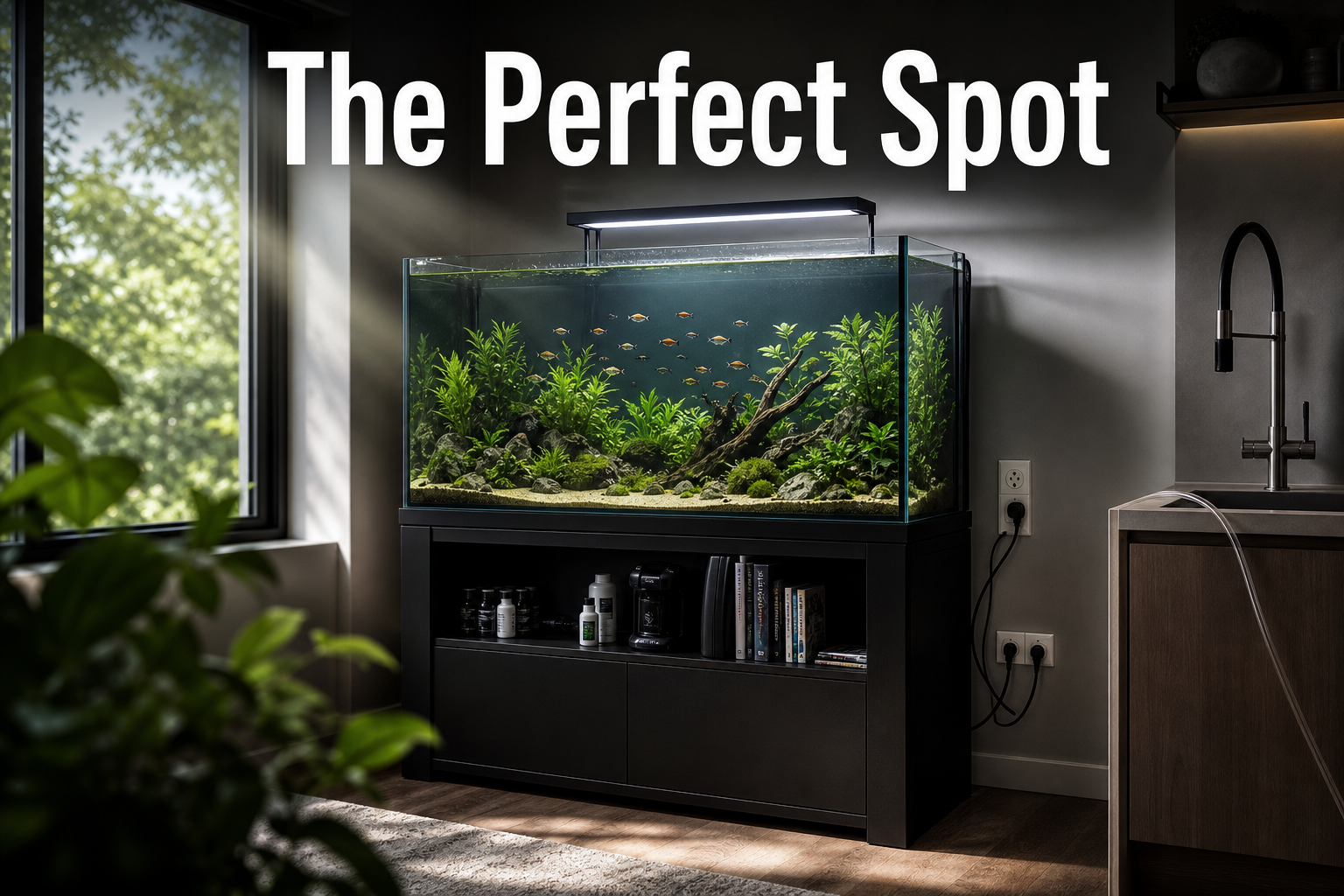
intro why aquarium location hits harder than the filter you bought
The best place to put an aquarium is against an interior wall, away from windows, doors, HVAC vents, and direct sunlight, on a level, structurally sound surface near a GFCI outlet and a water source.
That's the featured-snippet answer. Here's the flip side when you're actually setting up: a bad spot locks in problems for years. Algae you'll fight every water change. Temperature swings that stress your fish constantly. Electrical shortcuts that feel fine until they aren't. Plus the weekly maintenance tax of hauling buckets through the house because the tank ended up nowhere near a drain.
I've watched people troubleshoot cracked seams, Ich outbreaks, and chronic algae blooms, only to discover the root cause was placement. The filter was fine. The fish were fine. The spot wasn't.
These fish tank placement tips cover every decision before you buy anything. Each factor has a reason it matters and a practical fix you can test now, not after the tank is cycling. I've linked to the deeper hub content at each step, so you can drill in when you want more than a placement answer.
1. structural support and weight the will this floor hold it question
Freshwater is 8.34 pounds per gallon. Saltwater is roughly 8.55 pounds per gallon. A 75-gallon tank filled with water alone weighs 625 pounds. Substrate adds another 75 pounds. Rock, decorations, and the tank itself bring another 240 or so. You're looking at 940 pounds total on the stand's footprint.
A 75-gallon tank on a 48-by-18-inch stand sits on 6 square feet of floor. That's roughly 157 pounds per square foot. Building codes require residential rooms to support 40 pounds per square foot. You're almost four times the standard load.
The floor doesn't fail right away. It deflects. Over months and years, that stress concentrates on one seam of the glass tank, and eventually, usually at 2 a.m., it cracks.
choosing a stand and checking weight limits
A stand rated for your tank's filled weight exists for a reason. Most quality aquarium stands come with a load rating on the back panel or in the manual. Use it.
leveling shims and foam mats
A perfectly level tank distributes stress evenly across both bottom panels. An uneven tank concentrates stress on one corner or edge. Shims go under the stand legs, never under the tank directly. If the floor is slightly uneven, shim the stand until it's level. Then place a foam mat (neoprene, yoga-mat thickness, roughly 1/4 to 1/2 inch) under the tank itself. This absorbs minor surface imperfections on the stand top.
If the tank is rimless, the foam mat is mandatory. Any gap or high spot creates a stress riser on the bottom glass, and glass fails there first.
second floor installations joist direction and when to call an engineer
If you're placing the tank on a second floor, joist direction matters. Orienting the tank perpendicular to the joists spreads its weight across multiple joists. Parallel orientation concentrates all the weight on one or two joists running underneath the stand.
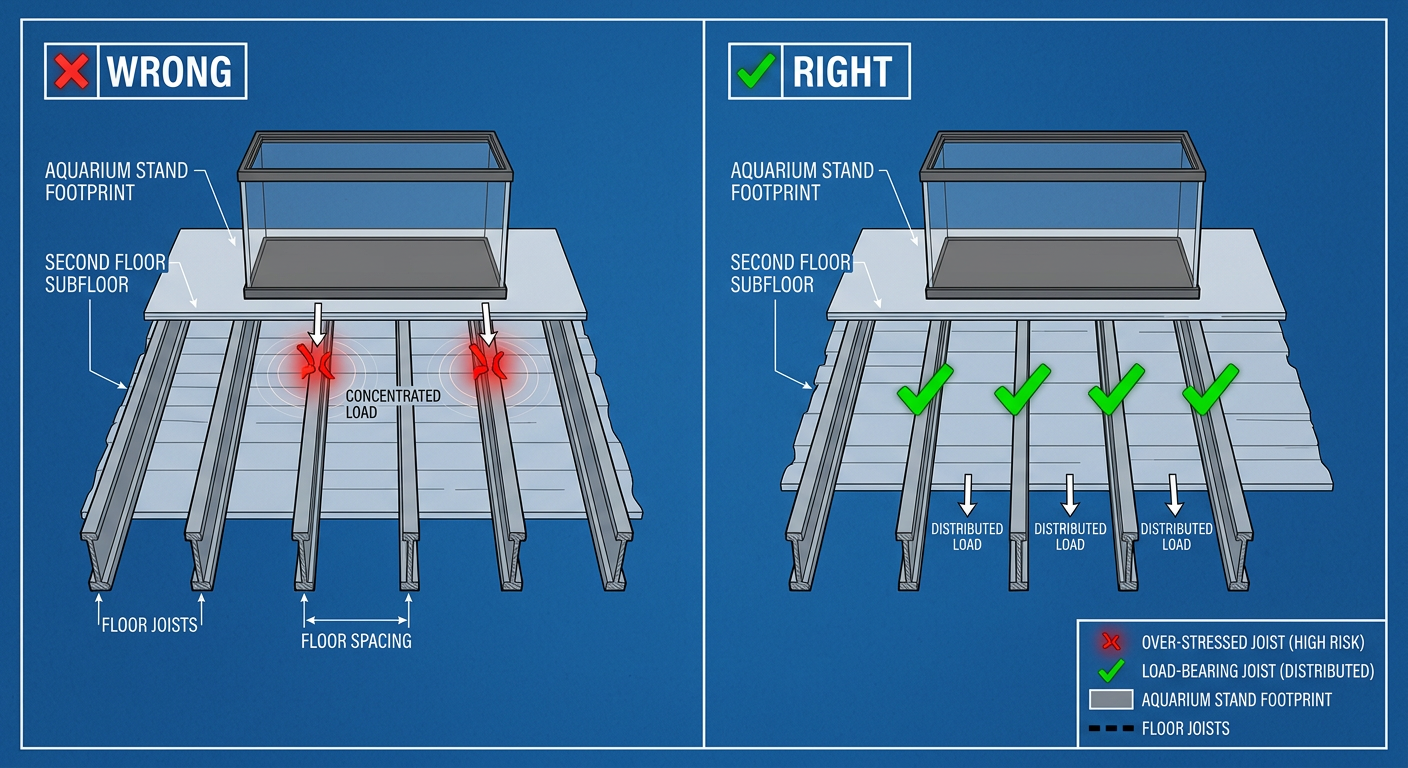 A rough rule: up to 55 gallons is probably safe anywhere indoors. 55 to 75 gallons on a second floor, place it perpendicular to joists, ideally against an interior load-bearing wall. Over 75 gallons on any floor above the foundation, this is when you call a structural engineer. It's not expensive, and it saves you from finding out the hard way that the floor wasn't ready.
interior vs exterior walls and temperature
An interior wall has conditioned space on both sides. Temperature stays relatively stable. An exterior wall has conditioned space on one side and the outdoor temperature on the other. In winter, that exterior wall is colder. Your heater runs harder to maintain temperature. You'll pay higher electric bills every December, or your fish will experience slow temperature drift as the outside temperature changes.
When possible, put the tank on an interior wall.
2. sunlight windows and algae
Direct sunlight carries 800 to 2,000 micromoles of light per square meter per second. A typical LED light running at medium intensity makes 50 to 150 micromoles. An hour of direct sun can spike the light levels past what plants can use, leaving the excess for algae.
Green water happens fast in direct sun. Hair algae grows on hardscape. Cyanobacteria blooms. I've seen all three triggered by one unscreened north-facing window.
The pattern I keep seeing is that beginners blame the filter, the test kit, or bad luck. They rarely blame the spot. But the spot is often the culprit.
window orientation and tank direction
South-facing windows (in the northern hemisphere) get direct sun for the longest part of the day. East-facing windows catch morning sun. West-facing catches afternoon sun, which is more intense and warmer. North-facing windows get only indirect ambient light, which is fine.
If the tank has to be near a window, orient it perpendicular to the glass, not parallel. Parallel orientation means the entire front pane gets lit. Perpendicular means only one end does. It's a simple change that reduces the lit surface area significantly.
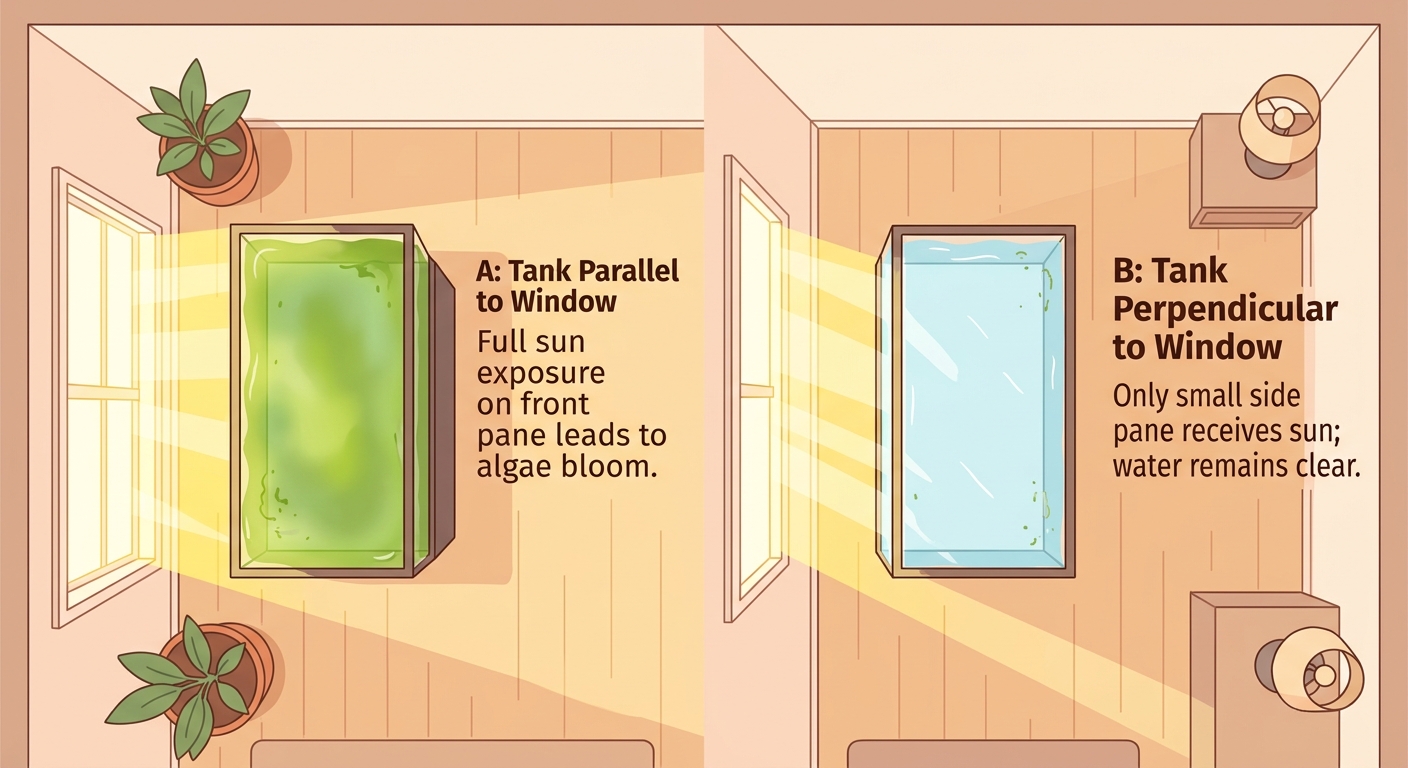 natural light vs led only
The nuance most placement articles skip is this: no direct sun doesn't mean no windows at all. Ambient room light, the indirect light bouncing around on a north-facing wall, is actually beneficial. It creates a more natural photoperiod ramp over the day instead of the harsh instant-on, instant-off of LED lighting. Fish notice the difference. They behave more naturally. The caveat is that ambient light has to be truly ambient. No direct beam should hit the water surface.
countermeasures
If the spot is otherwise perfect but happens to be near a window, blackout curtains are your only fully effective option. They block virtually all the light, including PAR. UV-blocking window film blocks UV-A and UV-B but lets PAR through, so it won't stop algae. Venetian blinds diffuse light but don't really block it. If you're considering these, just use the curtains.
The simplest fix, though, is to move the tank to a different room. If that's not an option, references to algae control walk through treatments for each algae type once sunlight damage is done.
3. temperature stability avoiding heat sources
Fish are ectothermic. They can't regulate their body temperature. The water temperature is their body temperature. In the wild, they experience large temperature swings, but those swings happen over hours or seasons in large bodies of water. In an aquarium, the small water volume means the same swing can happen in minutes.
The rate of change is what stresses fish, not the absolute temperature. A 5-degree swing over a week doesn't hurt. A 5-degree swing in an hour does. The stress from rapid temperature changes weakens the immune system. Ich outbreaks are commonly triggered by temperature fluctuations, not by a wrong absolute temperature.
Nitrifying bacteria prefer 65 to 85 degrees Fahrenheit. Below 65, they become sluggish. Above 95, they die. Temperature swings mean the nitrogen cycle slows and speeds unpredictably. Your parameters swing with it.
keep away targets
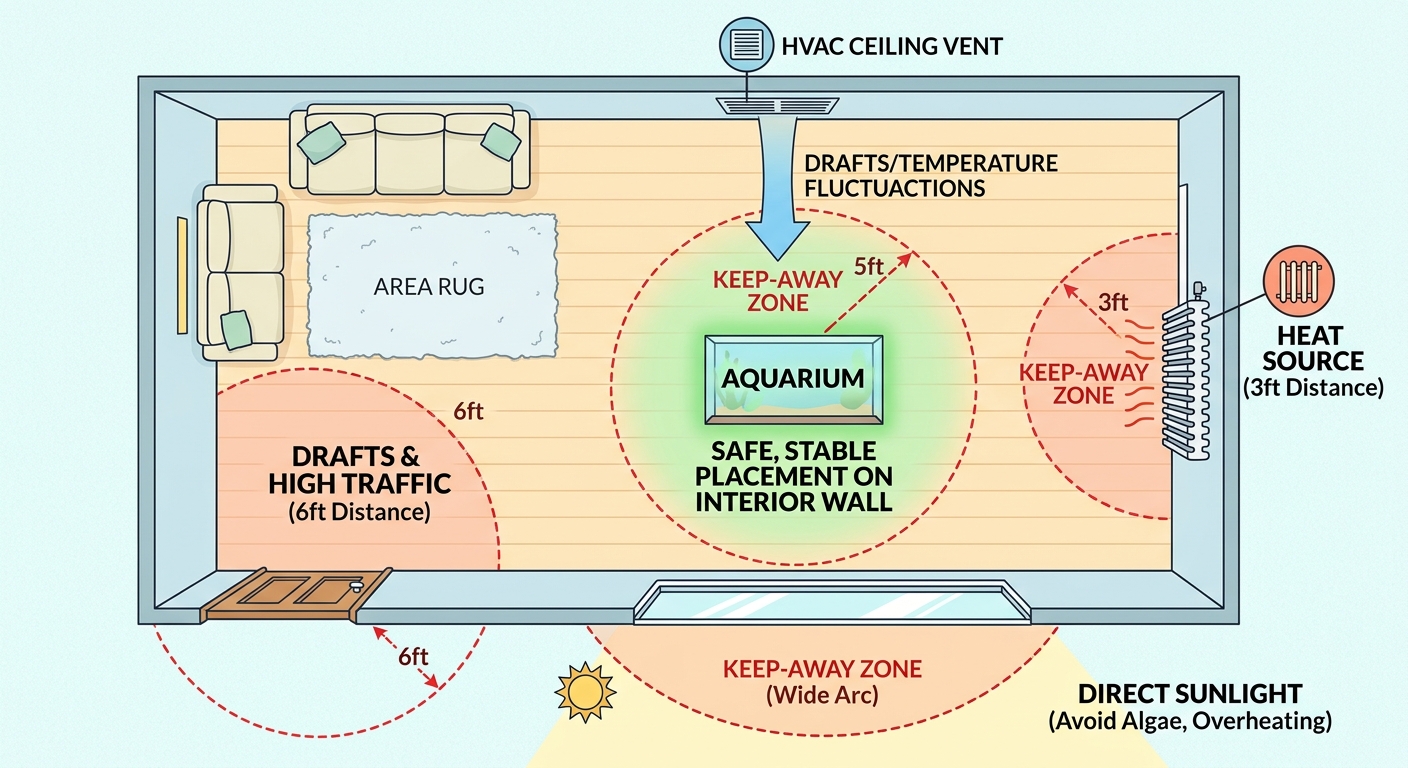
HVAC supply vents: minimum 5 to 6 feet away. Direct airflow causes rapid evaporative cooling on the water surface, dropping temperature unevenly across the tank.
Radiators and baseboard heaters: minimum 3 to 4 feet. Radiant heat warms the nearest glass pane, creating hot spots and temperature stratification inside the tank. One side of the tank stays warmer than the other.
Fireplaces and wood stoves: minimum 8 to 10 feet. Large radiant heat sources create the same problem, but worse.
Exterior doors: not for the heat, but for the constant cycling of indoor and outdoor temperatures every time the door opens. The room's temperature swings with it, and so does the tank.
Kitchens: ovens create large unpredictable temperature swings. 5 to 15 degrees hotter when cooking is active, then cooling as the oven cools down. Unpredictable, frequent, and stressful.
Bathrooms: shower steam raises the room temperature and humidity to 100 percent temporarily. Then the exhaust fan drops the temperature rapidly after. Same problem, different source.
 temperature testing before setup
Take a cheap digital room thermometer with a min/max recording function. Place it at candidate tank locations and monitor it for 48 hours. Check the log at different times: early morning before the HVAC runs, mid-afternoon on a sunny day, after cooking or showering. What you're looking for is no more than 3 to 4 degrees Fahrenheit of room temperature swing in 24 hours. That translates to about 1 to 2 degrees in the tank with a properly sized heater running. That's manageable. Anything more, and you'll be fighting temperature stability constantly.
4. electrical outlets gfci and drip loops
The National Electrical Code requires GFCI protection for all 125-volt, 15-amp and 20-amp receptacles in bathrooms, garages, kitchens, laundry areas, basements, and within 6 feet of sinks. While the code doesn't explicitly name aquariums, the combination of water plus electricity plus human hands near the tank makes GFCI protection the standard. Most aquarium insurance policies require it.
A GFCI trips at 4 to 6 milliamps of ground-fault current. That's well below the 100 to 200 milliamps that can cause cardiac problems. It stops the hazard before it becomes dangerous.
outlet placement and cord management
Target an outlet within 2 to 4 feet of the tank location. Cords should have slack, not tension. A stretched cord partially disengages from the outlet, increasing resistance, heat, and arcing risk.
Never run a cord under a rug. Never stretch it across a walkway where people will step on it. The sharp bends and pressure damage the cord insulation, and the risk builds silently.
drip loops
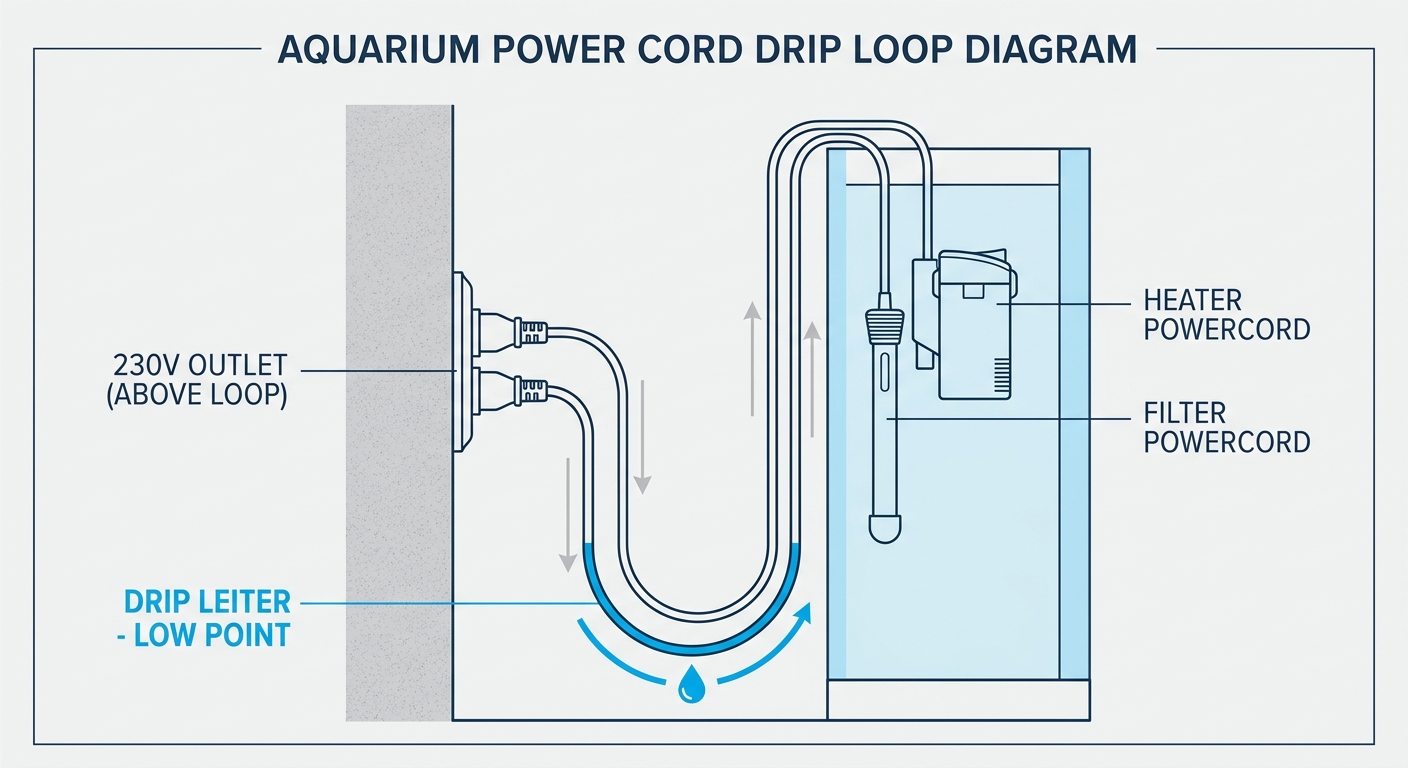
Every cord entering the tank, heater, filter, powerhead, light, must form a loop below the level of the electrical connection before rising to the outlet. Water traveling down the cord hits the bottom of the loop and drips off. It cannot travel upward against gravity to reach the outlet.
This is genuinely cheap insurance. It costs nothing and prevents the most common aquarium electrical failure mode: water tracking into a power strip or outlet behind the tank.
 dedicated circuits and load planning
A standard US residential circuit is 15 amps at 120 volts, which means 1,800 watts total capacity. But continuous loads running more than 3 hours can't exceed 80 percent of that, so 1,440 watts is your real working limit.
A typical aquarium electrical draw:
- Heater: 150 to 300 watts for a 75-gallon tank, often two heaters for redundancy (300 to 600 watts total)
- Canister filter: 10 to 30 watts
- LED lighting: 30 to 80 watts for planted tank lights
- Powerheads or wavemakers: 5 to 20 watts each
- UV sterilizer: 9 to 36 watts
- Total: roughly 400 to 800 watts for a well-equipped 75-gallon freshwater tank
That's comfortably under 1,440 watts if the circuit is dedicated. But if you share the circuit with a 1,500-watt space heater, a vacuum cleaner, or a window air conditioner, the breaker trips. It's a quiet failure. You don't realize it's the tank until the heater has been off for 12 hours and the temperature has dropped.
For tanks under 55 gallons, sharing a circuit is probably okay if there's nothing major also on that circuit. For tanks over 55 gallons with multiple heaters, a dedicated circuit is highly recommended. At minimum, map which outlets share the circuit with your candidate tank outlet before setup. Know what else can run on that circuit without tripping.
5. water access for top offs and water changes
Water changes are a weekly maintenance task, not a one-time setup task. A 75-gallon tank at 20 percent weekly change is 15 gallons of water moved every week, 780 gallons per year. If you're carrying 5-gallon buckets, that's 3 trips per water change, 156 trips per year. At 30 feet each way with a full bucket weighing 41.7 pounds, that's over 9,300 feet of walking with weight annually.
The placement decision here isn't about installation day. It's about Tuesday afternoon six months from now, when you're dreading the water change because the tank is in a room with no nearby water source and no drain.
gravity water changers
Python-style aquarium water changers work by connecting to a faucet. The running water creates a venturi effect that siphons tank water into the sink drain. They come in 25-foot, 50-foot, and 75-foot lengths. 50 feet is the most commonly sold and covers a typical single-room distance.
The limitation: the faucet must run continuously during draining, which wastes water. The user must also have a compatible faucet with standard aerator threading. Pull-out sprayer faucets often don't work without an adapter, and sometimes not even with one.
ro/di hose routing
RO/DI systems use 1/4-inch polyethylene tubing. They can run 50 to 100 feet without significant pressure loss because the flow rate is low and friction loss stays minimal. This matters more for reef tanks, which often have RO/DI units in a garage or basement with hundreds of gallons of storage far from the tank.
utility sink vs kitchen sink
A utility or laundry sink is ideal. It's designed for handling large spills and waste water. It's usually deep enough to fill and drain buckets easily. It's rarely used for food prep, so there's no cross-contamination risk.
A kitchen sink is workable for small tanks, but it's also used for food. Fish waste, dechlorinator residue, and salt creep on your hands create a hygiene risk that frustrates the household. Kitchen sinks also tend to be the center of household conflict. Everyone wants to use it, and hauling tank water through the kitchen during dinner prep is never popular.
A bathroom sink works for tanks under 40 gallons, but the basin is shallow and the faucet height limits bucket sizes.
the bucket distance rule
Under 20 feet: manageable.
20 to 30 feet: doable, but the maintenance dread builds.
30 feet or more: the tank will get fewer water changes. This isn't speculation. I've seen it repeatedly. People with long bucket walks stretch their change intervals from weekly to biweekly or monthly. The tank suffers.
6. drainage for water changes the overlooked half
Most aquarium placement guides mention drainage as an afterthought. I'm leading with it here because it's the differentiator between a tank you actually maintain and a tank that becomes a weekly chore you avoid.
Water has to go somewhere when you drain the tank. Where it goes determines whether you spend 15 minutes or 45 minutes on the maintenance.
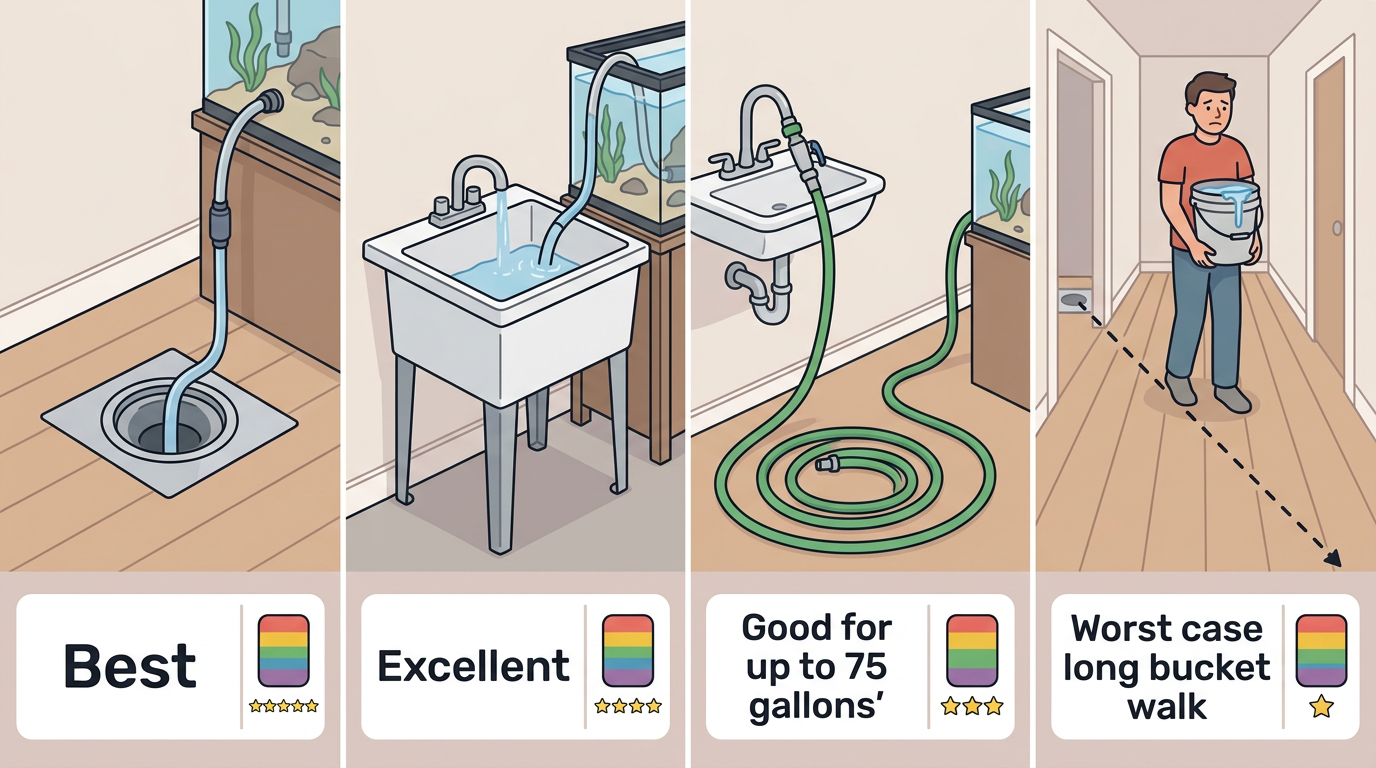
drainage options best to worst
Floor drain within hose reach: Ideal. Siphon or pump water straight to the drain. Zero carrying.
Utility or laundry sink: Excellent. Gravity siphon or pump discharge into the sink drain.
Toilet: Functional, but controversial. Risk of contamination (splash-back, bacteria from the toilet bowl to the hose end) makes this a last resort. Some hobbyists use it successfully if a dedicated drain hose never touches the water inside the toilet.
Bathroom or kitchen sink via Python: Good for tanks up to 75 gallons. The siphon rate slows with distance and vertical rise.
Out a window or door: Seasonal only. Winter hoses freeze. Summer hoses kill grass with treated water. More common for fish rooms and basement sumps than display tanks.
Buckets to a distant sink: Worst case, but the reality for many apartments and homes without utility rooms. This is also where the 30-foot bucket walk becomes a maintenance tax.
 drain pumps
A small submersible pump (400 to 800 GPH) with 3/4-inch or 1-inch ID vinyl tubing drains much faster than gravity siphoning. A 400 GPH pump drains 75 gallons in roughly 11 minutes, though real-world rates are lower due to head height and hose friction.
The pump can sit in the tank during water changes (watch the intake so small fish don't get pulled in) or in a dedicated sump if you're running one. Keep hose routing as straight as possible. Every 90-degree bend reduces flow rate significantly. Coil the hose under the stand or on a reel nearby. Never leave it across a walking path where people trip over it.
the corridor trap
A hallway placement looks perfect aesthetically. The tank is visible from multiple rooms. But if the hallway has no nearby drain and minimal water access, every water change involves bucket walks through the house. This is the placement that looks good on day one and becomes a maintenance tax by month three.
saltwater specific
Reef tanks add complexity. Automatic top-off systems keep salinity stable by replacing only evaporated freshwater. The ATO system requires a freshwater reservoir near the tank. A reservoir under 5 gallons means you're refilling it every 2 to 3 days. If the RO/DI unit is in the garage and the ATO fills from there, you're running tubing through the house or keeping a small reservoir nearby and constantly refilling it from the RO/DI unit.
Larger reef tanks frequently run plumbing through walls and floors to a remote sump and mixing station in the basement or garage. That installation is a bigger commitment, and placement suddenly affects the entire plumbing infrastructure.
7. vibration and household traffic
Fish detect vibration through their lateral line system, mechanoreceptors that sense water displacement, pressure waves, and low-frequency motion. This is their primary hearing. They don't hear airborne sound the way humans do. They feel vibrations in the water.
Chronic low-frequency vibration from foot traffic and appliances has been documented to reduce feeding response, slow growth rates, and suppress spawning behavior. Most beginners don't notice the effect until the tank has been in a bad spot for months. The fish are less active. They look duller. You assume it's the diet or the filter. It's the vibration.
foot traffic and door swings
Heavy foot traffic transmits vibration through floor joists. Daily traffic plus shoes equals constant low-amplitude vibration traveling into the water column. Place the tank away from the room's main walking line.
Door slamming sends a pressure wave plus vibration through the room, both of which transmit directly into the tank. Front doors that open many times daily, bedroom doors from kids running around, and bathroom doors that close hard all create the same problem. If the tank is within 6 feet of a frequently used door, it's experiencing constant disturbance.
appliances and speakers
Subwoofers and low-frequency speakers transmit vibration through building framing and directly into the water. The low frequencies (20 to 80 Hertz) travel efficiently through floors and walls. Keep subwoofers at least 8 to 10 feet from the tank and isolate them from the floor with foam pads.
Washing machines and dryers during spin cycle create rhythmic low-frequency vibration that travels through floor framing. Tanks in rooms adjacent to laundry rooms with shared walls experience this vibration constantly during wash days.
Dishwashers create less vibration than laundry but still transmit through cabinetry and shared framing.
clearance and design
The tank should not be in the primary walking line of the room. Aesthetically, the center of the room seems perfect. Functionally, it puts the tank in constant traffic and vibration. A corner placement is doubly bad: foot traffic often passes near corners, and corners amplify reflected sound and vibration.
Aim for placement where foot traffic is minimal and the tank is set back from common walkways. This also gives you better maintenance access and reduces the risk of someone bumping or colliding with it.
8. quick reference checklist do's and don'ts
Do:
- Do place the tank against an interior wall (temperature-buffered on both sides)
- Do install a GFCI outlet or GFCI breaker within 2 to 4 feet of the tank location
- Do check the candidate spot with a thermometer logging min/max for 48 hours before setup
- Do position the tank perpendicular to floor joists on upper-floor installations
- Do ensure at least 3 feet of clearance in front for maintenance access
- Do site within 25 feet of a water source (sink or utility tap) for manageable water changes
- Do use a foam mat under rimless tanks and level the stand with shims
- Do form a drip loop on every cord entering the tank
Don't:
- Don't place the tank in direct sunlight or within 3 feet of an unscreened window
- Don't put the tank near an HVAC supply vent, radiator, fireplace, or exterior door
- Don't place the tank in a hallway with no nearby drain. You'll dread every water change
- Don't put the tank on a second floor without checking joist direction and span first
- Don't use an extension cord as a permanent wiring solution
- Don't position the tank where a door can swing into it
- Don't place the tank in the kitchen or bathroom unless you have ruled out temperature and humidity swings
- Don't put the tank where household traffic creates constant vibration (main walking path, near speakers)
9. faq where people ask can i put my tank near
Can I put my fish tank near a window?
No, if the window receives direct sunlight at any point in the day. North-facing windows with indirect light only are generally fine.
Can I put an aquarium near a radiator or heating vent?
No. Radiators create hot spots on the nearest glass, and HVAC vents cause rapid evaporative cooling and temperature fluctuation. Keep tanks 5+ feet from any vent.
Can I put an aquarium on the second floor?
Yes, up to roughly 55 to 75 gallons on a standard residential floor if placed perpendicular to joists and against a load-bearing wall. Above 75 gallons, consult a structural engineer. Tank plus water plus stand plus rock can exceed 1,000 pounds concentrated on a small footprint.
Can I put a fish tank in the kitchen?
Not recommended. Ovens create large temperature swings. Cooking grease aerosols coat the water surface and reduce gas exchange. Cleaning chemicals overspray is a risk.
Can I put a fish tank in the bathroom?
No. Daily shower humidity and temperature swings, aerosolized soaps and cleaners, and typically limited space and outlets make bathrooms one of the worst locations.
Can I put my aquarium near a TV or speakers?
TV: fine. Speakers and subwoofers: keep subwoofers 8+ feet away. Vibration travels efficiently through water and stresses fish.
Can I put a fish tank behind a couch?
Not ideal. Reduced front access makes maintenance harder. Airflow behind the tank is restricted. Visibility is compromised. If you must, leave at least 6 inches between the tank back and the wall for filter hoses and airflow, and ensure the couch doesn't block front access.
How close can an aquarium be to a door?
At least 4 to 6 feet, and ensure the door cannot swing into the tank. Door slamming sends pressure waves through the room that transmit directly into the aquarium water.
Does an aquarium need a dedicated electrical circuit?
Not mandatory below roughly 55 gallons, but highly recommended for tanks over 55 gallons with multiple heaters. At minimum, identify what else is on the circuit before setup. Two 300-watt heaters plus filter plus lights on a shared circuit with a space heater will trip a 15-amp breaker.
10. conclusion decide the spot then buy the tank
Put the tank on an interior wall, away from windows, doors, HVAC vents, and direct sunlight. It sits on a level, structurally sound floor near a GFCI outlet and a water source. That's the goal.
If no spot in the house passes the checklist, that's useful information to have before the tank is on a credit card. Too many people buy first and figure out placement second. They end up with a tank that's fighting algae, cracked from uneven support, in a temperature-unstable corner, with water changes that feel like punishment.
Pick the spot first. Test it for a couple of days with a thermometer. Verify the electrical outlet and water access. Make sure the floor is sound and the placement makes maintenance realistic. Then buy the tank.
It's the one decision that makes everything else easier or harder for years to come.
Comments
No comments yet.