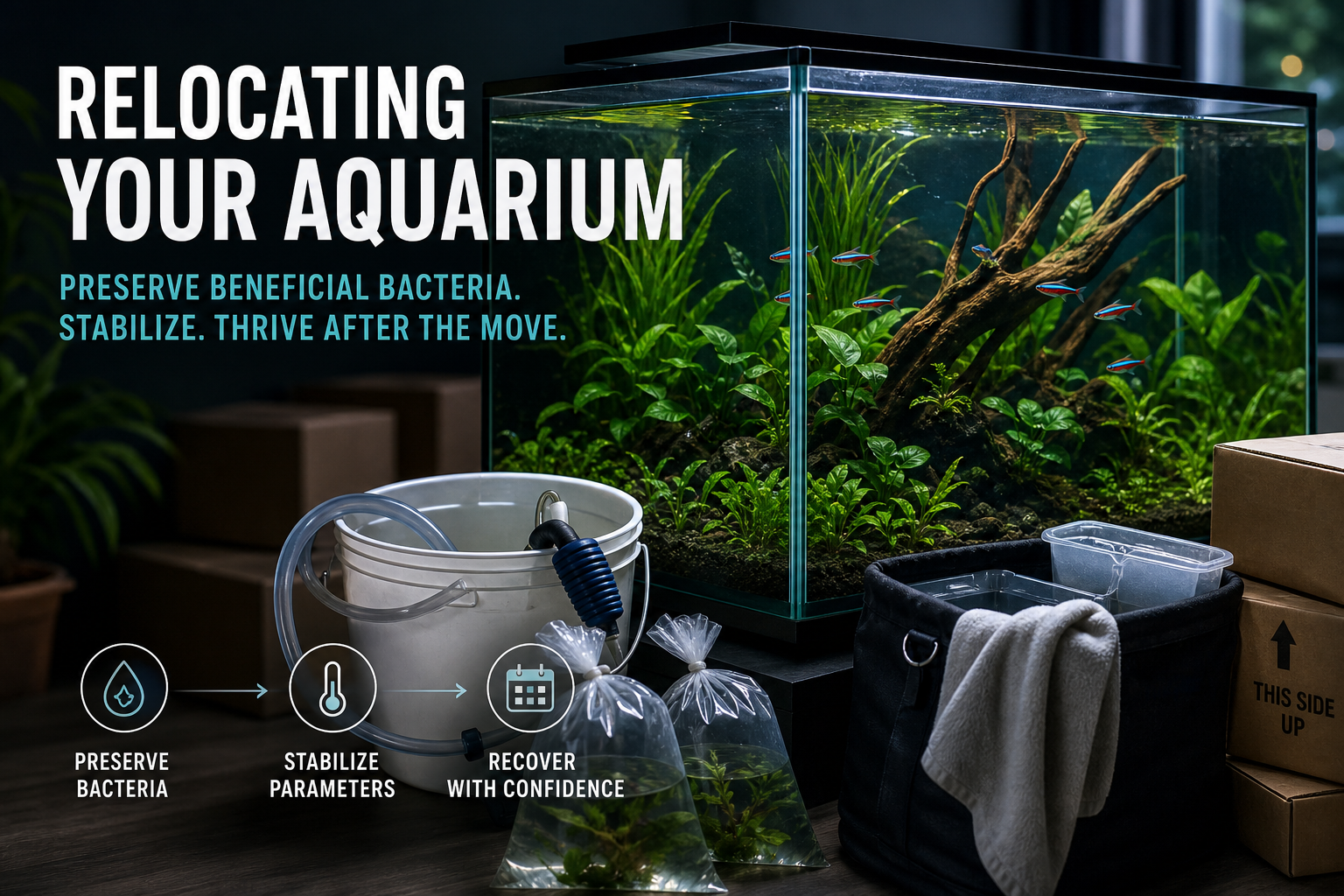
Can you move a fish tank with fish in it? No. Never move fish inside the tank. The water sloshes during transport, fish get battered against the glass and decorations, the tank can crack under stress, and you can seriously hurt yourself lifting hundreds of pounds of water-filled glass. Fish go in bags or buckets. The tank goes empty.
Moving an aquarium successfully comes down to three things: preserving your beneficial bacteria, keeping your fish stable through transport, and timing the setup so your nitrogen cycle doesn't crash. This guide covers the whole process—planning weeks ahead, executing on moving day, and stabilizing the tank in those critical first days and weeks at your new place.
Before the Move (1–2 Weeks Out)
Assess your timeline: the nitrogen cycle matters
If your tank is still working on establishing a cycle, moving it is genuinely awful timing. A newly cycled tank has a narrow window of stability, and disrupting it mid-establishment almost always crashes it completely.
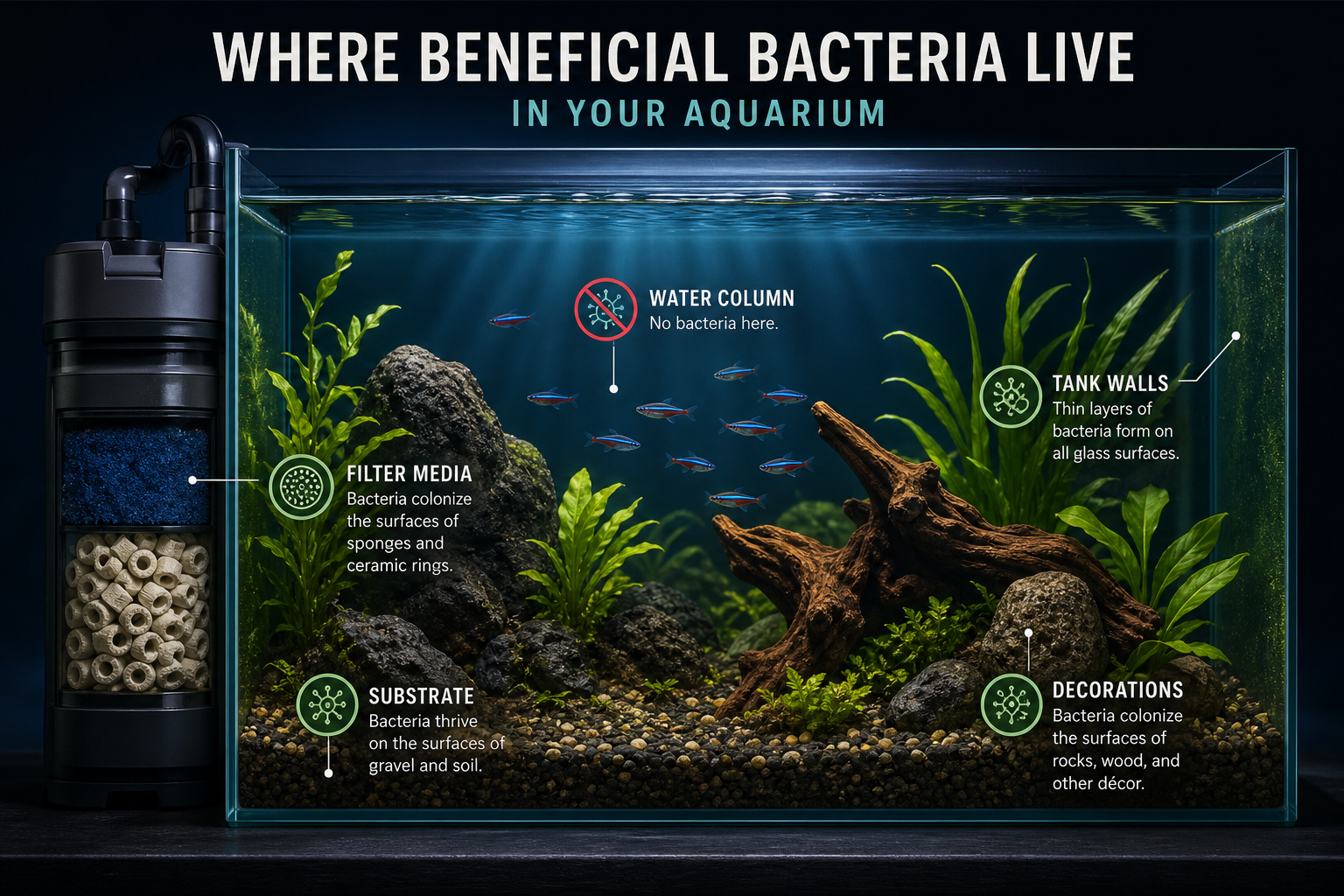
The nitrogen cycle lives on surfaces—filter media, gravel, tank walls, decorations. These bacteria colonies don't float in the water. When you move a tank, some die no matter what you do. An established tank with a strong biofilter can handle this. A tank that's been running for two weeks? It collapses.
If you're moving within 3–6 weeks of starting a cycle, ask yourself: can you wait? If you can delay the move by another 2–4 weeks, your odds improve dramatically. If you can't wait, accept that you'll likely need to re-cycle at the new location. It's not great, but it's better than trying to move mid-cycle.
For established tanks (2+ months running), moving is manageable. Your biological filter is mature enough to survive some die-off and recover within a few days.
Equipment check
A few days before the move, plug in every piece of equipment and run it. Heaters, filters, air pumps, powerheads—the moving box is not where you want to discover something stopped working.
Test your backup power too. Battery air pumps fail more often than I'd like. If you have a portable generator or a power inverter in your car, test those before moving day.
Gather your supplies
You need:
- Fish bags and rubber bands (most local fish stores provide free bags or sell them cheap)
- 5-gallon buckets with lids (food-grade HDPE only—hardware store paint buckets work if they're new)
- Styrofoam coolers or cardboard shipping boxes (insulation matters)
- Battery-powered air pump (get one even if your move is short; you'll use it)
- Dechlorinator and water conditioner (if you're not sure what you use, get a general-purpose one like Seachem Prime)
- Ammonia detoxifier (Seachem Prime, Amquel, or equivalent—binds ammonia for 24–48 hours)
- API Master Test Kit (liquid reagent; test strips are useless for tracking post-move cycles)
- Large turkey baster or aquarium siphon (for draining without destroying your substrate)
- Towels, newspapers, or wet-dry shop vacuum (final cleanup of the empty tank)
Plan livestock transport
Do not move fish inside the tank. Not even a little bit. Not even if your move is five blocks away.
A tank with water and gravel inside weighs hundreds of pounds. The water sloshes. Your fish get battered against the glass and decorations. The tank can twist during loading, cracking the silicone seals. And you can seriously injure yourself trying to lift it.
Fish go in bags or buckets. Tank goes empty. Period.
---
24–48 Hours Before Moving Day
Reduce feeding before transport
Skip feeding for a few hours before the move, or feed very lightly. Stressed fish suppress appetite, so any uneaten food decays into ammonia in the transport bags. Less material decaying in confined spaces keeps conditions slightly more stable during transit.
You don't need to starve the fish for 24 hours beforehand. That's overkill. Fish are fine skipping one meal. The real feeding restriction comes after the move—wait 24 hours before feeding again, because stressed fish won't eat anyway and uneaten food spikes ammonia in their already-fragile post-move environment. More on that below.
Save tank water
Save 75–80% of your tank water. This number makes sense.
Old tank water isn't valuable because of its bacteria—that bacteria lives on surfaces, not floating in the water column. But the water itself is valuable for its chemistry. Your fish have spent weeks or months adapting to that specific pH, GH, KH, dissolved organics, and trace minerals. New tap water, even when it tests "correct," often has a different mineral profile, different dissolved gas concentrations, different organic compounds. Using 100% new water can shock fish even when the numbers look the same on paper.
Transfer the old water into clean 5-gallon buckets with lids. Don't clean these buckets with soap—use just hot water and a rinse.
Before the move, check your tap water. Does it smell like chlorine? If yes, prepare your replacement water (20–25% fresh water) in advance and treat it with dechlorinator. Let it sit for a few hours so temperature stabilizes at room temperature, but don't heat it yet. You'll adjust temperature after setup.
Protect beneficial bacteria
Filter media needs to stay wet. That's the core rule.
If you have a canister filter, drain it but leave the media inside. Fill the canister with tank water, seal it, and transport it that way. This gives the bacteria several hours of survival time.
If you have a hang-on-back filter or sponge filter, remove the media and place it in a bucket of tank water. Add a battery-powered air stone if you have one, or just let the bucket sit open. Oxygen helps, but even standing water beats dried-out media.
Do not clean the filter media before the move. I know it looks gunky. That gunk is where the bacteria live. You're cleaning away the cycle if you wash it.
Pack the filter media bucket last so you can transport it where temperature stays relatively stable (passenger area of the car, not the hot trunk).
Prepare live plants
If you have rooted plants, leave them in the substrate. They survive the move fine as long as the gravel stays relatively moist.
If you have stem plants or moss that you want to save, place them in a damp towel inside a sealed container (zip-lock bag works). They can survive several hours without water as long as they don't dry out completely. Wilted plants usually recover within a few hours of being re-submerged.
---
Moving Day: Step-by-Step
Net and bag fish
The standard ratio is 1/3 water to 2/3 air. More air than water gives fish room to move and maximizes surface area for oxygen diffusion. Lay the bags on their sides in a box—flat bags with side-to-side room are better than upright bags.
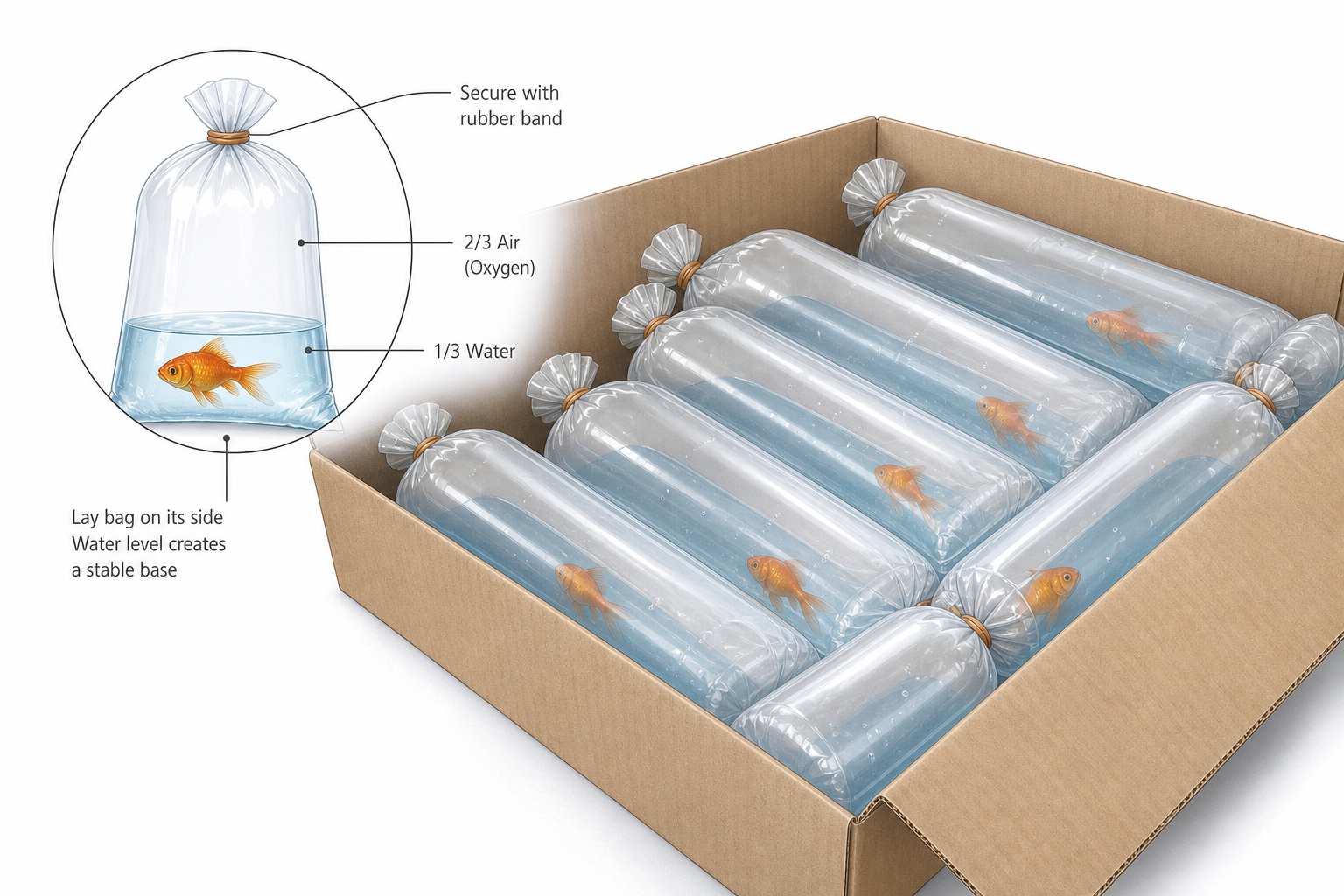 If you're moving more than 2 hours away, ask your local fish store if they can pack fish in pure oxygen. This extends safe travel time from 1–2 hours to 24–48 hours. Most will do it for a small fee (a couple bucks per bag).
Double-bag if you can. It's cheap insurance against punctures and leaks.
Never blow into fish bags yourself. Human breath is 16% oxygen and 4% CO₂. You're adding carbon dioxide, which acidifies the water and wastes precious oxygen. Use atmospheric air (a straw, a hand-pump if you have one) or nothing.
Drain and pack the tank
Remove decorations and place them in a separate bucket. Remove the heater (let it cool first if it was running) and place it in a small container wrapped in a towel.
Unplug the heater before draining. This is critical. A heater exposed to air will overheat and can shatter when you re-submerge it. Shattered glass plus hot element equals fire hazard and injury.
Drain the tank using a siphon or turkey baster. Remove maybe half the gravel into a bucket. Leave perhaps half in the tank—this reduces weight and preserves some of the substrate bacteria.
Once the tank is mostly drained, wipe down the inside walls with a soft cloth or sponge (no soap, no chemicals). Wipe out any debris, algae, or detritus. Setup is easier later if you clean now.
Let the tank dry for maybe 15 minutes. Then check the seams and corners for any remaining debris. A wet/dry shop vac is handy here if you have one.
Wrap the empty, dry tank in moving blankets or furniture pads. The goal is damage protection during transport, not insulation.
Transport filter media
This is where most people accidentally crash their cycles.
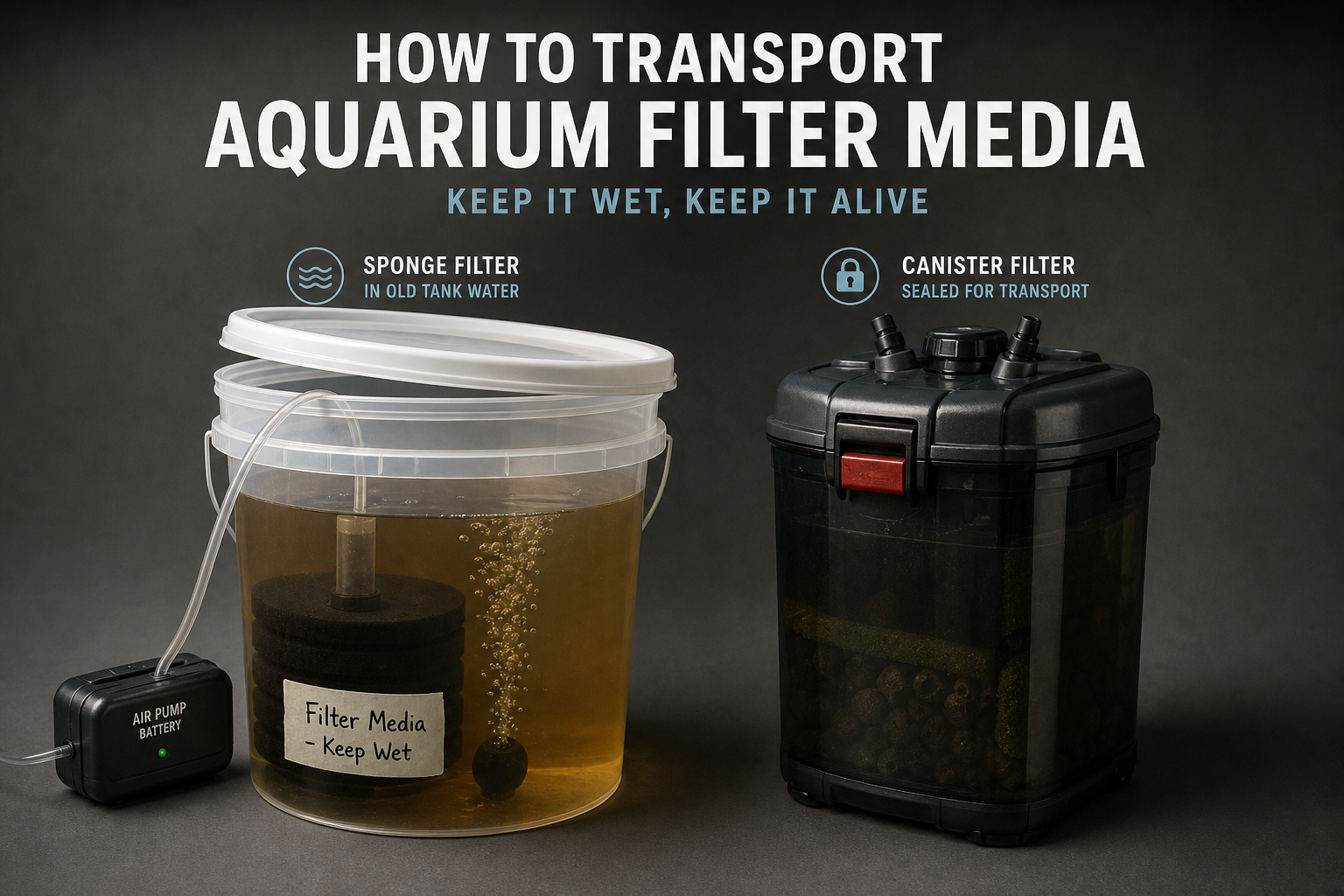 Keep your filter media submerged in tank water during the entire move. Don't let it dry. Don't let it sit exposed to air while you're loading the truck. Transport it in a sealed container in the passenger area of your car where temperature stays moderate.
The moment you arrive at the new location, don't plug the filter in yet. Don't run it with plain tap water. Chlorine and chloramine kill nitrifying bacteria on contact. Wait until you've set up the tank and added dechlorinated water. Then plug in the filter with the media already submerged in treated water.
Handle live rock and coral (saltwater)
Live rock dies if it's exposed to air for more than 30–60 minutes. The sponges, coralline algae, and encrusting organisms suffocate.
Transport live rock fully submerged in a sealed bucket of tank water. If the bucket has a lid that compresses, don't seal it hard—leave breathing room or drill small air holes. You're preventing it from drying out, not creating an anaerobic environment.
Corals are fragile. Transport them in individual sealed containers filled with tank water. Keep the containers insulated and temperature-stable. SPS corals (stony hard corals) need to stay submerged. LPS corals (large polyp stony corals) and soft corals can tolerate a few minutes out of water but don't push it.
Wrap everything in dark towels or place containers in dark bags to reduce light stress during transport.
Load order and transport strategy
Load the heaviest things first (the empty tank). Pack the truck strategically:
- Heavy items on the floor, secured so they don't slide
- Filter media bucket and fish bags in the passenger area where you can monitor temperature
- Bags of fish and invertebrates grouped together, out of direct sun
- Water buckets secured so lids don't pop off from sloshing
During transit, crack a window if the car gets hot. If it's cold, turn on the heater. You're keeping fish and filter media in the 65–80°F range, depending on your species.
For moves over 6 hours, plan a stop to check on everything. Open fish bags, let fresh air in (if using atmospheric bags), check water temperature, and listen for any problems.
---
After the Move: First 72 Hours
Setup sequence
Unload the tank and place it on its new stand. Check that it's level using a bubble level. An unlevel tank stresses the seals over time and can eventually leak or fail.
Add your substrate (the gravel you saved, maybe supplemented with a little new gravel to refill). Spread it evenly.
Add water—old tank water first, then new prepared water. Fill slowly, pouring over a plate or saucer placed in the tank to diffuse the flow and avoid displacing gravel. Aim for 75–80% old water and 20–25% new.
Once the tank is full, place your decorations back in. Install the heater (check that it's been unplugged long enough to cool; most manufacturers recommend 15–30 minutes before submerging). Plug it in and set it to your species' target temperature (usually 75–80°F for tropical fish, 72–76°F for temperate species).
Now set up the filter. Place the media inside. Fill the canister or hang-on-back with dechlorinated water (from your prepared bucket). Then plug it in. The media will already be submerged in treated water, so you're not exposing bacteria to chlorine.
Let the tank run for 30–60 minutes so temperature and flow stabilize and any air pockets in the filter work out. Then acclimate your fish.
Acclimate fish once temperature is stable
You don't need to keep fish waiting around in bags for hours. That's unnecessary stress. Once the tank has been running for 30–60 minutes and the heater has brought temperature to your target range, it's time to get them in.
Check that tank temperature matches the temperature the fish were transported in. If there's a gap of more than 2°F, wait another 10–15 minutes and check again. Once they're within 2°F, acclimate by floating.
Float method: Open the fish bags and let them float in the tank for 15–20 minutes. This brings the bag water gradually up to tank temperature. Then open the bag and add a small amount of tank water (1/4 cup). Wait 5 minutes. Repeat three more times over 15 minutes. Then net the fish out of the bag and into the tank. Dispose of the bag water—don't pour it in.
That's it. Twenty to thirty minutes total, and they're in. Fish are less stressed by a short acclimation window than by hours of being stuck in a bag while you wait for an arbitrary timer.
Some people use drip acclimation instead—a slow siphon from the tank into the bag over 30–45 minutes. That works fine too if you prefer the slower approach. The key is matching temperature first, then introducing tank water gradually. Both methods work. Pick whichever fits your move.
Test parameters immediately
Once fish are acclimated, test ammonia, nitrite, nitrate, and pH. Write down the numbers. These are your baseline.
What are you looking for?
- Ammonia: Should be 0 ppm. If it's above 0.25 ppm, do a 25–50% water change with conditioned, temperature-matched water. Dose with ammonia detoxifier.
- Nitrite: Should be 0 ppm. If it's above 0.5 ppm, same response—water change and detoxifier.
- Nitrate: Usually 0 ppm in a freshly moved tank. If it's elevated, it suggests the biological filter is already processing waste (good sign).
- pH: Should match your old tank. If it's swung more than 0.5 points, you have a problem. See the "Old Tank Syndrome" section below.
Watch for stress signals in fish
Fish that just went through transport will be stressed no matter what. Expect them to hide or huddle for a while. That's normal.
Concerning signs that go beyond normal stress:
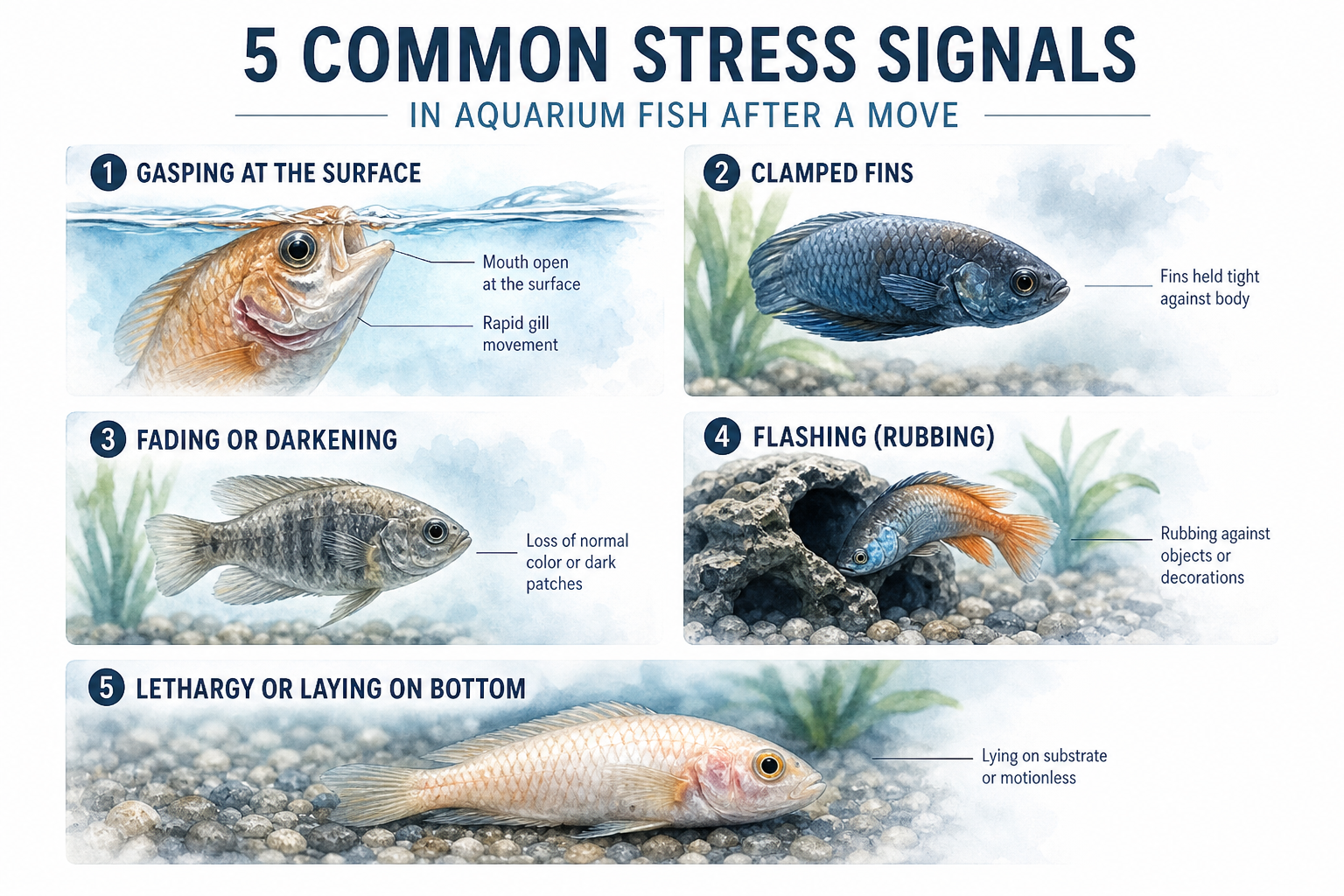 Rapid gilling or gasping at the surface: Either oxygen depletion or gill irritation from ammonia. Check ammonia and nitrite immediately. Make sure the filter is running and air stone (if you have one) is bubbling. If nothing's wrong with equipment, do an emergency 50% water change.
- Clamped fins held tight against the body: General stress. Usually improves within 24 hours. If it continues past 48 hours, test parameters to see if ammonia or pH has shifted.
- Color loss or unusual darkening: Stress hormone response. Normal for 24–48 hours post-move.
- Flashing (rubbing against objects) or white spots on skin: Ich (Ichthyophthirius multifiliis). This is the most common post-move illness—catch it early and treat with an appropriate ich medication.
- Lying on the bottom refusing to move: Temperature shock, pH shock, or severe ammonia toxicity. This is an emergency. Test water and temperature immediately. If temperature is wrong, adjust it gradually (no more than 1–2°F per hour). If ammonia is high, do an emergency water change.
Feed lightly once fish are settled
After acclimation, you can offer a small amount of food once the fish have settled for a few hours. Many people wait until evening of the first day, or skip the first meal entirely if the fish look really stressed.
Stressed fish have suppressed appetites. Uneaten food rots and becomes ammonia—exactly what you want to avoid in a newly moved tank. Start with about 1/4 of your normal feeding amount for the first 3–5 days. Watch what the fish eat in a minute or two, then remove what's left. As fish calm down and resume normal behavior, gradually increase feeding over a week to normal levels.
---
First Week and Beyond
Daily parameter checks
For the first week, test ammonia and nitrite every single day. Yes, every day. This is not excessive.
Most established tanks recover within 3–10 days. But recovery isn't guaranteed. Every tank is different. Your tank might spike ammonia on day two, recover by day five, then spike again on day seven. You can't know without testing.
A mini-cycle is almost inevitable. Expect to see some detectable ammonia or nitrite at some point. If you catch it at 0.25 ppm and do a water change, it stays manageable. If you ignore it, you wake up to dead fish and a tank at 2 ppm.
After the first week, test every other day for another week. After two weeks, you can move to weekly testing if the tank has stabilized.
Signs of old tank syndrome
If your tank has been established for 2+ years, it might have drifted into low pH and low KH—a condition called "old tank syndrome."
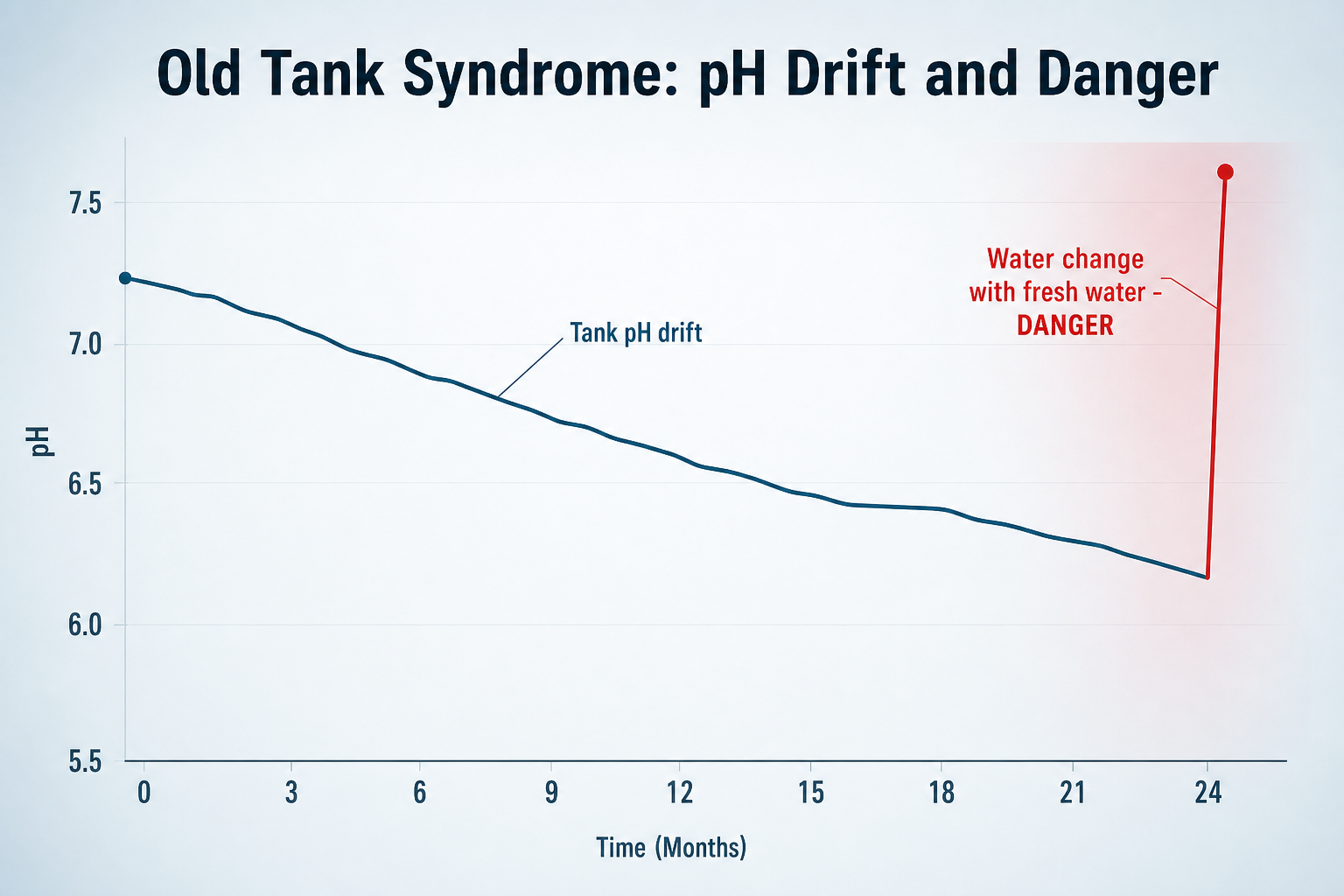 In these tanks, organic acids from decomposing waste have gradually depleted the carbonate hardness (KH). The pH has drifted downward slowly enough that fish and bacteria adapted. But the tank isn't actually healthy—it's just stable at that low point.
The danger emerges when you move. During setup, you do a water change with fresh, higher-pH source water. Suddenly the pH jumps 1.5–2 points. This shocks both fish and bacteria. Worse, ammonium (NH₄⁺, which had accumulated at the low pH and is less toxic) converts to toxic ammonia (NH₃) as pH rises. You get an ammonia spike that seems to come from nowhere.
Before the move, test your old tank's pH and KH. If pH is below 6.5 or KH is below 3 dKH, you have old tank syndrome. During setup at the new location, don't do large water changes all at once. Mix old and new water in stages. Add a KH buffer (crushed coral, aragonite, or commercial buffer) to the substrate to prevent pH from crashing again. Acclimate the system gradually over 3–5 days instead of going to stable parameters immediately.
When to intervene: emergency water changes
If ammonia reaches 0.5 ppm or higher, or if nitrite reaches 0.5 ppm, do an emergency 50% water change right away. Don't wait for tomorrow's test.
Use water that's been conditioned with dechlorinator and matched to tank temperature as closely as possible. If you don't have matching-temperature water prepared, use room-temperature water and change it slowly—pour a little in, wait a few minutes, pour more in. Temperature swings kill fish.
After the water change, dose with ammonia detoxifier (Seachem Prime or equivalent). This binds ammonia and nitrite into non-toxic forms for 24–48 hours while the biological filter recovers.
If you see ammonia or nitrite spike again within 24 hours of a water change, do another water change and consider whether you're overfeeding. Cut food back further. Be patient.
Long-distance moves: extended transport
If your move is more than 4–6 hours, think carefully about timing. Can you drive straight through? Can you stop somewhere safe to rest?
For moves over 6 hours with fish in bags, plan to stop and refresh the bag water. Open the bag, let fresh air in (if using atmospheric bags), and exchange maybe 1/3 of the bag water with fresh tank water. Reseal and resume travel. This keeps ammonia from building up too much.
Battery-powered air pumps change the game. If you can place a pump and air stone in a 5-gallon bucket of fish and water, you can keep them safe for 12+ hours. Refresh the water if the trip goes longer.
For moves spanning multiple days (12+ hours of driving), consider having your local fish store board and ship your fish once the tank is set up at the destination. Overnight fish shipping with pure oxygen keeps fish safe for 24–48 hours. This eliminates the danger of temperature fluctuations during your travel and gives your tank time to stabilize before livestock arrives.
---
Frequently Asked Questions
Can I move my fish tank with fish inside it?
No. The water sloshes. The tank can crack. Your fish get injured. And you risk seriously hurting yourself lifting hundreds of pounds of water-filled glass. Fish go in bags or buckets. Tank goes empty.
How do I keep fish alive during a move?
Use 1/3 water to 2/3 air in bags. Double-bag for puncture protection. Lay bags on their side for more surface area. For moves over 2 hours, ask the local fish store to pack fish in pure oxygen. Keep them out of direct sun and maintain temperature between 65–80°F depending on species. For trips over 6 hours, plan a stop to refresh bag water or set up a bucket with a battery air pump.
Will moving crash my nitrogen cycle?
Almost certainly some die-off of beneficial bacteria will happen. But "crash" depends on timing. A mature tank (2+ months established) can handle 10–30% bacterial die-off and recover within 3–10 days. A tank cycled only 2–4 weeks old will likely crash completely. If you're moving a new tank, expect an almost full re-cycle at the new location.
How long does it take a tank to recover after being moved?
With filter media preserved and kept wet, most established tanks stabilize within 1–2 weeks. You might see ammonia and nitrite spikes for 3–10 days; these are mini-cycles. The biofilter recovers faster with preserved media than if you started from scratch. Full stability (consistent 0 ppm ammonia and nitrite) usually takes 7–14 days depending on tank age and how well you preserved bacteria.
Should I feed fish before moving them?
Skip feeding for a few hours before the move to minimize uneaten food decay into ammonia in the transport bags. You don't need a full 24-hour fast—fish are fine skipping a meal. The real fasting period is waiting 24 hours after the move to resume feeding, since stressed fish won't eat and uneaten food spikes ammonia in their fragile post-move environment.
Can I reuse old tank water after a move?
Yes, and you should. Save 75–80% of the old water. It carries the chemistry your fish are adapted to—pH, GH, KH, dissolved minerals, organic compounds. Using 100% new water, even if it tests "correct," can shock fish because the water's character is different. Mixed old-and-new water is safer.
How do I move live plants with my aquarium?
Rooted plants stay in the substrate during the move. Keep the gravel moist but not actively wet (a closed container works). Stem plants and moss can be wrapped in a damp towel inside a sealed bag for several hours. They wilt but usually recover once re-submerged. Never let them dry out completely.
Is it safe to move a saltwater tank long distance?
Yes, but with extra care. Live rock needs to stay submerged or wrapped in wet cloth during transport (exposed to air for over 30–60 minutes kills the encrusting life). Corals need insulated containers filled with tank water and kept temperature-stable (narrow thermal tolerance). Invertebrates like shrimp are more sensitive to temperature swings than fish. Transport in the passenger area where temperature is stable. After setup, monitor first 3–5 days closely for stress signals.
---
Quick Aquarium Moving Checklist
Before the Move (1–2 Weeks Out)
- Choose timing: avoid moving tanks in the middle of cycling
- Test all equipment (heaters, filters, pumps, backup power)
- Gather supplies: bags, buckets, coolers, air pumps, dechlorinator, test kit
- Research your route and plan for fish transport (2-hour drive? 8-hour? Pure oxygen needed?)
24–48 Hours Before
- Skip feeding for a few hours before transport; avoid large pre-move meals
- Save 75–80% of tank water in clean buckets
- Change filter media to a bucket of tank water; do not clean it
- Prepare replacement water (20–25%) and treat with dechlorinator
- Wrap live plants in damp towel, place in sealed bag
Moving Day
- Unplug heater before draining (critical—prevents shattering)
- Bag fish: 1/3 water, 2/3 air; double-bag; lay flat
- Remove gravel (save ~50%); drain tank
- Wipe down interior; wrap empty tank in blankets
- Transport filter media in passenger area in sealed container with old tank water
- Keep fish bags out of direct sun; maintain 65–80°F
First 60 Minutes at New Location
- Unload and level the tank
- Add substrate, fill with 75–80% old and 20–25% new water
- Install and plug in heater
- Set up filter with media already submerged in dechlorinated water
- Let everything run 30–60 minutes while temperature stabilizes
After Temperature Is Stable
- Float-acclimate fish bags: 15–20 minutes floating, then add small amounts of tank water every 5 minutes
- Net fish into tank; discard bag water
- Test ammonia, nitrite, nitrate, pH immediately
- Watch for stress signals; feed sparingly or skip first meal if fish are stressed
First Week
- Test ammonia and nitrite daily
- Do 25–50% water changes if ammonia or nitrite exceed 0.25 ppm
- Gradually increase feeding as fish calm down
- Watch for ich (white spots appearing 3–7 days post-move)
Weeks 2–3
- Test every other day; watch for delayed mini-cycle spikes
- Resume normal feeding once fish are active and eating normally
- After day 14 with stable parameters, move to weekly testing
Comments
No comments yet.