Most aquarists skip quarantine. It seems like an extra step, another tank to set up, and your new fish look perfectly healthy anyway. Then something goes wrong.
You introduce a new shipment to your display tank. For a few days, everything's fine. Then one fish develops white spots. By day ten, every fish in the tank has them. What started as a problem on one fish has become a tank-wide outbreak. Now you're facing weeks of treatment, possible fish death, and the knowledge that you could have prevented this entirely with a 10-gallon tank and four weeks of waiting.
A basic quarantine tank setup takes under 30 minutes to assemble. This guide walks through how to quarantine fish from start to finish: the equipment, cycling, daily observation, and when it's safe to move new arrivals to your display tank.
why quarantine new fish?
The stakes are bigger than most hobbyists realize.
New fish are stressed. They've been shipped, handled, netted, and moved between tanks. During transport, their immune system drops. This matters because almost every new fish carries something—disease, parasites, or pathogens that haven't triggered a response yet because nothing's pushed the fish that way. The stress of shipping changes that equation.
In a quarantine tank, a problem stays contained. If it reaches your main tank, you're treating an entire ecosystem. Your plants can't handle copper. Your invertebrates die from medications. Your beneficial bacteria crash when you add antibiotics. Fixing a disease outbreak in an established display tank often means tearing it down.
The numbers add up. A proper quarantine eliminates roughly 90% of disease transmission risk, based on work published by fisheries researchers and veterinary programs. A basic quarantine setup runs $50 to $130. Losing hundreds of dollars worth of established livestock, or the months it takes to recover a display tank after a disease outbreak? Far more expensive.
Public aquaria are unanimous on this. AZA-accredited institutions—places that can afford the best equipment and expertise—quarantine every single new arrival for a minimum of 30 days. They're not doing it out of excessive caution. They've seen what happens when they don't.
quarantine tank vs. hospital tank: what's the difference?
These sound like the same thing. They aren't.
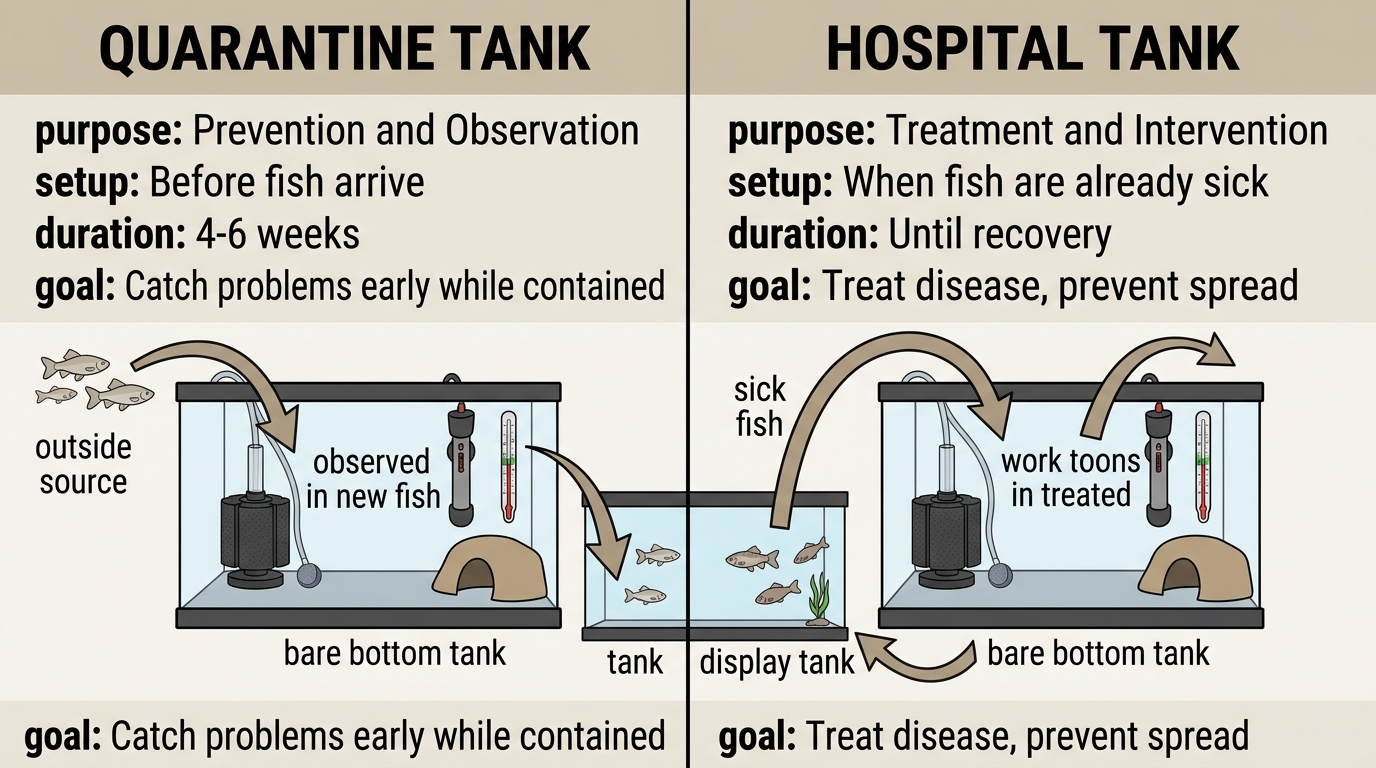
A quarantine tank is observation and prevention. You set it up before fish arrive. You fill it with a new fish, watch it for 4–6 weeks, and if nothing happens, transfer it to the main tank. The point is to catch problems early, while they're still contained.
A hospital tank is intervention. It's what you set up when a fish in your display tank is already sick. You move that fish to the hospital tank, start treatment, and hope you caught it before it spread. The physical setup is identical—bare bottom, sponge filter, heater, minimal decor—but the purpose is completely different.
Use the same physical tank for both purposes, but never at the same time. If you're running a quarantine, you're not also running a hospital. They share equipment, but they have different jobs. After you've quarantined and transferred fish to the display, break down the tank, clean it thoroughly, and only then use it as a hospital unit. Your future sick fish depend on you breaking the disease cycle between uses.
 quarantine tank setup: what you actually need
 quarantine tank size
You don't need much.
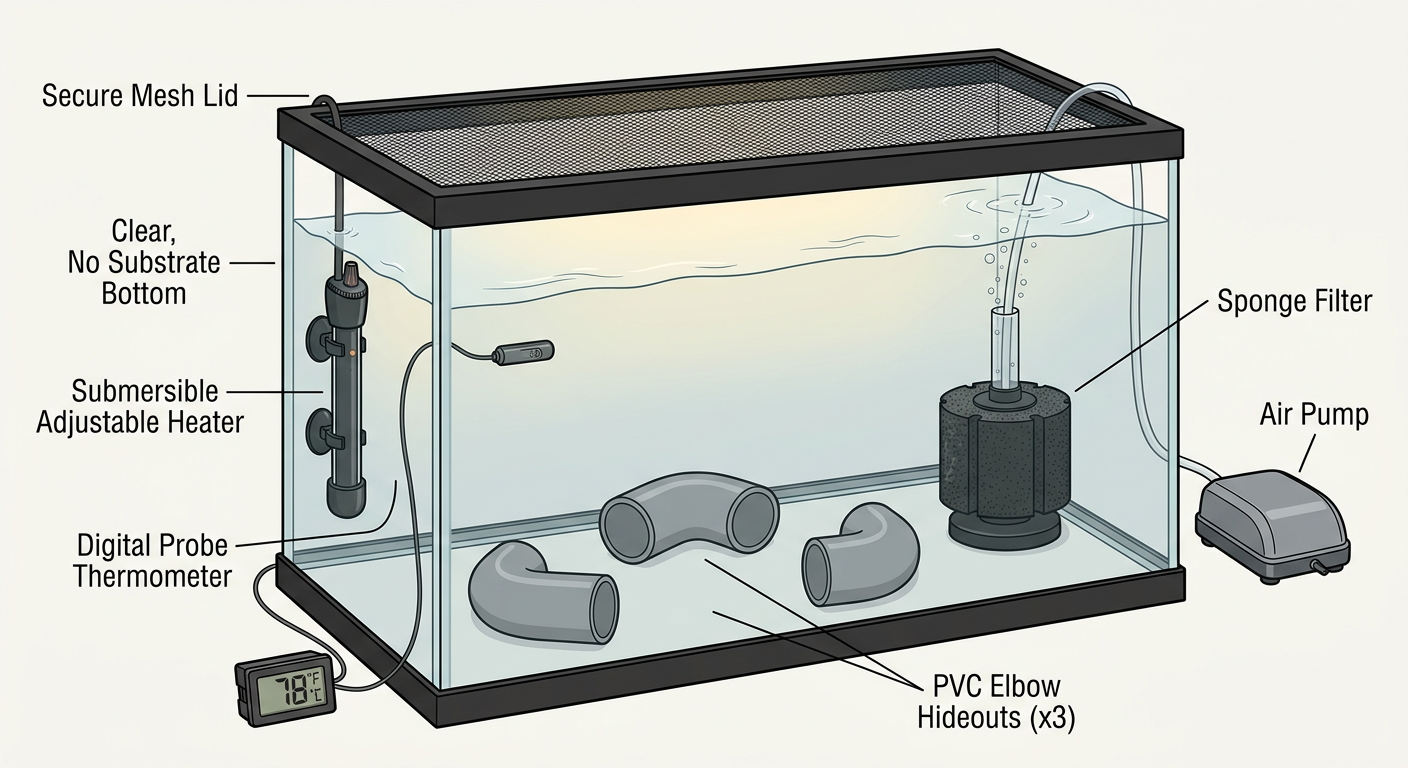
A 10-gallon tank works for most nano and small community fish—bettas, tetras, rasboras, small barbs, guppies. It's the practical minimum. You can house a single fish comfortably enough to observe behavior over weeks. The trade-off is that smaller water volume swings more sharply with ammonia spikes or temperature changes. That's manageable if you're doing water changes consistently.
A 20-gallon tank is the standard recommendation. It gives buffer against ammonia jumps, handles batches of smaller fish more easily, and gives you room for multiple hiding spots. Better buffer, more forgiving, only slightly more space.
For larger fish—cichlids, goldfish—you need proportionally more space. Koi need 250–500 gallons. A 29–30 gallon quarantine works for many medium-sized species or multiple small fish.
I've noticed people often overthink tank size for quarantine. Bigger seems safer. But smaller water volume actually has an advantage during observation—you see problems faster, and when you need to medicate, your dosing is cheaper and more precise. The catch is that you're managing parameters more actively. Choose based on how often you add fish and what you're typically quarantining. If you bring in five small tetras twice a year, a 10 gallon is enough. If you're constantly acquiring fish, a 20 gallon makes your life easier.
quarantine tank filtration
Sponge filters. I talk to aquarists with years of experience, and they all recommend them. The reasoning is concrete, not a habit.
A sponge filter does several things right for quarantine: gentle flow, so stressed fish don't get pushed around by current. No chemical media, so you can medicate without removing cartridges. Easy to disinfect between uses. The important part—you can pre-seed it in your display tank and transfer it when you need quarantine. The sponge carries an established bacterial colony. Your quarantine tank becomes cycled instantly.
A hang-on-back filter works if you remove carbon and chemical media first. It creates more current, which might stress weakened fish, but it's acceptable if a sponge isn't practical. Canister filters are overkill and expensive for a temporary setup.
The pre-seeded sponge is the single most useful trick I've found for quarantine. Keep a spare sponge running in your display tank's sump or tucked behind decor. When new fish arrive, grab that sponge and move it to the quarantine filter. Your quarantine is instantly cycled. Without this step, you're managing ammonia through daily water changes, which means more work and higher stress on fish.
heater, lighting, and essentials
Temperature matters more than precision. An adjustable heater—25 to 50 watts depending on tank size—is enough. For a 10–20 gallon quarantine, 25–50 watts maintains stable temperature without overshooting. A digital or probe thermometer is worth the few dollars. Stick-on LCD thermometers are unreliable and drift.
Most tropicals do fine at 74–78°F (23–26°C). If you're treating for parasites like ich, you'll raise temperature to 82–86°F (28–30°C) to accelerate the parasite lifecycle. Higher temperature speeds up ich from a 7-day cycle to 4–5 days, which lets medication work faster and you observe through multiple generations before the parasite reproduces again.
You need a lid. Stressed fish jump. New arrivals in an unfamiliar tank jump more. I've lost fish I shouldn't have because I was "just watching" without a lid and an unexpected jump happened.
Lighting is optional. Low light or no light reduces stress. You don't need much illumination to observe. A simple under-counter LED or natural window light is enough.
Add 2–3 hiding spots. PVC elbows ($1–2 each), terracotta pots, or dark plastic plants work. Fish don't care about substrate texture—they care about having a place to retreat when stressed. Cover matters, substrate type doesn't.
An air stone is optional but useful, especially if you're medicating with compounds that reduce dissolved oxygen (formalin, malachite green, some antibiotics). A simple air pump and stone take up minimal space.
Finally, dedicated equipment. Get nets, buckets, siphons that work only for quarantine. Color-code them with electrical tape so you never accidentally use QT equipment on the display tank. Cross-contamination through shared equipment is how secondary outbreaks happen.
bare bottom vs. substrate
Bare bottom wins for quarantine.
Ich tomonts (cysts) survive in gravel for weeks without a fish host. If you medicate and the fish clears, you transfer it to the display tank thinking it's healthy, and the encysted ich in the QT gravel releases new parasites into the next quarantine batch. You've created a disease factory.
Substrate also binds medications. Copper, antibiotics, and other treatments absorb into gravel, making it impossible to dose accurately. Your treatment either doesn't work, or you overdose trying to compensate.
Bare glass lets you see immediately what's happening—uneaten food, feces, waste accumulation. In quarantine, visibility is useful for catching problems.
What you lose: aesthetic naturalism. Some people worry that bare glass stresses fish. I haven't found research supporting this, and my own observations back that up. A bare tank with good hiding spots and dim lighting is less stressful than a natural-looking tank where the fish has nowhere to retreat.
PVC hides, terracotta pots, or dark plastic plants give you all the cover fish actually need. Use those instead.
cycling the quarantine tank
Cycling is the boring part that matters enormously.
If you've kept a spare sponge in your display tank, you don't cycle. You fill the QT with water from the display tank (same parameters, same temperature), transfer the seeded sponge, and test before adding fish. Ammonia should be 0, nitrite should be 0. If either is above 0.1 ppm, do partial water changes until they drop.
If you don't have a seeded filter—because this is your first quarantine or you didn't plan ahead—you have options.
Option one: the uncycled emergency approach. Fill the QT with mostly display tank water (80%+). Squeeze a sponge from your display filter into the QT water to seed bacteria. Dose with Seachem Prime, which detoxifies ammonia for 24–48 hours. Test ammonia every 12 hours. When ammonia climbs, do 30–50% water changes. It's stressful for fish, but survivable for 1–2 weeks until the filter seeds itself.
Option two: wait before adding fish. If you have a few days, fill the QT with display water and run the bare sponge filter. Feed it a pinch of fish food daily to give the bacteria something to work with. By day 3–5, you should have baseline ammonia processing. Not ideal, but workable.
I keep seeing the same pattern in quarantine failures: impatience. Someone gets new fish Friday evening, wants them in the QT right away, skips the cycling step, and by Monday ammonia is spiking. The fish are already stressed from transport. Adding ammonia stress on top of that triggers everything they were tolerating at the retailer.
Test daily during the first week. Ammonia is your main enemy—beyond 0.25 ppm and you're actively stressing fish. Do water changes before that happens.
Track these parameters: ammonia (target 0), nitrite (target 0), nitrate (<20 ppm), pH (match your display tank), temperature (match your display tank). An API Master Test Kit is the standard. A Seachem Ammonia Alert badge gives you continuous visual feedback, which is useful if you're primarily managing an uncycled tank.
the quarantine process: timeline, observation, and maintenance
how long to quarantine fish
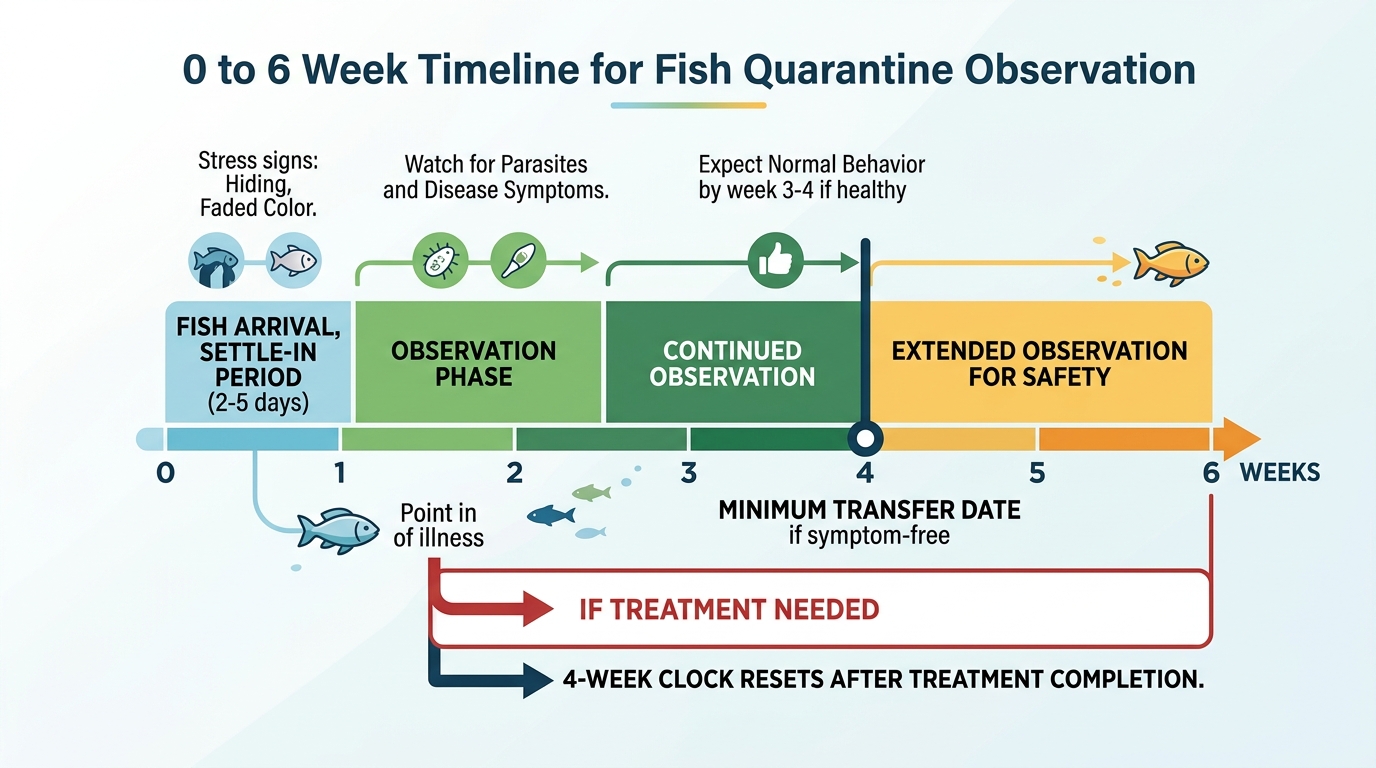
Four weeks minimum. That's the baseline everyone with credibility uses.
Some sources say 2–3 weeks. I don't recommend it. Two weeks misses the 7–14 day incubation window for many parasites and diseases. By the time symptoms show, you've already transferred the fish to your display tank.
Four weeks covers incubation for ich (4–7 days at 80°F), velvet (visible within days if it's active, but can be slow-acting), flukes (often subclinical, taking 2–3 weeks to produce visible symptoms), and internal parasites (3–4 weeks to show as stringy feces or wasting). Six weeks adds safety margin for slow-developing problems.
If you treat for something, the clock resets. If ich appears on day 15, you treat it, and the fish clears by day 22, that fish gets another 4 weeks of observation from day 22 onward. The point of quarantine is knowing your fish are clear.
Four weeks isn't a long time in practice. It's the time it takes for your fish to stop showing stress behavior and interact normally with the environment. It's the time it takes for parasites to either show themselves or remain hidden.
 daily observation checklist
You're watching for two categories: behavior and physical signs. Both matter.
Behavioral red flags:
- Flashing or rubbing. Fish scrapes its body against objects or the substrate. Classic sign of external parasites—ich, flukes, velvet. Stop everything else and watch closely.
- Clamped fins. Fins held tight against the body. General stress indicator or early disease sign. Expected for 2–5 days after arrival. If it persists beyond that, note it.
- Lethargy or listlessness. Fish stays in one spot, doesn't explore. Could be normal settling-in, could be illness. Track the trend. Does it improve each day?
- Gasping at the surface or rapid gill movement. Respiratory distress. Could indicate gill parasites, ammonia toxicity, or low oxygen. Act immediately.
- Hiding excessively or light-avoidance. Common with velvet or severe stress. If the fish hides for a few hours after introduction, normal. If it hides for days, investigate.
- Loss of appetite. Fish refuses food after the initial 1–2 day adjustment period. Once you're past settling-in, this is a red flag.
- Erratic swimming—darting, spinning, loss of equilibrium. Neurological or severe systemic illness. Rare but serious.
Physical signs:
- White spots (salt-grain size). Ich. Discrete, raised, countable. All over body and fins. Flashing usually accompanies it.
- Fine gold, rust, or yellow dusting. Velvet. Looks like powder, not spots. Best seen with a flashlight from the side. Often accompanied by rapid breathing before heavy external spots appear.
- Ragged fins with white or red edges. Fin rot, usually bacterial. Progresses from the edges inward.
- Cotton-like patches. Fungal infection or columnaris (which looks like cotton but isn't fungal). Often secondary to injury or bacterial infection.
- Cloudy eyes or pop-eye. Bacterial infection or water quality crash.
- Red streaks in fins or body. Septicemia. Bacterial infection in the bloodstream. Serious.
- Stringy white feces. Internal parasites. Especially significant if the fish is eating but losing weight.
- Sunken belly. Internal parasites or starvation. Combined with normal feeding, this points to parasites.
- Excess mucus or slime coat. Fish produces thick mucus in response to skin parasites (flukes, costia). Fish may look faded or patchy.
- Ulcers, red sores, or lesions. Bacterial infection, often secondary to injury or parasite damage.
Normal stress vs. actual illness:
New arrivals can show faded coloration, clamped fins, hiding, and reduced appetite for 3–5 days. That's adjustment, not disease. Record it as baseline. The distinction that matters is trend and persistence. Stress signs should improve by day 5. If they worsen, or if they're accompanied by physical symptoms, you've crossed into illness territory.
I track this with dated notes. Day 1: "hiding, faded, not eating." Day 3: "exploring, color returning, ate a little." Day 7: "normal coloration, active, eating well." That progression is exactly what I expect to see in a healthy new fish. If day 7 looks like day 1, something's wrong.
feeding and maintenance
Don't feed during days 1–2. It reduces ammonia load while the fish settles. The stress response suppresses appetite anyway, and uneaten food becomes waste.
Days 3–7: feed 20–50% of normal ration, once daily. Small portions. Remove uneaten food after five minutes.
Days 8 onward: normal feeding, once or twice daily, small portions. High-quality food supports immune function during the observation period.
Water changes are your main maintenance task. If the QT is cycled, 20–25% every 2–3 days is standard. Some recommend 25% weekly in a lightly stocked cycled tank—that works if your ammonia stays below 0.1 ppm.
If the QT is uncycled (no pre-seeded filter), test ammonia daily. When it creeps above 0.25 ppm, do 30–50% water changes. After day 5–7, the sponge filter is usually established enough that ammonia processing improves on its own.
During medication, follow the medication instructions precisely. Many treatments require water changes at specific intervals. If you do a 25% water change, redose medications proportionally—25% water change means you've diluted the medication 25%, so add 25% of the original dose.
red flags: signs of disease in quarantine
Common diseases show up in quarantine. You need to recognize them and know the basic response.
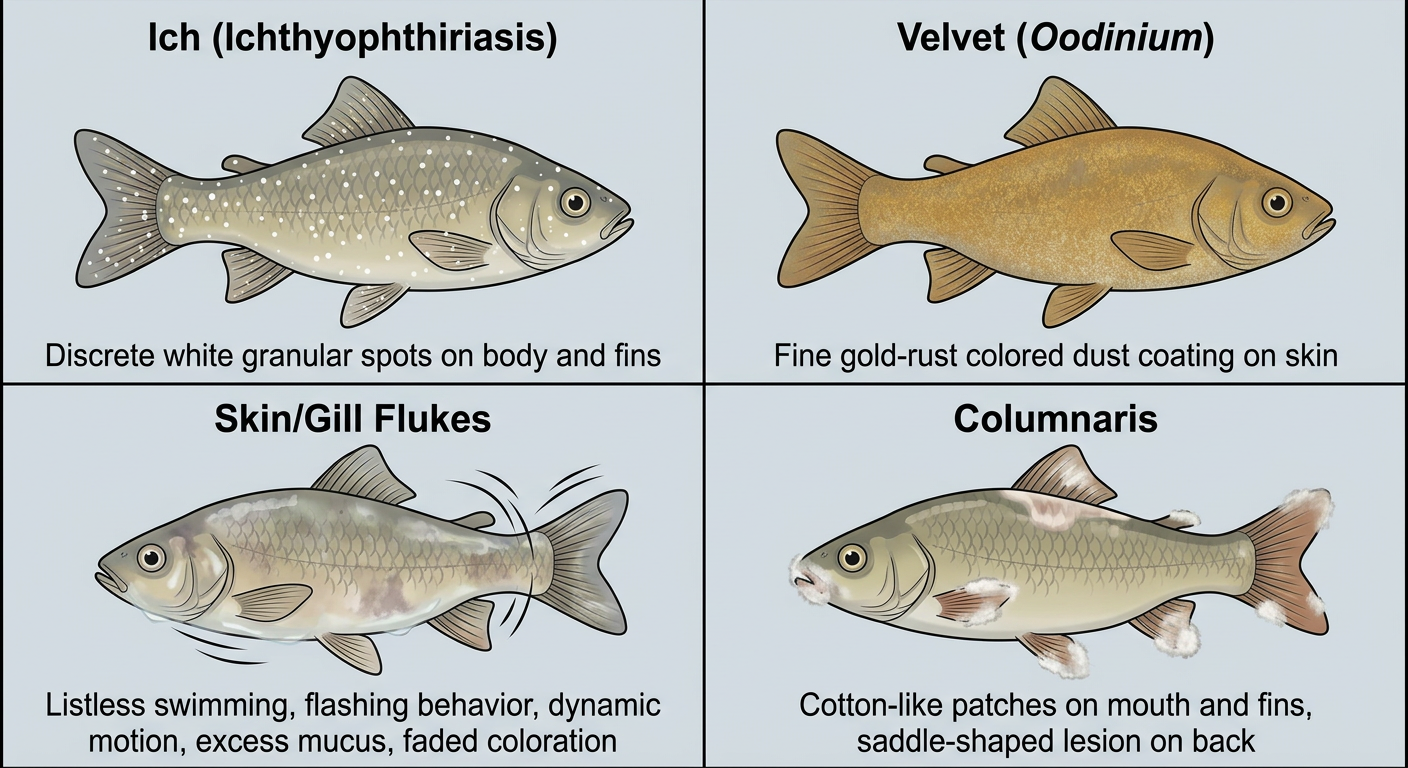 Ich (white spot disease):
Discrete white spots like salt grains, primarily on fins and body. Fish flashes against objects. The parasite is Ichthyophthirius multifiliis. Lifecycle is temperature-dependent—at 80°F, complete cycle in 4–7 days.
Treatment: raise temperature to 82–86°F. Use commercial ich medication—Ich-X, Rid-Ich, or other formalin/malachite green products. Or aquarium salt at 0.1–0.3% concentration. Treat for at least 14 days or 4–7 days after the last visible spot. You're trying to kill multiple generations of the parasite.
After treatment clears, reset the quarantine clock. Day 1 of treatment becomes day 0. You need another full 4 weeks symptom-free from the end of treatment.
Velvet (gold dust disease):
Fine gold, yellow, or rust-colored dust on skin and fins—not discrete spots, a coating. Best seen with angled light. Caused by Oodinium species. Different from ich because it attacks gills early and aggressively. Fish may breathe rapidly while showing minimal external spots initially. This is why it's dangerous—it progresses explosively.
Symptoms beyond the visible dust: light avoidance, clamped fins, lethargy, loss of appetite, excess mucus. Fish can decline within 24–48 hours.
Treatment: copper-based medication (narrow therapeutic window—test daily). For freshwater, aquarium salt + temperature increase to 82–84°F. Dim the lights—the parasite has a photosynthetic stage, and light triggers reproduction. Treat 10–14 days.
Flukes (monogenean trematodes):
Generally not visible to the naked eye. You see symptoms instead: flashing, twitching, excess mucus, reddened gills, small red dots or pink cast on skin, faded patchy coloration, rapid breathing. The parasites causing this are usually Gyrodactylus (skin flukes) or Dactylogyrus (gill flukes).
Flukes are often present in small numbers on healthy fish without causing problems. Stress suppresses immunity and flukes go from subclinical to problematic. This is why quarantine matters—stress from transport plus weak immunity equals fluke outbreak.
Treatment: praziquantel (PraziPro, API General Cure, Fish Tapes). Pond treatment strength or food dosing. Treat for 3+ weeks. A 3% salt bath (30 seconds to 10 minutes) can provide acute relief but won't eliminate the infestation. Freshwater dips (3–5 minutes) knock off adult flukes but don't kill eggs.
Columnaris (cotton mouth):
Cotton-like patches on mouth, fins, or body. Often confused with fungal infections but it's bacterial (Flavobacterium columnare). Can present as a saddle-shaped lesion across the back.
This is extremely common in fish from chain pet stores with shared water systems. AquariumScience.org estimates 50%+ incidence from those sources.
Treatment: gram-negative antibiotics. Maracyn 2 (minocycline) is much more effective than plain Maracyn for columnaris. Kanaplex (kanamycin) also works. Best administered through medicated food—soak food in medication for 30 minutes before feeding, then feed daily.
Internal parasites:
Symptoms: stringy white feces, fish eating well but losing weight, sunken belly. Especially common in livebearers (roundworms) and discus/large cichlids (hexamita).
Treatment: praziquantel plus metronidazole. Best administered through medicated food—soak food for 30 minutes, feed daily for 2–3 weeks. Oral treatment through food works better than water treatment for internal parasites because the medication reaches the gut where it matters.
When to treat prophylactically vs. observe-only:
Two schools of thought exist, and both have merit.
Observe-only means watching for symptoms for 4–6 weeks and treating only if something appears. Fish endure less medication stress, you avoid unnecessary chemical exposure, and you don't contribute to resistant pathogens. The downside: low-level fluke infestations or slow-developing internal parasites can remain subclinical and get transferred to the display tank.
Prophylactic treatment means medicating all new arrivals regardless of visible symptoms. Common protocol: praziquantel (flukes) plus metronidazole (internal parasites) plus or minus ich medication. The case for: catches subclinical infections before they establish in the display. The case against: unnecessary medication stresses fish, kills beneficial bacteria, and may select for resistant pathogens.
The pragmatic approach: observe for 1–2 weeks first. If any symptoms appear, or if the fish came from a high-risk source (chain store, shared water system, wild-caught), treat. If it remains symptom-free from a reputable source, continue observing. This splits the difference.
moving fish to the main tank
Before transfer, the fish must be symptom-free for the entire observation period. Minimum four weeks. Non-negotiable.
Transfer protocol:
Drip-acclimate from QT to display. Even if you're confident both tanks have matched parameters, a 30–45 minute drip acclimation handles any parameter drift that occurred during QT and reduces osmotic shock.
Use a clean net. Never transfer QT water into the display. The water in the QT is clean, but the philosophy of quarantine is complete separation until you're confident the fish is clear.
Release the fish with display tank lights dim or off. Feed your display fish lightly to distract them and reduce territorial aggression toward a new arrival.
Monitor the display for 7–10 days post-transfer. Late-onset symptoms are rare, but if the quarantine missed something, it'll show within a week of the stress of transfer.
After transfer, break down the QT. Clean the tank with hot water (no detergents). For full disinfection: bleach solution (1 part bleach to 9–10 parts water), soak for 10 minutes, rinse thoroughly, dechlorinate, air dry for 24–48 hours.
Return the seeded sponge to your display tank to maintain the bacterial colony for the next quarantine. Store the empty QT dry and ready to assemble in about 30 minutes when next needed.
quarantine tank FAQs
Do I really need a quarantine tank?
Yes. Every credible source treats this as essential. The "the fish looks healthy" argument is how you end up with a tank-wide outbreak. Even fish from reputable breeders carry pathogens your display fish haven't encountered. A $50–130 QT setup prevents disasters that can cost hundreds or thousands and require months of fallow recovery. If you can't fit a second tank, a food-grade plastic tote or 5-gallon bucket with a sponge filter and heater is infinitely better than no quarantine.
Can I use my main tank's filter to seed the QT?
Yes. This is the recommended method. Keep a spare sponge filter running in your display tank for at least 2–4 weeks. Transfer it when you need QT. Your QT is instantly cycled. You can also squeeze existing filter media into the QT to seed bacteria in an emergency.
What if I don't have space for a second tank?
Space constraints are real. In order of preference: (1) A 10-gallon tank takes roughly 20" × 10". Most homes have room. (2) A food-grade plastic tote or storage bin (10+ gallons) with a sponge filter and heater. (3) A 5-gallon bucket for temporary QT of small fish. (4) Skipping quarantine is the riskiest option. If you must, buy only from sources you trust completely and accept elevated risk.
How do I keep a quarantine tank ready between uses?
Two approaches: Keep it running empty with sponge filter, heater, and water. Feed it a pinch of fish food weekly to maintain the bacterial colony. Or store it dry and keep the sponge running in your display tank's sump. When needed, fill the QT, transfer the seeded sponge, and you're ready in under an hour. The second approach is most space-efficient.
Should I medicate prophylactically or observe only?
No universal consensus exists. Observe-only watches for symptoms for 4–6 weeks, treating only if something appears. Safer for the fish but misses subclinical infections. Prophylactic treats all arrivals regardless. Risk: unnecessary medication stress and resistant pathogens. The pragmatic middle: observe 1–2 weeks, treat if symptoms appear or if the source is high-risk, continue observation-only if symptom-free from a reputable source.
Can plants carry diseases into my tank?
Yes. Plants can carry ich cysts, snail eggs, and other pathogens. Standard plant quarantine: bleach dip (1 part bleach to 19–20 parts water) for 1–2.5 minutes depending on plant hardness, then thorough rinse and dechlorinate. Or hydrogen peroxide dip (3% H₂O₂, 3 minutes). Alternatively, use tissue-culture or emersed-growth plants, which carry no aquatic pathogens.
Can I quarantine multiple batches of fish together?
No. Never mix fish from different sources or purchase dates in the same QT. A single batch from one retailer on one day can share a QT. Adding a new batch later restarts the clock for all fish and introduces cross-contamination risk between sources.
What water should I use to fill the QT?
Ideally, water from your display tank. Identical parameters (pH, GH, KH, temperature) reduce osmotic shock. If you need fresh dechlorinated tap water, match temperature and parameters to your display as closely as possible. Note: display tank water does not cycle the QT—bacteria live on surfaces, not in the water column. You still need a seeded filter.
How many fish can I quarantine at once?
Keep stocking light—roughly one or two small fish per 10 gallons during quarantine. Overcrowding spikes ammonia, adds stress, and defeats the purpose. If you need to quarantine many fish, use a larger QT or run multiple batches sequentially.
Comments
No comments yet.