Introduction: Stop Fighting, Start Listening
You clean the glass. The algae comes back. You dose an algaecide. A week later, it's worse. You add more algae eaters. Your tank still looks like a green mess.
After years of keeping detailed records across tanks, I've noticed a pattern: most aquarists treat algae like an enemy at the gate. They fight it. They buy products to kill it. They scrub harder. And the algae returns, because nobody stopped to ask why it showed up.
What causes algae in an aquarium? Algae grows when light and dissolved nutrients (primarily nitrate and phosphate) outpace what your plants can use. It's a visible signal of imbalance. Usually that involves lighting duration, nutrient buildup, or water flow. Not a sign of a dirty or failing tank.
This article will help you read that signal. By the end, you'll understand why algae thrives in your specific tank, and you'll have a framework for keeping it in check that doesn't involve spending money on products that don't work.
What Is Aquarium Algae? (And Why It's Not the Enemy)
Algae are photosynthetic organisms. They use light, CO₂, and dissolved nutrients, primarily nitrogen and phosphorus, to grow. They respond to the conditions you've created, nothing more.
Leave a clear container of water in sunlight and it'll turn green. That's algae. It's not an aquarium problem. It's a universal pattern. Algae appears wherever light and nutrients exist together. Your tank is a controlled version of the same system.
What sets algae apart is adaptability. Algae are simple organisms that absorb a wider spectrum of light than higher plants. They consume different compounds. They respond to shifts in hours, not days. If your tank isn't balanced, algae gets there first.
I've seen this across multiple setups. In my lightly planted tank, algae appears the moment I shift the photoperiod. In my high-tech CO₂ tank, it shows up when diffusion gets inconsistent. In a new tank cycling, brown diatoms arrive within days. Each type tells me something specific about what's happening in the water. I learned to read those signals instead of just wiping them off.
Is algae harmful to fish? Not usually. Fish live with algae in natural habitats. The exceptions matter: cyanobacteria can produce mild toxins, severe blooms cause oxygen swings at night, and black beard algae can smother plant leaves. The real issue usually isn't the algae. It's what the algae signals about your tank's balance.
What Causes Algae in a Fish Tank: The Light + Nutrients Equation
Algae needs two things to flourish: light and nutrients. When those inputs are in equilibrium, when your plants or biological system is consuming as much as you're providing, algae stays in check. When one outpaces the other, algae fills the gap.
Light is the engine.
Most people don't think about how light drives the system. Stronger light or longer photoperiods increase demand for nutrients. Upgrade to a brighter LED without changing anything else and you've told every photosynthetic organism: grow faster. Plants respond over days. Algae responds in hours.
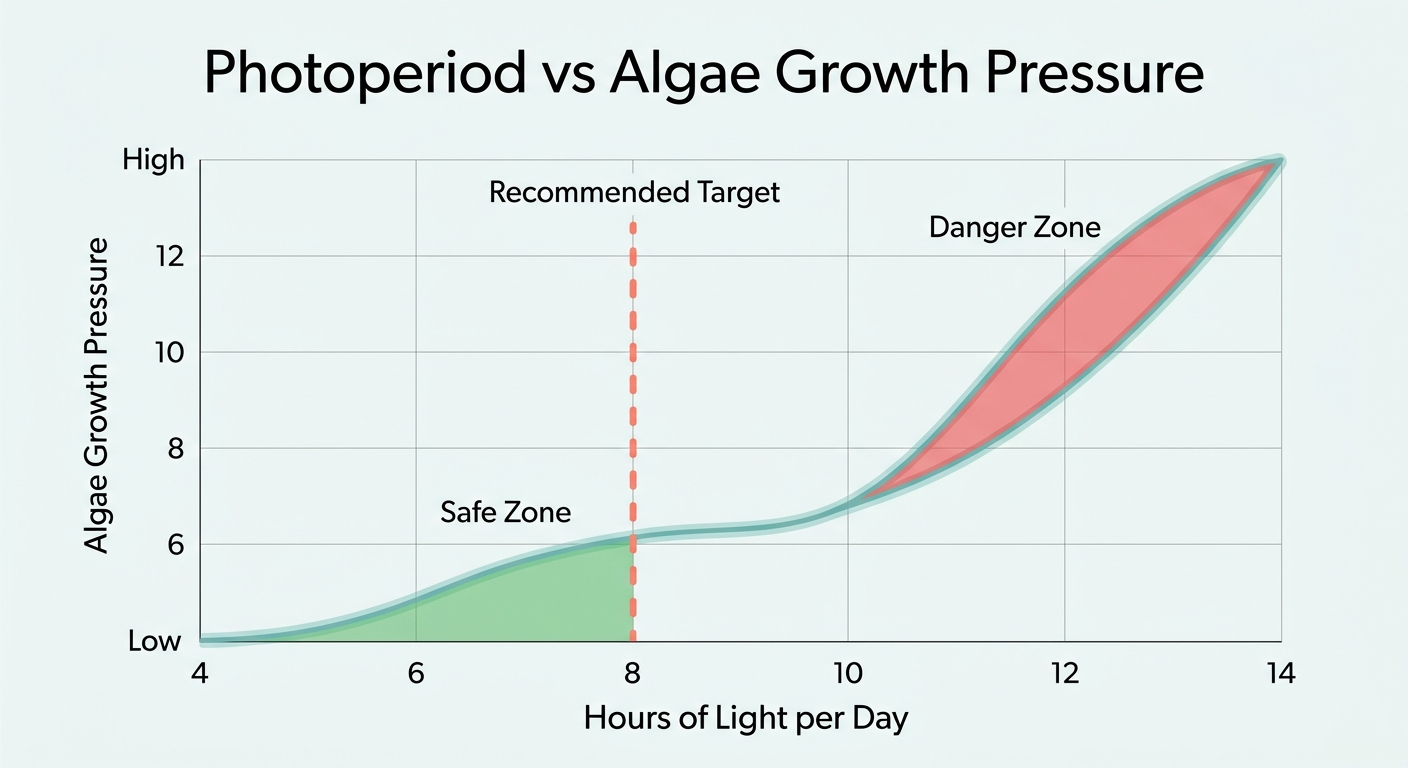
Photoperiod matters more than you'd think. Six to eight hours works for most tanks. Ten to twelve hours is the most common beginner mistake I see. Even a small shift, from 8 to 10 hours, can trigger algae growth in a week if nothing else changes. Intensity counts too. A bright LED in a 20-gallon tank creates different growth pressure than a dim fluorescent. Each pushes the system differently.
 Spectrum comes up in endless arguments. I've kept notes across multiple light types. Total intensity and photoperiod matter far more than whether my light is 6500K or 10,000K. What matters is consistency. Tanks on a stable timer have fewer problems than tanks where light shifts with the seasons or gets bumped around.
Nutrients are the fuel.
Fish waste breaks down into ammonia. Bacteria convert that to nitrate and phosphate. Those nutrients accumulate in the water. Without regular water changes, algae treats your tank like a buffet.
Every tank produces nutrients by existing. Fish produce waste. Food decays. Plants die back. Without water changes to dilute the buildup, nutrients hit levels that favor algae. A 25% water change removes roughly 25% of dissolved nitrate and phosphate. That's why regular changes matter.
Overfeeding accelerates all of this. Every uneaten flake becomes nitrate and phosphate. I've watched tanks cycle through green water blooms every few months despite maintenance, because feeding never changed. The moment I switched to only what fish eat in 2-3 minutes, the problem became manageable.
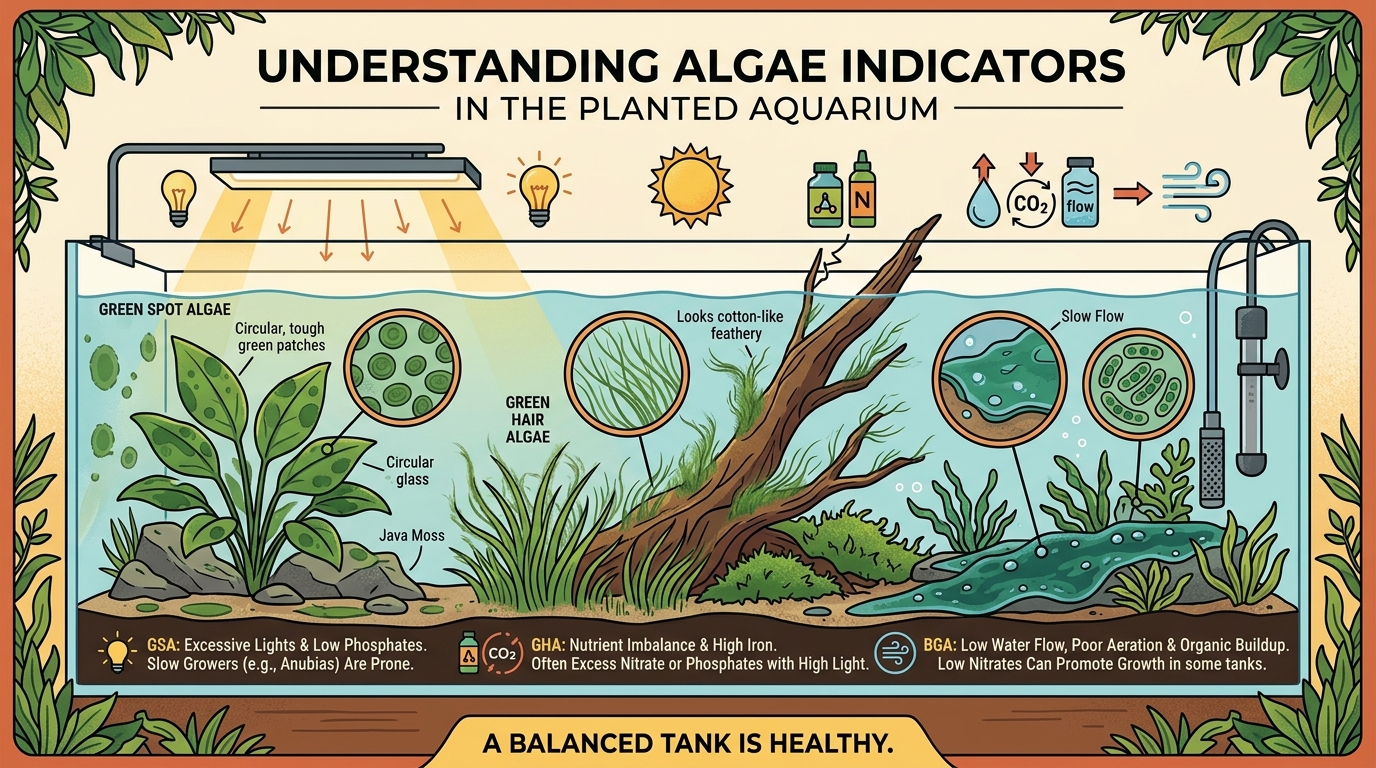
There's a wrinkle: some algae types thrive when nutrients are too low. Green spot algae loves phosphate-starved water. Cyanobacteria kicks in when nitrate drops. Standard advice to "reduce nutrients" can make these worse. If you chase low nutrient levels without testing, you might be creating the exact conditions that trigger the algae you're trying to prevent.
The balance.
When light and nutrients align with what your plants consume, algae stays background. You'll always have some. That's normal. That's healthy. It just won't take over.
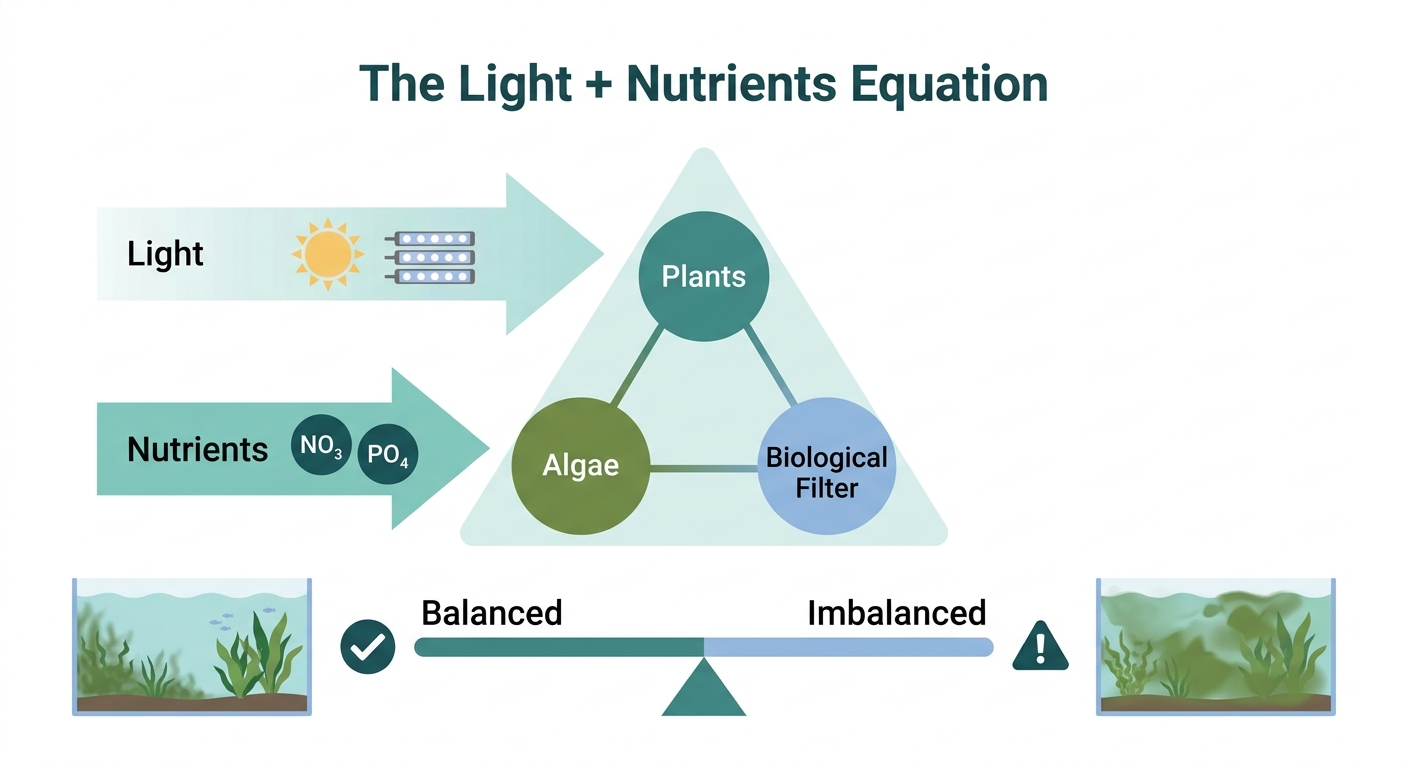 The moment one input shifts, algae capitalizes first. It adapts faster than anything else in the tank.
Aquarium Algae Types: Reading What Your Tank Is Telling You
Getting the identification right is where solutions start. I've watched people chase the wrong fix because they were looking at the wrong thing.
Use three tests: how it feels, how it wipes, and occasionally how it smells.
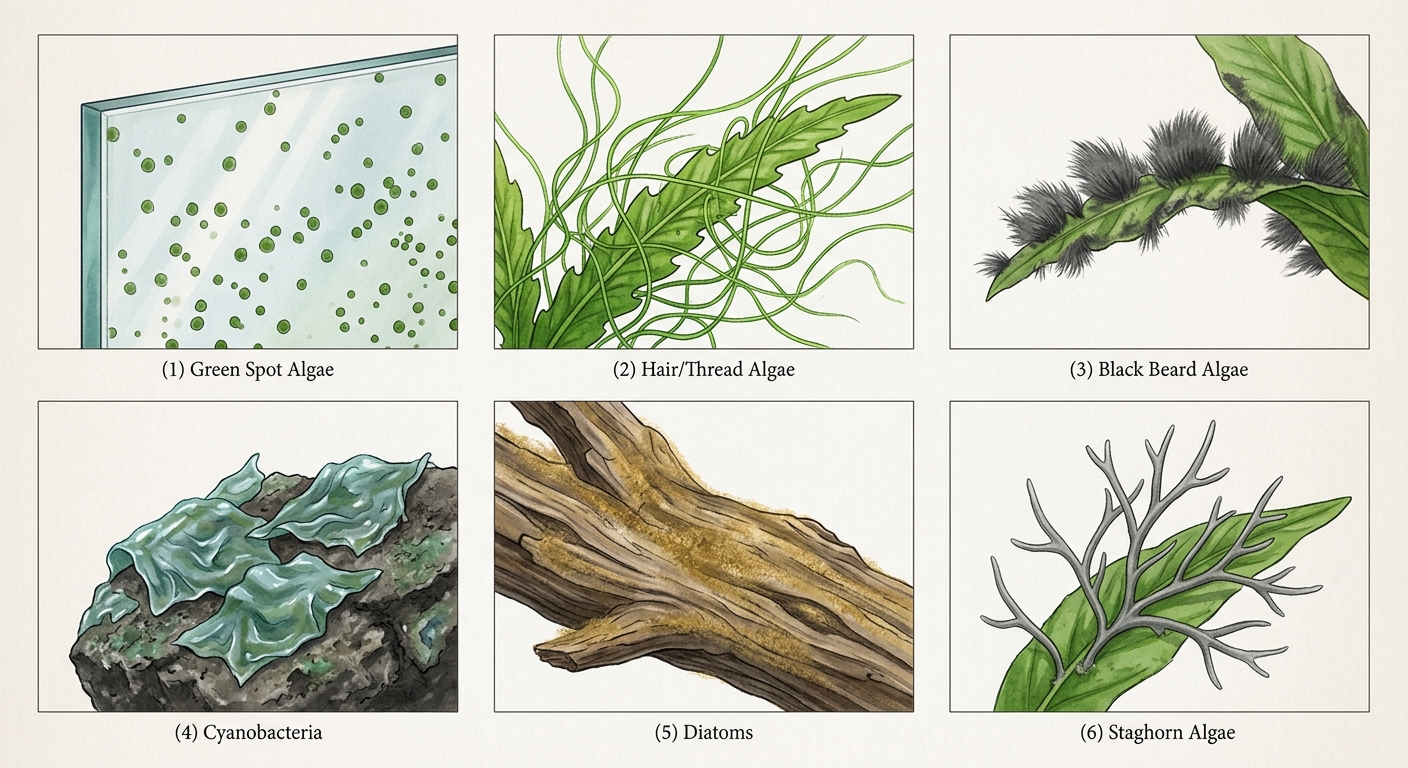 Brown algae (diatoms): Dusty brown film on glass, substrate, decor. Wipes off easily. I see this in weeks 2-8 of nearly every setup I've started. It's normal. Silicates from new substrate and tap water are feeding it. Diatoms resolve themselves as the tank matures. Otocinclus or nerite snails speed it up. It's cosmetic, not a crisis.
Green spot algae (GSA): Hard circular green dots on glass and slow plant leaves. You need a razor blade to remove them. GSA signals low phosphate, which sounds backwards. Starvation creates growth pressure for GSA. It loves high light and thrives when CO₂ drifts in planted tanks. Fix: test phosphate and dose to 0.5-2.0 mg/L. Nerite snails remove it from glass about 95% of the time. If you're running more than 10 hours of light, pull that back. Catch it early and it stays manageable.
Hair or thread algae: Long bright-green strands that wrap around plants and tangle into mats. Soft and stringy. Shows up when light is high and plant competition is weak. Also signals excess iron dosing without matching macronutrients, or inconsistent CO₂. First move: manual removal. Twist the strands around a toothbrush and pull. Reduce photoperiod. Add fast-growing plants. Amano shrimp teams of 10 or more are brutally effective. I've documented over 80% reduction in hair algae within 3-4 weeks using shrimp and proper lighting discipline.
Black beard algae (BBA): Dark gray to black dense tufts on leaf edges, driftwood, and filter equipment. Doesn't wipe off. Feels slightly soft when fresh. This is the one aquarists dread. It's stubborn. The cause is fluctuating CO₂. If your CO₂ runs out before lights go off, or your DIY system has erratic output, or flow is poor, BBA moves in. Dead zones make it worse. Stabilize CO₂ delivery, improve circulation, spot-treat with 3% hydrogen peroxide or liquid carbon on affected areas during water changes. A real Siamese Algae Eater (not flying fox lookalikes) is the only fish that reliably eats it. Expect 6-8 months for elimination. There's no shortcut.
Blue-green algae (cyanobacteria): Slimy blue-green, dark green, or reddish sheets that peel off in mats. Smells musty when disturbed. It's not true algae. It's a photosynthetic bacterium. Algaecides barely touch it. Cyano signals low flow, stagnant areas, anaerobic substrate pockets, and low nitrate. Nitrogen starvation triggers it. Pull mats manually, run a 3-4 day blackout, improve circulation, vacuum substrate regularly. Erythromycin (Maracyn) works for persistent cases but also hits beneficial bacteria. Last resort only. This is the one algae type I treat as urgent.
Green water (phytoplankton bloom): Water turns pea-soup green. Fish become blurry. Free-floating algae cells fill the column. This signals a nutrient spike combined with strong light. Ammonia surge from cycling, overfeeding, or a dead animal you haven't found. Direct sunlight makes it explode. A UV sterilizer clears it in 2-3 days. A 3-4 day blackout also works but stresses plants. After it clears, cut photoperiod and block direct sunlight.
Staghorn algae: Gray to white branching strands that look like tiny deer antlers. Stiff and wiry. Similar to BBA but triggered differently. Staghorn appears when CO₂ is low and you've got ammonia spikes from overstocking, dirty filters, or disturbed substrate. Pull affected leaves, spot-treat with hydrogen peroxide, fix the ammonia source. Unlike BBA, staghorn responds well once you raise and stabilize CO₂.
Green dust algae (GDA): Soft green film on glass that comes back fast after wiping. Unlike GSA, it wipes off as a cloud of dust. Common in young tanks and often self-limiting. The best fix sounds backwards: don't wipe it for 2-3 weeks. Let it complete its natural die-off cycle, then wipe everything clean at once. Nerite snails and otocinclus graze it over time.
How to Get Rid of Aquarium Algae: What Actually Works
If you want a clean starting point, here are proven algae control methods, listed roughly in the order you should address them:
- Consistent weekly water changes (25–30% for most tanks)
- Lighting discipline: 6–8 hours on a fixed timer, no direct sunlight
- Appropriate feeding (only what fish consume in 2–3 minutes)
- Regular filter and substrate maintenance to keep flow steady
- Algae-eating species matched to the specific algae type
- Fast-growing live plants as nutrient competitors
- Targeted spot treatments (hydrogen peroxide, liquid carbon) when needed
The foundation: consistent maintenance.
No algae eaters, no products, no tricks fix a broken foundation.
Water changes: 25-30% weekly for most community tanks. Pull out accumulated nutrients and dilute what's left. Heavily stocked tanks might need 40-50% weekly. Lightly planted tanks can stretch to 15-20% every two weeks. Target: keep nitrate under 20-40 ppm. Test it and adjust based on what you measure, not what a calendar says.
Consistency beats exact percentages. A 25% change every week keeps things more stable than a 50% change every two weeks. Stability is what plants and fish need. It's what keeps algae from surging during parameter spikes.
Filtration and substrate maintenance matter. A clogged filter means less flow. Substrate dead zones trap organic waste and lower oxygen. I vacuum about a third of my substrate during each water change. Enough to remove detritus without disrupting the beneficial bacteria colony.
Lighting discipline: use a timer. Set photoperiod to 6-8 hours and leave it. Don't chase lighting upgrades without thinking through what else needs to shift. Block direct sunlight. A few hours of sun is all it takes to trigger a green water bloom.
Feeding discipline: only what fish consume in 2-3 minutes, once or twice daily. I've watched this single change resolve algae problems, because uneaten food is direct fuel for algae.
Biological controls: algae eaters.
These are helpers, not cures. They earn their place as part of a balanced system, not as a band-aid on a broken one.
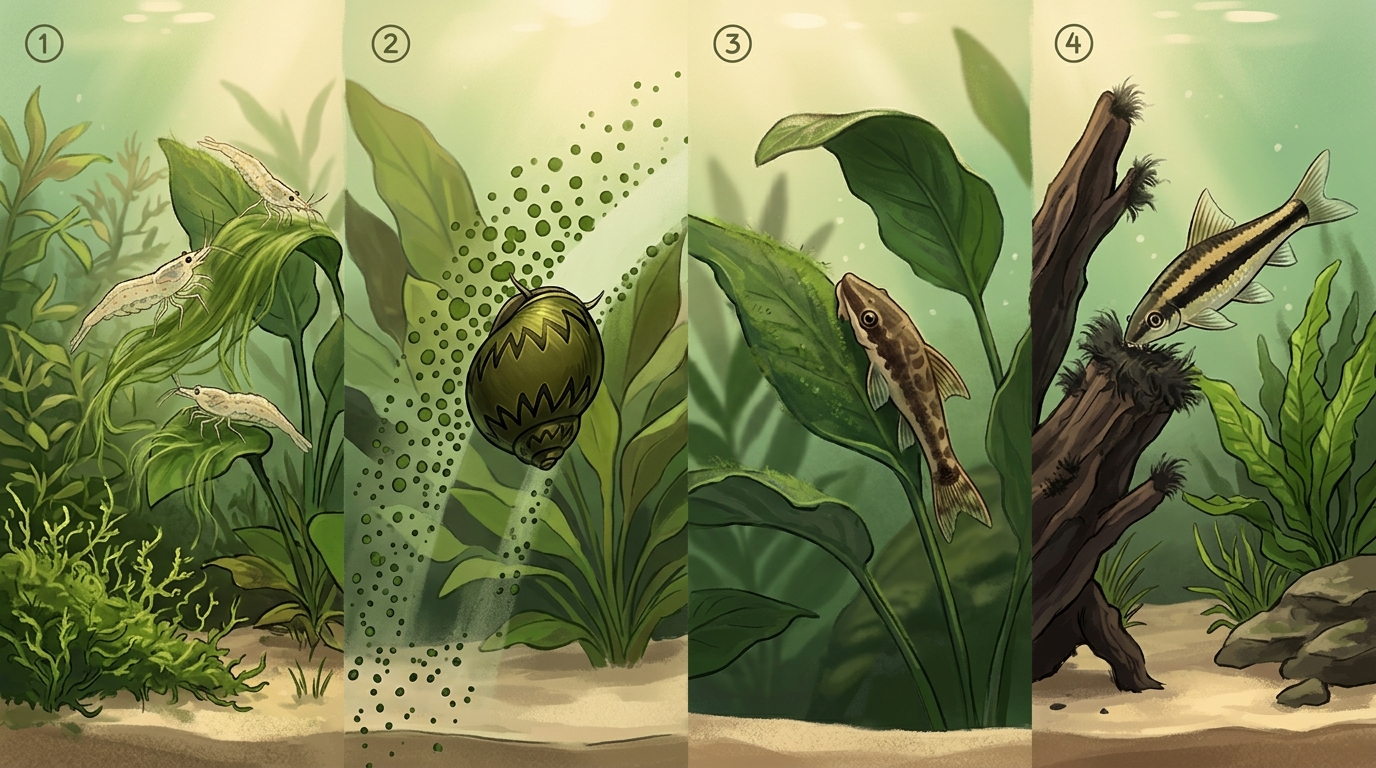 Match the species to the problem. Amano shrimp go hard against hair algae and soft green algae. Over 80% effective in groups of 10 or more. Nerite snails work for green spot algae on glass (about 95% effective) and diatoms (85%). Otocinclus catfish tear through soft algae and biofilm but need mature tanks and will starve in setups that are too clean. Siamese Algae Eaters reliably eat black beard algae but need at least a 120-liter tank and lose interest as they age.
Add algae eaters to a tank with unstable lighting, excess nutrients, and poor flow and they won't solve anything. They'll stress, possibly die. Get your environment stable first. That's when they become truly useful.
Live plants as competitors.
Healthy fast-growing plants outcompete algae for light and nutrients. That's well-documented and one of the most powerful tools, because it works with the system instead of against it.
Growing healthy plants means dealing with the same factors that control algae. Light intensity and duration, stable nutrients, CO₂ supply, substrate quality. If your tank can't support plant growth, it can't support plant-based algae control.
Low-tech planted tanks without CO₂ work fine when light stays moderate, plant choices match the light level, and nutrients stay stable. High-tech tanks with CO₂ can push more intense light and faster plant growth. That means faster nutrient uptake and tighter algae control, but demands more precision in CO₂ delivery and dosing.
Either works. The real difference is workload, not quality. A stable low-tech tank beats an unstable high-tech one every time.
Chemical treatments and products.
Algaecides kill algae temporarily. They don't fix anything. When the algae dies, it decays and can trigger ammonia spikes. The light and nutrients that created the problem are still there. New algae shows up days or weeks later.
3% hydrogen peroxide works as a spot treatment for black beard and staghorn. Apply it directly to affected areas during water changes, let it sit 2-5 minutes. The dying algae turns pink or white. Useful as one piece of a bigger fix, not as a standalone solution.
UV sterilizers work for green water. They kill free-floating cells in 2-3 days. They don't touch surface algae. Good to have when you need to clear a bloom fast, not useful for ongoing prevention.
Liquid carbon products like Seachem Excel give plants bioavailable carbon and work as spot treatments on BBA and staghorn. Helpful in planted tanks. Not much use in fish-only setups.
Erythromycin (Maracyn) works against cyanobacteria but damages beneficial filter bacteria. Only reach for it after you've manually removed cyano, improved flow, and stabilized nitrate. Last resort.
The maintenance mindset.
The aquarists I know who stay ahead of algae do something that sounds boring: they test regularly, they watch their tanks closely, and they adjust based on observation instead of product promises.
A twenty-dollar test kit for nitrate and phosphate tells you more about your algae situation than product marketing. Green water forming? Your light hours and recent feeding patterns often point at the answer faster than buying something. Black beard creeping in? Check your CO₂ consistency and water flow.
Real solutions take weeks, not days. If someone promises algae elimination in three days, they're selling a story or a temporary fix that guarantees you'll be back. Commit to 2-3 weeks of adjusted maintenance: proper lighting, regular water changes, appropriate feeding. That information is worth more than anything at the fish store.
Common Algae Mistakes That Make Things Worse
I've made most of these. So has every aquarist I know. The patterns are consistent enough to call out explicitly.
Buying algaecides without diagnosing the root cause. This locks you into a cycle of treating, solving temporarily, and buying again. Buy a test kit instead.
Overcleaning and stripping biofilm. Biofilm, that bacterial and fungal layer on surfaces, competes with nuisance algae and keeps the ecosystem stable. Aggressive scrubbing strips your tank's natural defense. I noticed a dramatic shift when I stopped cleaning substrate down to bare sand and started disturbing only the top layer.
Inconsistent maintenance schedules. Algae feeds on instability. Skip water changes and nutrients build up. Then you do a massive catch-up change and create a parameter swing. The swing stresses plants and benefits algae. Pick a schedule and stick with it.
Ignoring water parameters until algae appears. By the time you see it, the imbalance has been building for weeks. Regular testing catches trends early. Watching nitrate creep from 10 ppm to 30 ppm tells you something before the tank looks like a science experiment.
Adding algae eaters before fixing the environment. You'll stress the animals and watch them fail. Stabilize the tank first.
Changing the light schedule every time algae appears. Plants need stable photoperiods. Constantly adjusting light stresses the plants and benefits the very algae you're trying to stop. Set a schedule and commit to it for weeks.
Treating symptoms instead of the system. Scrubbing algae off glass without touching light, nutrients, or flow is temporary. Always. Remove the algae and leave the cause, and everything comes right back. This is the root mistake that keeps the product cycle going.
Rinsing filter media in tap water. Chlorine kills beneficial bacteria. Rinse in old tank water. Only clean filter media when flow rate drops noticeably, not on a schedule.
Overfeeding. I keep coming back to this because it's everywhere. Every uneaten flake becomes nitrate and phosphate. Direct algae fuel. Feed conservatively.
Frequently Asked Questions About Aquarium Algae
Is algae bad for my fish?
Not usually. Fish live with algae in natural habitats. Most algae is cosmetic. Exceptions: cyanobacteria can produce mild toxins, severe blooms cause oxygen depletion at night, and black beard algae can smother plant leaves. The real concern is what algae signals about tank balance. Fix the balance and algae becomes background noise.
How often should I do water changes to prevent algae?
25-30% weekly for most community tanks. Heavily stocked tanks might need 40-50%. Lightly planted tanks can stretch to 15-20% every two weeks. Target is nitrate under 20-40 ppm based on testing. Consistency matters more than exact percentages.
Will algae eaters solve my algae problem?
They help with maintenance but can't override a broken system. If your light, nutrients, or flow are unbalanced, algae eaters eat so much while conditions keep favoring algae growth. Get the environment stable first.
How can I tell different aquarium algae types apart?
Touch, wipe, and smell. Hard dots that won't wipe off: green spot. Slimy sheets that smell musty and peel in mats: cyanobacteria. Dark tufts on leaf edges: black beard. Long green strands: hair algae. Dusty brown film: diatoms. Pea-soup water: phytoplankton bloom. Gray stiff branching strands: staghorn. Soft green film that wipes as dust: green dust algae. Wrong ID is the number one reason treatments fail.
Can I have zero algae in my aquarium?
No. And you wouldn't want to. Some algae belongs in a mature ecosystem. Even competitive aquascapers have algae in their tanks. The goal is management, not eradication.
Why did my algae disappear and then come back?
Conditions shifted temporarily against the algae, then the original imbalance resumed. Common triggers: skipped water change let nutrients build up, light timer got bumped or reprogrammed, filter clogged and flow dropped, feeding habits shifted, or seasonal changes in natural light hit differently. Chemical treatments wear off if underlying conditions never changed. Algae comes back because the cause never went away.
Conclusion: The Long Game
Algae isn't an invasion. It's data. Your tank is telling you something about light, nutrients, flow, or stability. The aquarists who get ahead of algae are the ones who learned to read what their tanks communicate.
Shifting from reactive to proactive takes patience. Instead of buying things when algae shows up, you invest in testing and observation. Instead of scattering treatments, you change one variable and watch for results over weeks. You use algae as a diagnostic tool.
Every aquarium settles into equilibrium. I've watched tanks that looked hopeless become algae-stable after people committed to consistent lighting, regular water changes, and appropriate feeding. No expensive equipment required. Just attention and follow-through.
Documentation helps more than you'd expect. I keep notes on photoperiod, test results, and what I observe day to day. It sounds like overkill until you can't remember what changed between "algae-free" and "covered in hair algae," and your notes have the answer.
Understand what your tank needs, identify what the algae signals, adjust the variables that matter, and actually stick with the changes. That's how you stop fighting and start keeping a balanced tank.
Comments
No comments yet.