Introduction: aquarium species habitat preferences — beyond aesthetics
Most aquariums are built backwards. People choose the decor they like, pick the plants that look good, and then squeeze in fish that will tolerate it. The result looks fine. The fish, though, are constantly uncomfortable.
There's a difference between a tank that looks cohesive and a tank where everything actually works together. A functioning tank serves the actual habitat preferences of the species inside it, and those needs are often invisible at a quick glance. A betta with nowhere soft to rest isn't just missing "enrichment." A discus swimming under bright lights isn't just faded. A corydoras on sharp substrate isn't being finicky. These aren't preferences. They're stress. And stressed fish stop eating, develop illness, and die sooner than they should.
This article is about designing aquariums the other way around. Start with what your fish actually need, then build everything else to serve that.
Understanding aquarium species habitat preferences
Fish didn't evolve in glass boxes. They evolved in rivers, streams, lakes, and wetlands. Real places. With specific temperatures, light levels, water movement, substrate, plant density, and shelter patterns. Those evolutionary constraints are still written into their behavior, their physiology, and their stress responses. When you replicate those conditions, fish settle. When you don't, they're constantly evaluating whether this place is actually safe.
How behavioral ecology works: an environment either matches what the animal's nervous system expects, or it doesn't. Mismatch equals stress. Stress equals disease, shortened lifespan, and behavior problems.
The good news: you don't need perfect replication. You need alignment on the factors that matter most to that species.
Hiding spots and security needs by species
Watch fish behave in an aquarium and one pattern becomes obvious. They spend most of their time near something solid. A plant. A cave. A piece of driftwood. Even open-water swimmers will use the glass edge. Fish don't like being exposed in open space for long periods. That's not preference. That's predator avoidance running deep in their neurology.
Shelter needs vary wildly by species. A rainbowfish in a well-stocked tank uses cover, but they don't need it to feel safe. They're active, schooling, conspicuous hunters. A discus without cover looks different. Hidden most of the time, clamped fins, faded color. That's not shyness. That's an animal deciding whether it's safe.
I've kept bettas in bare tanks and in heavily planted tanks. The bare-tank fish stayed compressed, hanging near the bottom or the corner. Planted-tank fish patrolled, built bubble nests, displayed color. The difference isn't subtle.
Cichlids need cover to manage aggression. Many cichlids are territorial and will kill fish that can't reach cover fast enough. The cover isn't optional decor. It's the difference between a diverse tank and a single-species tank.
Corydoras are habitual shelter-users. They cruise the bottom, but they stop frequently at plants, under driftwood, or in crevices. They're checking for predators. They forage more openly, swim more actively, and feel measurably safer in structure-rich environments.
Not all shelter is equal. A pleco needs a cave with a flat bottom and a single entrance. The fish wedges in and becomes hard to reach. A corydoras uses narrow crevices and plant thickets. A betta rests on broad leaves near the surface. The shelter only works if it fits what the fish actually does.
Swimming space vs. structure
Fish don't want only shelter and they don't want only open space. They want both, separated by actual use.
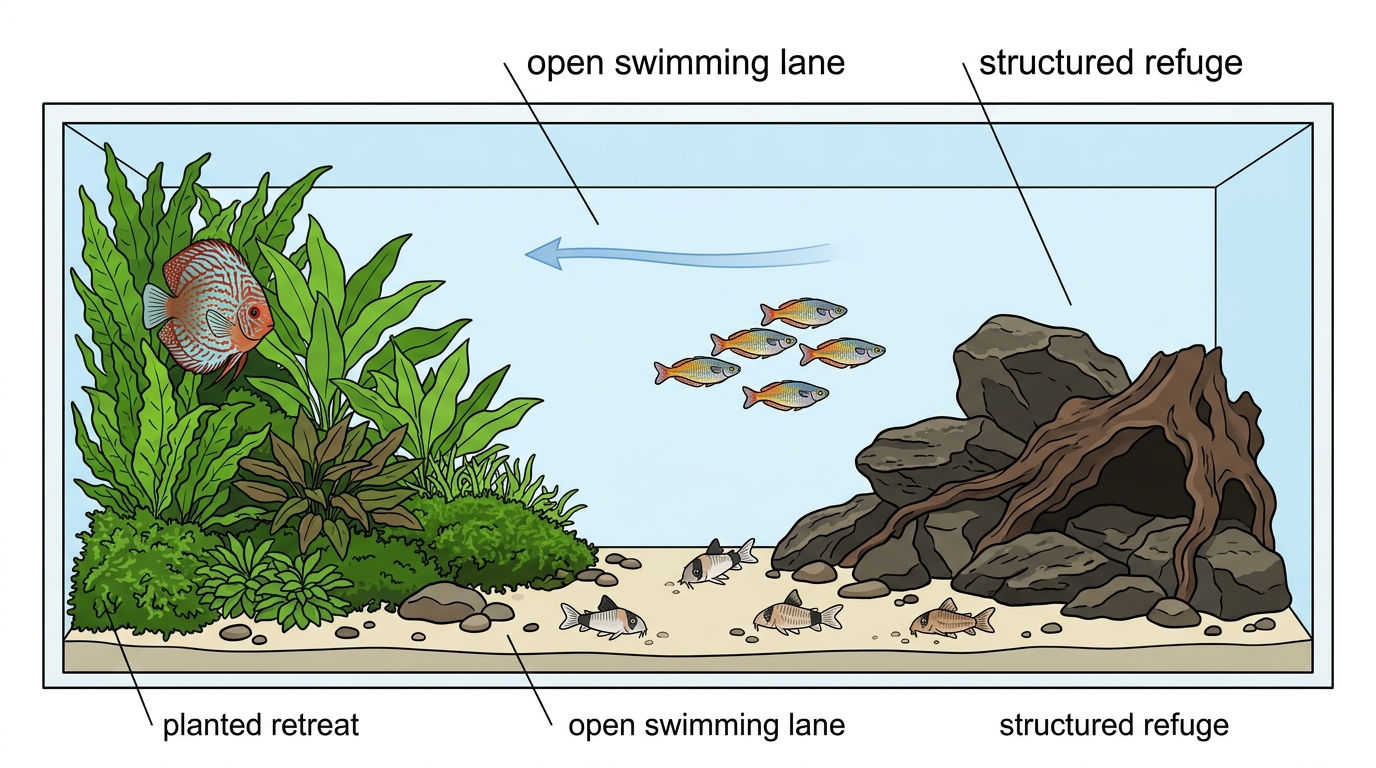
A rainbowfish is a good example because their preference is obvious. They evolved in West Papua mountain lakes with shallow margins densely planted in aquatic vegetation, adjacent to open areas where the water gets deeper. Rainbowfish spend a lot of time traversing the entire tank length. They need 4 feet minimum to be happy. But they also use the planted margins as staging areas and rest zones. In a rainbowfish tank, open space is where they live. Structure at the edges matters for retreat and staging.
Contrast that with discus. Discus want structure in the center of the tank where they can retreat. Tall root systems, driftwood, dense plant groupings. That's where they spend most of their time, especially when stressed. They don't use open space much unless they're feeding or moving to another structured zone. A discus in fully open water feels exposed to itself.
The pattern across most species: active, schooling fish need open zones big enough to move fast and turn freely. Shy, territorial, or bottom-dwelling species need structure they can reach quickly. Neither pattern is absolute, but acknowledging both changes how you design the tank.
Most aquariums get this wrong. Either too much decoration cramping active fish, or too open a space stressing timid ones. It's possible to have both. You just have to be intentional about partitioning the space.
 Caves, driftwood, and shelter types
Shelter isn't generic. Different species use different shelter geometry for different reasons.
A pleco cave needs to be deep, low-entrance, and cave-like. Somewhere the fish can back into and feel protected inside. A bristlenose pleco spawns by claiming a cave. The male defends it and fans eggs with his body. That means an actual cave. Open structure doesn't work. Flat-bottomed caves with a single entrance are what they evolved to use. Anything else becomes a liability.
Driftwood serves multiple functions at once. Plecos rasp on it for dietary fiber. Biofilm grows on it and becomes food for fry. It creates crevices where fish hide. It breaks line of sight so territorial fish feel less provoked by each other. It anchors plants naturally. But here's the nuance: driftwood works differently depending on species. For a pleco, the wood is food. For a corydoras, the driftwood is shelter and a landmark. For a discus deep in aquatic plants, driftwood roots become hiding structure. One piece of wood. Three separate purposes.
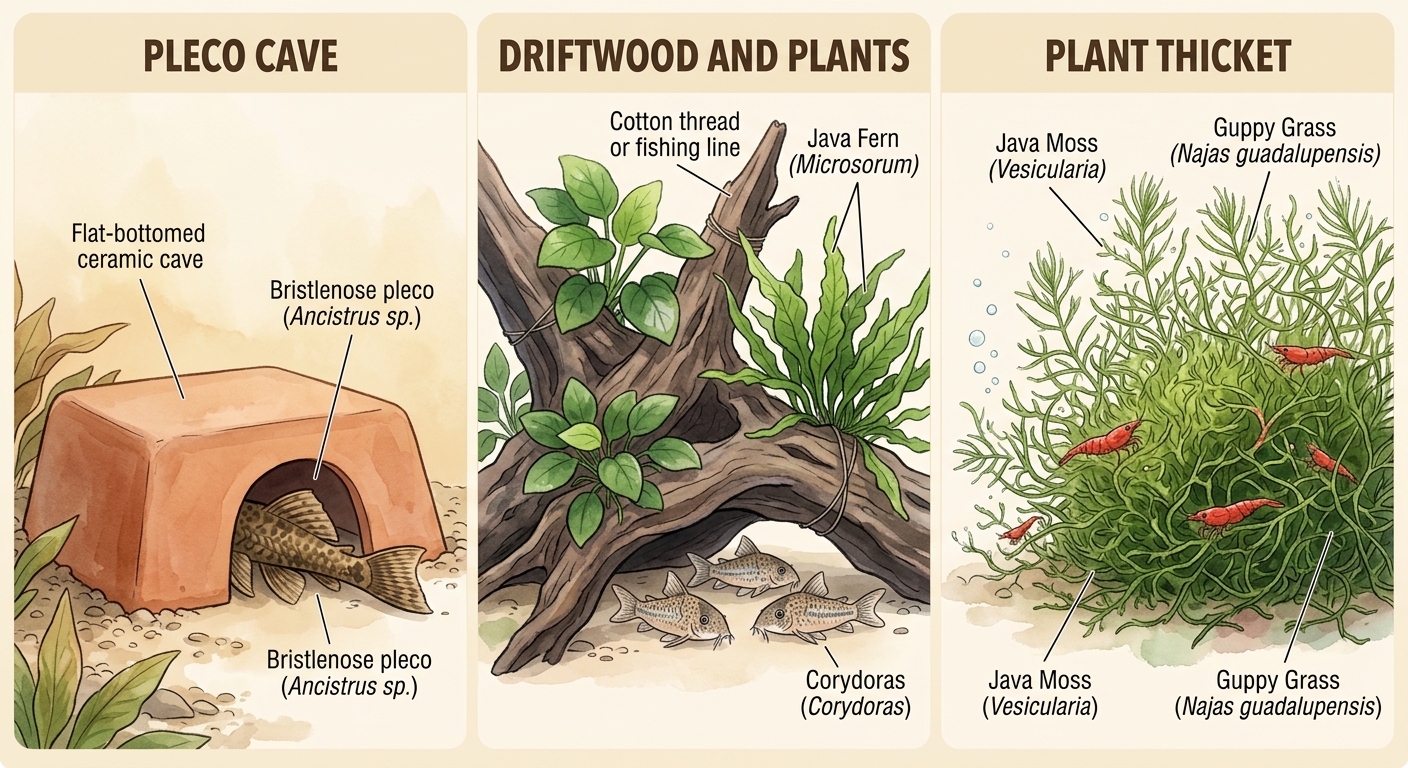 Plant thickets work best for species that need to disappear quickly. Schooling fish that need somewhere to scatter when startled, fry that need protection from larger adults, shrimp during their vulnerable post-molt period when their new exoskeleton is still soft. Dense mass matters here, not individual stems. Java fern or guppy grass grown thick enough to block line of sight. That's functional shelter. Artificial plants can work here too, if the density is right.
Shelter quality depends on whether it's actually sheltering. Caves too small for adult fish won't be used. Rough interiors injure entering fish. Open-bottomed decor traps debris and creates dead zones where waste sits. The best shelter is shelter that serves the actual behavior you're trying to support.
Aquarium plant preferences by species
Live plants do things plastic can't. They consume excess nutrients. They host biofilm and microfauna that shrimp and fry eat directly. They trigger natural behaviors that fish evolved doing. But live plants need light, nutrients, sometimes CO2, and stability. Sometimes those needs conflict with what your fish actually want.
This is where understanding the difference between water-column feeders and root-feeding plants becomes useful.
Water-column feeders (anubias, java fern, most stem plants, floating plants) absorb nutrients right from the water. They don't need rich substrate. They don't need replanting. They're stable. Most tolerate low light. They don't explode across the tank. Limited light or limited space? Water-column feeders are your solution.
Root-feeding plants (swords, vallisneria, cryptocorynes, carpets) need nutrient-rich substrate or root tabs. They send roots down searching for nutrients. Bare sand doesn't cut it. If you choose these plants, your substrate matters. You're committing to either active substrate (breaking down into mud over 1-2 years) or inert substrate plus regular root-tab dosing. Both work. Both require commitment.
Which do you choose? Start with what your fish actually need.
Dense cover vs. scattered planting
Corydoras breeding requires dense plant shelter. Eggs get hidden. Fry have somewhere to scatter if larger fish hunt them. Java fern or guppy grass has to be thick enough to actually block sight. Scattered planting fails.
Cherry shrimp in a display tank? Dense planting is survival. Hiding fast is their only defense. Thick plant mass, especially mosses, is functional shelter. Not decorative. All shrimp are vulnerable right after molting, when the new shell is soft. Without dense cover, they die. That plant density is the difference between thriving shrimp and extinction.
Bettas in community tanks use dense cover, but scattered plants work too. Bettas establish territories and defend spaces, not entire plant piles. Six or eight well-spaced stem plants can be enough if they're tall enough to break line of sight and create distinct spaces.
Rainbowfish and active schoolers don't need dense planting. It actually cramps them. They benefit from structured edges. Plant groupings that partition space and create swimming lanes, not walls. Open center, planted margins.
Dense versus scattered isn't aesthetic. It's functional. Does your fish need that density to live well, or does it actually harm what they do?
Live vs. artificial: making the right call
Some aquarists see artificial plants as giving up on live planting. I see them as a tool. When they solve a real problem, they're useful.
Live plants genuinely serve fish. They improve water quality. They host biofilm and microfauna that fry and invertebrates eat. They trigger natural behaviors. But they require light, nutrients (substrate or water column), and stability. They grow, die, and crash if chemistry or light cycles go sideways. They take time.
Artificial plants require none of that. They sit there indefinitely, providing exactly the same visual and functional structure they provided on day one. No growth, no decay, no maintenance.
When does artificial make sense? When your lighting won't support live plants but you need functional cover for the fish. When the species pulls everything up. When you need months of stability with zero changes (migration, illness, life shift). When you're quarantining and need fast setup and teardown. When live plants have just failed in that setup.
If you choose artificial, quality matters. Rounded edges, smooth seams, no tears. That matters most for bettas, discus, angelfish with delicate fins. Color has to be dye-fast so it won't leach or fade after a few weeks. The base has to be weighted so it stays put when fish bump it. The plant has to stay anchored. Tipping and waving as fish move is worse than nothing.
The worst artificial plants look beautiful but are functionally useless or actively dangerous. Sharp seams tear fish. Tall narrow plants that sway topple when touched. Densely packed artificial tangles trap debris, create dead zones, and stagnate water. Pick artificial plants for function, not beauty. Will they survive actual use without harming the fish? If yes, buy it.
Aquarium lighting requirements by species: plant and fish needs
Light is where plant needs and fish needs often collide.
High light (12+ hours, bright output) grows plants fast and well. It also triggers algae blooms if your nutrient balance is off at all. And some fish hate bright light. Discus evolved in shaded Amazon waters. Bright lights for months make them faded, stressed, sick. They want subdued light. But live plants in that same tank demand bright light. Conflict.
Some species let you compromise. Anubias and java fern tolerate low light. In a discus tank with moderate lighting, they thrive alongside driftwood creating shadows and crevices. You scale down growth, but shelter, biofilm, and water quality stay.
Other species don't compromise. Glowlight tetras come from tannin-stained, murky water where light filters through dense vegetation and dissolved organics. They evolved dim. Glowlights in bright, open tanks with no cover are stressed. Their neon stripe helps them find each other in dim water. Bright light and they fade. Behaviorally, not just colors.
You can create gradient lighting. Floating plants naturally shade below. Duckweed or water lettuce on the surface creates diffuse dimming underneath. Tall stem plants cast shadows. Broad-leaf swords cast shadows. Driftwood creates dark pockets. Just moving your light off-center instead of overhead creates a darker side.
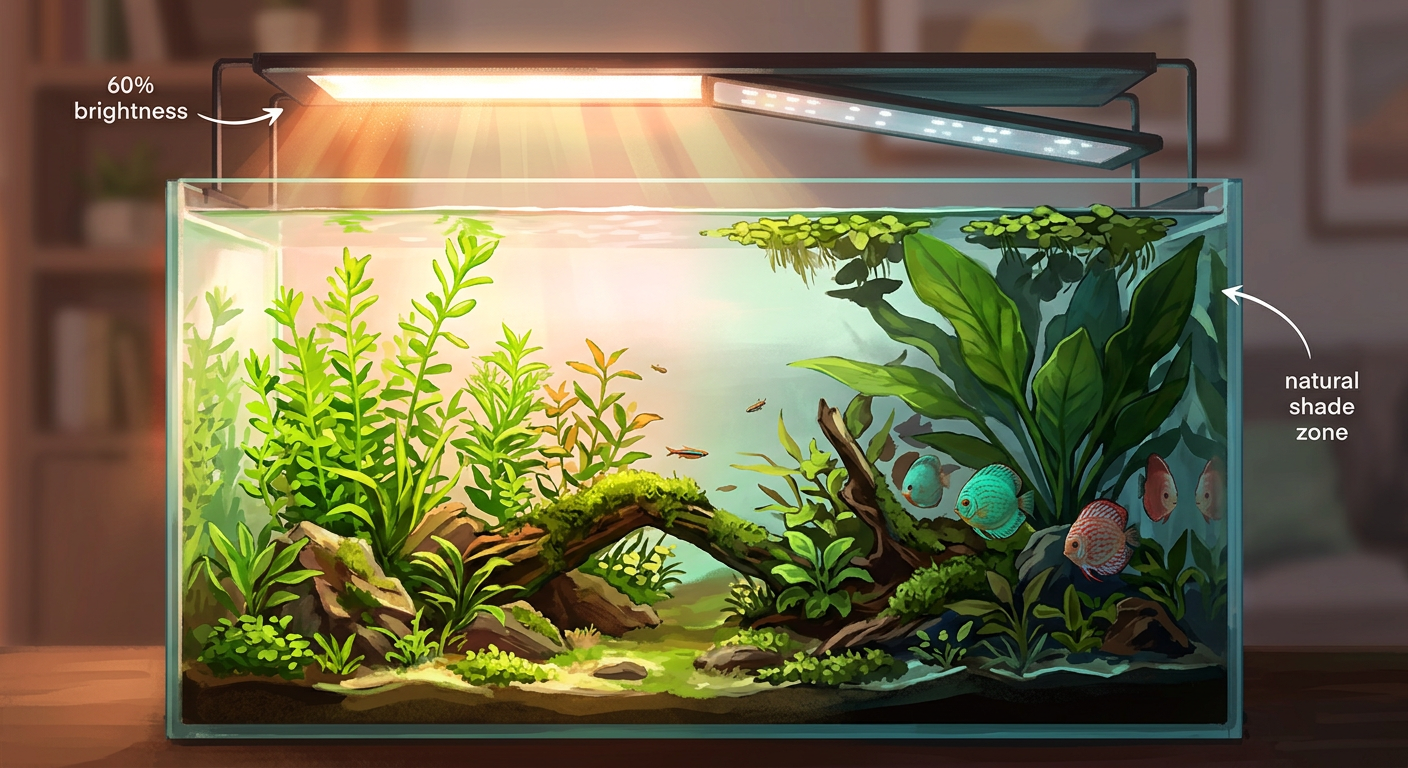 Dimmable LEDs are worth the investment if you're balancing plant growth with fish comfort. Run them at 50-60% brightness. Or split it: 6 hours bright morning, 4 hours dark midday, 6 hours bright evening. Plants get the light they need. No algae bloom risk from 12+ continuous bright light. Shy fish get the dimmed, changing environment they prefer.
The exact balance depends on your tank and species. The principle is consistent: fish lighting preference is probably lower than optimal for plants. Create zones where both get what they need.
Substrate selection and behavioral support
Substrate shapes what happens inside the tank.
Different substrate types support different behaviors. Sand lets fish sift and expose food the way they evolved. Gravel holds plant roots and stays loose enough for burrowers. Bare bottom simplifies cleaning. It offers no sensory input and gives fish nothing to root in for natural foraging. Soil substrate feeds plants but eventually breaks down into mud.
Each choice is a trade-off.
Aquarium substrate types by species
Corydoras are a useful example because their substrate preference directly affects how well they function.
Corydoras have barbels on their mouths. Whisker-like sensory organs they use to hunt through substrate. One persistent myth: corydoras need perfectly smooth sand because their barbels are delicate.
I've kept notes on this for years. The truth is more complicated. Wild corydoras habitats have sharp substrate. Barbel erosion usually isn't from sharp grains. It's from poor water quality. Bacterial infection frays barbels. Clean sharp substrate beats poor-quality smooth substrate with bacteria. But I'd give them smooth substrate when I can. Why risk it. Fine sand or very fine gravel works. The fish settles faster, forages actively, feeds in the open instead of picking at edges.
Cichlids benefit from sand because many sift through it during spawning. They mouth sand, rearrange it, dig pits. That's functional behavior their nervous system expects to do. Sand plus plenty of shelter (rocks or driftwood) gives them the options they want.
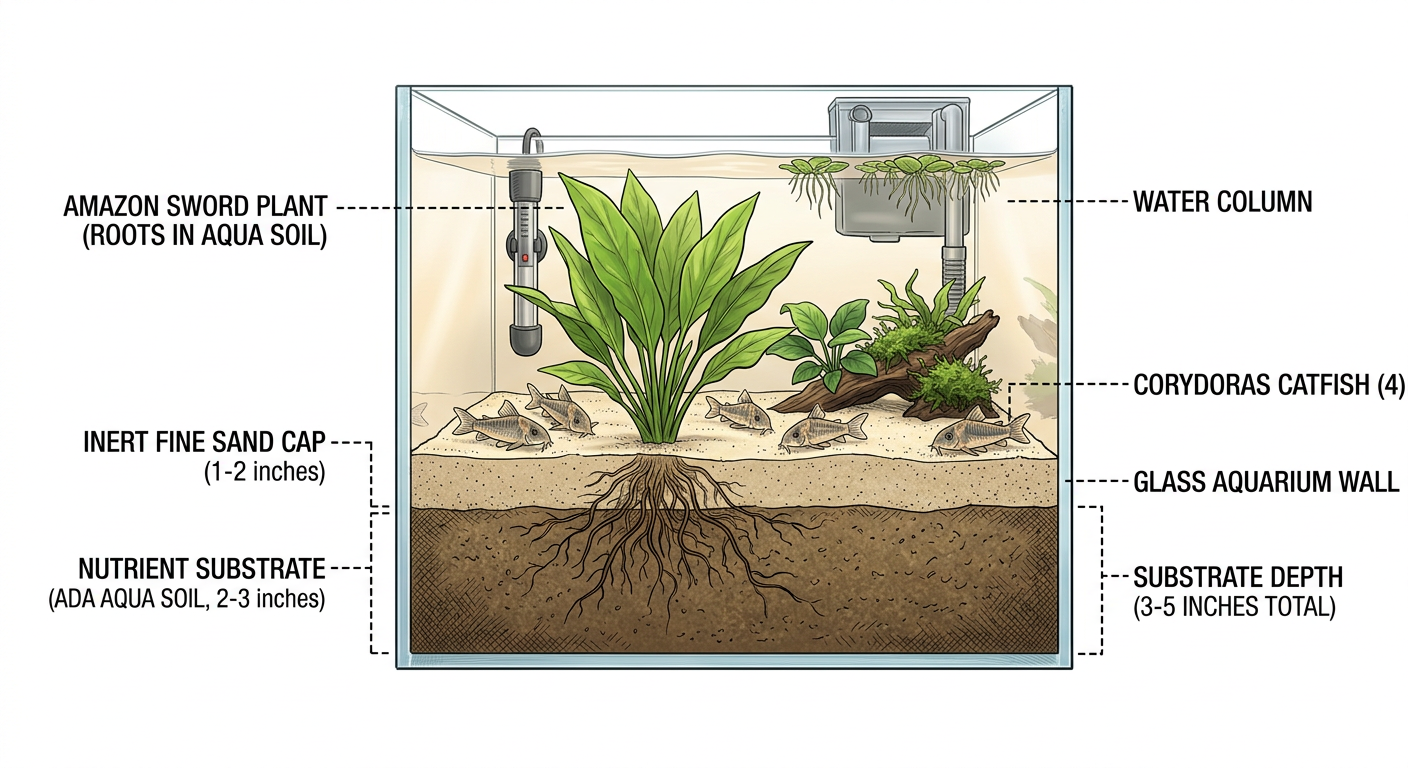
For planted tanks with root-feeding plants, nutrient-rich substrate (ADA Aqua Soil type) capped with inert sand works well. Plants get nutrients. Aesthetics look clean. Bottom-dwellers get some sensory benefit of sand. Layer it: soil on bottom (2-3 inches), sand or very fine gravel on top (1-2 inches). Roots reach the nutrient layer. Surface stays clean.
Shrimp tanks are substrate-specific. Cherry shrimp (Neocaridina) tolerate a range of substrates. Crystal shrimp and sensitive Caridina species nearly require active substrate that lowers pH and softens water. ADA Aqua Soil is the standard. It contains minerals adjusting GH/KH and breaks down gradually, simulating soil without the mud.
Bare bottom works for quarantine, breeding setups where you monitor waste, and temporarily under high-bioload species where debris piles up fast. Few weeks is fine. Permanent housing of bottom-dwellers that expect to forage is not.
Substrate depth and layering
Shallow substrate (0-1 inch) prevents burrowing and doesn't support roots. It looks clean. It fails the fish.
Deep substrate (4+ inches) supports burrowers and roots, but creates anaerobic layers if circulation stops. Dead spots form. Hydrogen sulfide builds up. You end up with that muddy smell.
The practical middle ground is 2-3 inches. Active substrate underneath (ADA Aqua Soil or similar), finer material on top. Deep enough for roots and burrowing. Shallow enough to prevent anaerobic pockets unless the tank gets seriously neglected. Deeper substrate? Add Malaysian trumpet snails. They turn the bottom and prevent dead zones.
If you're planting root-feeding plants, those 2-3 inches matter. Roots search down for nutrients. Shallow substrate means roots hit glass and stunted plants result. Deep substrate lets roots explore, establish, and draw nutrients from below.
 Fish tank water flow requirements and filtration
Filters do two things: remove waste and create flow. Most aquarists optimize for waste removal and ignore flow. That's the mistake.
Flow is behavioral. Species evolved in different currents. Mismatched flow stresses them the same way mismatched temperature does.
Low-flow vs. high-flow fish tanks: species needs
Bettas evolved in shallow, still Southeast Asian waters. Slow, deliberate swimmers. Long, flowing fins are a liability in strong current. Strong flow isn't stimulating. It's stressful. Fins get whipped. Energy goes into fighting current. They hide behind obstacles trying to escape. Sponge filters with gentle, dispersed flow work for bettas. Strong canister output harms them.
Discus respond similarly. They're fast, erratic swimmers in tight quarters, prone to injury in aggressive current. Low to moderate flow directed along tank length, not as a jet, helps them settle.
Gouramis are labyrinth fish. They breathe air at the surface. They prefer calm to moderate flow. Not river fish.
Hillstream loaches are the opposite. Specialized stream dwellers from Southeast Asia. Entire body built for clinging to rocks in fast-flowing water. Flat undersides. Powerful pectoral fins shaped like wings. Streamlined. They need flow. Still water stresses them. No flow eventually kills them.
Mismatched flow shows in behavior. A betta in strong current hides in caves, never displays, never patrols. A hillstream loach in calm water stops eating, stops moving, deteriorates. Once you look, the mismatch is obvious.
Creating flow zones within a single tank
Not every fish needs the same flow. You can create zones. Filter output on one side creates current there. The opposite side stays calm. Direct output along tank length instead of blasting the back wall. Current spreads naturally. Use flow deflectors (driftwood, rock formations) positioned to catch and redirect flow. Create calm zones behind obstacles and faster zones in open areas.
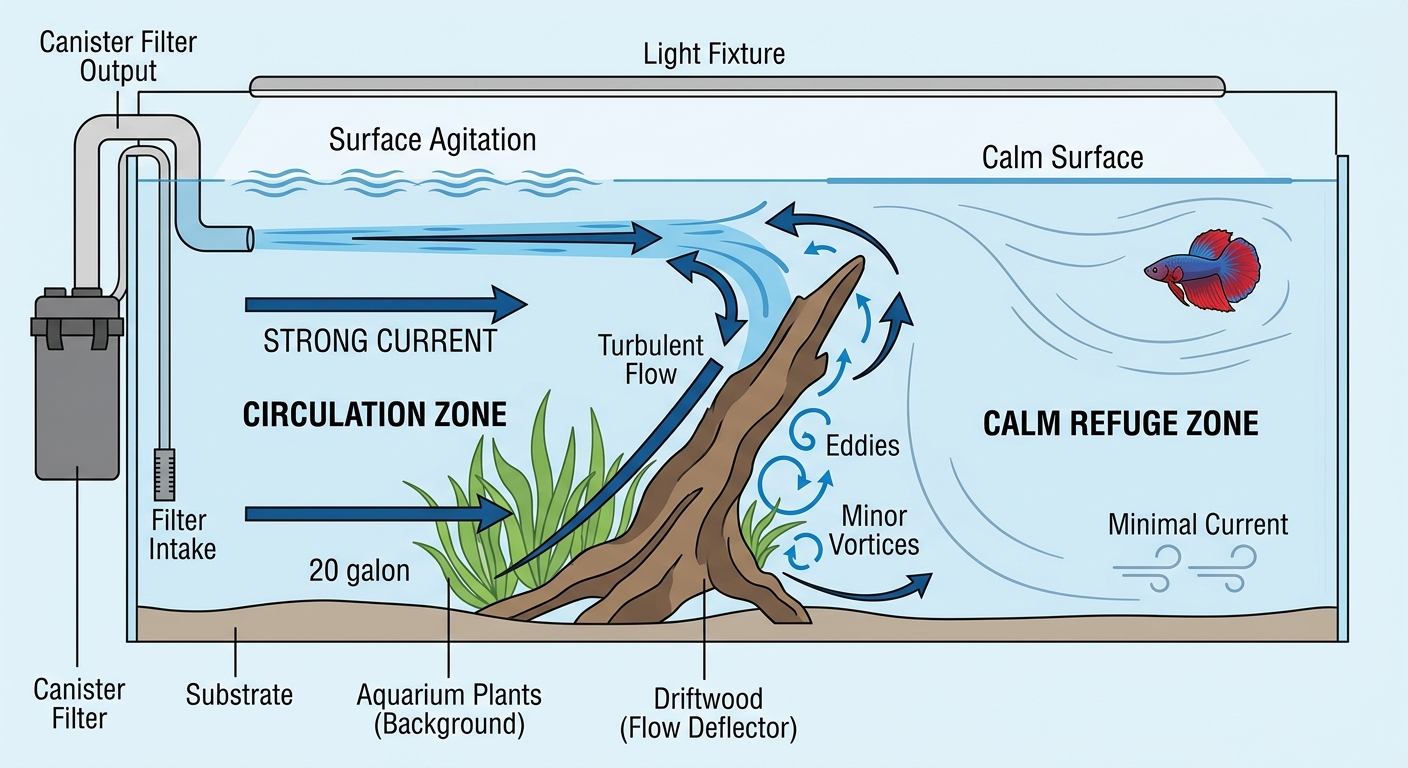 Strong filter? Use a spray bar instead of a single nozzle. Flow distributes across wider area instead of one jet. Feels less aggressive to fish that hate current. Powerheads and wavemakers increase flow in one area. That works. It also adds maintenance and complexity. Start by optimizing your main filter output placement, direction, and deflection before adding more.
Dense plant groupings slow current naturally. They create eddies and break flow into smaller patterns. Heavily planted tanks have naturally varied flow. That's why they work better for shy or low-flow species.
Surface agitation (movement at the water line) is separate from current and equally important. Bettas need surface agitation to prevent protein film buildup. They don't want violent, churning surface. Gentle movement, not waves. Discus need even gentler movement. Strong surface disruption stresses them.
Higher temperature tanks hold less dissolved oxygen. That's chemistry. At 86 degrees Fahrenheit water holds significantly less oxygen than at 74 degrees. Surface agitation becomes critical, not optional. Air stones help. Increased circulation helps. These are necessities in a warm discus tank, not luxuries.
Dead spots and why they matter
Dead spots develop wherever flow stops. Behind obstacles, in corners, under dense plants. Water stagnates. Detritus piles up. Aerobic bacteria stop, anaerobic bacteria take over. Substrate gets muddy. It smells bad.
You can't eliminate dead spots (and shouldn't, because some fish need retreat areas). Position them deliberately. Use dead spots as intentional refuge zones for shy fish or breeding colonies. Don't let them develop accidentally in corners you aren't monitoring.
Siphon dead spots during water changes. Small aquariums with poor circulation need more frequent siphoning. Regular dead spots signal that filter placement or intensity needs adjustment.
Aquarium biotope design: integrating all elements
Tank design becomes a system here, not just a list of preferences.
A biotope replicates a real environment. Not perfectly, but recognizably. Amazonian biotope: soft, acidic water, warm temperatures, driftwood, decomposing leaves, dense plants along margins, shade, lower light, slow to moderate flow. Southeast Asian stream biotope: rocky substrate, fast flow, cooler temperatures, bright light, algae growth on rocks, sparse vegetation adapted to current.
You can't combine these biotopes. But you can create a tank serving the species inside, and that usually means the species share environmental requirements.
Start with your most restrictive species. The one with hardest requirements. Discus are restrictive. 85-86 degrees Fahrenheit mandatory, large tank minimum, peaceful tank mates only, low light, soft water. If you're building a discus tank, start there. Everything fits into those parameters.
Add species that overlap. Cardinal tetras tolerate 85 degrees, prefer warm water. Sterbai corydoras handle 85 degrees. Peppered and cold-water corydoras species do not. Bristlenose plecos adapt to 85 degrees. Anubias and java fern tolerate low light. This creates a coherent biotope where inhabitants actually fit.
Now layer the elements.
Substrate: fine sand, nutrient substrate underneath (for root plants) or inert sand with periodic root tabs. Supports corydoras foraging and cichlid sifting.
Plants: tall root structures (large swords), driftwood with anubias, java fern thickets in low-light areas. Creates shelter and gradation.
Hardscape: driftwood as primary structure, creating crevices and cave areas. Stable base so nothing shifts. Rubble adds complexity.
Lighting: 8-10 hours daily, 40-60% brightness. Plant growth without algae. Shaded leaf-litter environment discus want.
Flow: moderate, directed gently along tank length. Driftwood and plants slow it naturally, create eddies. Gentle surface agitation.
Water chemistry: soft, acidic (pH 6-7, GH below 10 degrees). Changes gradually. No sharp swings stressing fish.
The result is a tank where every element supports actual fish needs. Fish are visible, active, healthy. Colors deepen. Breeding happens. Fish live full lifespans.
You don't need perfect. You need the factors that matter to align.
Matching aquarium decor to fish species: evaluating commercial products
Product companies sell aquarium decor by making it look good. That's fine if the decor serves your fish. It's a problem if you buy based on looks and it doesn't work.
What to look for in hiding structures
A cave is not a cave unless your fish fits inside and feels secure. Most commercial caves fail that test.
Size matters. "Medium" pleco cave fits a 3-inch fish but fails at 5 inches adult. Plecos grow. Will it still work? If no, skip it. Entrance geometry matters too. Wide-open entrance works for corydoras (quick-entry crevices). Plecos want a small, defensible opening where predators can't reach. Flat bottom beats rounded interior. Fish sit on flat surface, not balanced on curves.
Material safety is basic. Painted ceramics leach color or toxins. Rough resins develop sharp edges. Run your finger inside. If it catches skin, it shreds fish fins. Too rough for algae means plecos won't graze on it.
Internal darkness matters for nocturnal fish. White ceramic is better than nothing. Dark caves (black, gray, brown) signal "safe" to plecos more reliably. Light interiors feel exposed.
A cave that shifts or tips isn't a cave. It's a hazard. Test it on sand in-store and confirm it won't move.
What to look for in artificial plants
Material is your first signal. Silk plants move naturally and last longer than hard plastic before UV or heat degrades them. Test for colorfastness: rub a wet paper towel on the plant. If color transfers, it'll leach in your tank.
Edge finishing is safety. Bettas, discus, angelfish can tear on sharp plastic. Test on your bare arm. If it catches at all, it tears fish fins. Smooth edges only. Tipping or swaying plants don't provide stable shelter. Weighted bases that stay put separate decor from function. Place it and brush past gently. If it shifts, skip it. Look through the plant from both sides. Can you see clear? If yes, it's not shelter. Dense enough to break line of sight is minimum.
Fine texture traps debris and becomes waste accumulator. Broad, smooth surfaces rinse clean. Pull artificial plants and rinse during maintenance. Hard to clean is ongoing burden you'll resent.
When commercial products fall short and what to do instead
Mass-produced decor fails predictably. Rough cave interiors injure fish. Sharp plastic edges everywhere. "Universal" products fit no species. Artificial plants collect debris and become toxic.
When commercial products fall short, DIY alternatives often perform better.
Coconut caves: split a coconut shell, sand the interior edges smooth, and you have a functional cave. Fish love them. $2-3 versus $15 for commercial equivalents. Very DIY friendly.
Terracotta pots: low-cost, safe, functional. Stack them, hide seams with plants, and you have instant caves. Some aquarists bury them partially for a sunken-cave look.
PVC pipe covered in silicone and sand sounds complex but it's straightforward. Cut PVC, coat with silicone, roll in sand for texture, let cure, and you have a cave that fits exactly. Cost: $5-10.
Branches and wood: find safe, non-toxic branches from outside, boil them to sterilize, and use them as perches and shelters. Free or nearly free, and fish recognize them as natural.
Dense plant tangles: java moss tied or glued to driftwood creates dense shelter that bought artificial plants often can't match. It's live, it hosts biofilm, and it's cheaper than you'd think.
Evaluate any decor—commercial or DIY—by this question: does this serve my fish's actual need? If the answer is no, the cost is irrelevant. Five dollars wrong is more expensive than twenty dollars right.
Species-specific tank setup: putting it into practice
Start with observation, not assumptions. If you want a discus tank, watch discus videos. Read their care requirements. Note what stresses them and what makes them comfortable. Do the same for each species you're considering. Take notes. This takes time, but it's time that saves you the cost of fish deaths and tank redesigns later.
Once you've identified the species you want, identify their core requirements.
Temperature range: Is there an overlap where all your species can live? Or is one species incompatible with the others?
Hiding needs: Do they need dense cover? Specific cave geometry? Open water? Can you create zones that serve all of them in one tank?
Water chemistry: Soft vs. hard, acidic vs. alkaline, stable vs. variable tolerance? Do your species align?
Flow: Slow, moderate, or fast current? Can you partition flow zones?
Lighting: Bright, dimmed, dark preference? Can you create gradients?
Substrate: Does each species have specific substrate needs? Can you choose one type that serves all of them?
Plant needs: Are you keeping live plants or artificial? If live, what kind supports your species?
Once you've answered these questions, you have a filter. Buy or build equipment accordingly. Filter output placement, substrate depth, plant density, cave selection. All of these decisions should be made by reference to your species' actual needs, not aesthetics.
The result will look cohesive. More importantly, your fish will be cohesive. They'll settle. They'll show color. They'll breed, if that's possible. They'll live longer.
That's what a functioning aquarium looks like.
Comments
No comments yet.