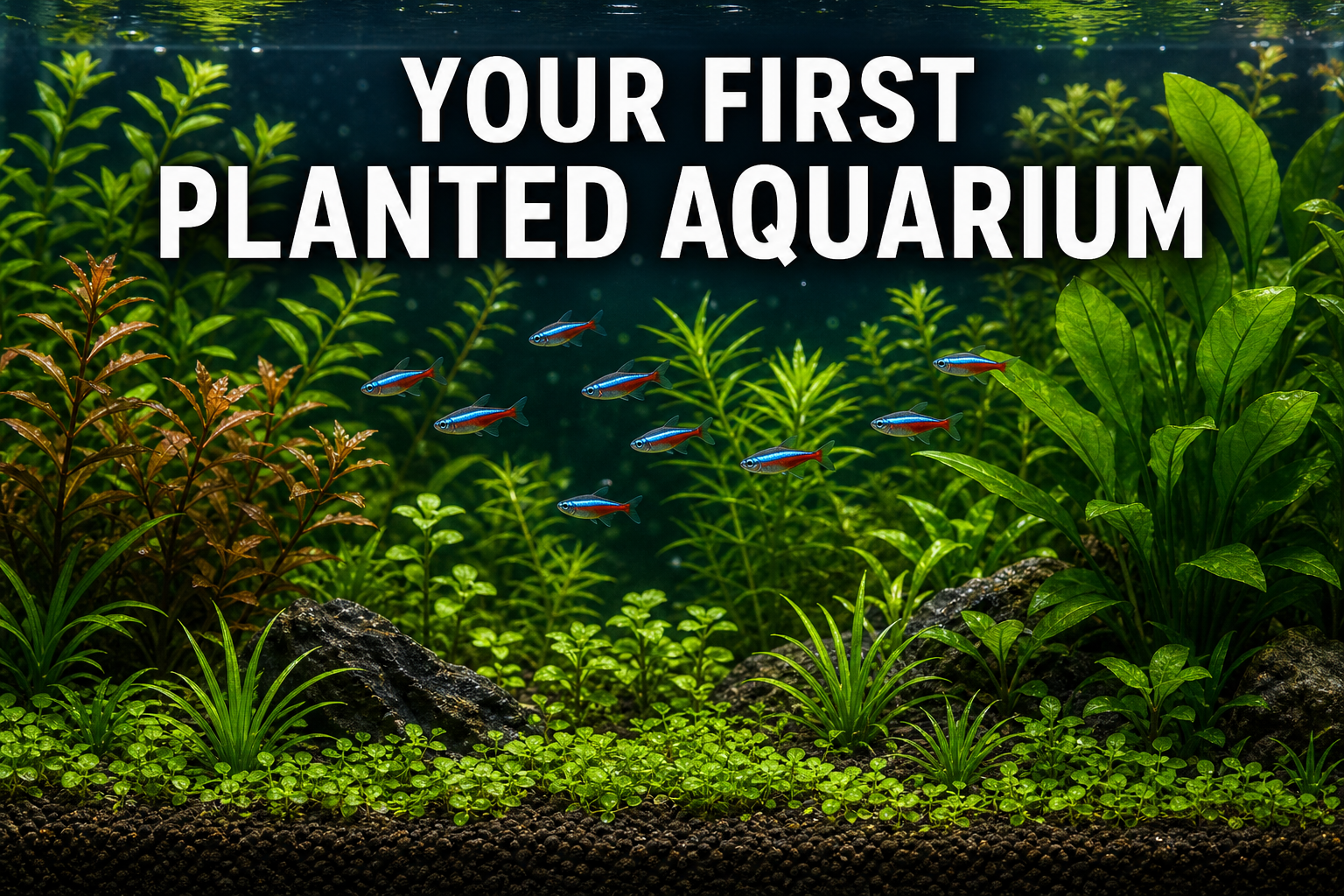
Why go planted?
Fish are healthier in planted tanks. That's not marketing — you can see it. Live plants eat the nitrates that pile up in bare-bottom setups. They oxygenate the water. They give fish somewhere to duck when they're stressed, and they starve out the algae by hogging the nutrients algae would otherwise feast on. Fewer green walls. Simpler, really.
There's a trade-off. A planted tank asks more of your attention than a bare-bottom ever will. You're maintaining two living systems now — fish and plants — and they don't always want the same things on the same schedule. Light timing, nutrient balance, substrate choice. These all matter in ways that a fish-only tank lets you ignore.
But honestly? Once you've had a planted tank running for a few months, bare-bottom starts looking kind of sad. Plants grow. They shift. They react to what you feed them and tell you when something's off. It's a different hobby, not a harder one. And it rewards you for paying attention.
Low-tech vs. high-tech — what you're actually signing up for
Before you pick plants, it helps to know which world you're entering. Most planted tanks fall somewhere on a spectrum:
Low-tech (beginner) High-tech
| CO2 | None | Pressurized injection |
| Light | Low to medium | Medium to high |
| Substrate | Plain gravel or sand + root tabs | Active soil (ADA Aqua Soil, Fluval Stratum) |
| Fertilizer | All-in-one liquid, weekly | Separate macro/micro dosing (EI method) |
| Maintenance | 30–45 min/week | 1–2 hours/week |
| Setup cost | $100–200 (lights, plants, fertilizer) | $300–600+ (CO2 system, active soil, test kits) |
| Growth speed | Slow and steady | Fast, needs regular trimming |
| Algae risk | Low if you stay consistent | Higher — imbalance shows up fast |
Everything in this article is written for the low-tech path. You can always upgrade later.
Best plants for beginners
Start with plants that forgive mistakes. Everything below needs no CO2 injection, handles low light, and won't die because you forgot to dose fertilizer for a week. You'll actually watch them put on growth instead of spending a month wondering if they're alive.
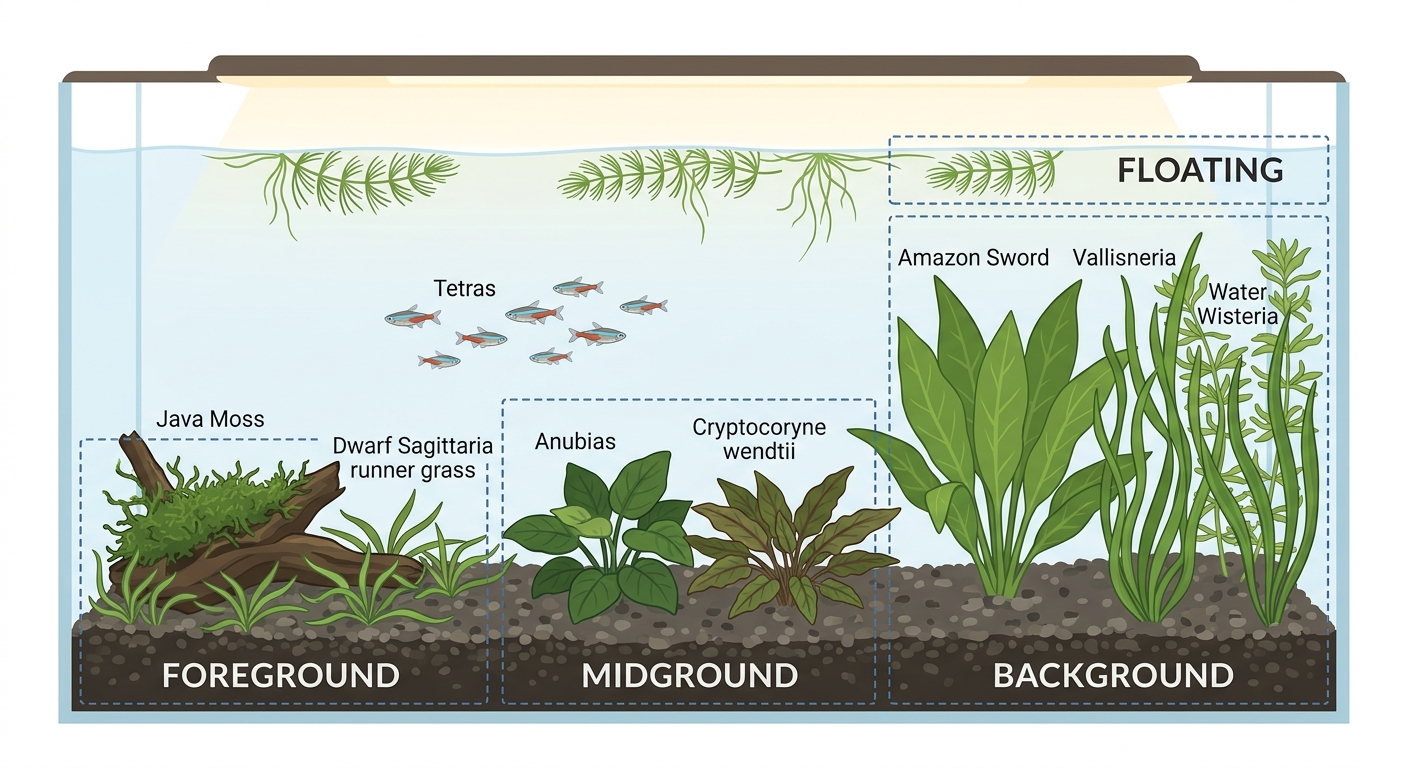 How to read these entries: Light is minimum PAR (photons the plant actually uses). Growth is what to expect in a stable tank. Placement is where it fits in a typical layout.
Foreground and carpeting
- Java Moss (Taxiphyllum barbieri) — probably the most forgiving aquarium plant in existence. Tie it to a rock or a piece of driftwood. It'll carpet, it'll climb, or it'll just sit there as a green lump. Doesn't really care. Grows slowly so you're not trimming it every other day. Light: 10+ PAR. Growth: slow.
- Dwarf Sagittaria (Sagittaria subulata) — grass-like, sends out runners, eventually fills in like a lawn. Not the fastest starter. Give it a couple months and some patience. Roots in substrate. Light: 15–30 PAR. Growth: moderate once established.
Midground
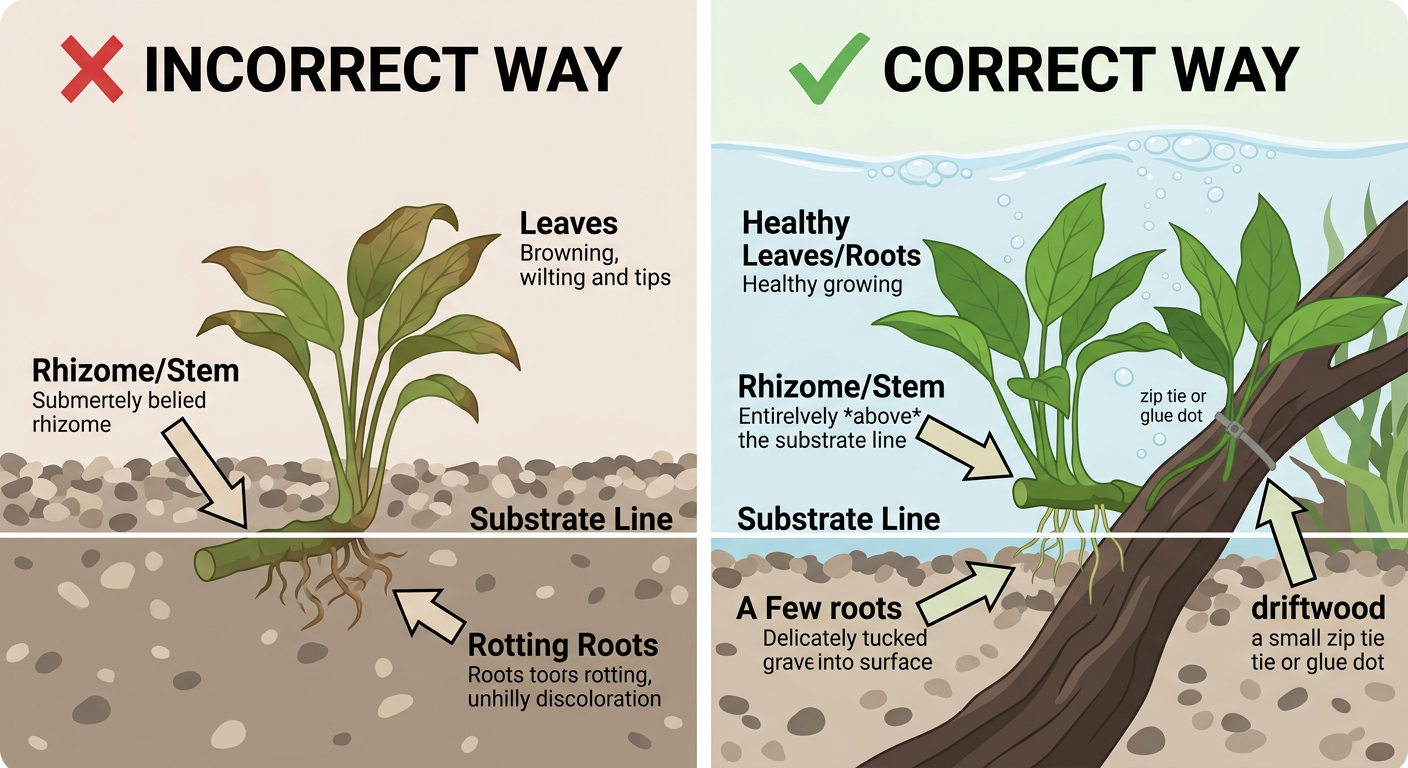
- Anubias (Anubias barteri nana, coffeefolia) — this plant is almost offensive about how hard it is to kill. Thick leaves, slow growth, handles neglect like a champ. One critical thing: don't bury the rhizome (that thick horizontal stem at the base). Glue or tie it to something. Plant the roots, leave the rhizome out, or it rots. Light: 10+ PAR. Growth: very slow.
- Cryptocoryne wendtii — solid little plant. Goes through an ugly phase when you first put it in (more on that below). Don't throw it out. It comes back. Roots in substrate, stays compact. Light: 15–30 PAR. Growth: slow to moderate.
- Bucephalandra — the rhizome cousin of Anubias. Same rules apply: don't bury the rhizome, attach to hardscape. Leaves come in all kinds of colors and textures depending on the variety. Slower grower but very forgiving. Light: 10–25 PAR. Growth: slow.
Background
- Amazon Sword (Echinodorus bleheri) — gets big. Broad leaves, tall stems, needs room for roots. A nutrient-rich substrate or some root tabs nearby make a real difference here. Heavy root feeder. Light: 20–40 PAR. Growth: moderate.
- Vallisneria (Vallisneria spiralis) — ribbon-like leaves that can shoot across the tank via runners. Once it decides it likes your water, it just goes. Good if you want that tall, flowing background fast. Roots in substrate. Light: 20–40 PAR. Growth: fast once established.
- Water Wisteria (Hygrophila difformis) — looks fragile, isn't. Plant it or let it float. Either way it grows quickly and pulls excess nutrients out of the water. Reliable. Light: 15–30 PAR. Growth: fast.
Floating and water column
- Hornwort (Ceratophyllum demersum) — no roots at all. Toss it in. It floats, grows like mad, and acts like a nutrient sponge. Occasionally sheds needles if it's unhappy, then bounces back. Cheap, effective background cover. Light: 10+ PAR. Growth: very fast.
- Java Fern (Microsorum pteropus) — attach to hardscape, same deal as Anubias. Tolerates genuinely terrible lighting conditions. Slow grower, which means maintenance stays low. Light: 10+ PAR. Growth: slow.
When you're ready to step up
After a few months with the plants above, you might want something with more visual punch. These need slightly more light (25–40 PAR) but still no CO2:
- Ludwigia repens — one of the easiest coloured stem plants. Reds and oranges show up in the leaves once there's enough light. Plant in substrate. Grows fast, easy to trim and replant. Light: 25–40 PAR. Growth: fast.
- Pogostemon helferi — curly, star-shaped leaves, forms a nice rosette. Needs decent nutrients in the substrate. Light: 20–40 PAR. Growth: moderate.
Why your store-bought plants melt (and why it's not your fault)
Most aquarium plants at the shop were grown emersed — in greenhouses, above water, with humidity doing the heavy lifting. Their leaves adapted to air. When you submerge them, those same leaves can't handle being underwater. They go mushy. Dissolve. Sometimes disappear completely within a week.
Not a crisis. It's what's supposed to happen.
Right now — even though you can't see it — the plant is pushing out new leaves built for aquatic life. Give it two or three weeks. The new growth looks different from what you bought: tougher, sometimes smaller, clearly adjusted to your tank. Trim the melted stuff when it gets ugly, stay patient, and it works out.
I mostly get my starter plants from other hobbyists now — cuttings, plantlets, whatever someone's trimming away. No emersed-to-submerged shock that way. But if you're buying from a shop, knowing that melt is normal saves you a trip back for "replacement" plants that go through the same thing.
Substrate — what your plants actually pull from
Two categories of plants, two different feeding strategies, and substrate matters for one of them more than the other. Rhizome plants like Java Fern and Anubias pull their nutrients from the water column. They could grow on a bare piece of glass and be fine. Root-feeders — Amazon Swords, Cryptocoryne, Dwarf Sagittaria — want something at their roots to eat from.
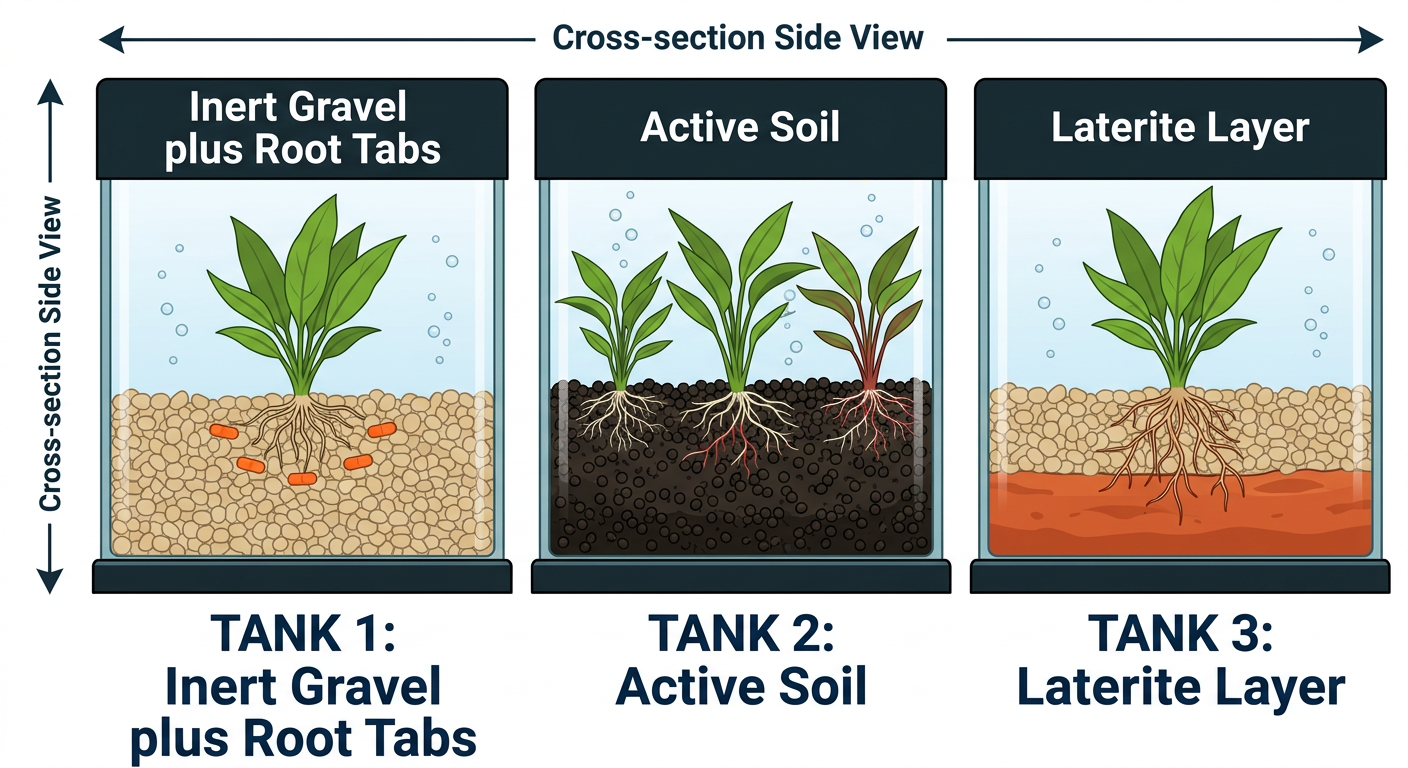 Substrate typeGood forProsCons Substrate typeGood forProsCons | |||
| Inert gravel or sand | Rhizome plants, water-column feeders, mixed setups with root tabs | Cheap, doesn't alter water chemistry, lasts indefinitely | No built-in nutrients — needs fertilizer or root tabs for rooted plants |
| Active soil (Fluval Stratum, ADA Aqua Soil, CaribSea Eco-Complete) | Rooted plants, heavily planted tanks, aquascaping | Built-in nutrients, visible growth boost, buffers pH downward (helpful for soft-water fish) | More expensive, can leach ammonia in first weeks, breaks down after 1–2 years and needs replacing |
| Root tabs (pushed into inert substrate) | Mixed tanks on plain gravel, budget setups | Cheap, targeted feeding, no water chemistry changes | Need replacing every 2–3 months, only feeds near the tab |
| Laterite-clay mixes (layered under gravel) | Long-term planted tanks on inert substrate | One-time setup, releases iron slowly, doesn't need replacing | Must be installed at setup (not after), messy to add later |
Where I'd land as a starting point: plain gravel or sand, with root tabs shoved next to your Swords and Crypts. Skip active soil until you know you're in this for the long run. You can always upgrade.
Lighting
Light is what drives growth. More light equals faster growth. Also more light equals more algae when your nutrients aren't matching — this is the bit that gets people in trouble. "More light is better" sounds right until your tank turns green.
Picking a fixture
Three fixture types show up in aquariums:
- LED — what you should buy. Efficient, long-lasting (50,000+ hours), adjustable intensity on better models, thin profile. Prices have dropped enough that there's no reason to look elsewhere for a beginner tank. Look for something rated for planted tanks with PAR values listed.
- T5 fluorescent — still used in high-tech setups where even light spread across long tanks matters. Bulbs need replacing every 12–18 months. Bulkier than LED. Not necessary for low-tech.
- Standard fluorescent/T8 — the old-style tubes. Cheap but dim, inefficient, and the spectrum tends to shift over time. Fine for a low-light Java Fern tank if that's what you already have. Not worth buying new.
Intensity
- Low light — around 10–20 µmol/m²/s PAR, or roughly 0.25–0.5 watts per litre. Covers everything I've listed so far: Java Fern, Anubias, Java Moss, Bucephalandra. Basic LED strip handles this fine.
- Medium light — 20–40 PAR, or 0.5–1 watt per litre. Amazon Sword, Vallisneria, Water Wisteria, Cryptocoryne, Ludwigia repens. This is where most beginner-friendly plants sit.
- High light — 40+ PAR. This is where things get demanding. Without CO2 and careful nutrient dosing, algae wins. Skip it for now.
How long to leave lights on
Six to ten hours a day. I'd start at six. If growth is too slow after a couple weeks, bump it to eight. Buy a cheap timer. The consistent schedule matters more than the exact number of hours. Plants — and algae — respond to regularity.
Color temperature
6500K to 7000K. That's "daylight white" on the box. It looks natural, shows fish colours well, and plants photosynthesise efficiently under it. You don't need to overthink this.
Plant food
Plants need nitrogen, phosphorus, and potassium — the big three (NPK) — plus iron, magnesium, and trace elements in smaller amounts. Fish waste covers some of the nitrogen and phosphorus. Most of the time it's not nearly enough.
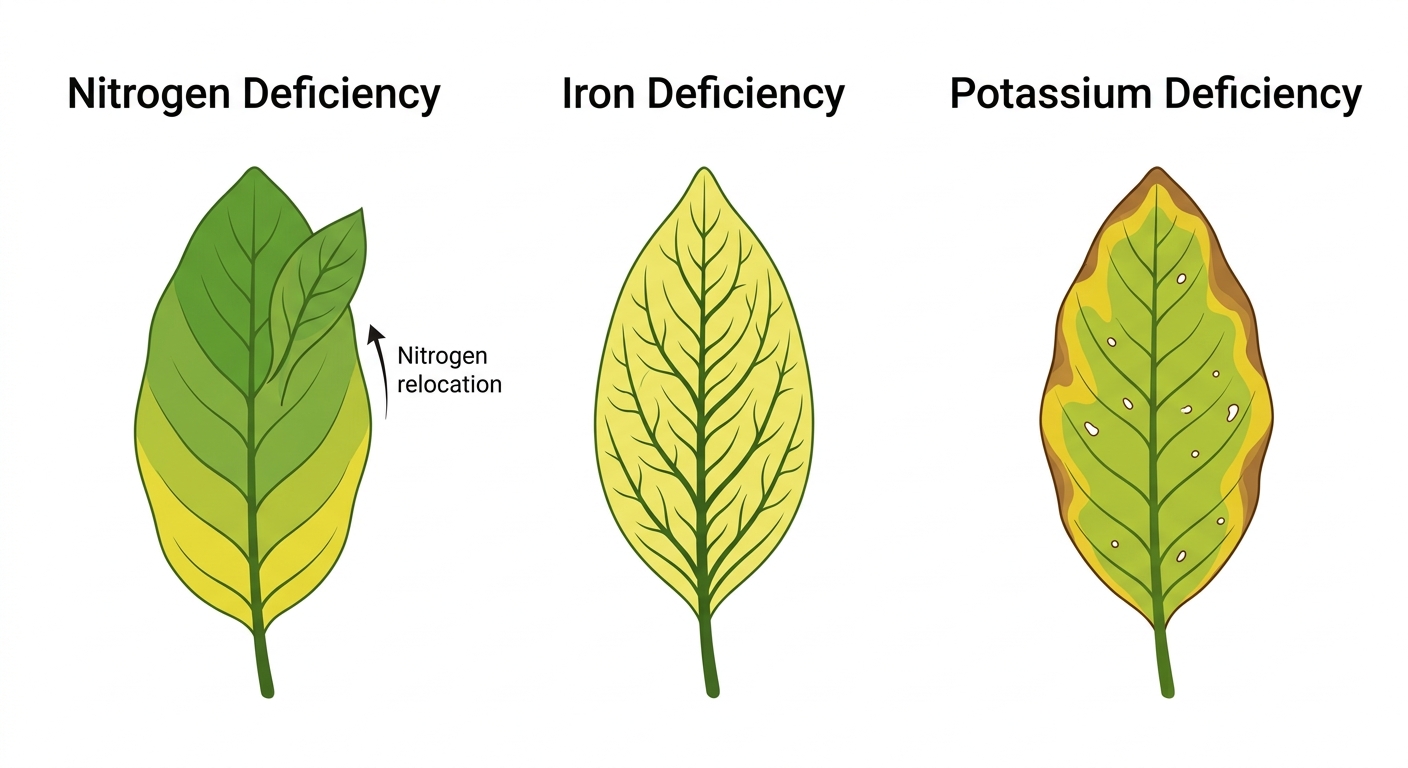
Deficiencies show up in specific ways:
- Nitrogen: older leaves yellow first because the plant moves what nitrogen it has to new growth.
- Iron: new leaves go pale while the veins stay green. Common in soft-water tanks.
- Potassium: yellowing edges, pinholes in leaves, generally weak growth.
 Fixing it — two approaches
Lean dosing — small amounts of fertilizer each week. Less algae risk. You check occasionally to make sure you're not missing something. Good for beginners who are comfortable doing light monitoring.
Estimative Index (EI) — flood the tank with enough nutrients that nothing's ever limiting, then do a big (50%) water change weekly to prevent buildup. More forgiving than lean dosing because you can't really underdose. But it means more fertilizer and a strict water change schedule.
Most beginners: grab an all-in-one liquid fertilizer. Thrive, Flourish Comprehensive, something like that. One bottle with macros and micros already mixed. Dose what the bottle says for your tank size. Watch the plants. If older leaves start yellowing, you're probably under-dosing. If algae shows up, back off a touch.
Root-feeders in plain gravel: use root tabs. They last months. You don't have to think about liquid dosing for those plants at all.
Do you need CO2?
No. Not for the plants on this list and not at the start.
CO2 helps. Growth gets faster, colours sharper, algae stays in check better under high light. But it adds cost, gear, and something else to maintain. It's not a requirement.
Skip it. Get the rest dialled in first. If six months in you're still enjoying planted tanks and want to push further, here's what exists:
- Pressurized CO2 — CO2 tank, regulator, solenoid on a timer, bubble counter, and a drop checker to monitor levels in the tank. Reliable, adjustable, the real deal. Runs $150–300 to set up.
- DIY yeast-and-sugar — cheaper (under $30) but unreliable. CO2 output drops off unpredictably as the yeast runs out. Fine as a test. Not something you'd trust long-term.
- Liquid carbon products (glutaraldehyde-based, like Seachem Excel) — dosed into the water. Help with algae, but don't actually replace injected CO2 for plant growth. Think of them as an algae tool, not a carbon source.
Mistakes beginners actually make
Burying rhizome plants in substrate. Java Fern, Anubias, and Bucephalandra have a thick horizontal stem called a rhizome. Plant it below the gravel line and it rots. Tie or glue those plants to hardscape instead. The roots will work their way down naturally.
 Running lights too long without enough nutrients. Eight-plus hours of light with weak fertilization turns into an algae party. Hair algae, green water, black spots on everything. Start at six hours. Increase slowly. Match the extra light with extra fertilizer.
Panicking over melt and throwing away plants. Covered this already but it's worth repeating. New plants melt. Wait three weeks. They come back.
Vacuuming substrate too aggressively when plants are in it. Heavy gravel vac-ing near rooted plants yanks roots and pulls nutrients out of the substrate. Light cleaning around plant bases is enough. Go deeper only where detritus is obviously building up.
Adding tap water straight from the sink. Chlorine and chloramine kill both fish and the beneficial bacteria that process fish waste. Condition the water before it goes in. One capful of dechlorinator, done.
Skipping water changes because plants handle everything. They don't. Plants take up some nutrients but waste still accumulates. The nitrogen cycle — ammonia to nitrite to nitrate — keeps running. Weekly 25–50% water changes stay as important in planted tanks as in any other setup.
Algae — what it means
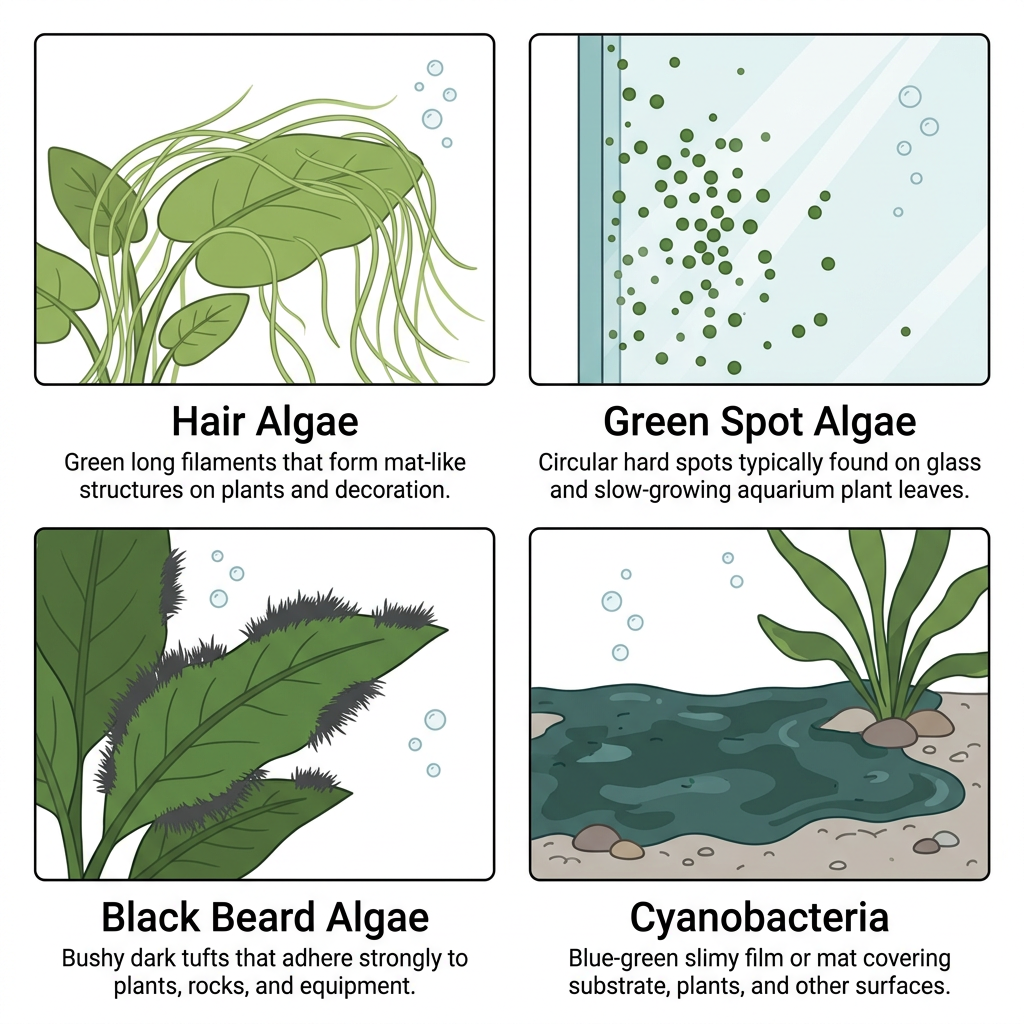 Hair algae — usually means too many nutrients (phosphate and nitrate) combined with too much light. Pull it out by hand first. Then reduce fish food, add more fast-growing plants (floater species help here), and trim the photoperiod back to eight hours or under.
Green spot algae — hard, round spots on glass and leaves. Comes from low phosphate or low CO2 paired with high light. Adding phosphate to your fertilizer routine usually clears it. Back off the light if you're running a hotter fixture.
Black beard algae — fuzzy dark patches, especially on slower-growing leaves. Low CO2, poor water movement, accumulated organics. Spot-treat with a little hydrogen peroxide (careful around shrimp). Increase flow with a powerhead if you can. Pull dead leaves.
Cyanobacteria — the slimy blue-green stuff that isn't actually algae despite how everyone refers to it. Often shows up when nitrates are very low (below 10 ppm) or circulation is dead. Raise nitrate if needed. Improve flow. Manual removal. A 24-hour blackout covers the visible problem but you still fix the underlying conditions or it returns.
Maintenance — a realistic schedule
Planted tank guides always make maintenance sound daunting. It isn't. After the first few months of learning, weekly work is 30–45 minutes. That's all.
Every week
- Water change, 25–50%. Siphon out the water, run the gravel vac lightly.
- Liquid fertilizer — one bottle cap. Takes ten seconds.
- Trim stems that are getting too tall or bushy.
- Pull dead leaves, spot-clean algae.
- Quick equipment check — filter flowing, heater warm, lights coming on.
- Check a CO2 drop checker if you're running injected CO2 (colour should be lime green; blue means too little, yellow means too much).
Monthly
- Test water with a liquid test kit (API Freshwater Master Kit covers ammonia, nitrite, nitrate, and pH — the one most people use). GH and KH test if you're running active soil or notice plant issues. Don't use strips; they're inaccurate.
- Rinse filter media in old tank water — never tap water, which kills the bacteria.
- Refresh root tabs if your schedule calls for it.
- Prune, replant stems you've trimmed.
- Look for algae patterns and nudge light or fertilizer up or down.
Every few months
- Replace filter carbon if you're using it.
- Think about whether light output has dropped — older bulbs and cheap LEDs dim over time.
- Deeper substrate clean only if you can see detritus building up.
- Calibrate a pH meter if you use one (or replace the probe).
That's the whole list. Not a second job.
Answers to the usual questions
Do I need CO2 for a planted tank?
No. The plants listed here grow without it. Add it later if you want more.
What's the best substrate for a beginner planted tank?
Inert gravel or sand with root tabs for your root-feeders. Cheapest option, lowest maintenance, doesn't need replacing after a couple of years the way active soil does.
How often should you change water in a planted aquarium?
Weekly. 25–50%. Planted tanks don't get a pass on this.
Can any light grow aquarium plants?
For low-light species, yes, basically any aquarium light works. Want to grow medium- or high-light plants? You need a fixture rated for planted tanks with adequate PAR. Start with what you have if you're sticking to low-light plants like Java Fern and Anubias.
Why are my aquarium plants turning mushy?
Either the emersed-to-submerged transition (totally normal — store-bought plants were grown above water) or shock from a big change in conditions. Trim the worst leaves, wait a couple of weeks. New growth usually follows.
What fertilizer should I use for aquarium plants?
All-in-one liquid with macros and iron included. Seachem Flourish Comprehensive, Thrive, API Leaf Zone — any of them. Dose to the bottle's direction and adjust from what you see.
What are the easiest low-light aquarium plants?
Java Fern, Anubias, Java Moss, Cryptocoryne wendtii, Bucephalandra. All handle low light without CO2. Growth is slower and that's fine — less trimming for you.
Is a planted tank harder than a regular aquarium?
Different, more than harder. You swap one set of concerns for another. Planted tanks ask for more upfront thought. Once they settle in, most people find them easier, not harder, to live with.
Comments
No comments yet.