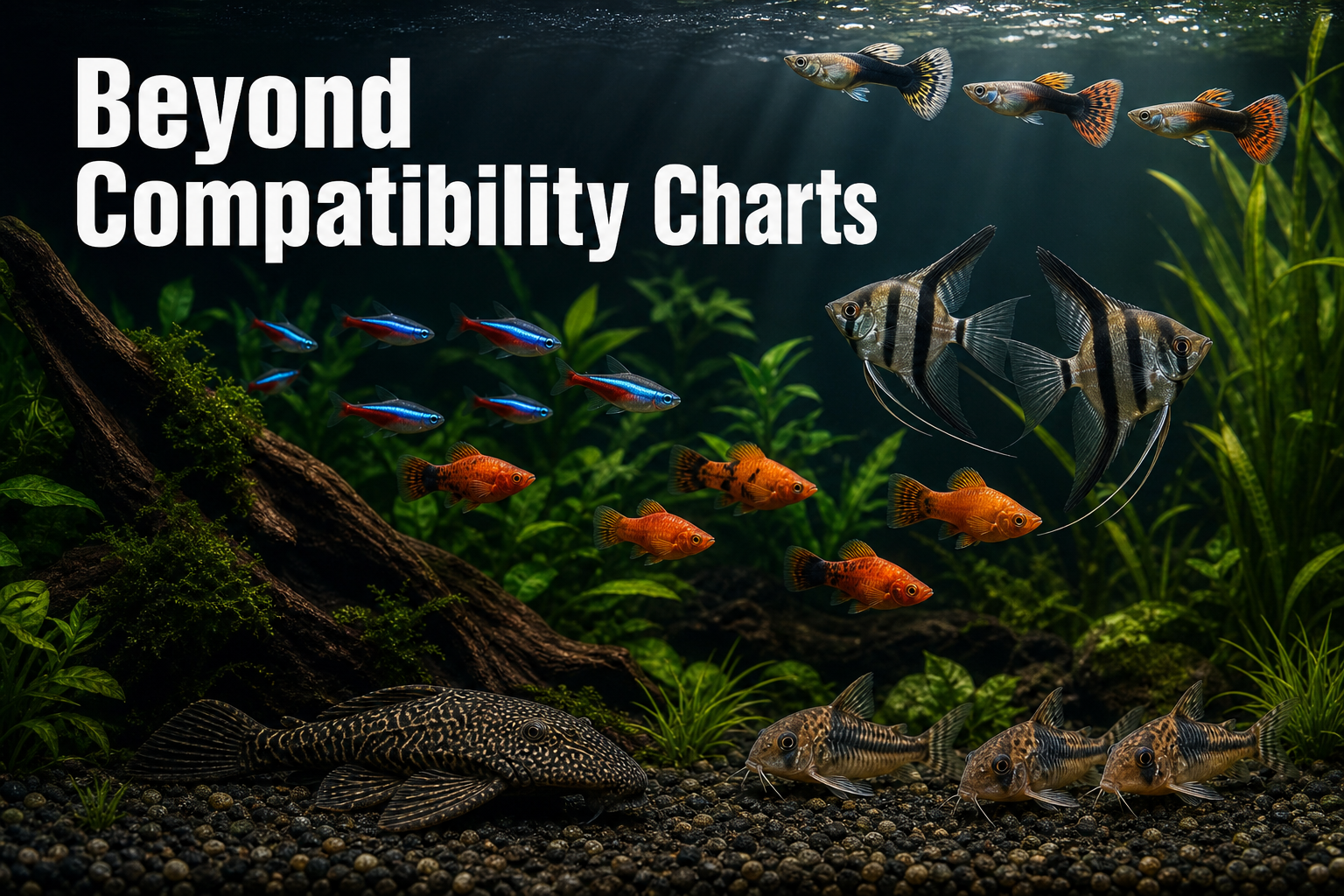
Introduction: Beyond the Compatibility Chart
Compatibility charts are everywhere, and they're making people fail at this hobby.
You've probably seen them: long tables with green checkmarks and red X's, reassuring you that neon tetras and angelfish can coexist, or warning that tiger barbs will destroy your guppy tank. The problem is that these charts treat fish like static creatures. They don't account for how a fish's behavior changes as it grows, how group size shifts personality, or how a 30-gallon tank that feels peaceful turns into a warzone at 20 gallons.
I've spent years tracking tank observations, behavioral patterns, and water parameters. What keeps surfacing is that how to stock an aquarium isn't about matching species names on a chart. It's about understanding behavior, recognizing when territorial disputes are just hierarchy settling versus when they're actually harmful, and reading the water parameter story your fish are living inside. The question isn't just which fish can live together — it's why they can, and under what conditions that answer changes.
This guide covers what matters: ecological niches, adult size compatibility (not the petstore juvenile), how aggression patterns actually work, territory dynamics, stress signals you can catch before something goes sideways, and how water chemistry determines whether your stocking choices make sense. It's built around aquarium species compatibility principles instead of lists, because principles let you adapt when the chart doesn't fit your tank.
The Aquarium Water Column Framework
The aquarium water column is the vertical space from substrate to surface, divided into three distinct zones — bottom, mid-water, and top. Each zone supports different species with different behaviors, and understanding this structure is the single most useful tool for how to balance aquarium species without overcrowding. Most community tanks are underutilized in the mid and upper regions because people focus on bottom dwellers.
Thinking vertically lets you stock more fish in the same footprint by stacking ecological niches rather than stacking competitors.
Bottom-Dwelling Fish for Community Tanks
Bottom dwellers — corydoras, plecos, loaches, and similar species spend their time on the substrate or close to it. They feed from the bottom, hide in crevices, and generally don't compete for mid-water food. Corydoras are the classic example. Bronze corydoras stay around 2.5 inches, live 15–20 years (I have records of individuals lasting longer), and need sand substrate to root through. They're peaceful with everything, including each other. A group of 4–6 is functional; more is better for their comfort. If you're looking for the best bottom dweller fish for a community tank, corydoras are the starting point.
Mid-Water Species
Mid-water species — tetras, rasboras, barbs, and most schooling fish occupy the middle third of the tank. This is where most of the action happens. Rummy-nose tetras cruise the mid-column all day and double as one of the better water quality indicators; their noses fade from bright red to pale when nitrate or other stressors climb. Harlequin rasboras are similarly active and extremely hardy. Tiger barbs live here too, though they come with complications (more on this later).
Top-Dwelling Aquarium Fish
Top dwellers and surface feeders — gouramis, hatchetfish, guppies and other livebearers, plus some tetras spend time in the upper third. Dwarf gouramis are a common choice, though males are solitary; keep more than one per tank and you're asking for territorial chaos. Pearl gouramis are slightly larger and more peaceful. Hatchetfish are strict top dwelling aquarium fish and excellent jumpers — they need a tight-fitting lid.
This works because it cuts interspecies competition for space and resources. A corydoras on the bottom doesn't interfere with rummy-nose tetras in mid-water, which don't interfere with a gourami at the surface. You're stacking niches instead of cramming everyone into the same zone, fighting for the same territory. A well-structured community tank has representatives in each zone — that's community aquarium stocking done right.
Size Matters: The Growth Factor
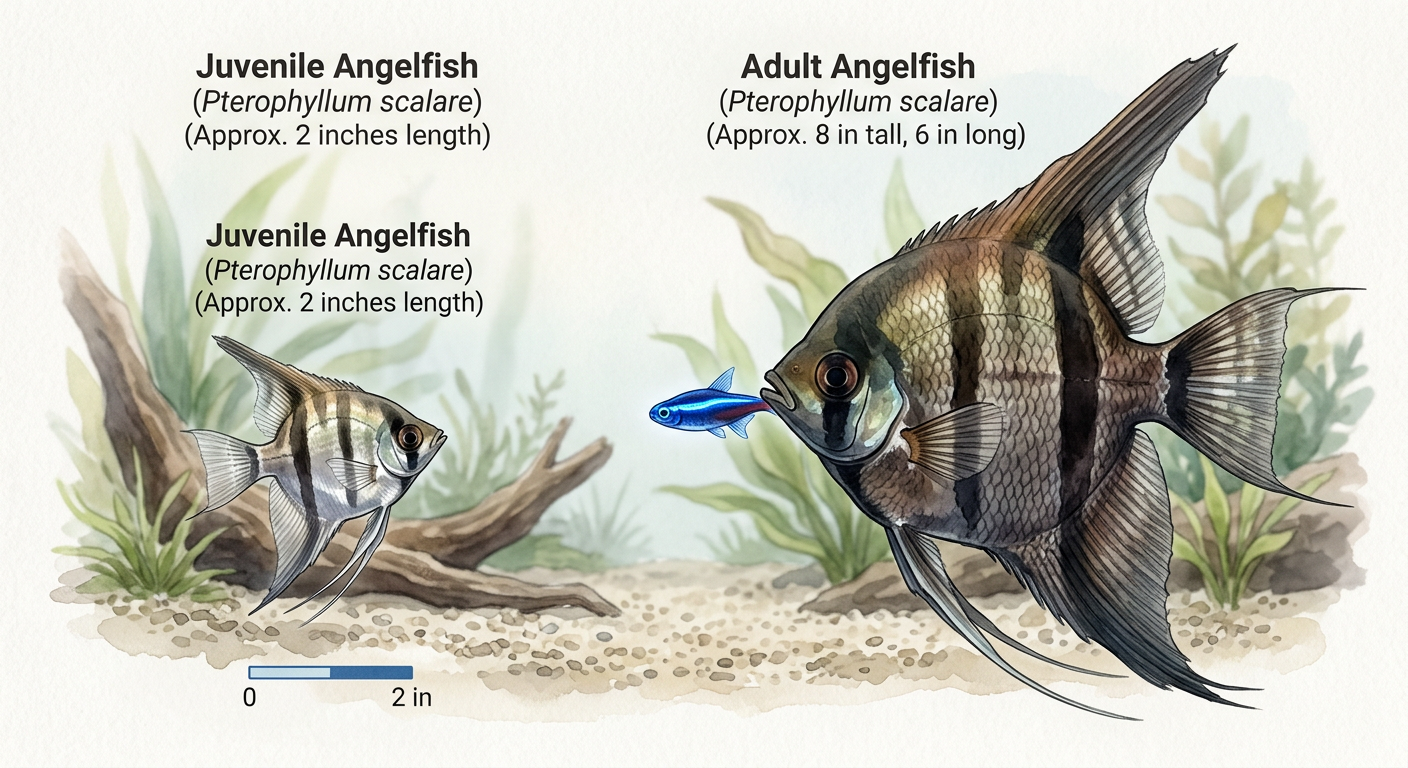
One of the most common stocking mistakes I see in beginner notes goes by the "it was so small at the store" problem. You buy a 2-inch angelfish because it's peaceful and fits your 29-gallon tank perfectly. Three years later it's 8 inches tall, territorial, and eating your neon tetras.
Match fish by their adult size, not their juvenile appearance. This matters in two ways: predator-prey dynamics and swimming space.
Predator-Prey Dynamics
Angelfish fry and juveniles are peaceful, community-friendly fish. But as they mature — really mature, not just a bit larger — their mouth size increases and their territorial instinct sharpens. A full-grown angelfish considers a neon tetra (1.6 inches) to be a snack. If you want neons with angelfish, you either need a large angelfish that's been raised with them since they were tiny (and even that's a gamble), or you accept that one will eat the other eventually. This isn't random. It's predator-prey behavior that emerges as the fish grows into its role.
 The same dynamic shows up with other size mismatches. A young pleco fits fine in a 55-gallon. An adult bristlenose pleco (4–6 inches) needs 20 gallons minimum. A clown pleco (3–4 inches) still needs 20. Clown loaches grow to 12 inches and end up needing 75+ gallons. So many tanks I've seen end up with an overgrown pleco in cramped quarters.
Swimming Space Requirements
Different species have different activity levels and space requirements. Tiger barbs are hyperactive and cover a lot of territory. Tetras are active but less aggressive about space. Gouramis are slow and deliberate. If you're stocking a 20-gallon tank, you can fit more stationary fish (bottom dwellers, sedate gouramis) than active schoolers (tiger barbs, zebra danios). Space isn't just about bioload — it's about habitat fit. How to stock an aquarium always comes back to matching activity levels to available swimming space.
Understanding Fish Aggression in Community Aquariums
Aggression in community tanks isn't random, and it's not automatically a sign you've made a terrible stocking choice. What triggers aggression in aquarium fish? Three things: natural temperament, environmental stress (space, group size, water quality), and breeding instinct. Understanding which of those is driving the behavior determines whether you intervene or wait it out.
Natural Temperament vs. Environmental Stress
Some fish are just more aggressive than others — that's genetic. Tiger barbs are semi-aggressive whether you like it or not. But how aggressive they become depends heavily on environment. A tiger barb in a 20-gallon tank with four others is a menace. That same species in a 55-gallon with eight to ten tankmates and plenty of visual barriers is manageable. Group size and space transform behavior. Avoiding aggression in community aquariums starts with giving each species enough room and company to express normal behavior.
Fin Nippers and Long-Finned Tankmates
This deserves its own section because so many people end up with beautiful long-finned fish — bettas, black skirt tetras, guppies — damaged by tankmates they chose based on a chart that said "compatible." Tiger barbs are the most notorious fin nippers. In small groups (fewer than 6), they target other fish relentlessly. In larger groups (8+), their aggression diffuses within the school instead of pointing outward. But pair them with long-finned fish — bettas, angelfish, guppies — and you're losing fins regardless of group size. Serpae tetras are moderate fin nippers. Some barb species nip more than others. If you have a long-finned centerpiece, avoid species known for nipping. Not negotiable.
Breeding Aggression
Cichlids, gouramis, and plenty of other fish undergo a personality shift during breeding. An angelfish that's been minding its own business becomes territorial and aggressive the moment a pair decides to spawn. I've watched this play out repeatedly: full-grown angelfish guarding a breeding site will attack fish thirty times their size and chase them into hiding. It's temporary and intense. Subsides after spawning, or if eggs don't survive. If you keep breeding cichlids, expect temporary aggression. Have a backup plan — extra tank, extra hiding spots, or the ability to pull the aggressive fish into quarantine.
The Hierarchy Establishment Period
When you first introduce fish, expect chasing, displaying, and minor fin-nipping for the first week. That's normal. Fish are working out the freshwater aquarium fish hierarchy — who dominates, who yields, and where the boundaries are. This phase should die down by day 8–14. If aggression is still harmful by day 21, something's off: group size too small, tank too crowded, or the species combo genuinely doesn't work. The first week of chaos doesn't mean disaster — it means hierarchy setup is running its course.
Territory and Space: Giving Fish Room to Thrive
How do fish establish territories in an aquarium? They claim specific physical features — a cave, a rock overhang, a dense plant patch — and learn to recognize them as landmarks. They then defend those landmarks against intruders. Cichlids do this most obviously, but even peaceful fish develop preferred spots over time. Territory isn't abstract dominance — it's spatial ownership tied to physical structure.
Visual Barriers and Decor
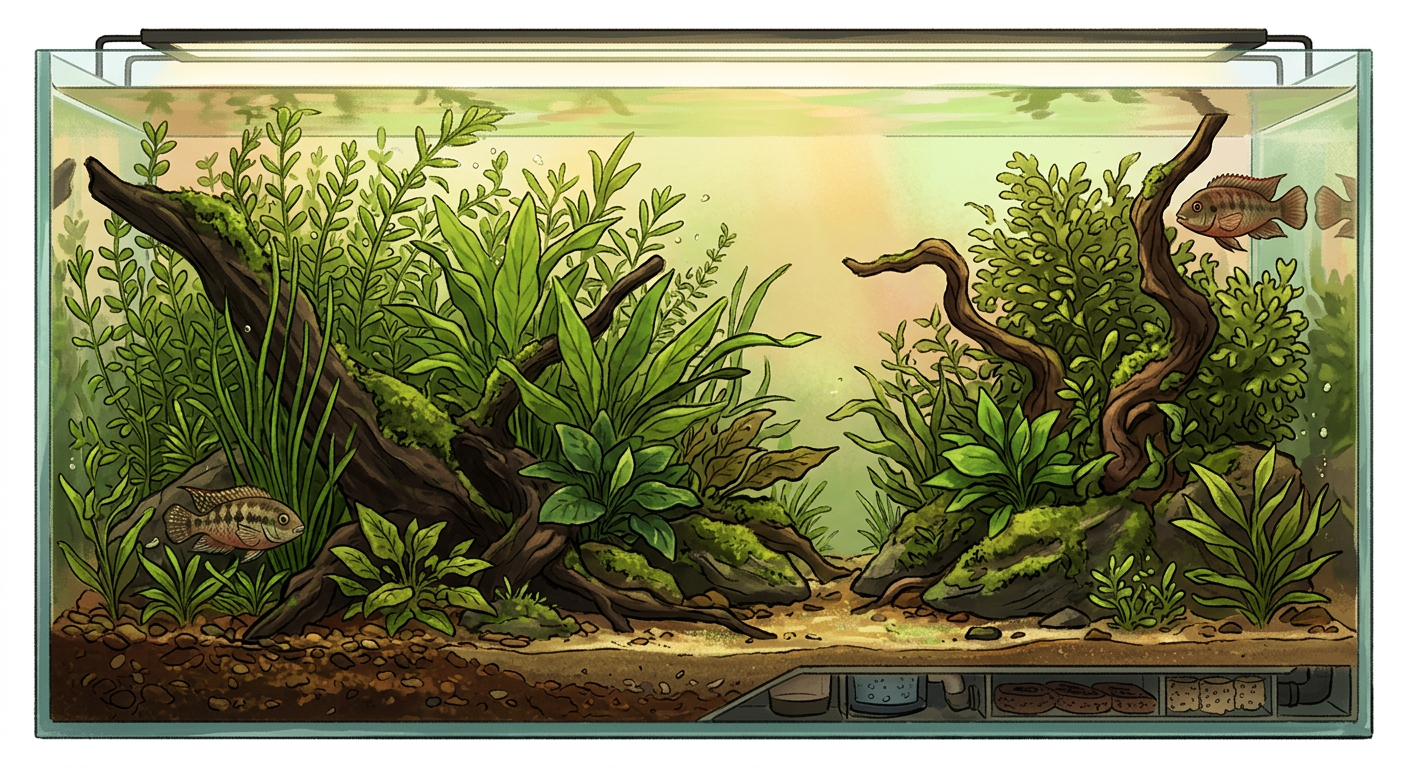
Dense plants, driftwood, and rockwork do more than look nice; they break line of sight. When fish can't constantly see each other, they perceive less threat and register fewer territorial intrusions. I've seen this play out multiple times: tiger barbs in a sparsely decorated tank come across as more aggressive than the same group in a heavily planted one. The barriers don't physically separate the fish, but they dial back the constant visual stimulation that triggers territorial behavior. If you're stocking densely or keeping semi-aggressive species, plant your tank. Two-thirds planted, one-third open is a good ratio.
 Species-Specific Territory Needs
Cichlids are extremely territorial. A pair of angelfish or German blue rams needs real space, multiple potential spawning sites, and room to establish separate territories if they don't get along. Schooling fish like tetras and rasboras don't stake out territory the same way. They care about group cohesion and room to swim, not owning a particular corner. That distinction directly affects tank mate compatibility — you can stock around territorial species more effectively when you understand which fish need space and which just need a group.
Territory Reset During Tank Rearrangement
This is my favorite low-effort intervention. If you introduce a new fish and the established residents are aggressively territorial, rearrange the decor. Move plants, shift rocks, reposition driftwood. That erases the territorial mental map the existing fish built. The whole hierarchy has to resettle, and the new fish often lands in a better position within the reordered landscape. With cichlids especially, rearranging before you introduce a new individual cuts aggression substantially.
Stress Signals: Reading Your Fish
Your fish can't say "I'm stressed," but they broadcast it if you're paying attention. Learning these signals means you can adjust before things go sideways.
 Color Changes and Fading
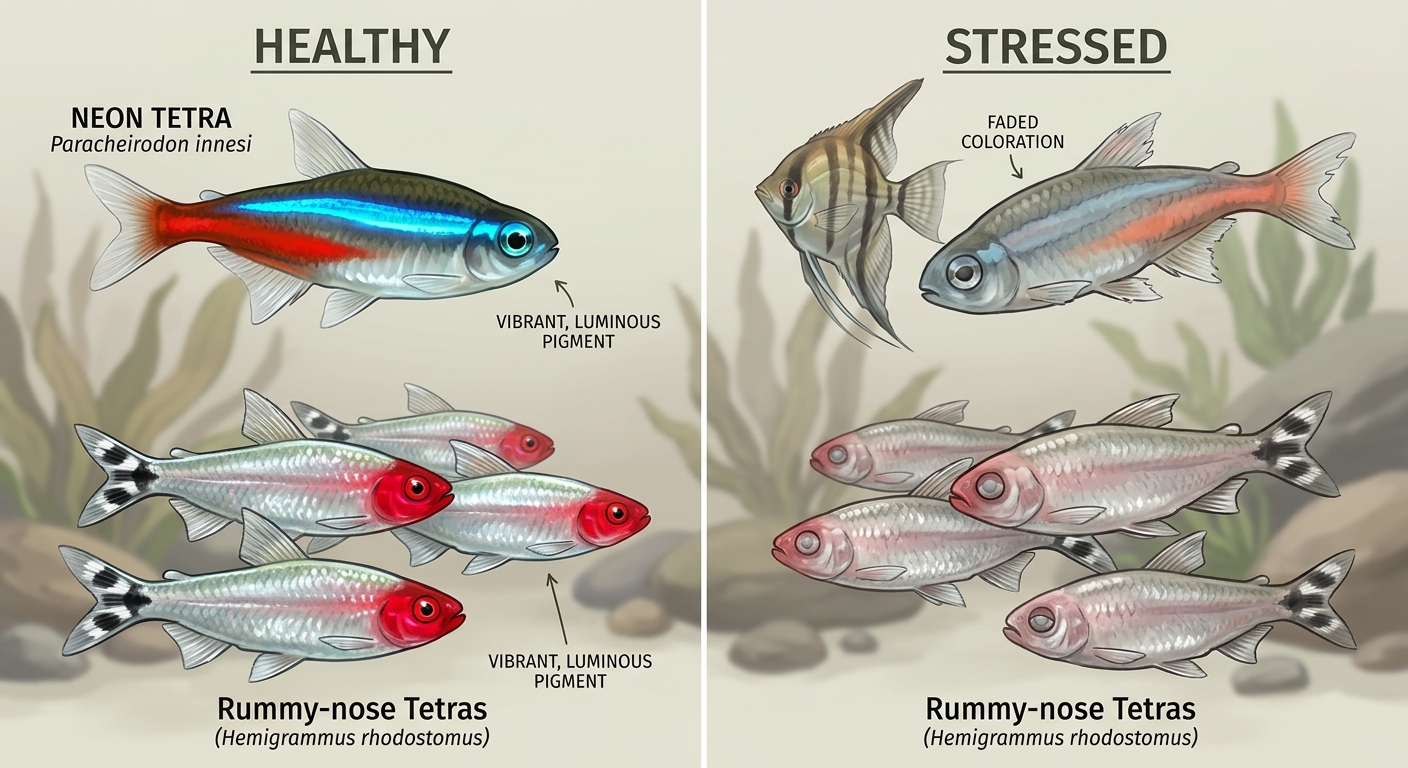
Neon tetras carry a bright stripe down their body during the day. At night or in darkness, it fades to gray — totally normal. But if a neon's stripe looks consistently pale during daylight hours, that fish is stressed. Rummy-nose tetras earn their name from the bright red coloration around the nose. That red fades noticeably when water quality drops or stress spikes. It's one of the best real-time indicators I've found anywhere. Tiger barbs lose vibrancy when temperature dips below about 21°C/70°F. Angelfish develop dark vertical stress bars when they're frightened or uncomfortable.
Behavior Changes
Hiding is normal for new fish — they need days or even a week to settle. But a fish that's hidden constantly after two weeks is a problem: it's being bullied, the water parameters are off, or the species doesn't fit your setup. Feeding refusal is a red flag. If fish aren't coming to food or are getting outcompeted and starving, you've got something to fix. Watch corydoras barbels closely if you're keeping them on gravel (which I don't recommend). Their barbels are sensory organs, and when they're damaged or eroded, that signals unsuitable substrate or poor water conditions. Surface breathing is normal for labyrinth fish (gouramis) but not for other species. If cardinals or neons are gasping at the surface regularly, it's either an oxygen problem (check filter and aeration) or ammonia/nitrite spiking (test your water immediately).
Chasing and Fin Damage
Brief chasing, fin-spreading, and displays are hierarchy establishment — normal. Persistent chasing that lasts minutes, cornering a fish so it can't eat or rest, or visible fin splits and torn scales are not normal. If you're seeing continuous damage, intervene: add visual barriers, increase hiding spots, reduce the population, or pull the aggressor into quarantine.
When to Step In vs. When to Let It Settle
The distinction matters for your sanity. If two fish chase and display for 30 seconds at feeding time and then settle, that's fine. If one fish is constantly pursuing another, blocking it from food, and doing visible damage, step in. I usually give new introductions two weeks before acting. If aggression is still harmful after 14 days, the combo doesn't work.
Water Parameters: The Non-Negotiable Foundation
Water chemistry determines whether your stocking choices actually hold up. You can have the most compatible species list on paper, but if your water parameters don't support them, you're running a slow-motion failed experiment. Aquarium stocking by water parameters — matching species to the chemical reality of your tank — is more important than matching names on a compatibility chart.
pH and Temperature Overlap
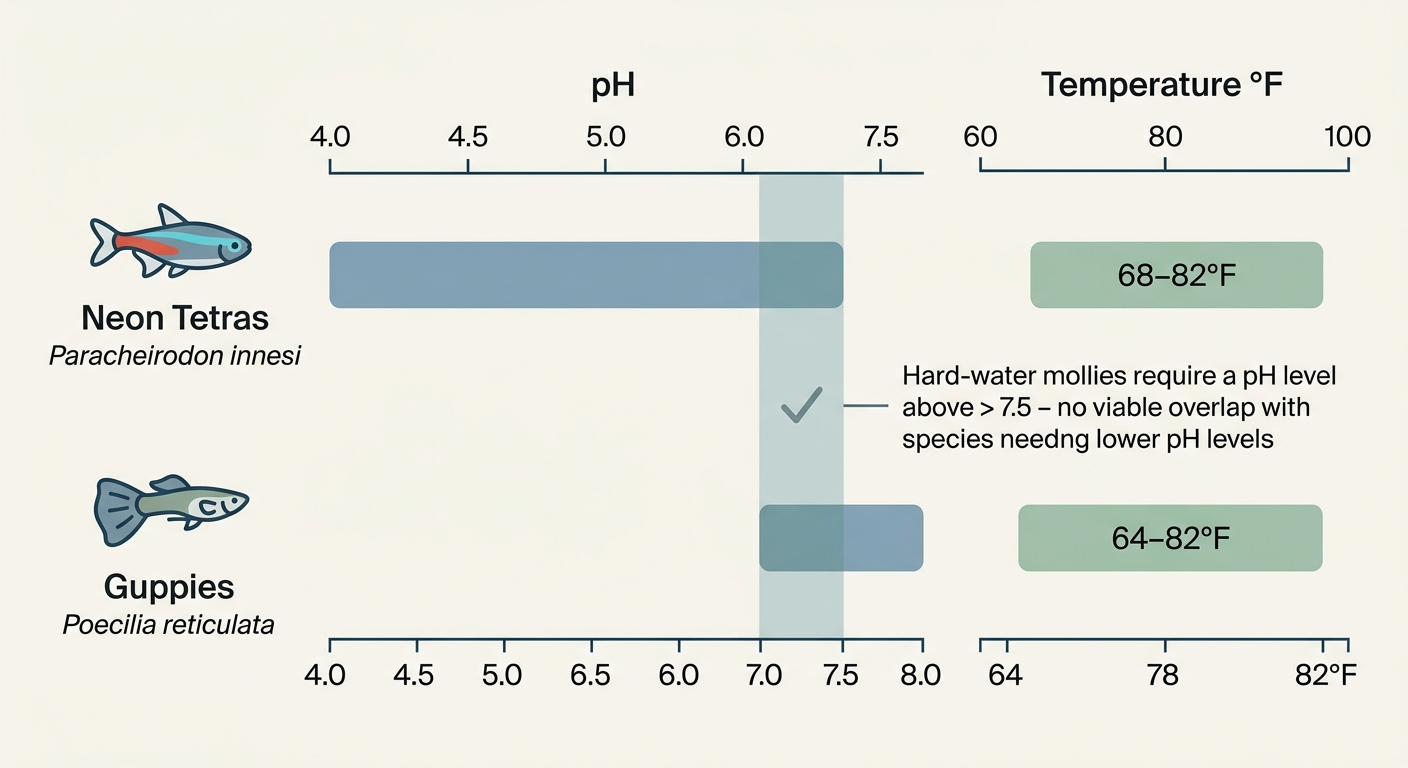
Different species have different requirements. Neon tetras need pH 4.0–7.5 and temperature 68–82°F. Guppies want 7.0–8.0 and 64–82°F. The overlap between those ranges is roughly 7.0–7.5 pH and 68–77°F. That's functional, but you're keeping both near the edge of their comfort zone. Neither is thriving; both are surviving. The pattern that shows up in long-term observations is clear: fish kept at the edge of their parameter range develop health issues earlier, catch disease more easily, and die sooner than fish kept well within their range. If you can't find a parameter set where most of your fish are comfortable — not just surviving — the stocking plan isn't sustainable.
 Hardness Preferences
Soft-water species (neons, cardinal tetras, German blue rams, discus) need low general hardness (GH below 10). Hard-water species (livebearers — guppies, mollies, platies, swordtails — and African cichlids) need moderate to high hardness (8+ dGH). There's no compromise here. Mollies in soft water develop shimmies (muscle spasms) and decline fast. Rams in hard water get stressed and sick. If your tap water is naturally hard, you're not creating a soft-water tank without serious effort (RO water, peat filtration, etc.). Know your water first, then stock around it. Don't plan your aquascape and hope the water cooperates.
Nitrate Tolerance
Species vary in how they handle accumulating nitrate. Neon tetras, discus, and German blue rams start showing stress above 20 ppm. Most community fish are comfortable up to about 40 ppm. Some species tolerate more (danios, certain barbs, livebearers). If you're stocking sensitive species, you need water changes frequent enough to keep nitrate consistently below 20 — usually weekly 25–30% changes at minimum. Hardy species give you more room. This directly affects maintenance burden, which is part of sustainability that compatibility charts never mention.
The Compromise Parameters Trap
Here's the mistake I see most in beginner setups: someone wants soft-water species and hard-water species in the same tank. They split the difference at pH 7.0 and temperature 75°F, somewhere between the ranges. Nobody dies for a few months. But by month four or five, the soft-water fish are getting ich or velvet. The hard-water fish develop pinhole disease or start hiding. The "compromise" was slow-motion failure the whole time. If you're going to compromise, bend toward your most sensitive fish, and accept that hardier species won't be at peak condition. Don't split the difference equally.
Putting It Together: A Community Tank Stocking Example
Here's what these principles look like in a real tank. These same principles scale to any size — stocking a 20-gallon tank with compatible fish follows the identical logic of water column zones, adult size matching, and parameter overlap, just with fewer species. I'm working with a 40-gallon breeder (36" × 18" × 16") because it demonstrates the full framework. Target parameters: pH 7.0, 78°F, moderate hardness (8–12 dGH), and nitrate under 20 ppm.
Bottom Zone
8 panda corydoras (1.5–2 inches each), 1 bristlenose pleco (starts at 3–4 inches, will reach 4–6), and 6 kuhli loaches (3–4 inches). The corydoras are schooling bottom feeders, peaceful with each other. One pleco is enough — adding more creates territorial issues. The kuhli loaches are nocturnal and burrow in sand, adding biodiversity without competing directly with the corydoras.
Mid-Water Zone
12 harlequin rasboras (2 inches) and 8 rummy-nose tetras (2 inches). Both are peaceful schoolers. Rummy-nose tetras are more sensitive to water quality and nitrate, so they work as an early-warning system. When the noses fade, it's time to water change.
Top Zone
1 pearl gourami (4–5 inches). Solitary, peaceful, and doesn't fit anywhere else in the column. It occupies the surface and upper third without competing with schoolers or bottom dwellers.
Total Bioload and Maintenance
Roughly 34 fish. This is moderate-to-full stocking for a 40-gallon. Sustainable with 25–30% weekly water changes and solid filtration (I aim for 240–300 gallons per hour turnover, which is 6–8× tank volume per hour).
Introduction Order
Introduction order matters: (1) Harlequin rasboras in week 1–2 — establish the mid-water school first so they can settle hierarchy. (2) Corydoras and bristlenose in week 2–3 — add bottom dwellers once mid-water territory is set. (3) Rummy-nose tetras in week 3–4 — introduce sensitive fish into a more stable environment. (4) Pearl gourami in week 4–5 — add the territorial centerpiece last so it doesn't claim everything and lock the others out. Each group gets time to settle before new fish add disruption.
First 30 Days Observation Checklist
- Days 1–7: Watch rasbora chasing and displaying. Should decrease daily as hierarchy settles. No permanent damage should be visible.
- Days 8–14: Check corydoras barbels for damage. Confirm all bottom fish are feeding. Watch the pleco cruising at night.
- Days 15–21: Rummy-nose noses should be bright red, signaling good health and water quality. If they're pale, test water and consider a water change.
- Days 22–30: Watch the pearl gourami. If it's harassing other fish, add tall plants as visual barriers so there's more refuge. Solitary gouramis don't need company, but they do need their territory respected.
- Ongoing: Test ammonia and nitrite every few days (should read 0). Keep nitrate below 20 with water changes. Weekly 25% change minimum.
Observation Over Assumption
Every aquarium has personality quirks no chart accounts for. That's what years of note-keeping hammered home for me.
I've kept tiger barbs that were exactly as aggressive as predicted, and I've kept tiger barbs that surprised me with how calm they were. The difference usually came down to tank size, group dynamics, and decor. I've seen individual fish break the mold entirely — a gourami that was peaceful despite being a male surrounded by potential rivals, or a pleco that turned aggressively territorial at three years old after being docile the whole time before.
Individual personality matters. Age matters — fish change as they mature, sometimes dramatically. Tank maturity matters; stable six-month-old tanks run softer than newly cycled ones. And water chemistry stability matters more than having perfect parameters: a tank at pH 7.2 that swings daily stresses fish more than one sitting consistently at pH 7.5.
This is why observation beats any compatibility chart. Watch your fish. Notice when the neon's stripe starts fading. Notice when the cory stops eating. See the patterns emerge as your tank settles. Read the signals your fish are broadcasting.
Have backup plans. Keep a spare quarantine tank in case aggression turns harmful and you need to pull an individual. Know where you can rehome fish if a combination genuinely doesn't work. Accept that you might need to adjust — not every stocking plan succeeds, and that's not failure. It's how you learn.
The goal isn't a perfect tank matching some theoretical ideal. It's a functioning ecosystem where your specific fish are healthy, stable, and actually thriving. That takes principles, observation, and willingness to adjust when reality diverges from the plan.
Comments
No comments yet.