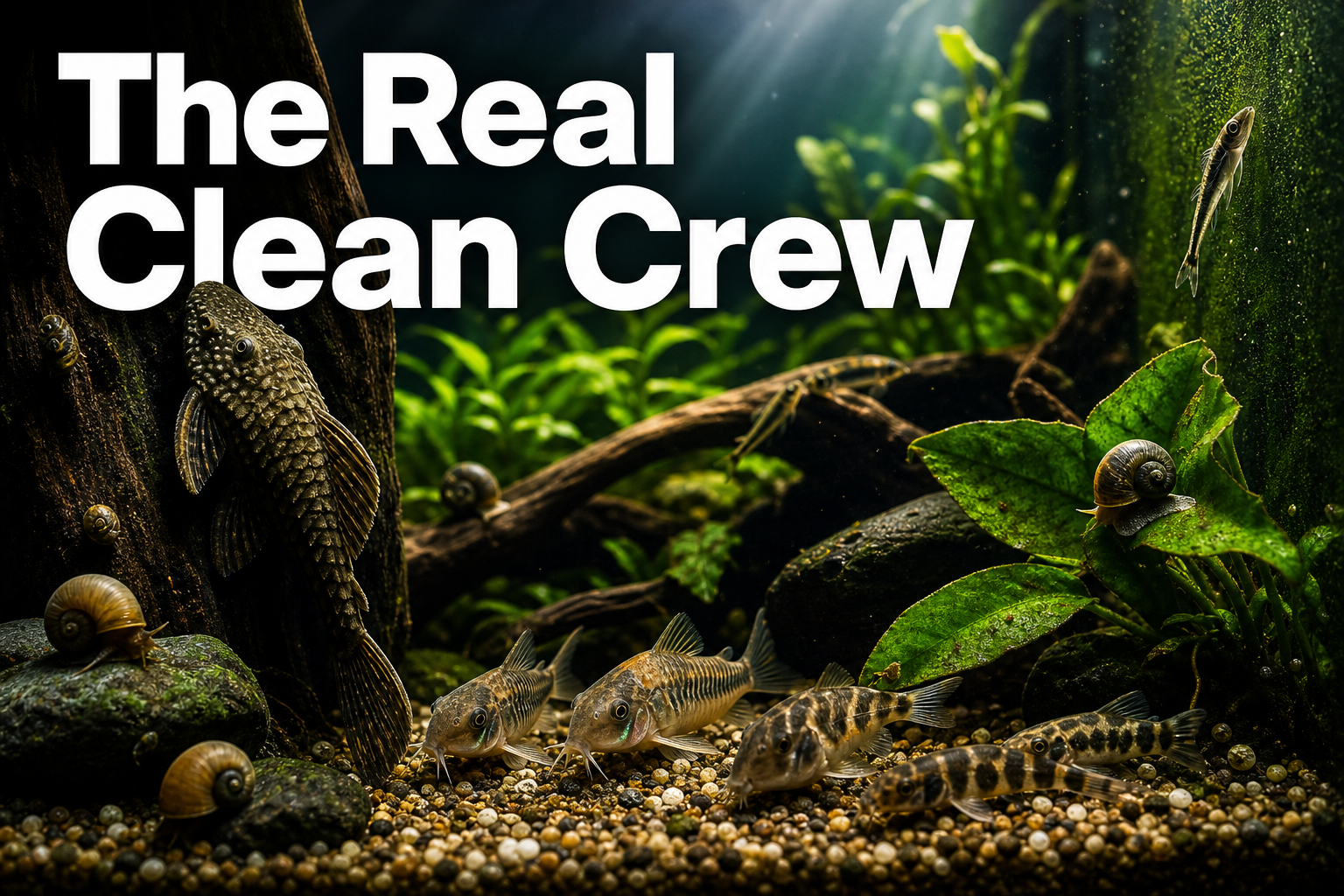
Understanding What Tank Cleaners Actually Do
Why people buy aquarium cleaner fish (and what they're actually hoping for)
Every beginner aquarist hears the same pitch: get a pleco, some corydoras, or a few otocinclus, and they'll keep your tank clean. Pet store employees repeat it. Fish care sites mention it casually. The implication is always the same - these fish will handle the dirty work so you don't have to.
This is mostly wrong.
That doesn't mean cleaner fish are useless. It means they don't do what most people expect. The difference between what people hope for and what actually happens saves you money, saves fish from starvation or an undersized tank, and prevents months of wondering why your "clean-up crew" didn't actually clean anything.
The core misconception is that one type of fish does all the cleaning. That's not how it works. Different "cleaner fish" eat different things. A pleco doesn't do what a corydoras does. A corydoras doesn't do what an otocinclus does. And crucially, none of them eat fish waste, no matter what anyone tells you.
Three different jobs, not one
When people talk about "cleaner fish," they're usually mixing together three separate ecological roles:
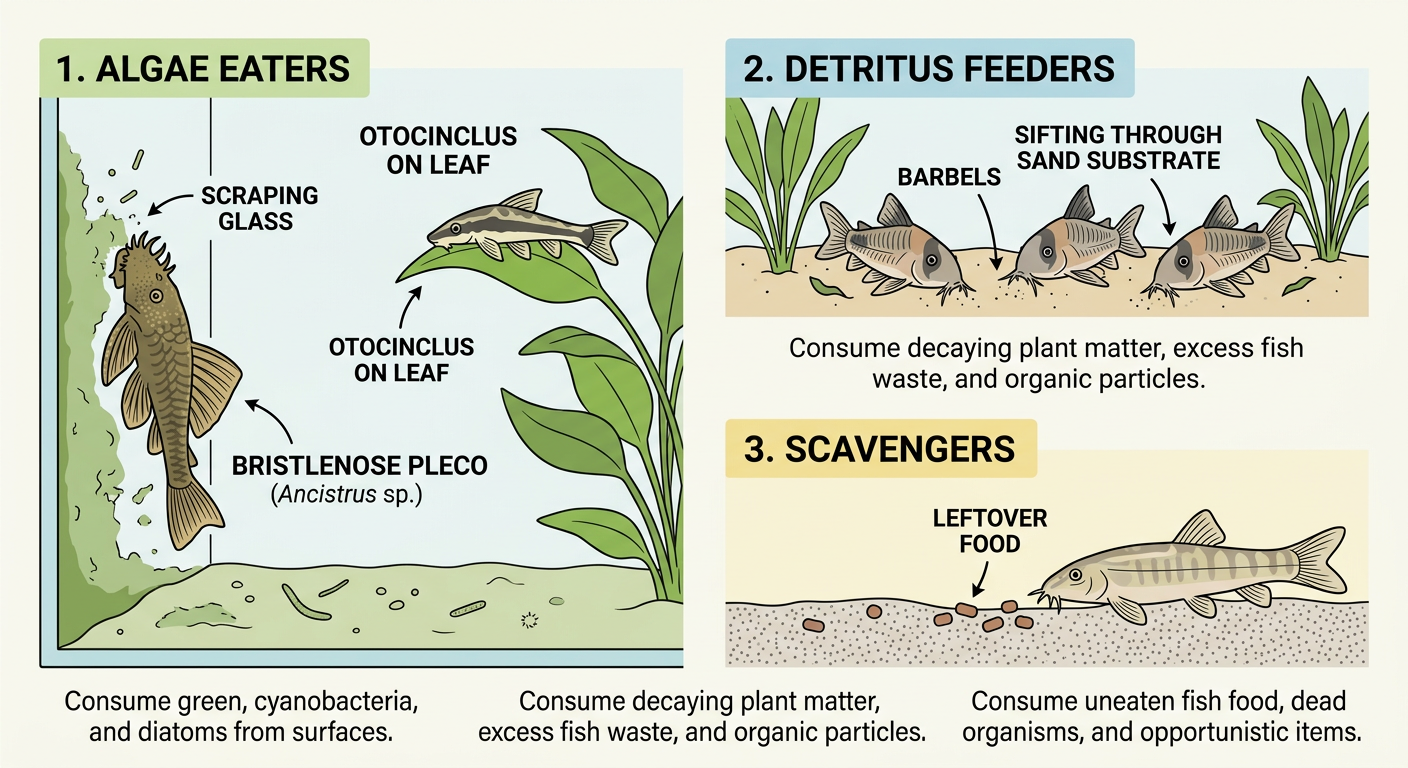 Algae eaters - the classic algae eating fish choice - consume live algae growing on surfaces: glass, rocks, plants, décor. Different species specialize in different algae types because their mouth shape and feeding behavior are adapted to specific surfaces and textures. A pleco scrapes flat surfaces. An otocinclus sucks on fine algae films. A Siamese algae eater picks through hair algae and black beard algae with a different mouth structure entirely.
Detritus feeders sift through the substrate looking for uneaten food and decaying organic matter. Corydoras are the classic example - they have barbels (whisker-like sensory organs) they drag through sand to find food particles. This is useful. But it's not algae eating, and it has nothing to do with removing waste from the water column.
Scavengers pick at leftover food, dead material, and small invertebrates wherever they find them. Loaches fit this category. They're somewhat useful in a community tank, but their contribution is opportunistic - they eat what they stumble across, not what the tank needs them to eat.
Knowing which category a fish belongs to matters, because it determines what it will and won't actually do in your tank.
Which cleaner for which problem (matching species to your setup)
Most questions about choosing aquarium cleaner fish come down to matching species to specific problems, so here's the short version:
If you're looking for the best tank cleaner fish for beginners - including solid bottom feeder fish for a tank with other community fish - a bristlenose pleco or a group of corydoras are the safest starting points. Both are hardy, peaceful, tolerate typical beginner tank conditions, and are easy to feed. Start with one bristlenose in a 25-gallon tank or a group of six corydoras in a 20-gallon.
The most common specific comparison is otocinclus vs pleco, and the choice comes down to tank size and algae type. Otocinclus stay under 2 inches and work well in planted tanks or smaller setups (10 gallons, but only if established with visible algae growth). A bristlenose reaches 4-5 inches, needs driftwood in its diet, and handles tougher algae on glass and décor. For soft green algae in a planted tank, otos are ideal. For a general-purpose aquarium cleanup crew in a larger tank, bristlenose is the safer, more practical choice.
A question that comes up constantly is how many cleaner fish per gallon. A reasonable baseline is one small cleaner (an otocinclus, a small pleco, or a corydoras group counted as a unit) per 5-10 gallons - but treat this as a starting estimate, not a rule. Every cleaner adds to the bioload exactly like any other fish. The real limit is your total stocking and filtration capacity.
Can fish clean your tank without a filter? No. Tank cleaner fish cannot remove ammonia, suspended particles, or dissolved organics the way biological and mechanical filtration do. A filter is not optional even with a full aquarium cleanup crew.
And yes - do tank cleaner fish really work? The honest answer: yes, for what they actually do. They reduce specific maintenance tasks like algae scraping frequency and substrate mulm buildup. They do not replace water changes, filtration, or your regular maintenance routine. They're part of a cleanup crew, not a substitute for one.
The most important thing to know: cleaner fish don't eat fish waste
Saying this plainly because I've seen too many people buy extra fish for the wrong reason:
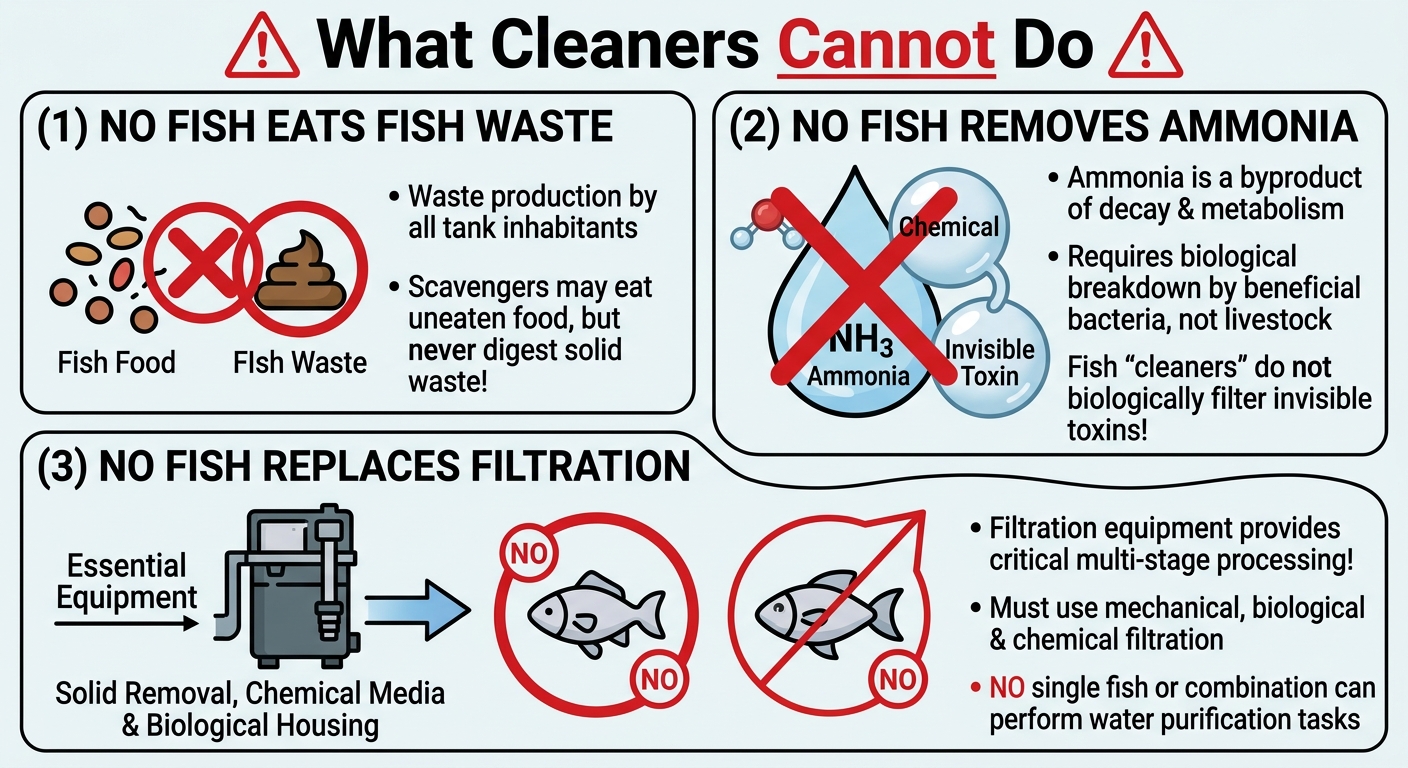
No aquarium fish consumes fish waste as a food source.
Fish feces is mostly indigestible material - stuff that's already been through the digestive system and has minimal nutritional value. A pleco might mouth at waste while scavenging, but it's not eating it for nutrition. It's not breaking it down into something useful. It's not removing ammonia. Ammonia comes from fish waste, but it doesn't come from the solid poop - it comes from fish gills, urine, and decomposition. Nitrifying bacteria in your filter handle ammonia. Neither plecos nor corydoras nor any other fish can do that job.
This is the myth that causes the most problems, because acting on it leads people to add "just one more cleaner" to solve a dirty tank issue, which actually makes things worse by adding more bioload to an already-struggling system.
Common Species: What Each Actually Eats
Plecos and suckermouth catfish
Common Pleco (Hypostomus plecostomus) is probably the most famous cleaner fish and definitely the most misunderstood. Most people meet them at 2-3 inches, a manageable size for a small tank. Almost nobody pays attention to the part where it says "reaches 18-24 inches as adult."
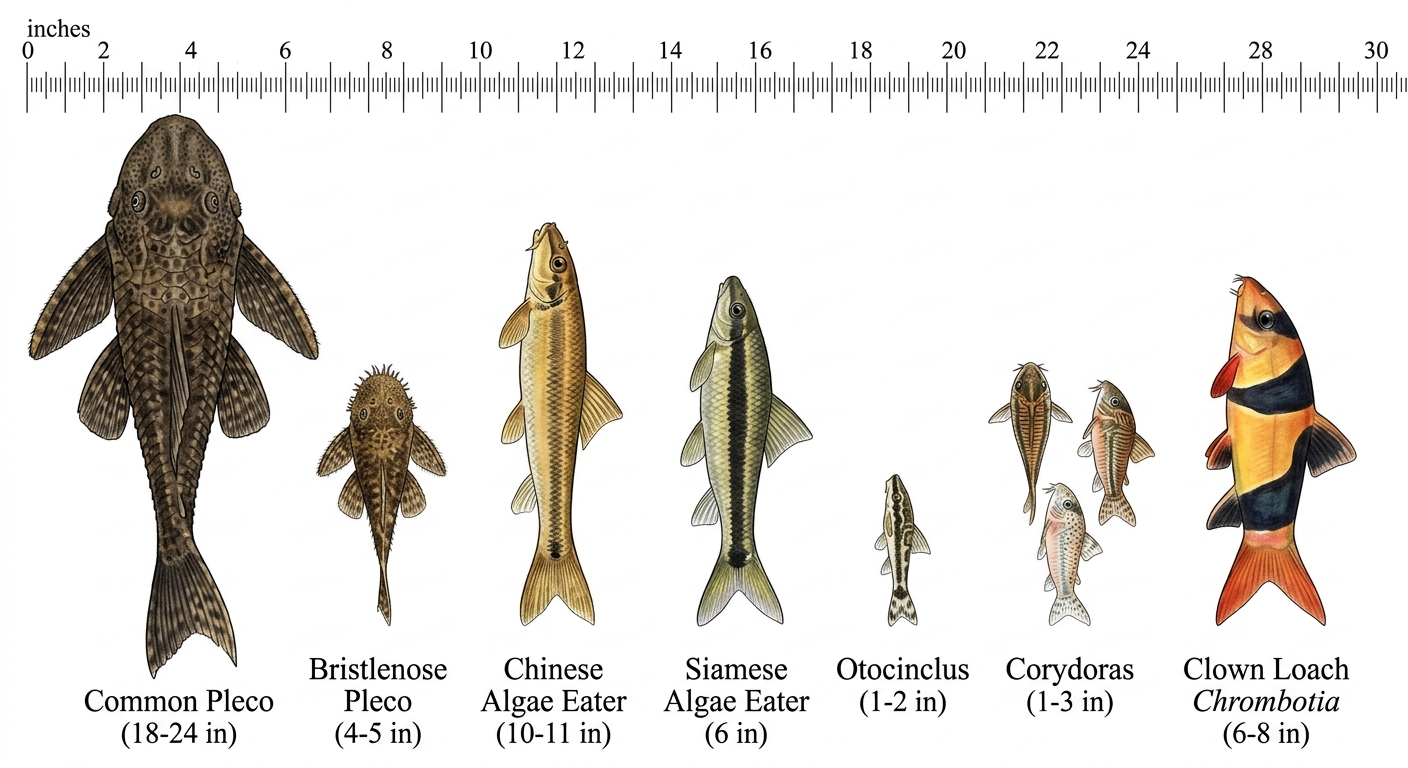 That size matters because it determines what these fish actually eat. A juvenile pleco eats algae from surfaces. It also eats sinking wafers, vegetables (zucchini, blanched green beans), Repashy gel food, and frozen bloodworms. It won't survive on algae alone once it grows, and it grows fast in a good environment.
Here's the pattern I keep seeing in rehoming situations: someone buys a 2-inch pleco for a 20-gallon tank, expecting algae control. For a year or two, it eats algae and the owner feels validated. But by year three, the pleco is 12 inches, algae production can't keep pace with its appetite, and the owner starts noticing the fish looks thin and stressed. Or it starts sucking slime coats off other fish (which happens when a pleco is hungry). At this point people realize they either need a 150-gallon tank or they need to rehome the fish. Most choose rehoming.
If you want a pleco that fits a small tank, get a Bristlenose Pleco instead. These reach 4-5 inches, live 5-8 years, and do well in 25-30 gallons. They eat algae, will nibble at sinking wafers and vegetables, and need driftwood (not optional - it's part of their diet). Bristlenose plecos breed readily in captivity. Males are easier to sex (prominent bristles on the snout). They're not as easy to find at pet stores, but they exist and they're worth the search.
Clown Plecos are smaller (3.5-4 inches) but have a specific requirement: they must have driftwood. No driftwood, the pleco will starve. Rubber Lip Plecos reach 4-5 inches and are decent algae eaters; they prefer cooler water than most tropical plecos (68-78°F).
The key difference between plecos: smaller species like bristlenose actually stay small. Common plecos do not.
Corydoras catfish
Corydoras are detritus feeders, not algae eaters. Let me repeat that because lots of people buy them thinking they'll solve an algae problem, but they won't. A corydoras eats uneaten food from the substrate, small organisms living in the sand, and organic material. It's useful for cleanup, but it's a completely different job from what a pleco does.
Different corydoras species vary slightly, but the basics are consistent: they're small (1-3 inches), live 5-7 years, need to be kept in groups (minimum 6 of the same species, though wild groups number in the tens or hundreds), and require sand or very smooth gravel. Sharp substrate can damage their barbels, though I've noticed that when barbels are eroded, poor water quality is usually the real culprit, not the substrate being too sharp.
Corydoras have armored bodies with venomous fin spines (not dangerous to humans unless you catch them barehanded, but they can cause a mild wound). They'll occasionally breathe air at the surface - this is normal, not a sign they need more aeration. They're mostly active at dawn and dusk, though they're not strictly nocturnal like some bottom dwellers.
Popular species include Bronze or Albino (easiest to find), Panda (beautiful but more sensitive to water quality), Sterbai (can tolerate warmer water), and Julii (natural coloration makes them distinctive). There are 160+ described species, and hobby availability varies.
Corydoras require deliberate feeding - they need sinking wafers, frozen bloodworms, live blackworms, or gel food. They will not survive on the scraps that fall from top-dweller feeding. And they produce waste just like any other fish, so adding a group of six corydoras increases your tank's bioload noticeably.
Otocinclus (dwarf suckers)
Otocinclus are the best small-tank algae eaters available, and they're also the most commonly starved to death in captivity.
These fish are 1-2 inches, live 3-5 years if well cared for, and eat soft algae - primarily diatoms and fine green algae on flat surfaces like glass and plant leaves. They don't eat hair algae, black beard algae, or green spot algae. That's important to know before you buy them, because if your tank doesn't have the algae types they actually like, they'll starve.
The issue starts at the pet store. Almost all otocinclus sold in the hobby are wild-caught from South America after shipping and handling that leaves them already underfed. They arrive stressed and depleted. Most pet stores don't know this, so they don't mention it. If you buy otocinclus, you must put them into an established tank: not a brand-new one, not a tank that's been running three weeks. A tank that's been running at least four months with visible algae growth on the glass and décor.
Even in an established tank, most otocinclus will need supplemental feeding: blanched zucchini slices, canned green beans (plain, no salt), Repashy Soilent Green, or quality algae wafers. Without this, they'll spend two weeks quietly starving while the tank looks fine and the owner wonders why the fish keeps hiding.
They also need to be kept in groups (minimum 3-6, depending on who you ask - they're schooling fish). A single otocinclus will hide and stress out.
When otocinclus are properly established and fed, they're good at their specific job. But they're also sensitive. If you're drawn to them, commit to the setup requirements instead of gambling that they'll just work out.
Siamese algae eater (Crossocheilus oblongus / C. siamensis)
This is one of the few fish that eats black beard algae and hair algae - two of the toughest algae problem types. It reaches 6 inches, can live 10 years, and does well in 20-gallon tanks (more if keeping multiples).
Juveniles are aggressive algae eaters. As they mature, they lose interest and start preferring prepared foods. This is normal aging behavior, not a sign something's wrong. You can re-engage that algae-eating behavior by moderating the overall tank feeding - when they're hungrier, they're more motivated to graze.
Siamese algae eaters are active swimmers, peaceful, and can be territorial with their own species. Keep one, or keep three or more. Don't keep two.
The most common mix-up is mistaking these for Flying Fox, which look similar but are a different species. The Siamese algae eater's black stripe runs through the tail fin. The Flying Fox's stripe stops at the base of the tail. Also, Flying Fox have mouth flaps that Siamese algae eaters don't have.
Chinese algae eater (Gyrinocheilus aymonieri)
Chinese algae eaters are often confused with Siamese algae eaters because they have similar names and similar roles. They're actually completely different, from different families, with very different behaviors.
A juvenile Chinese algae eater eats algae. An adult Chinese algae eater eats prepared foods and increasingly becomes a territorial bully. This isn't a quirk - this is a progression that happens consistently enough that experienced aquarists actively avoid keeping them in community tanks.
Here's what I've observed from records I've kept on species compatibility: they reach 10-11 inches (sometimes described as smaller if kept in undersized tanks), live 10 years, and become semi-aggressive to aggressive as they mature. They're known for attacking slow, flat-bodied fish like angelfish, discus, and gouramis, latching onto them and ripping off scales. Their sucker mouth is evolved for clinging to rocks in fast-moving water, and they seem to use that sucker for harmful purposes if they get territorial.
They tolerate an impressive temperature range (64-86°F) and can survive even in unheated tanks, which makes them popular in some setups. But the behavioral shift is consistent and significant. Most experienced hobbyists recommend against them for anything other than a dedicated species tank.
They also have unique gill anatomy: two openings per gill slit instead of one, which lets them breathe without using their mouth. This is neat biology, but it doesn't make them easier tank mates.
Loaches (clown, yo-yo, kuhli, and others)
Clown Loach is beautiful, long-lived (20-30 years, no exaggeration), and completely inappropriate for most aquariums because of the space requirements. They reach 6-8 inches typically, though wild-caught specimens are reportedly larger. They're highly social and need groups of at least 6. That's 6 fish that produce significant waste, need to swim, and are easily stressed by isolation.
Their minimum tank size is 120 gallons (450 liters). Most people who buy them at 1-2 inches have no idea that's where they're headed. They think 20 gallons is fine. A year later the fish is stunted, stressed, or already dead.
They eat snails (moderately effective snail control), worms, sinking foods, and leftover food. They don't eat algae. They're scavengers, not algae eaters. They're also active, playful, and prone to getting stuck in inappropriate places, so they need open space and careful décor planning.
Clown loaches have a movable spine under each eye (an anti-predator defense), make clicking sounds with their pharyngeal teeth, and are famous for swimming upside down and "playing dead." These are endearing behaviors if you have the tank space. They're heartbreaking if you don't.
Yo-Yo Loach is smaller (4-6 inches), lives 8-15 years, and needs 40-55 gallons. Minimum group is 5-6. They eat snails (excellent snail control), worms, and prepared foods. Better for mid-sized tanks than clown loaches, but still a commitment.
Kuhli Loach is eel-like, nocturnal, plant-safe, small (3-4 inches), and needs sand substrate plus lots of cover. They reach 10+ years. Minimum group is 6. They won't eat snails or algae but will scavenge leftover food from the substrate. Underrated for planted tanks if you're okay with not seeing them during the day.
Dwarf Chain Loach gets 2-2.5 inches, eats snails readily, actively controls pest snail populations, and needs 20-30 gallons for a group of 6-8. Minimum group size is larger for this species than for others because they're naturally more schooling-oriented.
Aquarium snails: the often-forgotten cleaner
Most people talk about "cleaner fish" without mentioning snails. That's a mistake, because snails fill ecological niches that very few fish occupy and shouldn't be dismissed just because they're not fish.
Nerite Snails are probably the most useful snail for community tanks. They're small (0.5-1 inch), live 1-2 years, and are exceptional at eating green spot algae: the hard, crusty algae that grows on glass and plants. This is valuable because almost nothing else eats green spot algae effectively. Brushless plecos will try. Nerites are dependable.
They don't reproduce in freshwater (they lay eggs but larvae don't develop), so population control isn't an issue. They move slowly, don't bother plants, and prefer harder water (which is fine for most community tanks). The downside: they're particular about water quality and can decline rapidly if parameters shift. They also need a calcium source - they need hardness to build their shells. A cuttlebone or mineral supplement helps.
Mystery Snails (Apple Snails) are larger (1-2 inches) and more robust than Nerites. They eat algae, leftover food, decaying plants, and general detritus. They're hardier and tolerate a wider range of conditions. The catch: they breed readily in freshwater. If you don't want snail population explosions, keep only one, or keep only females (females are larger). They also have higher bioload than Nerites: each mystery snail adds waste to the system comparable to a small fish.
Mystery snails are escape artists, they're herbivorous (they'll eat live plants, especially soft ones), and they need calcium for shell health.
Amano Shrimp (technically not snails, but they're often grouped with invertebrate cleaners) are expensive ($3-5 per shrimp in most places) but good at eating hair algae and black beard algae (two tough algae types). They're small, need to be kept in groups, prefer cooler water (72-78°F), and are sensitive to medication and copper. They don't breed in freshwater, so population control isn't an issue.
Assassin Snails are carnivorous snails that eat other snails. If you have a pest snail explosion (usually from mystery snails or pond snails breeding out of control), assassin snails provide control. They're 0.5-1 inch, slow-moving, and reasonably safe with most fish, though they'll eat smaller shrimp. They reproduce slowly in freshwater, so one or a few is usually enough.
Snails add to your tank's bioload like any other creature, but they fill specific niches that fish don't reach. Green spot algae control (Nerites), pest snail management (Assassins), hair and black beard algae (Amano shrimp) - these are specialized jobs where snails and invertebrates often do better than fish.
What cleaners cannot do (and this is important)
 What they physically don't eat
Fish waste: We covered this already, but it bears repeating. No fish eats poop as a food source. Never buy a fish to solve an ammonia or nitrite problem. That's what filters and water changes are for.
Dissolved organic compounds: These include excess ammonia, hormones, and other waste broken down into the water column. They're removed by water changes, not by fish. No fish has gills that work backward well enough to extract these compounds and somehow "absorb" them away.
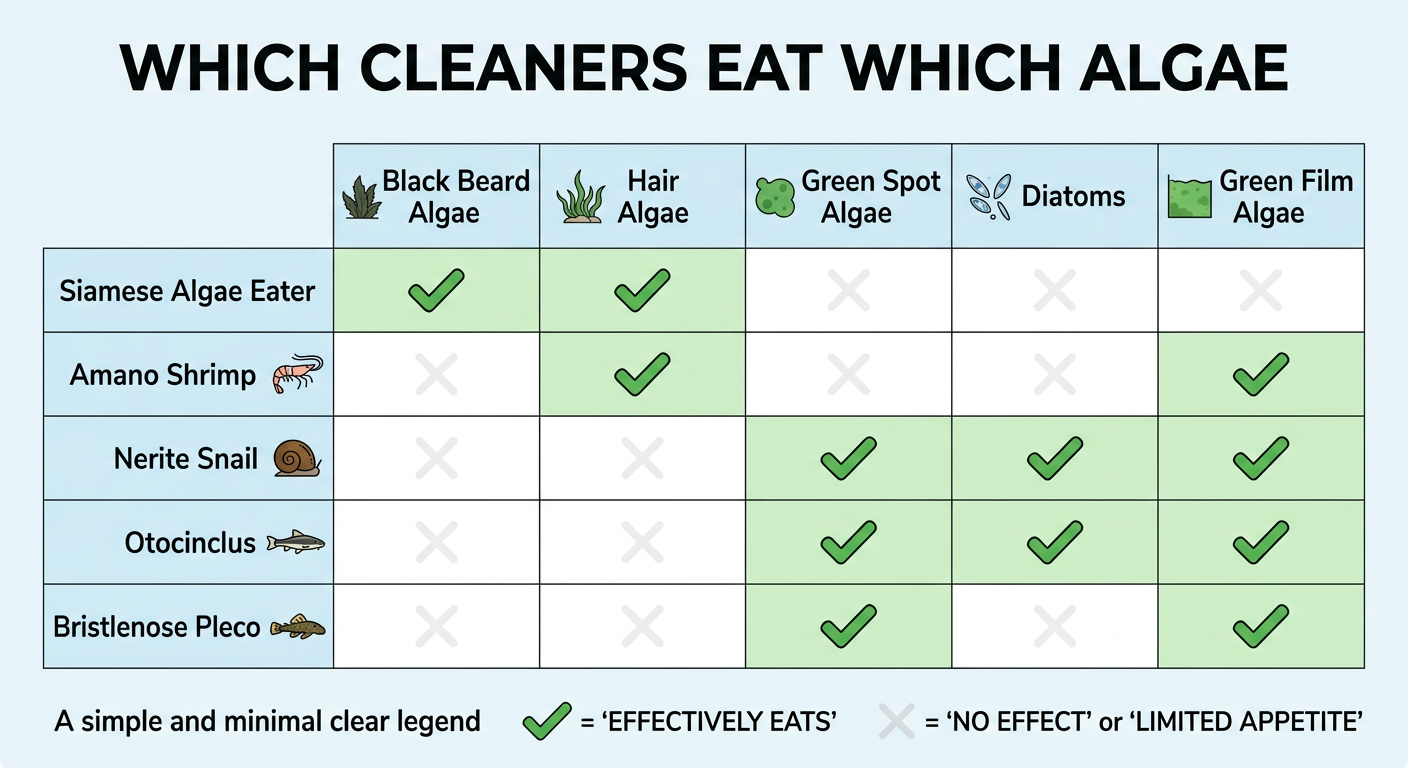 Algae types most cleaners ignore: This is where I see people most often frustrated. They buy an otocinclus expecting it to control black beard algae, not realizing otocinclus don't eat black beard algae. Or they get a pleco thinking it'll solve all algae problems, not realizing plecos ignore green spot algae.
Breakdown: Black beard algae is eaten by Siamese algae eaters, Amano shrimp, and Florida flagfish - and Florida flagfish are hard to find and have aggression issues. Hair algae is eaten by Siamese algae eaters, Amano shrimp, and mollies. Green spot algae is eaten by Nerite snails and some plecos (bristlenose will try). Blue-green algae - which is actually bacteria, not algae - nothing eats it. Staghorn algae, which people mistake for hair algae, is barely eaten by anything.
Knowing what your problem algae actually is matters enormously for choosing which "cleaner" might help.
When cleaners give up or starve
Cleaner fish reach a predictable and depressing endpoint: they outgrow their job or run out of food to eat.
A common pleco in a 20-gallon tank eats algae for 1-2 years. Then the pleco is too large and produces too much waste for the tank to support. The available algae can't keep pace with its growing appetite. The owner notices the fish is thin or starting to suck slime coats off tank mates. At this point the pleco is starving - not because food doesn't exist in the tank, but because there's not enough available food for a 12-inch fish that should be in a 150-gallon aquarium.
Otocinclus have an opposite problem. In a "clean" tank with no visible algae, they starve silently. The owner sees the tank is healthy and clean (because it is), so they don't realize the fish is slowly dying. Otocinclus don't have the obvious bloat or strange behavior of a starving fish. They just get thinner and more lethargic until they die.
Siamese algae eaters lose interest in algae as they age. Whether this is satiation from other foods or just a natural behavioral shift, I'm not entirely sure. But the pattern is real: younger individuals graze algae actively; older individuals prefer prepared foods. This isn't a failure - it's just how they work.
Want to know if your cleaner is underfed? Watch for these signs: a sunken belly (visible concavity behind the pectoral fins), lethargy and lots of hiding, unusually pale or thin appearance. With otocinclus specifically, watch for a pinched look behind the head - that's starvation, and the fish will die within days or weeks if not corrected. With corydoras, eroded or shortened barbels can indicate malnutrition, though poor water quality is usually also involved. With plecos, look for long, stringy white feces (can also signal internal parasites, but malnutrition is a common cause).
Why supplemental feeding is non-negotiable
Nearly every cleaner species needs deliberate feeding beyond what the tank naturally produces. The exception might be a heavily planted, well-lit tank with intentional algae growth - and even then, most species benefit from variety and additional nutrition.
Plecos eat sinking wafers, Repashy gel food, blanched vegetables, frozen bloodworms, and driftwood. Corydoras need sinking wafers, blackworms, frozen bloodworms, and Repashy gel. Otocinclus need Repashy Soilent Green, blanched zucchini, canned green beans, and quality algae wafers. Siamese algae eaters want sinking pellets, algae wafers, blanched vegetables, and frozen foods. Loaches eat sinking pellets, frozen bloodworms, brine shrimp, snails, gel food, and blanched vegetables. Nerite snails need calcium (cuttlebone or supplement). Mystery snails also need calcium and supplemental feeding on blanched vegetables.
This is not optional. This is baseline care. If you're not planning to feed your cleaners, don't get them.
Practical Planning: Tank Size, Parameters, and What Fits Your Setup
Real minimum tank sizes and how bioload works
Here's where careful calculation matters, because this is where people most often accidentally overstock their tanks.
A common pleco needs 75 gallons as a juvenile and 150-500 gallons as an adult. When a pet store employee tells you "it's great for any tank," they're technically not lying. It survives in small tanks. It just doesn't thrive, stunts, and often dies early. That's not "works for any tank." That's "dies slowly in most tanks."
A clown loach needs 120 gallons minimum for proper space and group dynamics. A Chinese algae eater needs 50 gallons. A Siamese algae eater needs 20 gallons. Otocinclus need 10 gallons if the tank is established with algae - but that 10 gallons includes nothing else, or maybe just a few small rasboras. Nerite snails technically need just 5 gallons for a small group, but that doesn't mean 5 gallons plus everything else. It means a dedicated 5-gallon snail-focused setup.
The moment you add a "cleaner" to your tank, you have to count it toward your total bioload. It produces ammonia. It produces waste. It's a creature, not an appliance. A 20-gallon community tank with a school of tetras and a dwarf gourami is already moderately stocked. Adding six corydoras isn't "cleaning the tank up" - it's pushing the bioload closer to the tank's capacity. This works fine with good maintenance, but it doesn't automatically make the tank less work.
In fact, most well-planned "cleanup crews" actually increase maintenance burden slightly because now you're managing more creatures, each with its own requirements and feeding schedule.
Water parameters and sensitivity differences
Most cleaner fish tolerate similar ranges - around 72-80°F, pH 6.5-7.5 - but sensitivity varies.
Corydoras are fairly sensitive to ammonia and nitrite. They come from soft-water environments in South America. High pH or hardness stresses them. They also can't tolerate salt (used for some fish conditions), which rules them out of certain treatment scenarios.
Otocinclus are even more sensitive. They're stress-prone and need pristine water with zero ammonia and nearly zero nitrite. If you're considering adding otocinclus, your tank needs to be so established and well-maintained that it barely needs cleaning anyway.
Plecos tolerate fairly wide ranges but are reportedly sensitive to high nitrate. Chinese algae eaters are hardy across a huge temperature range (64-86°F) and can survive in unheated tanks where tropical fish would die. Nerite snails need harder water (higher calcium and minerals) to maintain their shells; mystery snails are hardier but still benefit from some hardness.
Know what your tank's parameters are before choosing a cleaner. Different species have different requirements, and putting a sensitive creature in wrong conditions fast-tracks it to stress and illness.
Lifespan: planning for the long term
This is where I think people most often underestimate the commitment. A common pleco is a 10-15 year investment. Some sources report 20+ years. If you buy one as impulse décor, you might be caring for it for two decades.
Loaches live even longer - clown loaches hit 20-30 years in established tanks. That's not a maybe. That's a real possibility if the creature is well cared for.
Even "short-lived" cleaners like otocinclus live 3-5 years. Corydoras live 5-7 years. A bristlenose pleco lives 5-8 years. Nerite snails live 1-2 years (shorter, but fast commitment). Mystery snails live 3-4 years if well cared for. Amano shrimp live 2-3 years.
This matters when you're considering whether to add another cleaner. Figure out the total lifespan commitment you're taking on. If you're not comfortable keeping a creature for that duration, don't buy it.
Community compatibility - when peaceful cleaners become problems
Most cleaner fish are peaceful by nature. Corydoras, otocinclus, and bristlenose plecos are safe with community fish. But "safe" often depends on circumstances.
Corydoras in undersized groups (fewer than 6) become stressed and stop foraging. They hide more and contribute less to tank health. Otocinclus in groups of fewer than 3-4 are similarly stressed. Male bristlenose plecos without sufficient caves might fight other bottom dwellers.
Chinese algae eaters are problematic as adults. They attack slow, flat-bodied fish like angelfish and discus - not from predation, but from territorial aggression.
Siamese algae eaters are generally peaceful but can be territorial with their own species.
Clown loaches are peaceful but energetic. In small groups (fewer than 6), they become stressed and stop normal foraging behavior, spending more time hiding than moving.
Assassin snails are safe with most fish but will eat smaller shrimp. Nerite snails are generally peaceful and won't bother anything. Mystery snails are peaceful but move slowly and can be knocked around by aggressive fish.
The pattern: keep group-oriented cleaners in proper groups, or don't keep them at all. A stressed isolated creature contributes nothing and suffers.
The Maintenance Reality Check
What cleaners physically cannot do
I'll be direct here because this is where misunderstanding leads people to make poor decisions.
Cleaner fish cannot remove dissolved waste - ammonia, nitrites, nitrates. This is the job of biological filtration (bacteria) and water changes. No cleaner eats ammonia.
They cannot remove particulate waste from the water column. Mechanical filtration removes suspended particles. Creatures don't breathe particles out of water.
They cannot scrape algae from every surface. They're selective about surfaces and algae types. They can't reach inside filter tubes or behind stacked rocks.
They do not replace water changes. Nothing replaces water changes. Accumulated nitrates, hormones, and dissolved organics leave the tank only through water removal and replacement.
They cannot vacuum the substrate deeply. Some will sift through sand for loose particles, but they're surface-level. Anaerobic pockets that form in gravel need human intervention with a substrate vacuum.
And no cleaner eats cyanobacteria (blue-green algae), staghorn algae, or most green spot algae. Nerite snails are the main exception for green spot algae - they handle it reasonably well.
What still remains your job
Here's the non-negotiable list:
Water changes: Weekly or biweekly (25-50% depending on stocking). No amount of cleaners eliminates this. Nitrate accumulates, period. Only new water removes it.
Gravel vacuuming: You have to remove mulm and uneaten food before it decomposes and crashes water quality. Corydoras help with surface scavenging, but they don't prevent deep substrate problems.
Glass scraping: For algae types cleaners won't eat, you scrape it. Period. A well-stocked crew might extend your scraping interval from weekly to biweekly. It doesn't eliminate it.
Filter maintenance: Cleaning mechanical media, replacing chemical media, checking for clogs. This is 100% your responsibility.
Parameter monitoring: Testing ammonia, nitrite, nitrate, pH, and other relevant parameters. You need to know your water's actual status. You cannot trust that the tank is fine just because it looks fine.
Feeding your cleaners: Deliberate supplemental feeding. Your cleaner is not an appliance. Treat it like a pet.
Building a realistic plan
If all this sounds like cleaners add more work rather than reducing it, that's because sometimes they do. But they can still be useful if you plan correctly.
A well-designed aquarium cleanup crew (example: bristlenose pleco + group of corydoras + some Amano shrimp + a couple of Nerite snails) can reduce the frequency and intensity of manual cleaning tasks. You might scrape glass biweekly instead of weekly. Substrate scavenging might mean less mulm accumulation. Snail control (from loaches or assassin snails) prevents algae-eating snails from covering the tank. Specialized algae control (Amano shrimp on hair algae, Nerites on green spot algae) solves problems fish can't address.
But these are reductions in frequency, not eliminations. You still scrape glass. You still vacuum substrate. You still do water changes. You still feed your cleaners.
The most effective cleanup crew combines different feeding strategies. Surface grazers like otocinclus and bristlenose plecos handle algae. Substrate sifters like corydoras handle uneaten food and debris. Scavenger invertebrates like Amano shrimp and Nerite snails handle specific algae types and excess growth. Assassin snails prevent pest snail explosions. Together, they lighten the workload. Separately, they specialize in different types of "cleanup" that don't actually overlap.
Before you add every cleaner you can fit, ask yourself: What specific problem am I trying to solve? Do I have Black beard algae (need Siamese algae eater or Amano shrimp)? Do I have excessive leftover food (need corydoras)? Do I have pest snails (need loaches or Assassin snails)? Do I have green spot algae (need Nerite snails)? Once you know the problem, pick the right tool. Don't just add cleaners and hope something sticks.
And remember: every cleaner you add is another mouth to feed, another creature producing waste, another species with its own specific requirements. The cleaner that makes your tank easier is the one you understand and care for. The cleaner that sounds convenient is probably the one that'll starve or become stressed.
Comments
No comments yet.