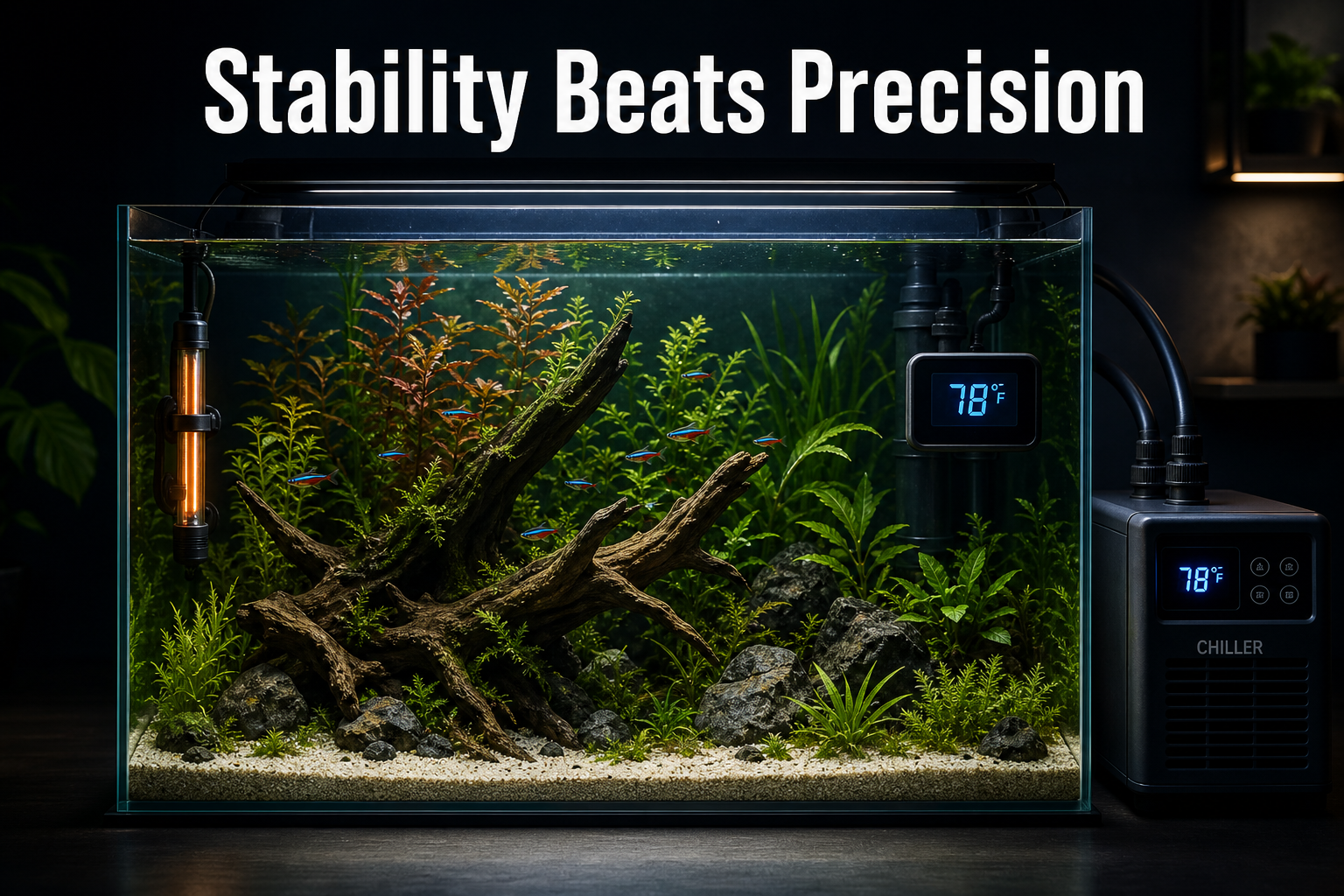
Fish are cold-blooded. That's it. Their metabolism, digestion, immune system, enzymes. All of it hinges on water temperature. They can't regulate it, so you have to.
Here's where most hobbyists get it wrong: they obsess over hitting 78°F exactly. Wrong target. Stability matters more than precision.
This guide covers setting up a heater correctly, managing temperature through the seasons, and knowing when you actually need a chiller.
why stability matters more than hitting the exact number
A tank holding steady at 76°F beats one that swings between 76°F and 82°F every day, even though the second one averages exactly 78°F. Tropical fish evolved with seasonal shifts over weeks, not hourly temperature swings.
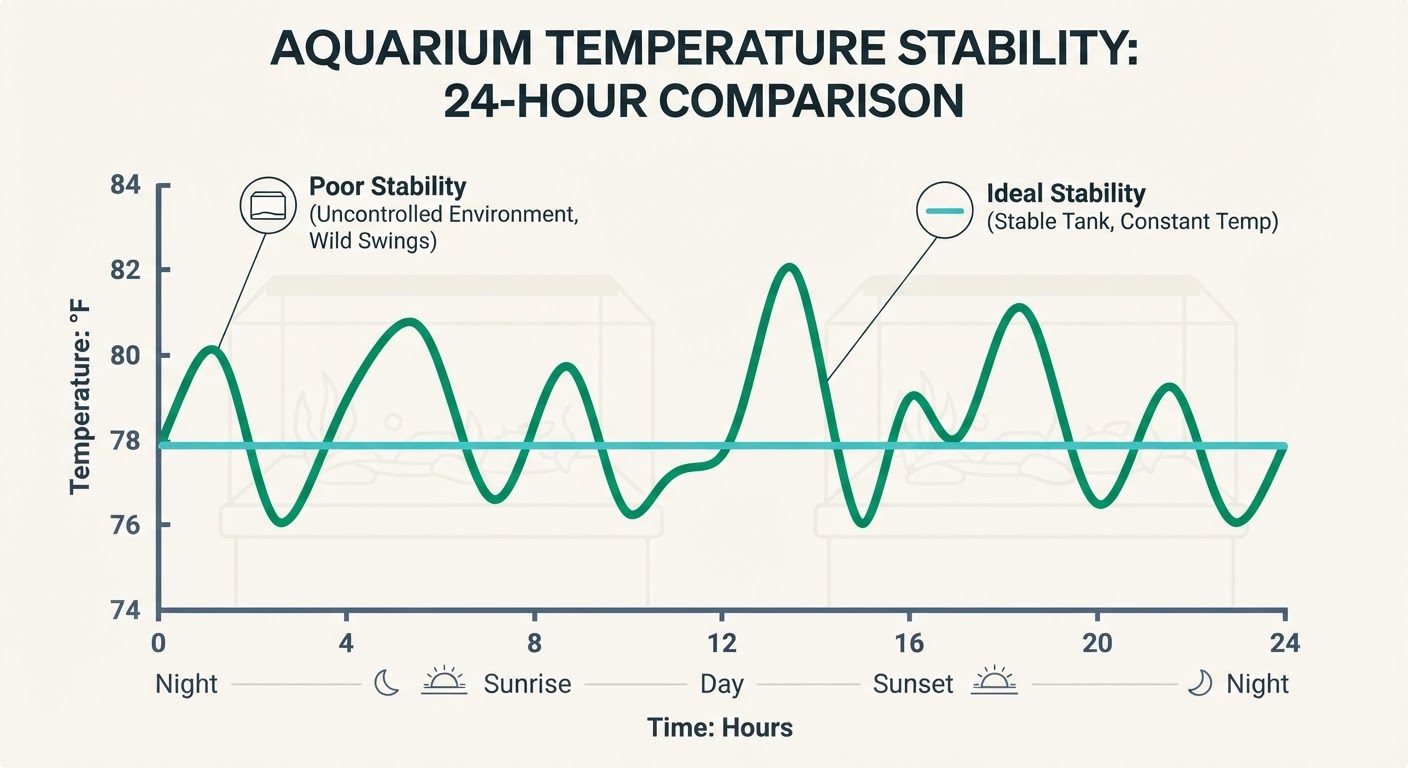 Watch what happens when temperature spikes 5°F in a few hours: fins clamp, fish hug the bottom or surface. Breathing gets faster. They stop eating. That's often the first sign something's wrong. Some start shimmying or darting. The immune system weakens. Ich blooms. Severe cases: they lose balance and gasp.
A 10°F rise roughly doubles metabolic rate. But dissolved oxygen drops as temperature climbs. Fish need more oxygen while there's less available. They're literally gasping for air that isn't there.
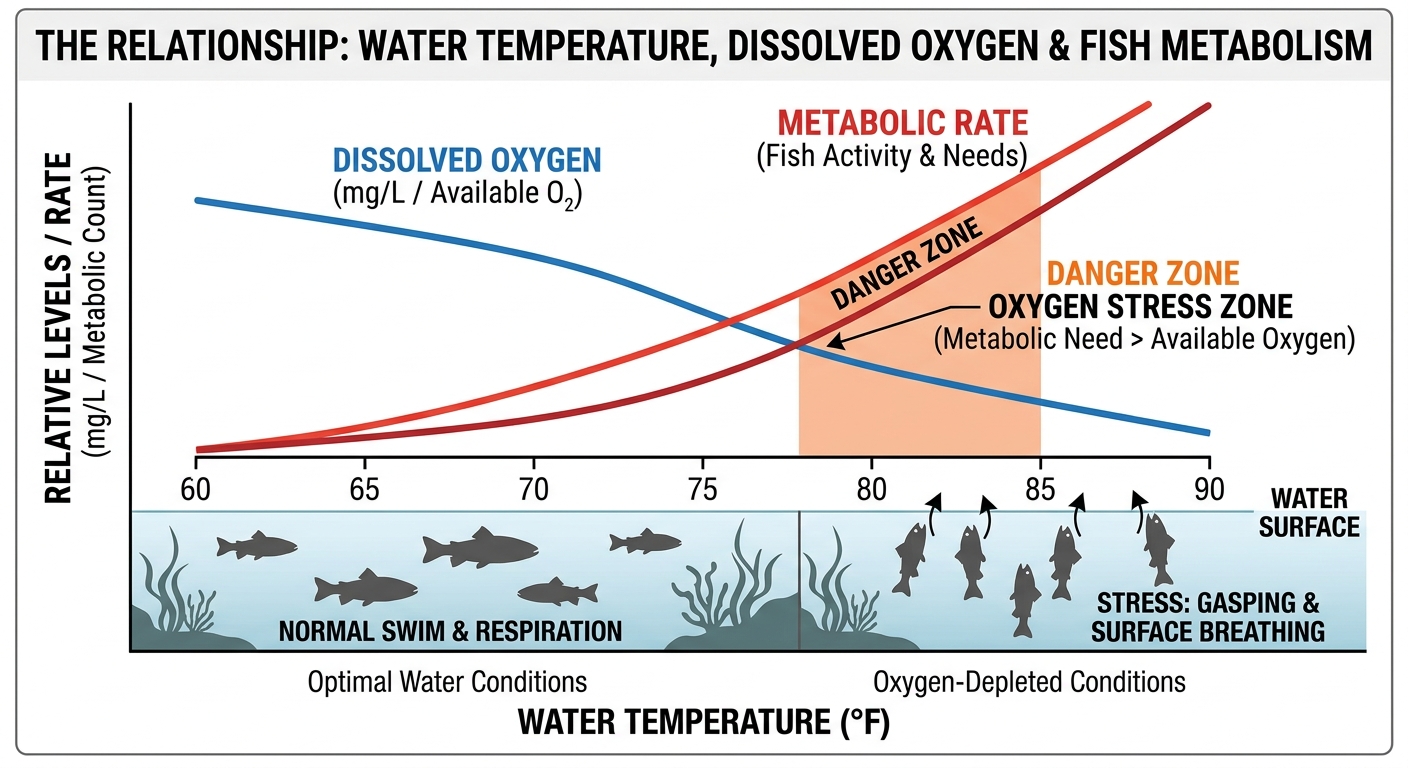 I keep seeing the same pattern: tanks with 5–10°F swings between day and night. Room heating kicks on during the day, cools off at night. AC cycles. Lights on and off. Evaporative cooling at night. A heater that's too small to catch up.
Good aquarists keep daily variation within 1–2°F. If your thermometer reads the same number in the morning, afternoon, and evening, you're doing it right.
do you need a heater
Tropical fish like tetras, rasboras, gouramis, cichlids, and corydoras – yes. Most aquarium fish come from places where water rarely drops below 75°F. Unless your room stays warm around the clock, get a heater.
Check your room temperature honestly. Most homes fluctuate 5–10°F between day and night. Rooms with exterior walls, basements, or windows near AC vents do worse. Water temperature typically sits 1–3°F below room temperature because of evaporative cooling.
Exceptions exist. White Cloud Mountain Minnows, Japanese ricefish, and zebra danios handle cooler water fine. Goldfish don't need heated tanks unless you're keeping fancy varieties, but they do better at 68–74°F than most people think.
People misunderstand goldfish. They're not coldwater-only. Below 60°F, digestion stalls. Fancy goldfish start bloating, developing swim bladder issues because food doesn't move through efficiently. Above 78°F, oxygen stress climbs. A heater set to 68–70°F keeps them stable.
choosing and sizing a heater
The 5-watts-per-gallon rule is a starting point. It oversimplifies.
The real calculation accounts for how cold your room gets. Run these numbers:
- How many degrees do you need to raise the water? (target minus room temperature)
- Start with 5 watts per gallon as base
- Add roughly 1 watt per gallon for every additional 5°F you need
- Add 20–30% more if your tank has no lid (evaporative cooling is aggressive)
- Add 10–15% more if the tank's in a cold room or against an exterior wall
Example: 20-gallon tank, room stays around 72°F, target is 78°F (6°F difference). Base = 20 × 5 = 100W. That works. If the room drops to 68°F at night, jump to 150W.
55-gallon tank in the same room? You need 250W minimum, ideally 300W. For 75+ gallons, use two heaters of 150–200W each instead of one large one.
Why two smaller heaters? Redundancy. If one fails stuck ON, the other isn't powerful enough to overheat the tank. If one fails stuck OFF, the second keeps heating. They cycle less frequently during transitional seasons, so less thermostat wear. Cost difference is small – two 100W heaters cost about the same as one 200W.
heater types
Submersible (glass tube): Heating element wrapped around a ceramic core, sealed in a glass tube filled with sand. Most common, reliable, affordable ($15–50). Mount at a 45° angle next to water flow so heated water circulates instead of rising past the thermostat.
Titanium: Metal body, virtually unbreakable, no glass to crack. Needs an external controller. Popular in large tanks and sumps. $40–100+.
Inline: Plumbed into the canister filter return line. Heats water as it flows through. No equipment in the display tank. Excellent heat distribution. Needs a canister filter and separate thermostat. $50–150+.
Substrate cable: Heating cable buried in the substrate. Gentle convection moves through and delivers nutrients to roots. Popular in planted tanks but rarely the only heat source. Needs a separate thermostat.
Heating mats: Under the tank. Glass conducts heat poorly, these are inefficient. Don't bother.
aquarium heater thermostats and how they fail
Most affordable heaters use a bimetallic strip thermostat. Two metals bonded together expand at different rates when heated. The strip bends until it breaks electrical contact and cuts power. The dial adjusts where that happens.
They work, but they degrade. New: accurate within ±2°F. After 2–3 years: ±4–6°F. After thousands of cycles, metal fatigues. Contacts weld from electrical arcing (stuck ON) or the spring loses tension (stuck OFF).
Premium heaters use electronic thermostats with a thermistor – a temperature-sensitive resistor talking to a microchip. Accurate within ±0.5°F, no mechanical contacts to fail. Digital display, tighter control, fewer failure modes. Costs more ($40–80), but worth it for expensive fish or tanks needing precision.
An external temperature controller is the gold standard. The heater plugs into the controller, a temperature probe sits in the tank. When the tank hits target, the controller cuts power completely. Even if the heater's thermostat fails stuck ON, the controller stops it. Inkbird ITC-306A ($35) is cheap insurance. Recommended for discus, shrimp, or tanks with animals you can't replace.
Heaters fail for specific reasons: bimetallic thermostats fatigue after years of cycling, contacts weld (stuck ON), water seeps through the cord entry and corrodes internals, thermal shock cracks the tube, thermistors drift 2–5°F over time.
To catch failure early: independent thermometer, check daily. Put it on the opposite side of the tank from the heater so you verify heat reaches everywhere. If the indicator light never turns off, it's stuck ON. If tank temperature drops despite the light being on, it's failing OFF. If temperature drifts 2–5°F from your setting, the thermostat is drifting.
heater placement for even heat
Position the heater near water flow – next to filter output, near a powerhead, under an air stone. Without circulation, heated water rises and sits at the top while the rest stays cool. A 55-gallon tank with poor flow can develop a 3–5°F gradient from end to end.
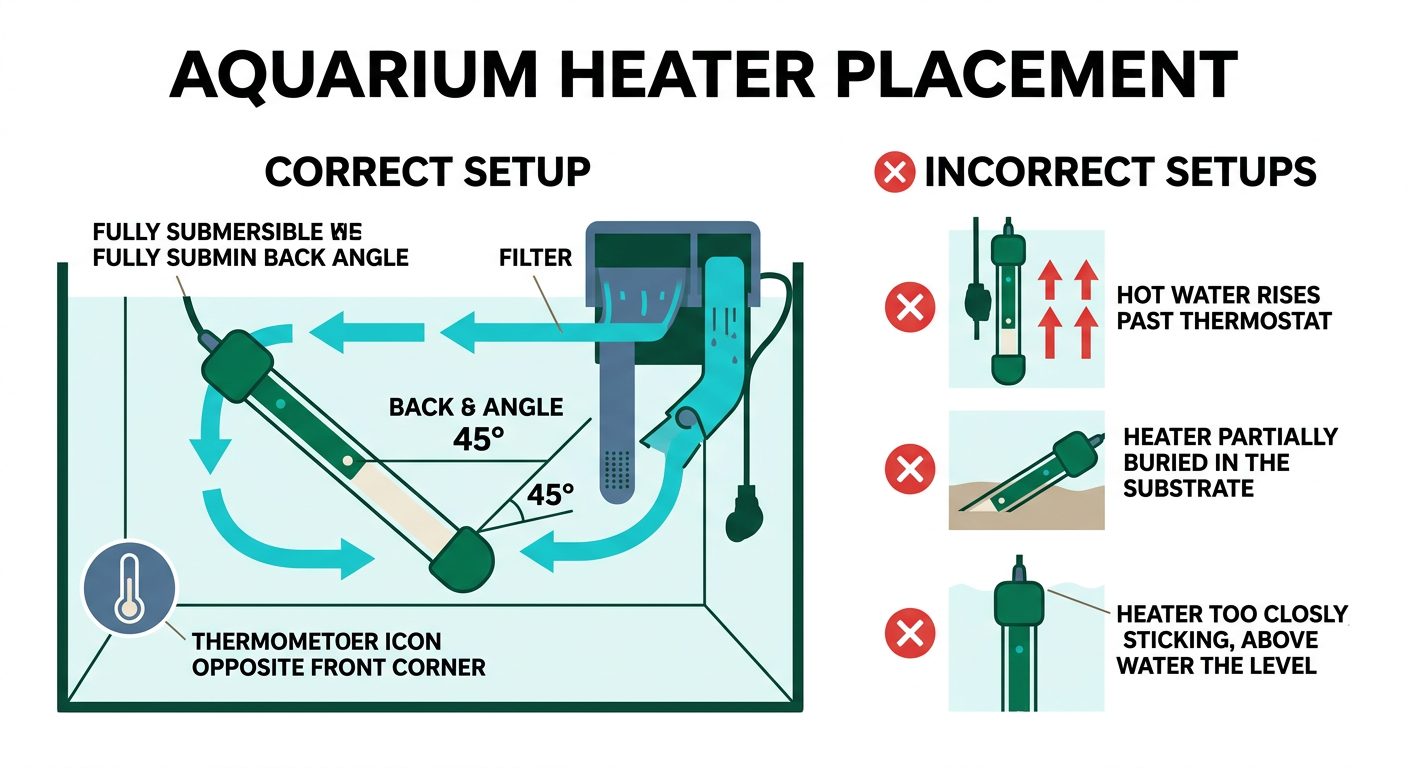 Mount submersible heaters at a 45° angle, not vertical. Vertical placement lets heated water rise past the thermostat, triggering early shutoff and wrong readings.
Never bury the heater in substrate. It needs free water circulation to work and sense temperature. Check the minimum water level line marked on the heater. Operate above that or the element will overheat in air and crack the tube.
Hiding hardware is easier than people think. Tall plants like vallisneria, amazon swords, and stem plants work well. Driftwood or rockwork too. Horizontal placement low along the back glass works if your model allows it. Titanium or black heaters blend into dark backgrounds. In a sump or canister return, the heater goes in the sump – hidden and heating return water distributes warmth instantly.
Never trust the heater's dial markings. I've measured heaters off by 3–5°F from what the dial said. Get a separate thermometer – digital probe ($10–15) is reliable, or go old-school with alcohol glass ($3–8). Hang it on the opposite side from the heater. Check the same spot morning, afternoon, evening for a week. If those readings stay consistent and the heater cycles on and off at the right temperatures, you have stable control.
when you need cooling
Everyone focuses on heating. Summer heat and warm climates create the opposite problem. Most people don't actually need expensive equipment to solve it.
If you keep tropical community fish in a temperate climate, you probably don't need active cooling. A fan across the water surface during heat waves (evaporative cooling, 4–8°F drop) covers most situations. Remove the glass lid or switch to a mesh top for a few weeks. Reduce lighting during hottest hours. That's usually enough.
Specialty fish that need cool or precise temperatures are different. You've made a deliberate choice to keep that species and the equipment comes with it.
Axolotls must stay below 70°F. Above 72°F, they're in distress. Above 75°F, they die within days. If you live anywhere warm, a chiller isn't optional. It's foundational. Same setup cost as keeping these animals responsibly.
Discus thrive at 82–86°F. But in hot climates, room temperature plus equipment heat can push toward 88°F or higher, past what they tolerate. If you keep discus where summer ambient temps hit 85°F or higher, you need cooling capacity. Not optional.
Sensitive shrimp like Crystal Reds and Taiwan Bees need 68–74°F. Above 78°F, mortality jumps. If you breed these, temperature control is part of the hobby. You know going in.
Planted tanks with CO2 injection peak at 72–78°F. Above 82°F, most plants decline. CO2 solubility drops as temperature rises and algae thrives instead. In warm climates, this is a real constraint.
For these situations, here's what works:
Fan cooling: The baseline. A clip-on or desk fan blowing across the water surface costs $15–40. Evaporative cooling drops temperature 4–8°F. You'll top off more frequently, but it's sustainable. Start here.
Removing the lid: Open top or mesh lid. Increases evaporative cooling 3–5°F. Problem: fish can jump and you'll top off constantly. Use during heat waves, not year-round.
Reducing light or raising it higher: Lights generate measurable heat. Cutting photoperiod during summer or lifting fixtures helps as a secondary measure.
Aquarium chillers: Now we're talking real equipment. Thermoelectric chillers (Peltier-based) work on nano setups up to about 10 gallons. Solid-state, quiet, but inefficient at scale. Cost: $100–200. Compressor-based chillers work like refrigerators. They maintain precise temperature regardless of ambient heat and handle any tank size. Downside: they're loud, produce hot exhaust, and cost $300–1,500+. Brands: JBJ Arctica, Teco, Aqua Logic.
Practical reality: if you keep axolotls or Crystal Reds in a warm climate, a chiller isn't an accessory. It's part of what you've committed to. You budgeted for it before you bought the fish. Not a "nice to have." Same with discus breeding in a hot region. You build the tank around the fish's actual needs, not retrofit cooling to a tank built for something else.
Standard tropical community fish and summer heat: fan, open lid, reduced lights. That covers most scenarios. Chillers are for specialty setups, not general use.
troubleshooting heater problems
Heater stuck ON is the catastrophe. Tank temperature climbs above set point and keeps climbing: 1–3°F per hour past where it should stop. Indicator light stays on constantly. Fish gasp at the surface because warm water holds less oxygen.
Confirm with an independent thermometer. Tank reads 85°F or higher and heater is set to 78°F? Unplug it immediately. Don't wait.
Heater stuck OFF is slower but still bad. Temperature drops 2 or more degrees below set point over hours. Indicator light never comes on. Heater body feels cold when it should be warm.
Thermostat drift is sneaky. Tank runs consistently 2–5°F above or below your setting. Temperature creeps up or down over weeks even though you haven't touched the dial.
To test a heater safely: fill a bucket with water at a known temperature. Fully submerge the heater and plug it in. Set it to 5–8°F above current water temperature. Monitor with a separate thermometer for 30–60 minutes. The heater should raise temperature smoothly to set point, then cycle off. If it overshoots by 3°F or more, won't turn off, or undershoots, the thermostat is failing.
Replace immediately if condensation is inside the glass tube (electrical hazard), it tests stuck ON, or the glass is cracked or cord is damaged.
Replace within weeks if thermostat drift exceeds 3°F consistently or the indicator light flickers or sticks.
Lifespan expectations: budget heaters under $25 last 1–3 years. Mid-range ($25–50) last 3–5 years. Premium electronic heaters ($50–100+) last 5–8 years, especially with an external controller. I keep seeing the same pattern: most people replace heaters only when they fail. Experienced hobbyists replace them proactively every 2–3 years.
seasonal temperature management
Summer heat waves need a plan. Remove glass lids or switch to mesh tops for better evaporative cooling. Run fans across the surface 24/7 during heat events. Reduce or turn off tank lights during hottest hours. Perform water changes with water slightly cooler than the tank (1–2°F below, never a shock).
Winter power failures: priority is oxygenation, not instant heating. A battery-backed air pump ($15–25) is essential. It keeps water moving and oxygenated while you handle the situation. Wrap the tank in blankets or foam insulation to slow heat loss. Float bottles of hot water in sealed containers (rotate as they cool). Most fish survive days without food, so don't feed. Uneaten food and waste degrade water faster without filtration.
Longer backup: a computer UPS (uninterruptible power supply) runs a 200W heater and air pump for 2–4 hours. A 12V deep-cycle battery with an inverter running a 100W heater buys 4–8 hours. Small USB/12V DC heaters exist for nano tanks. The goal is buying time until power returns or you move fish.
Why this matters for the two-heater setup: redundancy covers seasonal scenarios. In summer with AC running, room temperature drops at night – two smaller heaters cycle less frequently, reducing wear. In winter, if the room is colder than usual, both may run but neither maxes out. If one fails, the other buys you 12–48 hours to notice and replace.
Insulated tank lids reduce evaporative heat loss by 50–70% versus an open top. Twin-wall polycarbonate greenhouse panels or foam board cut to fit over your lid add another layer.
temperature ranges by species
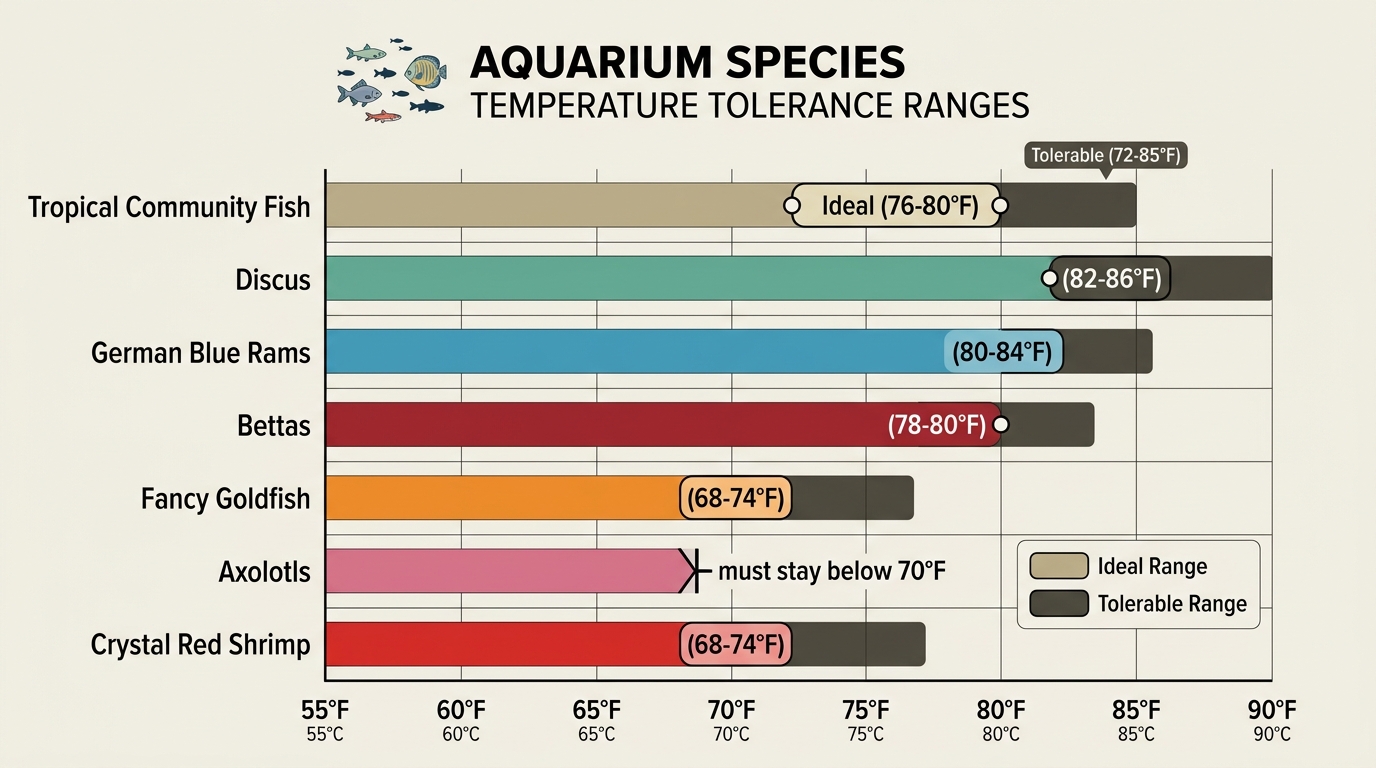 tropical community fish
Tetras, rasboras, gouramis, and most cichlids do best at 76–80°F, with 78°F as the sweet spot. They tolerate 72–85°F, but anything outside 76–80°F is survival mode, not thriving.
discus
Discus need 82–86°F. Higher temperatures increase metabolism and feeding response. Juveniles especially need 84–86°F for proper growth. Below 80°F, immune function drops.
german blue rams and bettas
German Blue Rams are the warmest-water community fish. 80–84°F preferred, ideally 82°F. They often fail in standard 78°F setups because they're chronically cold-stressed. If you keep them, commit to a warm setup.
Bettas do best at 78–80°F. Below 76°F, they become lethargic and constipation sets in. Above 84°F, lifespan shortens and they age faster.
tetras
Neon tetras prefer 74–80°F. Cardinal tetras need 78–82°F.
goldfish and coldwater species
Fancy goldfish need 68–74°F with a heater to maintain stability. Below 60°F, digestion stalls. Above 78°F, oxygen stress climbs. The question isn't whether they need heat; it's whether their tank stays stable.
Common and comet goldfish are far hardier (they overwinter under ice in ponds), but in aquariums they do best at 65–72°F.
White Cloud Mountain Minnows are classic coldwater: 60–72°F, no heater needed in most homes. Zebra danios have massive temperature tolerance: 64–75°F is ideal, but they survive far outside that.
axolotls
Axolotls are the exception to warmth. They must stay below 70°F. Above 72°F, they're in distress. Above 75°F, they die within days. They often need a chiller.
shrimp
Caridina shrimp (Crystal Reds, Taiwan Bees) are sensitive to temperature swings. They prefer 68–74°F. Above 78°F, mortality rises sharply. Neocaridina shrimp (cherry reds, blue dreams) are hardier: 68–78°F is comfortable and they tolerate wider swings.
planted tanks
Planted tanks peak at 72–78°F. Most aquatic plants start declining above 82°F. CO2 solubility drops and algae thrives in warm, CO2-depleted water.
Here's the thing: "preferred" and "tolerable" aren't the same. Fish kept at the edge of their tolerable range will have shortened lifespans, faded coloration, lower breeding success, higher disease susceptibility, even though they outwardly survive. That's the difference between thriving and just getting by.
Comments
No comments yet.