Sizing Your New Tank: Bigger Isn't Always Better
The logic seems obvious. Your fish are cramped. A bigger tank means more water volume, which buffers temperature swings and means less frequent water changes. So you upsize, maybe from a 55-gallon to a 125-gallon. On paper, 2.3 times the space should solve your problems.
It doesn't work that way.
Larger volumes do resist parameter swings, which sounds great. But that same inertia cuts both ways. When something goes wrong—an ammonia spike, a disease outbreak—the water that protected you now makes it harder to fix. A 75% water change on a 125-gallon tank means moving 94 gallons. That's logistically demanding. Compare that to a 55-to-75 gallon upgrade (36% volume increase), which removes only about 56 gallons. The jump feels less dramatic, but it's proportionally more manageable.
There's another trap that catches most people upgrading. When the new tank fills, the instinct is to add more fish. You've got all this space—why not stock it? The problem is the biological filter hasn't caught up yet. Your bacteria colony only grew to handle the bioload in the old tank. Adding fish immediately after an upgrade triggers what looks like new tank syndrome, except it's happening in a tank that should be established. You end up watching ammonia and nitrite spike even though you moved old filter media. It's frustrating and preventable.
The safe approach: keep your current stocking level for 2 to 4 weeks after the move. Let the bacteria expand to match the new volume. Then add fish gradually.
Before you decide how much bigger to go, think about what you're actually trying to achieve. More water volume isn't always the answer. Sometimes the problem is filter capacity, not tank size. Sometimes it's overstocking in the current tank. Upsizing without fixing the root issue just delays the problem.
Then there's the weight issue. A filled 125-gallon tank weighs around 1,400 pounds. That weight isn't just a floor problem—it's a furniture problem too. Most aquarium stands are rated for a specific tank size. A stand rated for 75 gallons won't safely hold a 125. The wood or metal flexes and settles over time, and once it starts failing, it fails suddenly. Check the weight rating on your stand. If the weight exceeds it, the stand will warp, components will crack, and your tank is at risk.
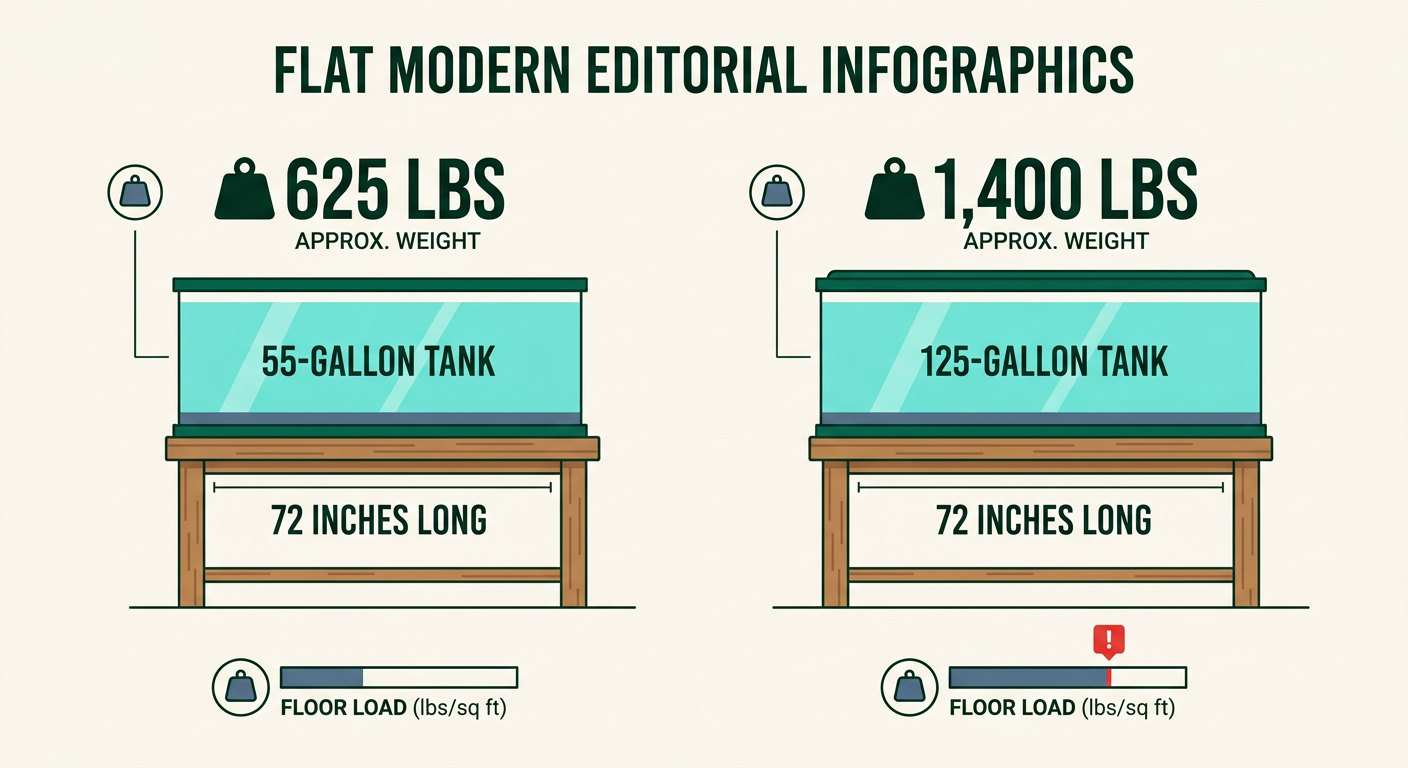
Floor joists matter too. Standard residential floor joists are rated for 40 pounds per square foot of live load. A 125-gallon on a 72-by-18-inch footprint exerts roughly 155 pounds per square foot—well above code without reinforcement. This isn't a small concern. Structural failure is an actual risk, and most upgrading guides ignore it because they don't want to scare people. I'm telling you this because it matters. Check both the stand and the floor before committing to the upgrade.
The Migration Sequence: A Step-by-Step Checklist
Moving a tank isn't about randomly transferring stuff. The order matters because you're trying to preserve the bacterial colony that makes your tank livable.
Can you move your fish and filter media to a new tank the same day? Yes—but the order matters. Here's the sequence:
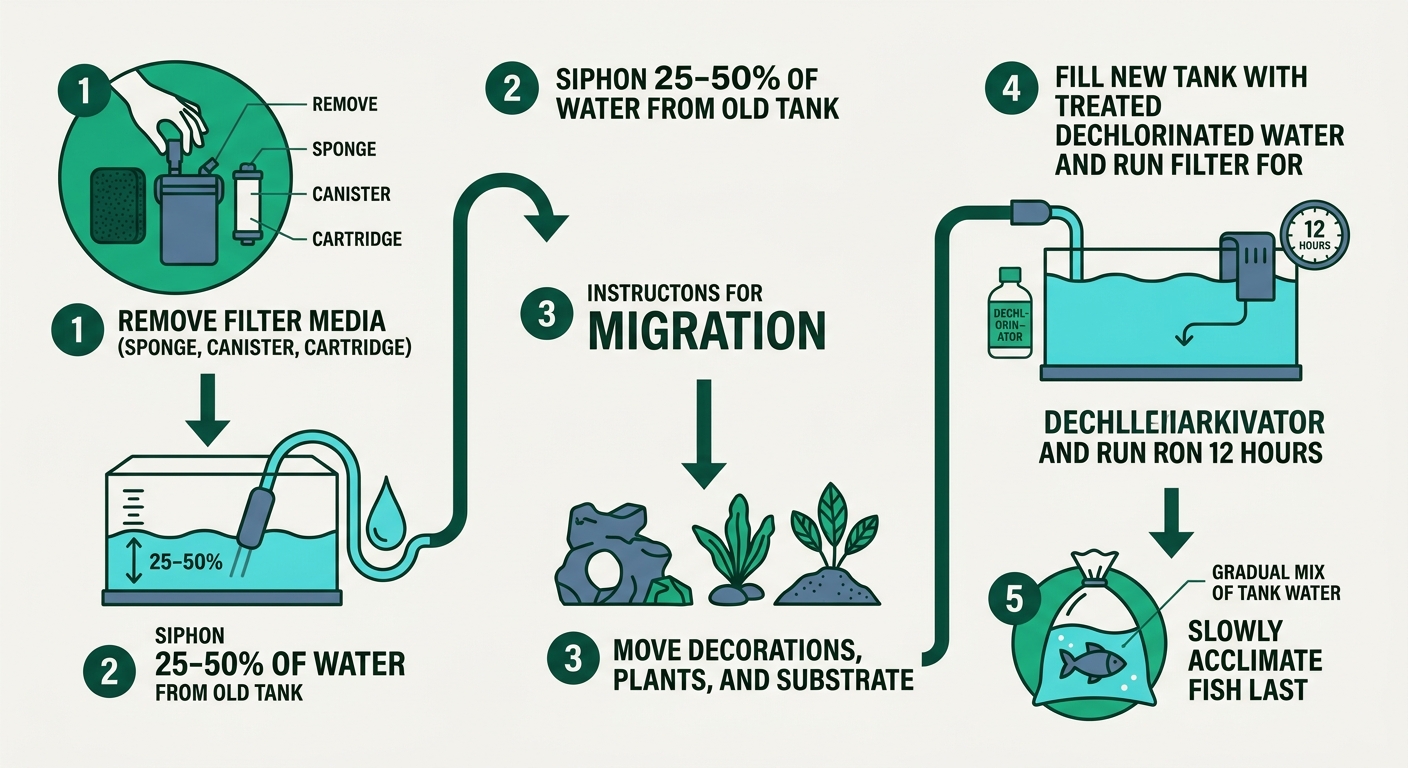
- Pull filter media first (never rinse in tap water—chlorine kills the biofilter)
- Siphon 25–50% of the new tank's volume from the old tank, temperature-matched
- Move hardscape, substrate, and plants
- Fill with dechlorinated new water and run the filter for at least 12 hours before adding fish
- Acclimate fish slowly and introduce them last
Filter media comes out first. The densest concentration of nitrifying bacteria lives in your filter, not floating in the water column. When you move the tank, bring your filter media with you. If you have a sponge filter, move the whole thing. If you have a canister filter, move it unopened—the bacteria colony inside stays intact. If you're using cartridge media, move the old cartridges with you.
Never rinse old filter media in tap water. Chlorine and chloramine kill nitrifying bacteria on contact. If you need to clean something, rinse it only in dechlorinated water or water from the old tank.
Then the water. This is where people get confused. The old tank water isn't going to "cycle" the new tank because beneficial bacteria don't float in the water column—they colonize surfaces. The old water is valuable for other reasons: it matches your fish's current parameters (temperature, pH, hardness), contains dissolved organics they're accustomed to, and means your fish aren't experiencing a 100% water change on top of tank stress.
How much old water should you transfer to the new tank? 25 to 50% of the new tank's volume if you can. More than that provides diminishing returns. The important part is matching temperature as closely as possible—aim for within 1 or 2 degrees Fahrenheit. A digital thermometer in both tanks during setup is worth the investment.
Treat the entire new-water volume with a dechlorinator before adding it. Chlorine dissipates on its own in about 24 hours with aeration, but chloramine doesn't. A good dechlorinator like Seachem Prime handles both.
Hardscape and substrate next. Move your decorations, plants, rock, and as much old substrate as practical. These surfaces harbor bacteria and add biological capacity. If you're using entirely new substrate, that's okay—the filter media carries the bacterial load—but moving at least some established substrate helps.
Fish go in last. Don't move fish until the tank has been running for at least 12 hours. The filter needs time to establish flow patterns, the water needs to stabilize, and you need to verify everything is functioning. Then acclimate your fish slowly—either by drip acclimation for sensitive species or by floating them for 30 minutes to an hour.
Equipment Migration Strategies
Keeping Your Biofilter Alive
The difference between a smooth transition and a crashed cycle often comes down to how you handle the filter.
Sponge filters are ideal for upgrades. Move them directly to the new tank with the old air pump. A seasoned sponge provides immediate biofiltration, and because sponges are just porous material colonized by bacteria, they transfer perfectly intact. This is the single most reliable strategy for smaller tanks.
Canister filters are straightforward too. Move the entire canister to the new tank without opening it. The water and media inside are colonized by bacteria—disturbing them risks killing the colony. Let it run for at least 2 weeks before any filter maintenance or cleaning.
For tanks transitioning between filter types, the best approach is running dual filters during the changeover. Keep the old filter running alongside the new one for 2 to 4 weeks. The old filter handles the established bioload while the new filter colonizes. After the transition, you can remove the old filter gradually—remove a section of old media each week rather than ripping it all out at once.
If you're replacing worn filter pads, run the old and new pads side by side for at least 2 weeks. This gives bacteria a gradual path from old media to new media.
Water Introduction Methods
The way you introduce new water makes a difference, especially in the first 24 hours.
Pouring water directly from buckets is fine, but pour it slowly—into a plate or saucer in the tank rather than straight onto the substrate. This prevents the substrate from getting churned up and keeps particles from clouding the water. It also lessens the shock to fish if you've already moved them.
Match the temperature of new water to the tank as closely as you can. A difference of more than 2 or 3 degrees triggers cold-shock responses in fish, and temperature swings during a move they're already stressed from only make things worse.
Temperature-matching matters for another reason too. Water temperature affects pH, and pH determines ammonia's toxicity. Below pH 7.0, ammonia exists mostly as ammonium (less toxic). Above pH 7.0, it shifts toward ammonia (highly toxic). A sudden temperature drop can swing the pH and make existing ammonia more dangerous.
After the Move: Observation and Monitoring
What to Watch For in the First 48 Hours
After the fish go in, the temptation is to overmanage. Resist it. Most of what you'll see is normal.
Fish hiding for 12 to 48 hours is expected. They're in an unfamiliar space, figuring out territories from scratch. Some species take longer—nocturnal fish might not venture out during the day for a few days. That's fine.
Reduced appetite for 24 to 72 hours is normal. If they won't eat after 3 days, test your parameters. If ammonia and nitrite are zero and nitrate is stable, they're probably just stressed. Give it time.
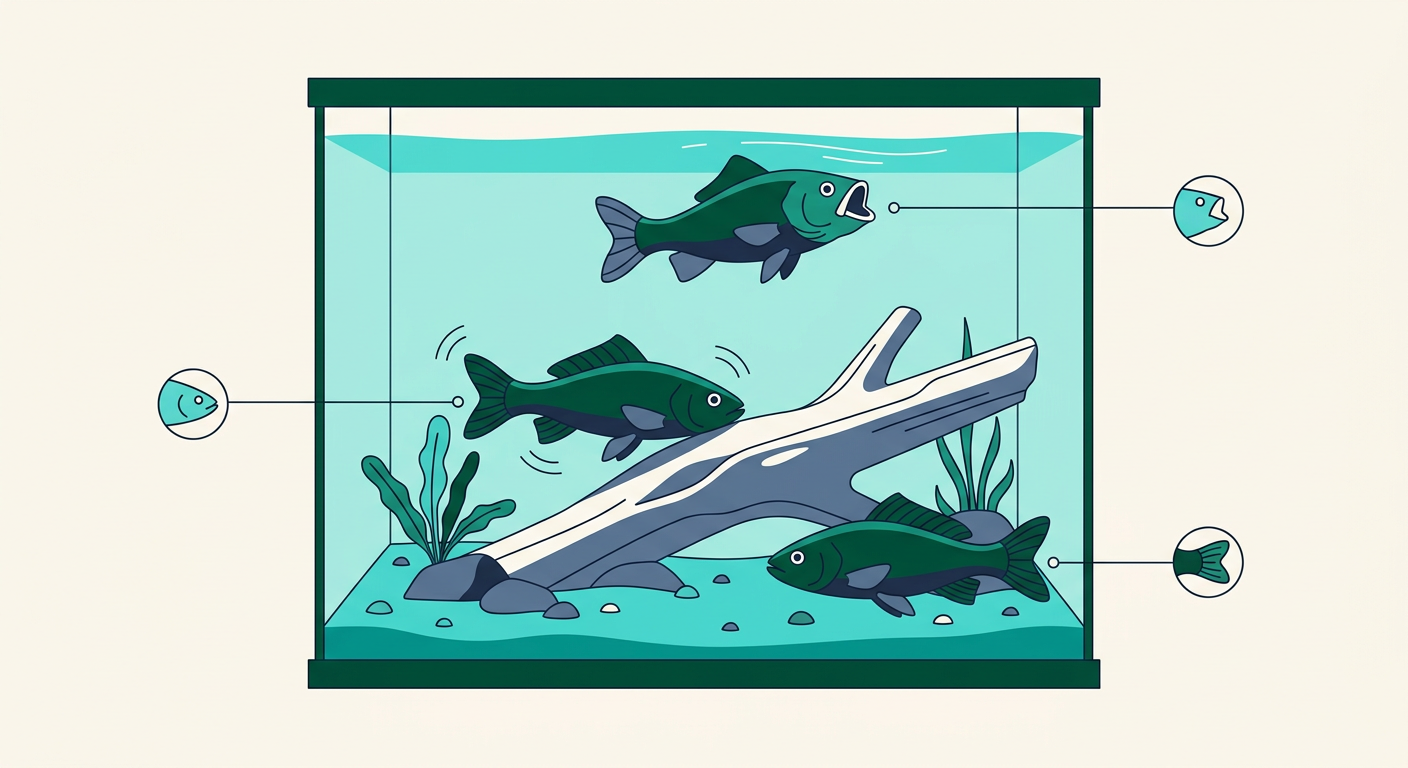
These signs aren't fine. Clamped fins (held tight against the body) signal stress or poor water quality. Flashing—fish rubbing against objects or the substrate—can mean parasites, but it also happens when ammonia or nitrite irritate them. Gasping at the surface, especially in still water, is a red flag. That's usually nitrite poisoning—the bacteria that convert nitrite to nitrate may not have colonized yet in a new setup, or the mini-cycle hit harder than expected.
Lethargy plus loss of color is advanced stress. Rapid gill movement even in well-aerated water points to gill irritation from ammonia or nitrite.
If you see any of these, test ammonia and nitrite right away. Don't wait for a scheduled test.
Critical Water Parameters
Testing schedule after upgrade: ammonia and nitrite every 12 hours for the first 3 days. If both are zero for 3 consecutive days, drop to daily testing for a week. If stable, go back to your normal weekly schedule.
The thresholds that matter:
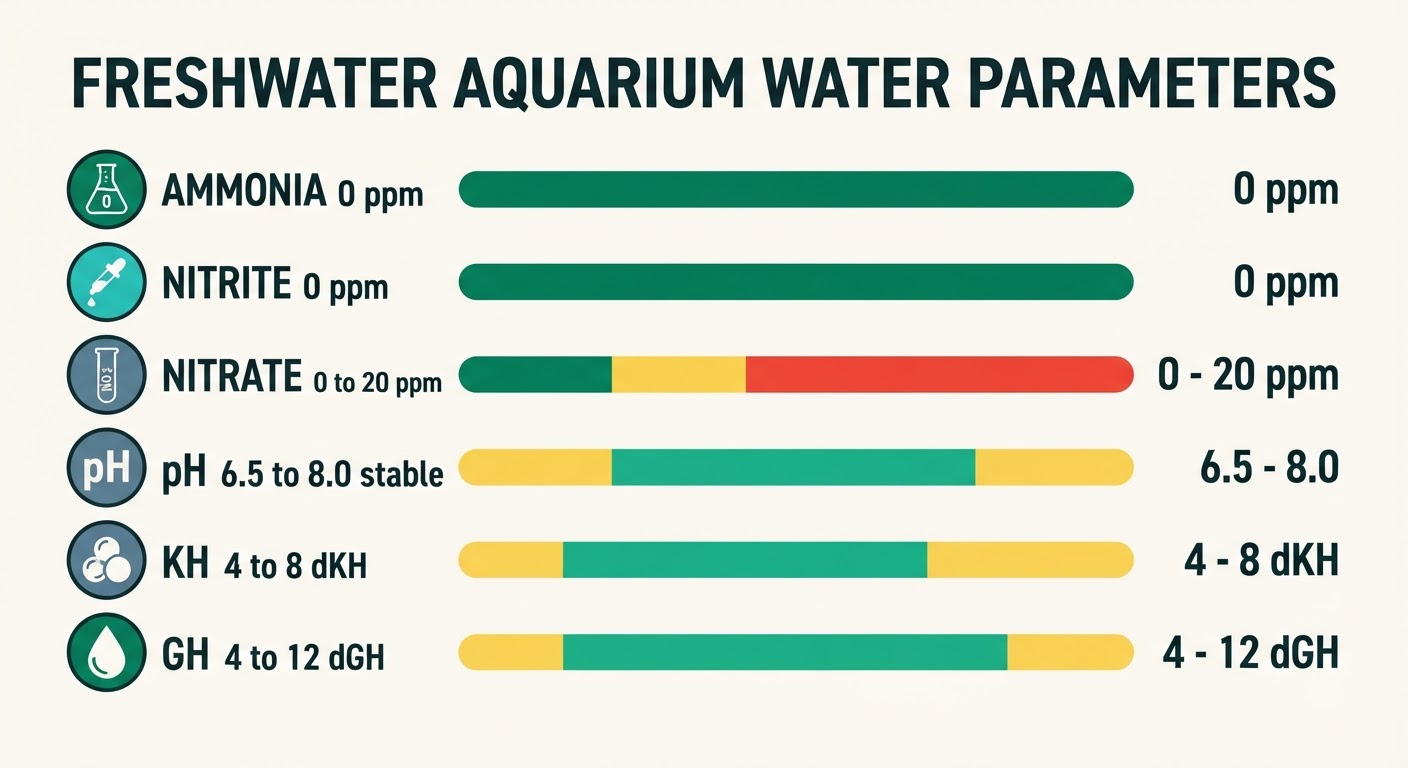
- Ammonia: 0 ppm is the goal. Anything detectable is a problem. At 0.25 ppm, do a water change. At 0.5 ppm or higher, it's an emergency—water change immediately and consider dechlorinator/salt treatment if fish are showing stress.
- Nitrite: 0 ppm. Any detectable level needs action. Nitrite binds to hemoglobin and prevents oxygen transport—fish suffocate even in well-oxygenated water. Water changes and possibly methylene blue or salt help.
- Nitrate: Below 20 to 40 ppm for freshwater, below 5 to 10 ppm for saltwater. It accumulates over time and rarely causes acute problems, but it confirms your nitrogen cycle is working.
- pH: Stable matters more than "ideal." A steady 7.8 is safer than a fluctuating 7.0. Watch for crashes—a sudden pH drop usually signals an ammonia/nitrite spike, or the substrate has run out of buffering capacity.
- KH (carbonate hardness): This buffers pH. Below 3 dKH, your pH can crash without warning. Aim for 4 to 8 dKH for a community tank.
- GH (general hardness): Species-dependent. Soft-water fish (tetras, rainbowfish) need below 8 dGH. Livebearers and African cichlids want 10 dGH or higher.
Always test before a water change, not after. You need to know what your fish are experiencing, not what it was after you diluted it.
When Bigger Backfires: Common Post-Upgrade Problems
The Mini-Cycle
You moved established filter media. You tested parameters the night before migration and everything was zero. But on day 2, ammonia shows up. You panic. You moved old media—so do you need to cycle a new tank if you have old filter media?
No. And this is worth understanding because it's not a failure.
I've noticed this happens reliably enough that I can explain why. When old filter media moves to a new tank, the bacterial colony is intact but undersized for the new environment. Bacteria don't float around freely—they colonize surfaces, and their population adjusts to the available food supply. Ammonia-oxidizing bacteria (Nitrosomonas) and nitrite-oxidizers (Nitrobacter, Nitrospira) each expanded in the old filter to handle the specific waste distribution and current patterns there. In the new tank, everything is different. Flow changes, dilution changes, and some bacteria die during the physical disturbance of being moved.
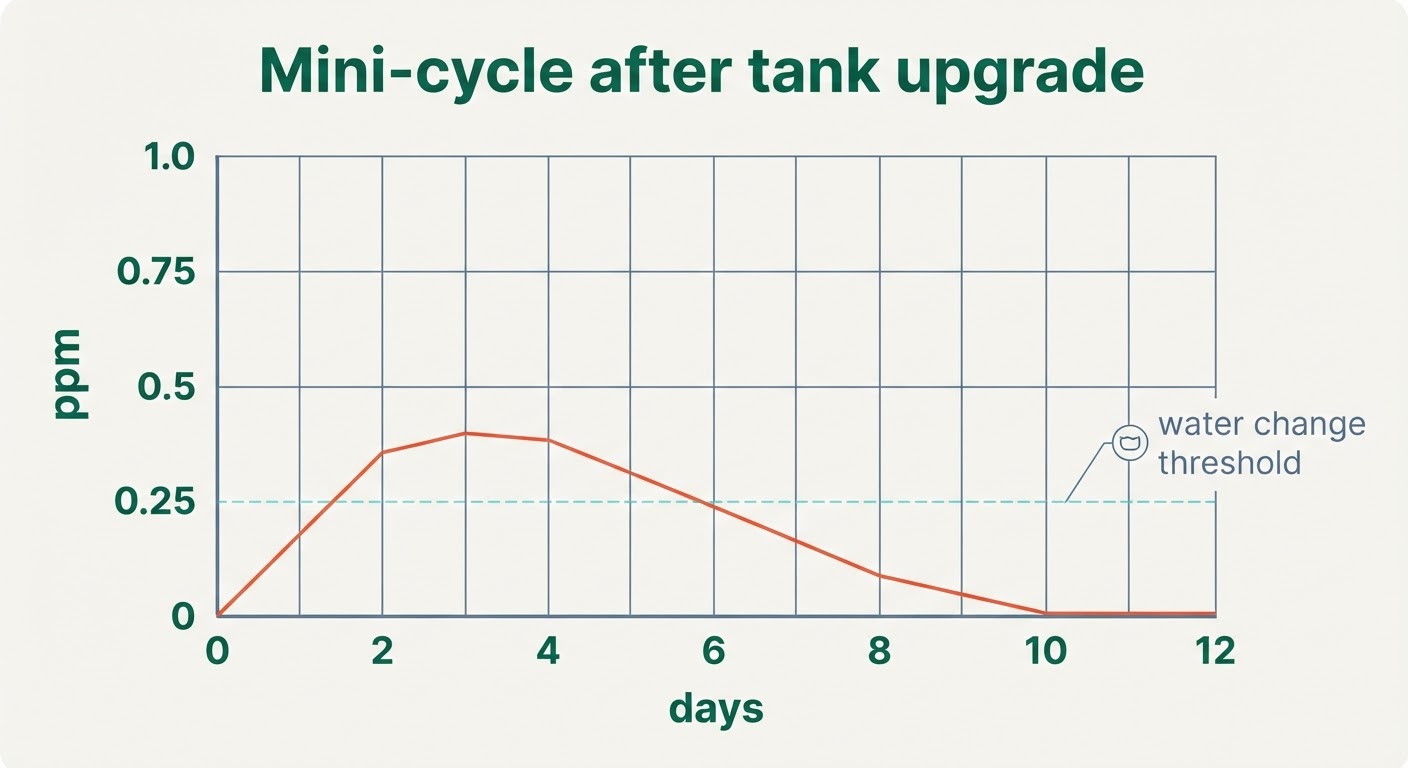
Result: a mini-cycle. Detectable ammonia (usually 0.25 to 0.5 ppm) or nitrite (occasionally both) shows up for 3 to 10 days. That's normal.
Treatment: 25 to 50% water changes whenever ammonia or nitrite exceeds 0.25 ppm. Cut feeding in half, so you're lowering the amount of waste your fish produce while the bacteria catch up. A bacterial starter culture like Tetra SafeStart adds live nitrifying bacteria and can speed recovery, though the bacteria have to colonize surfaces anyway—it's not a magic fix.
The mini-cycle is annoying, I'll admit. But it's self-limiting. The bacteria are already there. They're just reorganizing.
Why Are My Fish Acting Weird After the Upgrade? (Even When Parameters Look Perfect)
You've tested ammonia and nitrite. Both are zero. Nitrate is climbing normally. But your fish are hiding, not eating, or acting stressed. The parameters don't explain it. I've watched this happen in established tanks enough times to know what to look for.
Territorial confusion: In the old tank, every fish had its boundaries and its spot. Tank rearrangement resets all of that. Fish that were peaceful in the 55-gallon start squabbling as they re-establish dominance. Cichlids are especially prone to this—they're basically living with a completely redrawn map. Rearranging the hardscape after the move actually helps. It removes the territory markers they remember, so nobody can default to defending the same spots.
Open-water stress: Some species (tetras, rasboras, smaller schooling fish) feel genuinely exposed in a larger tank with more open space. I've kept records of behavior changes as tanks doubled in size—they school tighter, hide more, or refuse to swim out where they can be seen. Add floating plants, tall background plants, or more hardscape to break sight lines and create visual shelter. They want cover, not just room.
Social hierarchy shifts: In a 20-gallon with 6 fish, the dominant one controls maybe a 2-gallon territory. In a 75-gallon, that same fish tries to claim a much bigger area, stressing subordinates who have nowhere to hide. Multiple visual barriers—plants, driftwood, rock—create micro-territories where weaker fish can retreat and breathe.
Missed subclinical spikes: Your test kit might be missing very low ammonia or nitrite. A Seachem Ammonia Alert badge (continuous monitoring strip) catches spikes between manual tests. If parameters read zero but something still feels off, try one for a few days. I've had tanks where the spike lasted only 4 to 6 hours between tests, and the badge caught it.
Temperature issues: If the heater is undersized for the new volume, different parts of the tank end up at different temperatures. Cold spots suppress appetite and make stress worse. Check multiple areas with a thermometer: top, middle, bottom, near the filter inlet. You'd be surprised how uneven large tanks get.
Flow stress: A new, stronger filter means stronger current. Some species (bettas, gouramis, fancy goldfish) are poor swimmers in high flow. They get exhausted and stressed by constant current they can't escape. Consider adding baffles around the filter outlet to slow things down and create low-flow zones.
Social bullying: Things happen when you're not watching. Spend 30 minutes sitting and observing the tank from a distance. You'll probably see the actual dynamic that the parameters don't reveal.
Bacterial Blooms and Cloudy Water
A white or gray cloudiness shows up 1 to 5 days after setup. That's heterotrophic bacteria—ones that feed on dissolved organics, not the nitrifying bacteria you want. They bloom when organic compounds get released into the water (disturbed substrate, moved objects, new water introduction). Harmless to fish, but they consume oxygen as they multiply.
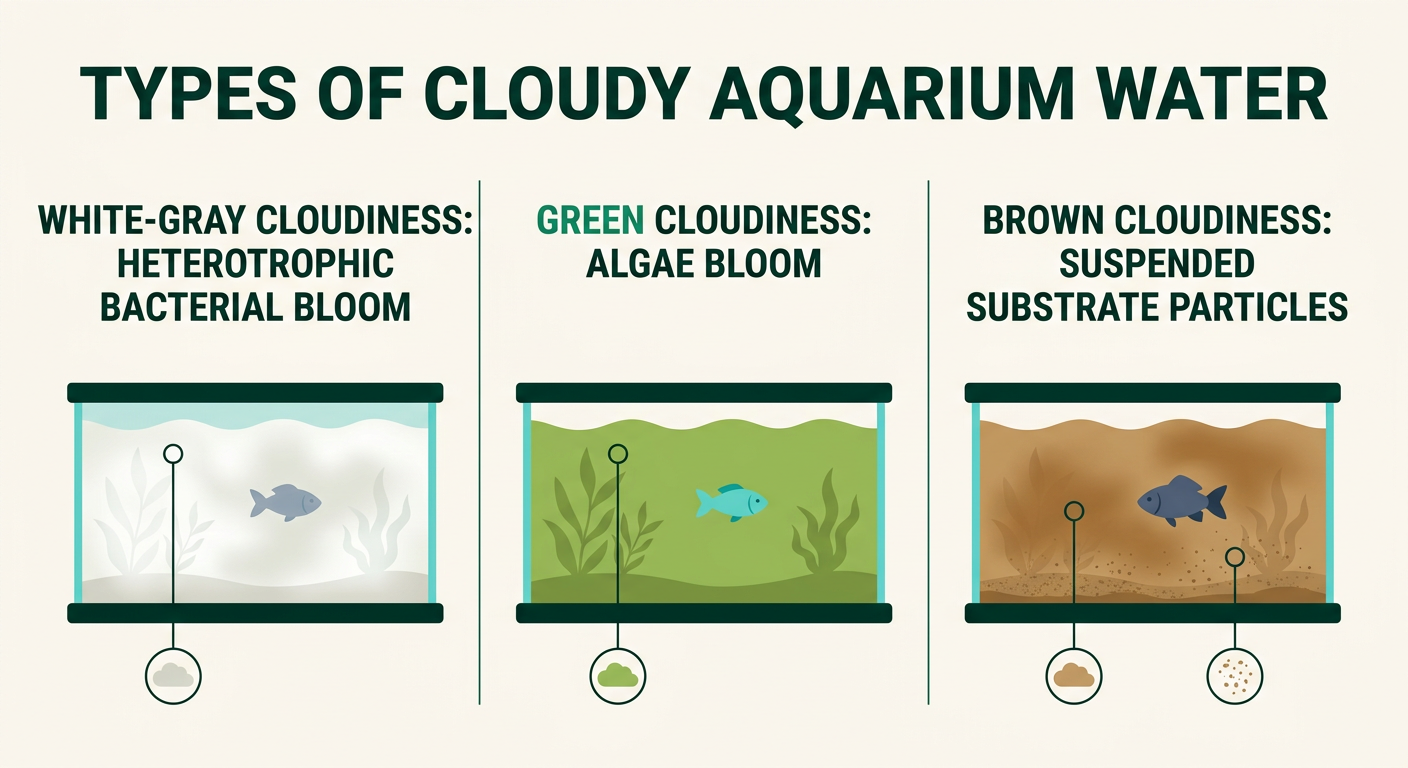
Fix: add an airstone or increase surface agitation. The bloom clears on its own in 3 to 7 days once the organic load is consumed. Don't reach for a UV sterilizer or algaecide—let it resolve naturally. Interference usually makes it worse.
If the cloudiness is green, that's algae (phytoplankton bloom)—usually triggered by ammonia acting as temporary fertilizer, plus light, plus the disruption of the old tank's competitive balance. A 3-day blackout plus reduced feeding usually stops it. UV sterilizers work for green water but not bacterial blooms.
Brown or tan cloudiness right after filling is suspended substrate particles. Mechanical filtration (filter floss) clears this in 24 to 48 hours. If it persists, the substrate wasn't rinsed well enough—water changes and patience do the rest.
How Long Should I Wait Before Adding More Fish After an Upgrade?
Wait 2 to 4 weeks after ammonia and nitrite show zero consistently. This gives the biological filter time to stabilize at the new equilibrium. The bacteria aren't just there—they're expanded and steady enough to handle real bioload.
When you do add fish, add no more than 25% of the current bioload at one time. If you have 20 inches of fish (total length), add no more than 5 inches of new fish in a single addition. Wait at least 2 weeks between additions, testing every 2 to 3 days.
Don't use the "inch per gallon" rule to calculate stocking for the new volume. It's dangerously crude. A 12-inch oscar produces way more waste than twelve 1-inch neon tetras. Respiration and feeding metabolism scale with body mass, not length. A stocking calculator like AqAdvisor accounts for species, adult size, and filtration—use that instead.
Quarantine everything going into the main tank—fish, plants, inverts, all of it. The new tank's biological filter is still fragile. Introducing a pathogen that requires medication can crash the cycle, since many medications harm nitrifying bacteria. A 4 to 6 week quarantine is actually more important after an upgrade, not less.
I know that sounds cautious. It is. But a crashed cycle three weeks after upsizing is worse than adding fish slowly.
Comments
No comments yet.